

Case Study for Class 10 Maths Chapter 12 Surface Areas and Volumes
The Case Study Questions for Class 10 Maths Chapter 12 "Surface Areas and Volumes" include short, real life problem situations that have clear answers and step by step solutions to help students gain confidence for exams. It covers important topics including calculating surface area and volume of cubes, cuboids, cylinders, cones, spheres, and hemispheres, finding the surface area and volume of combinations of solid shapes, understanding conversion of solid from one shape to another (melting and reshaping), calculating the volume of frustum of a cone, determining the curved surface area and total surface area of composite solids, solving problems involving melting and recasting of metals, finding the capacity of containers like buckets, tanks, and silos, calculating the amount of material needed for making hollow objects, and applying surface area and volume concepts to real-world scenarios like packaging, construction, water storage, and manufacturing. These practice questions help the students in better understanding of the concepts, handling surface area and volume problems smoothly and to be faster and accurate for their board exams. A free PDF is included for offline timed practice.
Introduction to Case Study Questions on Surface Areas and Volumes
Surface Area of Three-Dimensional Shapes
Surface area is the total area of all the outer surfaces of a solid shape. It tells you how much material is needed to cover or wrap the object completely.
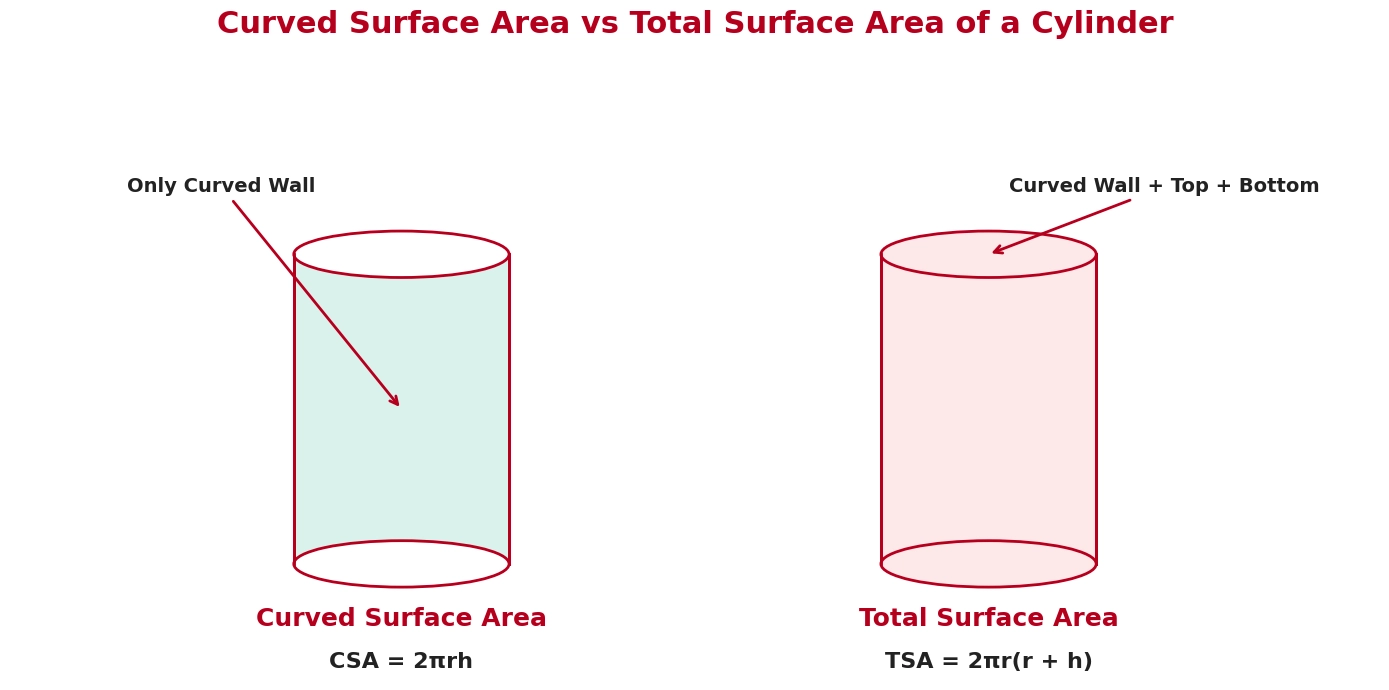
There are two types of surface area used in this chapter: Total Surface Area (TSA), which includes every face of the solid including the top and bottom, and Curved Surface Area (CSA) or Lateral Surface Area (LSA), which includes only the curved or side surfaces, excluding the flat top and bottom faces.
Key Surface Area Formulas:
Cube: TSA = 6a² (where a is the side length)
Cuboid: TSA = 2(lb + bh + hl) (where l, b, h are length, breadth, height)
Cylinder: CSA = 2πrh, TSA = 2πr(r + h)
Cone: CSA = πrl, TSA = πr(r + l) (where l is the slant height)
Sphere: Surface Area = 4πr²
Hemisphere: CSA = 2πr², TSA = 3πr²
Volume of Solids
Volume is the amount of three-dimensional space occupied by a solid, or the amount it can hold if it is hollow. Volume is always expressed in cubic units.
Key Volume Formulas:
- Cube: Volume = a³
- Cuboid: Volume = l × b × h
- Cylinder: Volume = πr²h
- Cone: Volume = (1/3)πr²h
- Sphere: Volume = (4/3)πr³
- Hemisphere: Volume = (2/3)πr³
Conversion of Solid Shapes
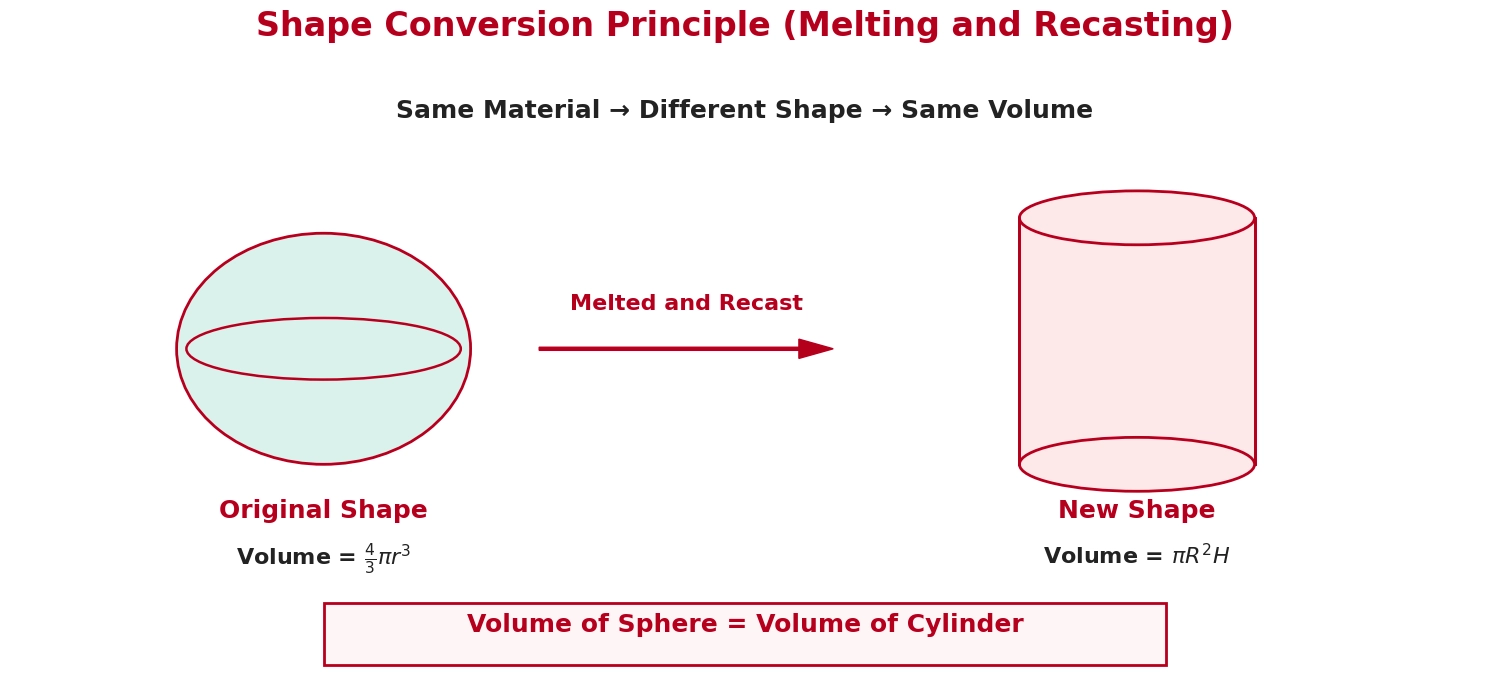
A very important concept in this chapter is the conversion of solid shapes when one solid object is melted, reshaped, or recast into a different solid shape. The key rule used in every such problem is: Volume remains constant during conversion.
This means the volume of the original solid is always equal to the volume of the new solid formed, even though the shape changes. This single principle is the foundation for solving nearly every "melting and recasting" case study question in this chapter.
Units Used in Surface Area and Volume
Surface area is always measured in square units, such as cm², m², or mm², because it represents a two-dimensional covering. Volume is always measured in cubic units, such as cm³, m³, or mm³, because it represents three-dimensional space. A common related unit for liquid volume is the litre, where 1 litre = 1000 cm³ and 1 m³ = 1000 litres. Always check that your final answer carries the correct unit type for the quantity being calculated.

Case Study 1: Designing a Water Tank
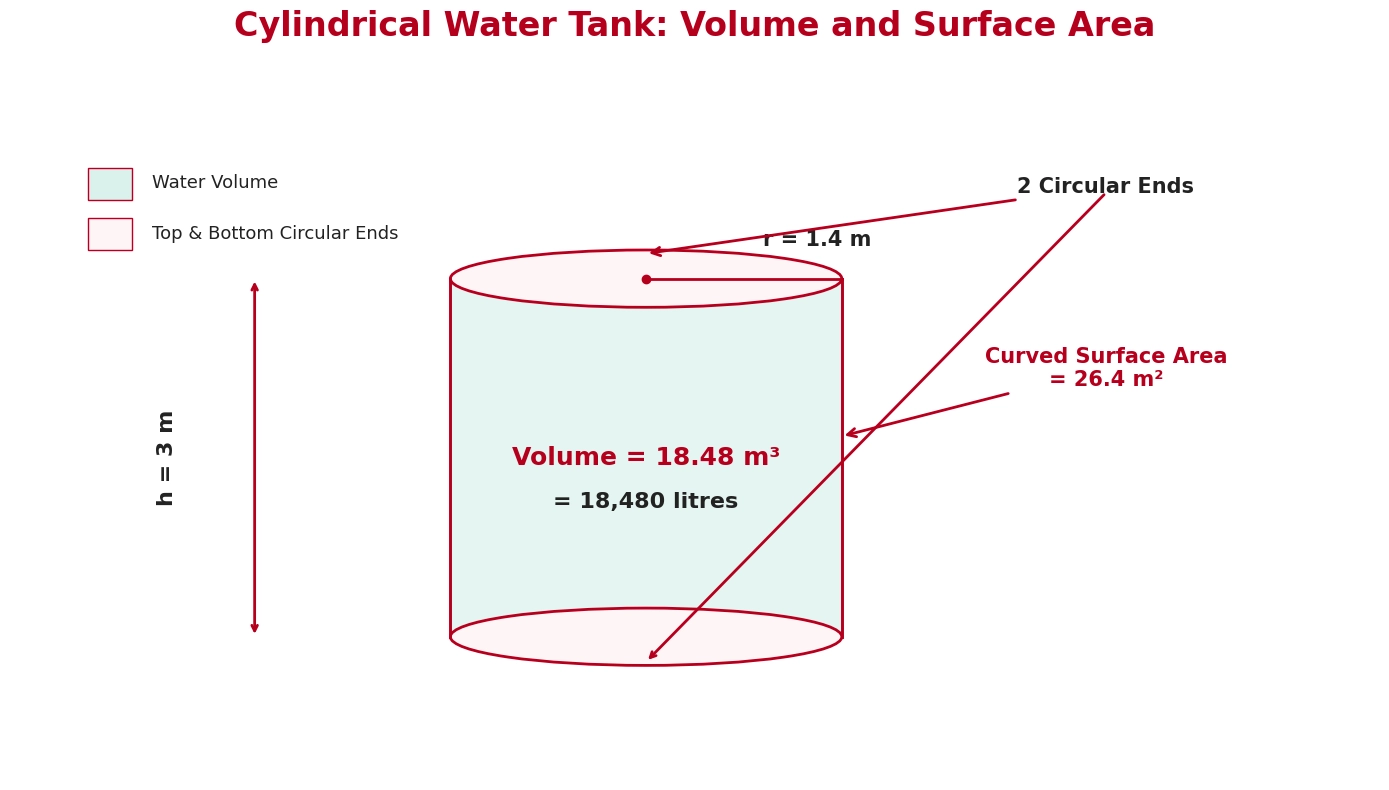
A residential apartment building plans to install a cylindrical water tank on its rooftop to supply water to all the flats. The tank has a radius of 1.4 metres and a height of 3 metres. The building manager wants to know how much water the tank can hold and how much sheet metal is required to construct the tank, including its top and bottom. He asks a civil engineering student to calculate these values using surface area and volume formulas. (Use π = 22/7)
Questions:
(i) What is the volume of the cylindrical water tank?
(ii) How many litres of water can the tank hold?
(iii) What is the curved surface area of the tank?
(iv) What is the total surface area of the tank (including top and bottom)?
(v) If sheet metal costs ₹250 per square metre, what is the total cost of constructing the tank?
Solution:
Answer 1: Radius, r = 1.4 m, Height, h = 3 m
Volume = πr²h = (22/7) × 1.4 × 1.4 × 3
= (22/7) × 1.96 × 3
= (22/7) × 5.88
= 18.48 m³
Answer 2: Since 1 m³ = 1000 litres:
Capacity = 18.48 × 1000 = 18,480 litres
Answer 3: Curved Surface Area = 2πrh = 2 × (22/7) × 1.4 × 3
= 2 × 22 × 0.2 × 3
= 26.4 m²
Answer 4: Total Surface Area = 2πr(r + h) = 2 × (22/7) × 1.4 × (1.4 + 3)
= 2 × (22/7) × 1.4 × 4.4
= 2 × 22 × 0.2 × 4.4
= 19.36 m²
Note: TSA = CSA + 2 circular ends = 26.4 + (2 × πr²) = 26.4 + (2 × 6.16) = 26.4 + 12.32 = 38.72 m². Recalculating directly with the formula: 2πr(r+h) = 2 × 22/7 × 1.4 × 4.4 = 38.72 m². So the correct Total Surface Area = 38.72 m².
Answer 5: Cost = Total Surface Area × Rate
= 38.72 × 250 = ₹9,680
Case Study 2: Packaging and Storage Containers
A company manufactures cuboidal cardboard boxes to pack and ship electronic gadgets. Each box has a length of 40 cm, a breadth of 25 cm, and a height of 20 cm. The packaging manager wants to know the amount of cardboard required to make each closed box and the volume of space available inside each box for storage. He also wants to find out how many such boxes can fit inside a larger cuboidal shipping container of dimensions 2 m × 1.5 m × 1 m.
Questions:
(i) What is the total surface area of one cardboard box?
(ii) What is the volume of one cardboard box?
(iii) What is the volume of the larger shipping container? (Convert to cm³)
(iv)How many small boxes can fit inside the larger shipping container?
(v) If cardboard costs ₹0.05 per cm², what is the cost of making one box?
Solution:
Answer 1: Length l = 40 cm, Breadth b = 25 cm, Height h = 20 cm
TSA = 2(lb + bh + hl)
= 2[(40×25) + (25×20) + (20×40)]
= 2[1000 + 500 + 800]
= 2 × 2300
= 4600 cm²
Answer 2: Volume = l × b × h = 40 × 25 × 20 = 20,000 cm³
Answer 3: Container dimensions: 2 m × 1.5 m × 1 m
Convert to cm: 200 cm × 150 cm × 100 cm
Volume = 200 × 150 × 100 = 3,000,000 cm³
Answer 4: Number of boxes = Volume of container ÷ Volume of one box
= 3,000,000 ÷ 20,000
= 150 boxes
Answer 5: Cost = TSA × rate = 4600 × 0.05 = ₹230 per box
Case Study 3: Ice Cream Cone Manufacturing
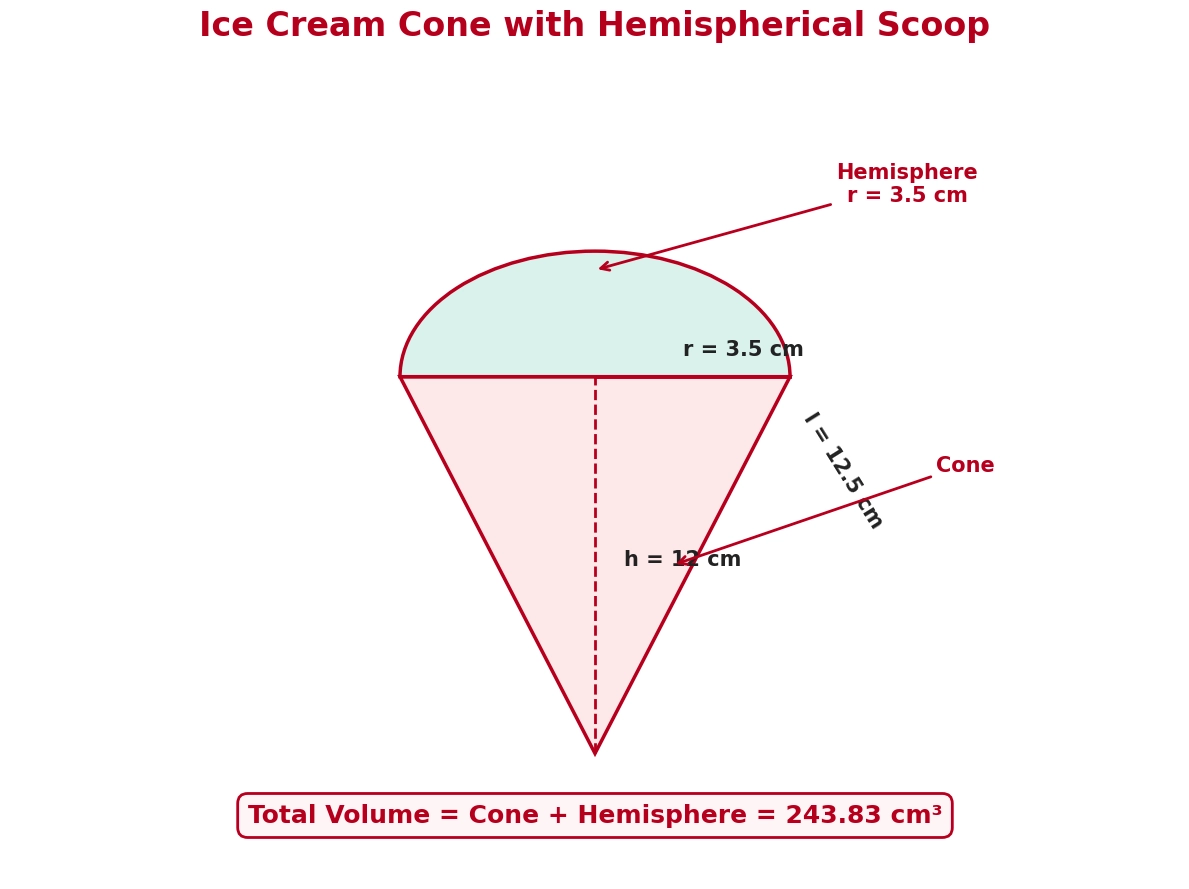
An ice cream company manufactures cone-shaped wafer cups to serve ice cream. Each cone has a radius of 3.5 cm and a height of 12 cm. The company wants to know how much wafer material (curved surface area) is needed for one cone and how much ice cream (volume) each cone can hold when completely filled. They also want to compare this with a hemispherical scoop placed on top of the cone. (Use π = 22/7)
Questions:
(i) What is the slant height of the cone?
(ii) What is the curved surface area of the cone (the wafer material needed)?
(iii) What is the volume of the cone (ice cream capacity)?
(iv) If a hemispherical scoop of the same radius (3.5 cm) is placed on top of the cone, what is the volume of the hemisphere?
(v) What is the total volume of ice cream (cone + hemispherical scoop on top)?
Solution:
Answer 1: Radius, r = 3.5 cm, Height, h = 12 cm
Slant height, l = √(r² + h²) = √(3.5² + 12²) = √(12.25 + 144) = √156.25 = 12.5 cm
Answer 2: Curved Surface Area = πrl = (22/7) × 3.5 × 12.5
= (22/7) × 43.75
= 137.5 cm²
Answer 3: Volume of cone = (1/3)πr²h = (1/3) × (22/7) × 3.5 × 3.5 × 12
= (1/3) × (22/7) × 12.25 × 12
= (1/3) × (22/7) × 147
= (1/3) × 462
= 154 cm³
Answer 4: Volume of hemisphere = (2/3)πr³ = (2/3) × (22/7) × 3.5 × 3.5 × 3.5
= (2/3) × (22/7) × 42.875
= (2/3) × 134.75
= 89.83 cm³
Answer 5: Total volume = Volume of cone + Volume of hemisphere
= 154 + 89.83
= 243.83 cm³
Case Study 4: Construction of a Cylindrical Water Pipe
A construction company is installing a cylindrical water pipe to supply water from a treatment plant to a residential colony. The pipe has an external radius of 10 cm and an internal radius of 8 cm (it is hollow, like a tube), and its length is 21 metres. The engineer wants to calculate the volume of metal used to make the pipe and the amount of water the pipe can carry at any given time. (Use π = 22/7)
Questions:
(i) What is the internal volume of the pipe (the water-carrying capacity)?
(ii) What is the external volume of the pipe (the total space it occupies)?
(iii) What is the volume of metal used to construct the pipe (the hollow tube material)?
(iv) How many litres of water can the pipe hold when full?
(v) What is the curved surface area of the outer surface of the pipe?
Solution:
Answer 1: Internal radius, r = 8 cm = 0.08 m, Length, h = 21 m
Internal Volume = πr²h = (22/7) × 0.08 × 0.08 × 21
= (22/7) × 0.0064 × 21
= 22 × 0.0064 × 3
= 0.4224 m³
Answer 2: External radius, R = 10 cm = 0.10 m
External Volume = πR²h = (22/7) × 0.10 × 0.10 × 21
= (22/7) × 0.01 × 21
= 22 × 0.01 × 3
= 0.66 m³
Answer 3: Volume of metal = External Volume − Internal Volume
= 0.66 − 0.4224
= 0.2376 m³
Answer 4: Capacity in litres = Internal Volume × 1000
= 0.4224 × 1000
= 422.4 litres
Answer 5: Curved Surface Area (outer) = 2πRh = 2 × (22/7) × 0.10 × 21
= 2 × 22 × 0.10 × 3
= 13.2 m²
Important Topics from Surface Areas and Volumes for Case Studies
Cubes and Cuboids
Cubes and cuboids are the simplest three-dimensional shapes covered in this chapter. The total surface area of a cube is 6a², and its volume is a³. For a cuboid, total surface area is 2(lb + bh + hl), and volume is l × b × h. These formulas frequently appear in case studies involving boxes, rooms, and storage containers.
Cylinders
Cylinders are extremely common in real-life case studies, appearing as water tanks, pipes, and storage drums. The curved surface area is 2πrh, the total surface area is 2πr(r + h), and the volume is πr²h. Questions involving hollow cylinders (pipes) require calculating the difference between the outer and inner cylinder volumes.
Cones
Cones appear in case studies involving ice cream cones, decorative caps, and funnels. The slant height is calculated using l = √(r² + h²), the curved surface area is πrl, the total surface area is πr(r + l), and the volume is (1/3)πr²h. Remember that a cone's volume is always one-third of a cylinder with the same base radius and height.
Spheres and Hemispheres
Spheres and hemispheres appear in case studies involving balls, fountains, and decorative bowls. The surface area of a sphere is 4πr² and its volume is (4/3)πr³. For a hemisphere, the curved surface area is 2πr², the total surface area is 3πr², and the volume is (2/3)πr³.
Combination of Solids
Many advanced case study questions combine two or more solid shapes together, such as a cone with a hemisphere on top (an ice cream cone with a scoop) or a cylinder with hemispherical ends. For these combination of solids problems, the total surface area is found by adding the relevant curved surfaces of each part (never double-counting any shared flat surface), and the total volume is found by simply adding the volumes of each individual part together.
Download Free PDF - Case Study: Class 10 Chapter 12 - Surface Areas and Volumes
Download PDF - Case Study for Class 10 Maths Chapter 12 Surface Areas and Volumes
Numbers make sense when they're taught right. To see how Orchids The International School turns Maths from intimidating to intuitive, reach out to our admissions team.


Admissions Open for 2026-27
What type of concept pages would you prefer?
CBSE Schools In Popular Cities
- CBSE Schools in Bangalore
- CBSE Schools in Mumbai
- CBSE Schools in Pune
- CBSE Schools in Hyderabad
- CBSE Schools in Chennai
- CBSE Schools in Gurgaon
- CBSE Schools in Kolkata
- CBSE Schools in Indore
- CBSE Schools in Sonipat
- CBSE Schools in Delhi
- CBSE Schools in Rohtak
- CBSE Schools in Bhopal
- CBSE Schools in Aurangabad
- CBSE Schools in Jabalpur
- CBSE Schools in Jaipur
- CBSE Schools in Jodhpur
- CBSE Schools in Nagpur
- CBSE Schools in Ahmednagar
- CBSE School In Tumkur











Orchids The International School is one of India's leading chains of CBSE and ICSE schools, with 110+ schools across the country.