

Class 10 Maths Chapter 11 Areas Related to Circles Notes Free PDF Download
Class 10 Maths Chapter 11 Areas Related to Circles Notes Free PDF Download is prepared based on the latest CBSE and NCERT syllabus. These notes will help in school exams, board exams, and quick revision. They help students understand the chapter clearly, revise faster, and prepare for exams with confidence.
Table of Contents
- Important Topics Covered in Chapter 11
- Important Formulas from Areas Related to Circles
- Areas Related to Circles Formula Chart
- Area of a Sector Revision Notes
- Arc Length Revision Notes
- Area of a Segment Revision Notes
- Difference Between Sector and Segment
- Important Concepts to Remember
- Solved Example on Class 10 Maths Chapter 11 Areas Related to Circles
- Common Mistakes in Areas Related to Circles
- Frequently Asked Questions on Class 10 Maths Chapter 11 Areas Related to Circles

Important Topics Covered in Chapter 11
The key topics are: area of a circle, circumference, area of a sector, arc length, area of a minor and major segment, and problems involving shaded regions that combine shapes like triangles and circles.
Key Terms to Remember
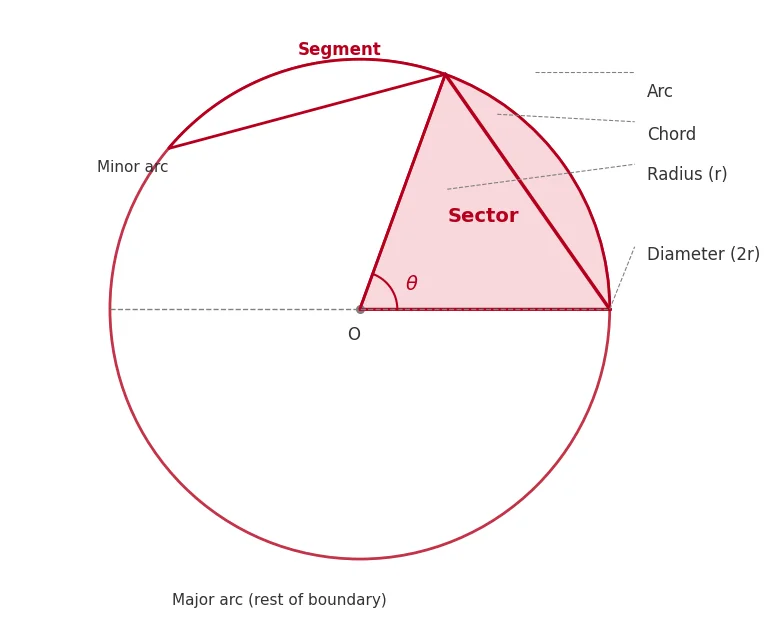
- Circle: A circle is a closed curved line on a flat surface where every point on the curve is at the same distance from a fixed centre point.
- Radius: The radius (r) is the distance from the centre of the circle to any point on its boundary. All radii of the same circle are equal.
- Diameter: The diameter (d) is the longest straight line that passes through the centre of a circle, connecting two points on the boundary. It is always twice the radius: d = 2r.
- Arc: An arc is any part of the curved boundary of a circle. A minor arc is the smaller part, and a major arc is the larger part.
- Sector: A sector is the region enclosed between two radii and the arc joining them like a slice of a pie. The angle between the two radii is called the angle of the sector (θ).
- Segment: A segment is the region between a chord (a straight line joining two points on the circle) and the arc it cuts off. It is not the same as a sector.
The diagram below shows a circle with all these parts labelled clearly
Know more about related topics:
Important Formulas from Areas Related to Circles
These are the core areas related to circles formulas you must memorise for CBSE Class 10 board exams.
1. Area of a Circle Formula
Area = πr²
Where r = radius and π ≈ 22/7 or 3.14
2. Circumference of a Circle Formula
Circumference = 2πr
3. Area of a Sector Formula
A sector is formed by an angle θ at the centre. The formula is:
Area of sector = (θ/360) × πr²
4. Length of an Arc Formula
The arc is a part of the circumference, so:
Length of arc = (θ/360) × 2πr
5. Area of a Segment Formula
A segment = sector minus the triangle formed by the chord and the two radii.
Area of segment = Area of sector − Area of triangle
Area of segment = (θ/360) × πr² − (1/2) × r² × sin θ
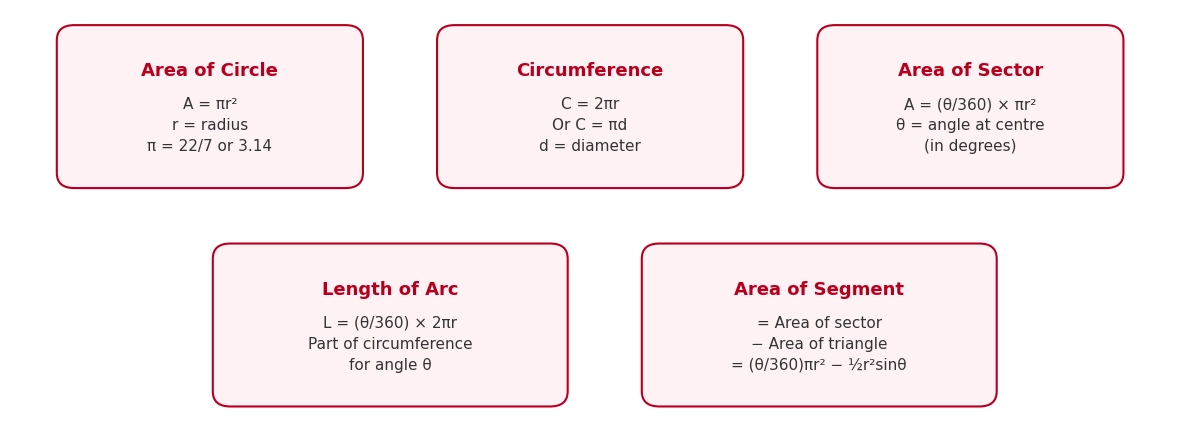
Areas Related to Circles Formula Chart
-
Area of circle = πr²
-
Circumference = 2πr
-
Area of sector = (θ/360) × πr²
-
Arc length = (θ/360) × 2πr
-
Area of segment = (θ/360)πr² − ½r² sin θ
-
Area of major sector = πr² − Area of minor sector
-
Area of major segment = πr² − Area of minor segment
Area of a Sector Revision Notes
Formula for Area of a Sector
A sector is like a pizza slice. The bigger the angle θ, the larger the slice. If the full circle has an area of πr², then a sector with angle θ takes up a fraction (θ/360) of that full area.
Area of sector = (θ/360) × πr²
For a semicircle, θ = 180°, so Area = (180/360) × πr² = ½πr², which makes perfect sense.
Key Points
Angle θ must always be in degrees when using this formula. If θ = 360°, the sector becomes the full circle. The area of the major sector = πr² − area of the minor sector.
Arc Length Revision Notes
Formula for Arc Length
An arc is a portion of the circle's circumference. Since the full circumference is 2πr, the arc for angle θ is simply that fraction of the total.
Length of arc = (θ/360) × 2πr
Students often confuse arc length (a length measured in cm or m) with area of sector (measured in cm² or m²). Arc length uses 2πr, not πr². Always check your units in the answer.
Area of a Segment Revision Notes
Formula for Area of a Segment
A segment is the region between a chord and its arc. To find it, subtract the triangle (formed by the two radii and the chord) from the sector.
Area of segment = (θ/360) × πr² − (1/2) × r² × sin θ
This formula works directly when θ is given in degrees. For common angles, sin 30° = 0.5, sin 60° = √3/2, sin 90° = 1.
There are two types of segments: a minor segment (smaller region, below the chord) and a major segment (larger region, above the chord). Most exam questions ask about the minor segment. Area of major segment = πr² − Area of minor segment.
Difference Between Sector and Segment
Sector vs Segment Comparison
This is one of the most common points of confusion in Chapter 11. The diagram below shows the visual difference clearly.
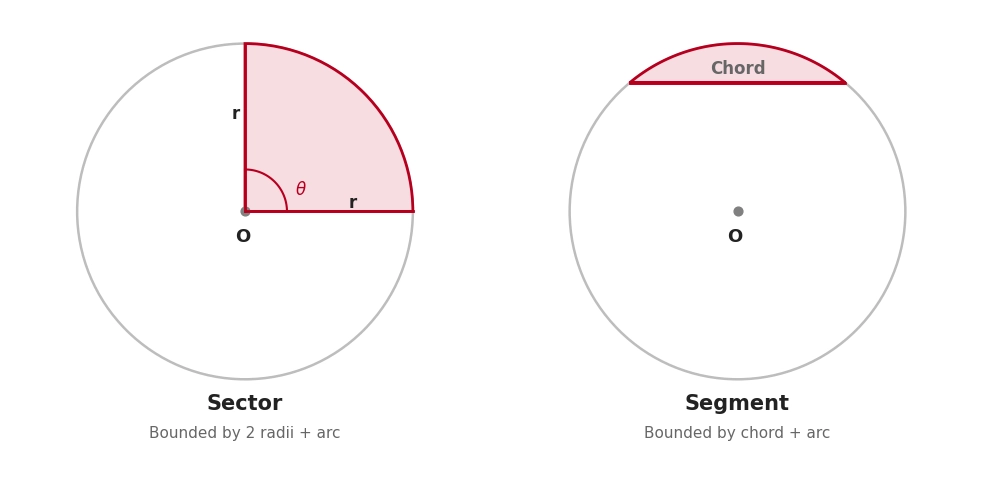
Remember a sector always includes the centre point O, while a segment never does. Another confusion is with the formula the segment formula subtracts a triangle, but the sector formula does not.
Important Concepts to Remember
Relationship Between Arc Length and Circumference
Arc length is always a fraction of the full circumference. If the angle is 90°, the arc is one-quarter of the circumference. If the angle is 120°, it is one-third. This fraction is always θ/360.
Relationship Between Sector Area and Circle Area
Similarly, the area of a sector is always (θ/360) of the full circle's area. A 90° sector is exactly one-quarter of the circle.
Finding Areas of Shaded Regions
Shaded region problems ask you to find an area that is left over after removing one shape from another. Common combinations in CBSE exams include: circle minus triangle, sector minus triangle (= segment), and two overlapping sectors. Always identify which shapes are involved and then use subtraction or addition of areas.
Solved Example on Class 10 Maths Chapter 11 Areas Related to Circles
1. Question: Find the area of a sector with radius 7 cm and angle 60°.
Solution:
Area = (θ/360) × πr²
= (60/360) × (22/7) × 7²
= (1/6) × (22/7) × 49
= (1/6) × 154 = 25.67 cm²
2. Question: Find the length of an arc with radius 14 cm and angle 90°.
Solution:
Arc length = (θ/360) × 2πr
= (90/360) × 2 × (22/7) × 14
= (1/4) × 88 = 22 cm
3. Question: Find the area of the minor segment of a circle with radius 7 cm and angle 90° at the centre.
Solution:
Area of sector = (90/360) × (22/7) × 49
= (1/4) × 154 = 38.5 cm²
Area of triangle = (1/2) × r² × sin 90°
= (1/2) × 49 × 1 = 24.5 cm²
Area of segment = 38.5 − 24.5 = 14 cm²
4. Question: A square of side 14 cm has a circle inscribed in it. Find the area of the shaded region (corners of the square outside the circle).
Solution:
Area of square = 14 × 14 = 196 cm²
Radius of inscribed circle = 14/2 = 7 cm
Area of circle = (22/7) × 49 = 154 cm²
Shaded area = 196 − 154 = 42 cm²
Common Mistakes in Areas Related to Circles
Using Diameter Instead of Radius
The most common error in Chapter 11 is plugging the diameter into a formula that needs the radius. Always check: does the question give you r or d? If it gives d, divide by 2 first.
Confusing Sector and Segment
A sector uses only the angle and radii. A segment also needs the triangle subtracted. If you use the sector formula when asked for a segment, you will get the wrong answer.
Incorrect Use of π
CBSE questions usually specify which value of π to use (22/7 or 3.14). Using the wrong one causes small but avoidable errors. When the radius is a multiple of 7, prefer π = 22/7. When it is a multiple of 10, 3.14 is more convenient.
Errors in Shaded Region Questions
Students often forget whether to add or subtract. Draw a rough sketch, identify each region clearly, and decide: is the shaded region inside the shape (subtract what is removed) or is it the leftover (full area minus the inner shape)?
Areas Related to Circles Class 10 PDF Notes
Download PDF - Class 10 Maths Chapter 11 Areas Related to Circles Notes
Numbers make sense when they're taught right. To see how Orchids The International School turns Maths from intimidating to intuitive, reach out to our admissions team.


Admissions Open for 2026-27
What type of concept pages would you prefer?
CBSE Schools In Popular Cities
- CBSE Schools in Bangalore
- CBSE Schools in Mumbai
- CBSE Schools in Pune
- CBSE Schools in Hyderabad
- CBSE Schools in Chennai
- CBSE Schools in Gurgaon
- CBSE Schools in Kolkata
- CBSE Schools in Indore
- CBSE Schools in Sonipat
- CBSE Schools in Delhi
- CBSE Schools in Rohtak
- CBSE Schools in Bhopal
- CBSE Schools in Aurangabad
- CBSE Schools in Jabalpur
- CBSE Schools in Jaipur
- CBSE Schools in Jodhpur
- CBSE Schools in Nagpur
- CBSE Schools in Ahmednagar
- CBSE School In Tumkur











Orchids The International School is one of India's leading chains of CBSE and ICSE schools, with 130+ schools across the country.