

Class 10 Maths Chapter 10 ‘Circles’ Notes: Complete NCERT Guide for CBSE Board Exams
Chapter 10: Circles Notes for Class 10 give you a clear, NCERT-aligned guide to circle properties and tangent theorems for CBSE exams. Learn Theorem 1 (tangent ⊥ radius) and Theorem 2 (equal tangent lengths from external point) with step-by-step examples to find tangent lengths, prove perpendicularity, and solve Pythagorean theorem problems. Get shortcut tips, common error fixes, revision bullets, practice problems with answers, and assertion–reason questions to master circles confidently.
Table of Contents
- Key Terms and Definitions
- A Line and a Circle: Three Possibilities
- Number of Tangents from a Point to a Circle
- The Two Key Theorems
- Important Properties at a Glance
- Solved Questions on Circles for Class 10
- Frequently Asked Questions of Chapter 10: Circles Notes for Class 10 Maths

Key Terms and Definitions
-
Circle:
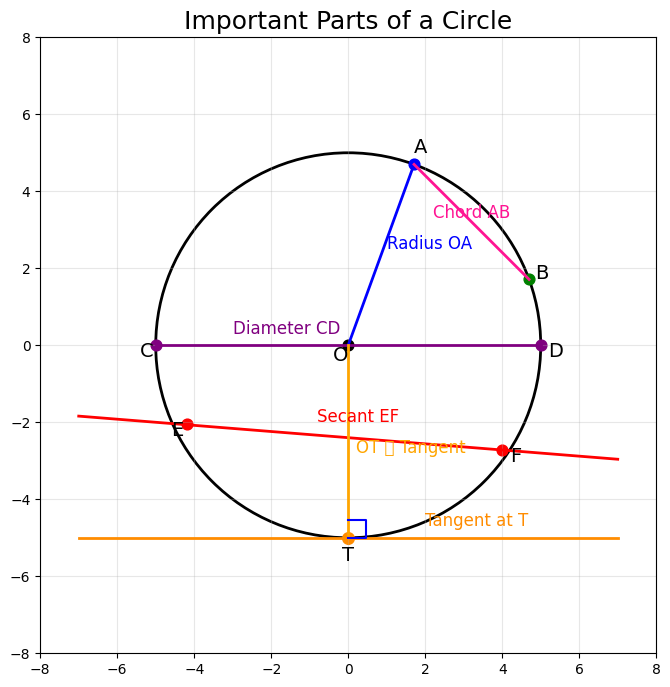
A circle is the set of all points in a plane that are at a fixed distance from a fixed point called the centre.
Centre: O, Radius: r
-
Radius
The fixed distance from the centre of the circle to any point on it. All radii of a circle are equal in length.
OA = OB = r
-
Chord
A line segment whose both endpoints lie on the circle. The longest chord of a circle is the diameter.
AB is a chord
-
Diameter
A chord that passes through the centre of the circle. Diameter = 2 × Radius.
d = 2r
-
Secant
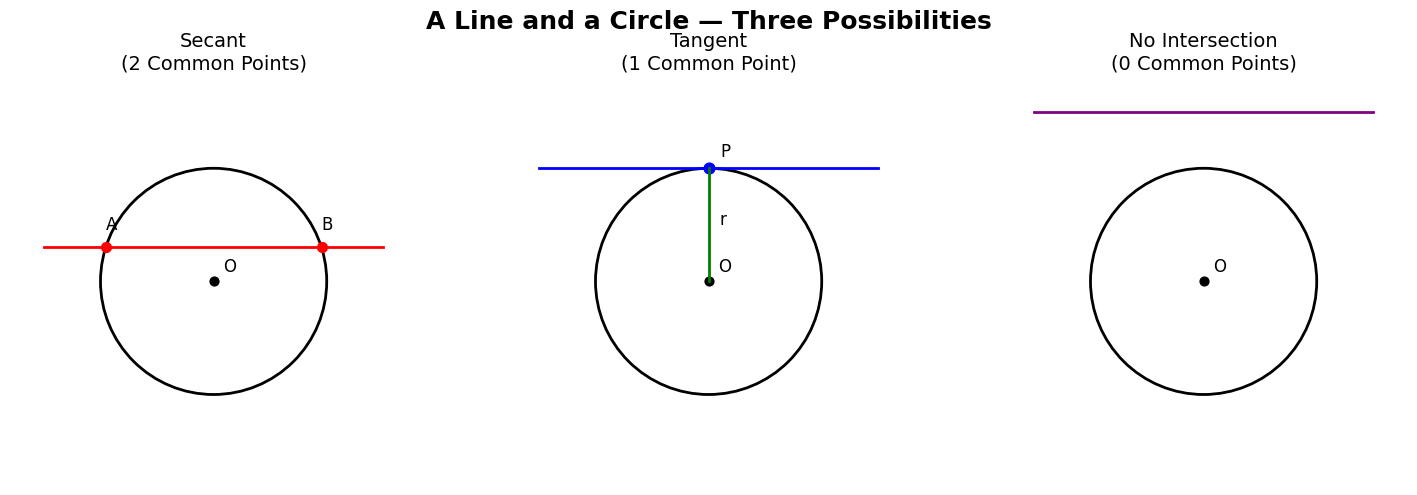
A line that intersects a circle at two distinct points. It cuts through the circle, creating a chord inside it.
2 common points
-
Tangent
A line that touches a circle at exactly one point. That single point is called the point of contact (or point of tangency).
1 common point
-
Point of Contact
The single point where the tangent meets the circle. The radius drawn to this point is perpendicular to the tangent.
P (tangent point)
-
Length of Tangent
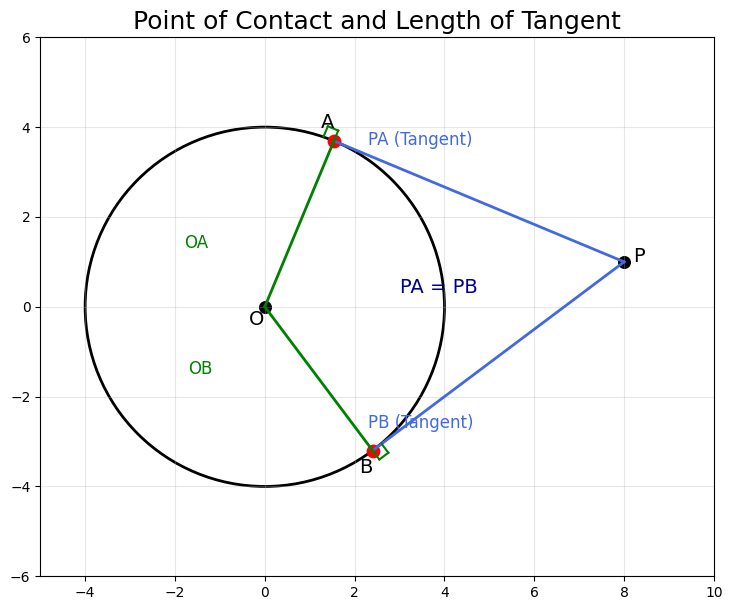
The distance from an external point to the point of contact. If P is external and PA is tangent, then PA is the length of the tangent from P.
PA = PB (external)
Know more about related topics:
A Line and a Circle: Three Possibilities
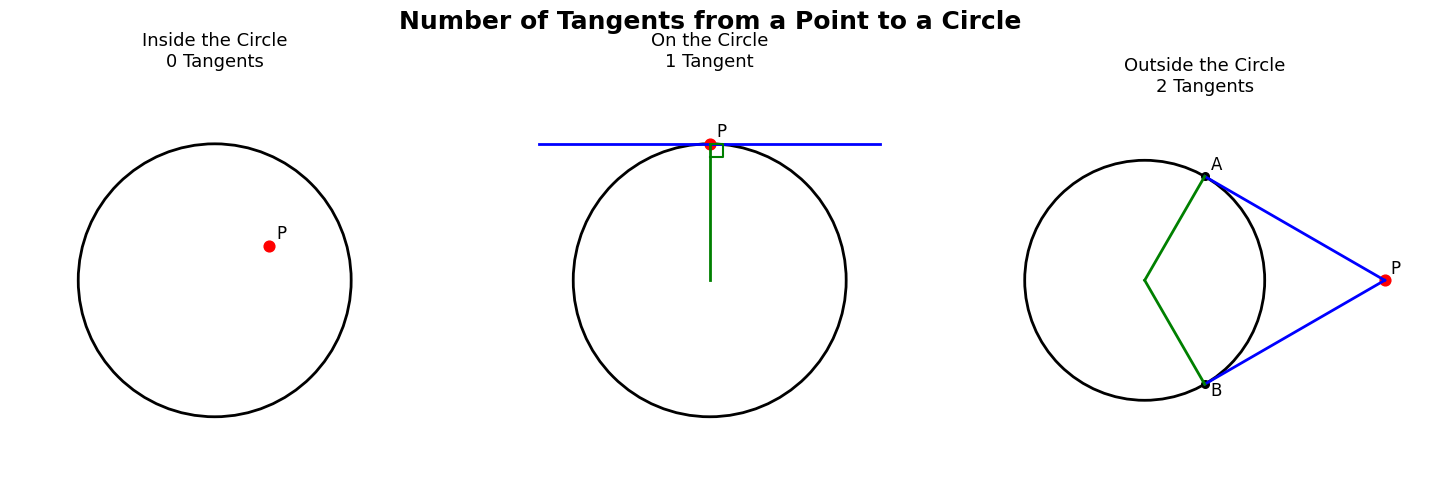
Number of Tangents from a Point to a Circle
The Two Key Theorems
Theorem 10.1
The tangent at any point of a circle is perpendicular to the radius through the point of contact.
In simple words: If a line touches a circle at point P, then the radius OP is perfectly perpendicular (at 90°) to that tangent line at P.
Proof :
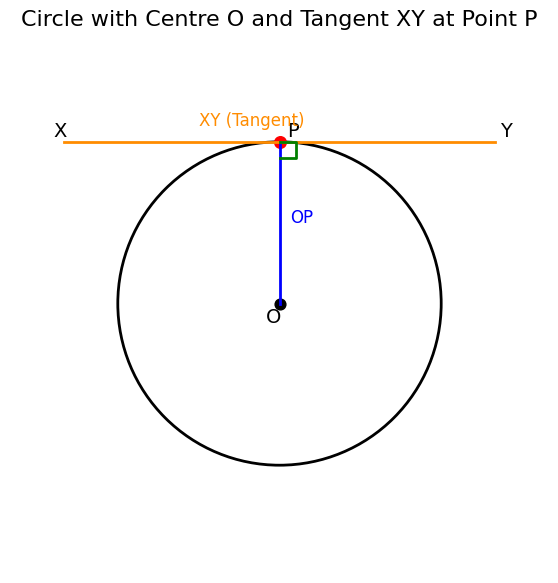
Given: Circle with centre O. XY is a tangent at point P.
To Prove: OP ⊥ XY
Take any point Q on the tangent XY, other than P, and join OQ.
Since XY is a tangent and Q is a different point on it, Q must lie outside the circle. (If Q were inside the circle, XY would become a secant, not a tangent.)
Since Q is outside the circle and P is on the circle:
OQ > OP (radius)
This is true for every point Q on XY except P. So OP is the shortest distance from O to the line XY.
The shortest distance from a point to a line is always perpendicular to the line. Therefore:
OP ⊥ XY
Hence Proof
The converse is also true: A line drawn through the end of a radius and perpendicular to it is a tangent to the circle.
Theorem 10.2
The lengths of tangents drawn from an external point to a circle are equal.
In simple words: If you stand outside a circle and draw two tangent lines to it, the distance from your position to each tangent's touching point is the same. Always.
Proof:
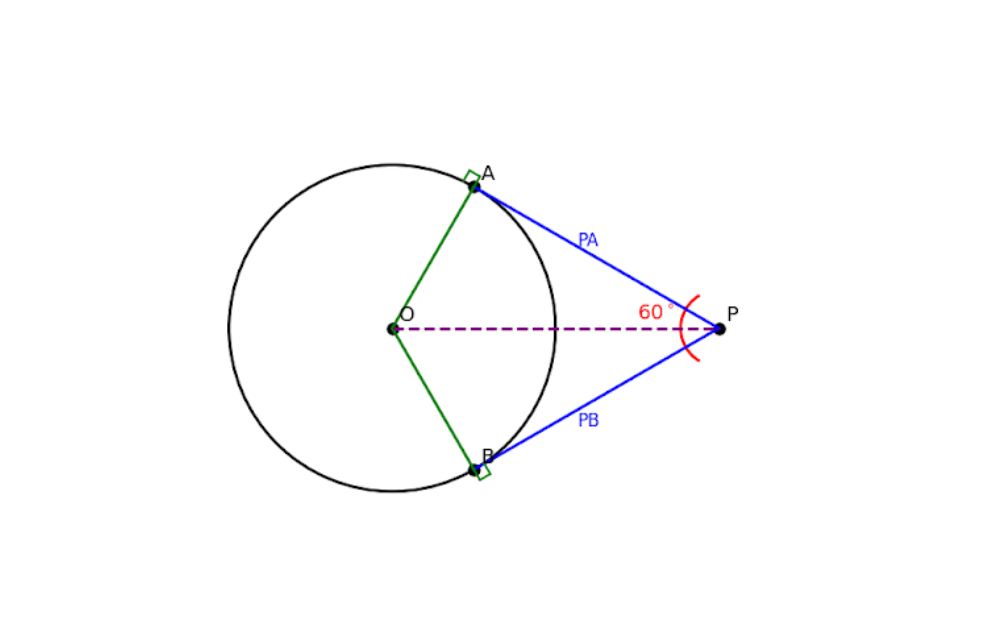
Given: Circle with centre O. P is an external point. PA and PB are tangents touching the circle at A and B respectively.
To Prove: PA = PB
Join OA, OB, and OP.
By Theorem 10.1, the tangent is perpendicular to the radius at the point of contact:
∠OAP = 90° and ∠OBP = 90°
In triangles OAP and OBP, consider the following:
OA = OB (radii of same circle)
OP = OP (common side)
∠OAP = ∠OBP = 90° (from step 2)
By the RHS (Right angle–hypotenuse–side) congruence rule:
△OAP ≅ △OBP
By CPCT (Corresponding Parts of Congruent Triangles):
PA = PB
Hence Proof
Note:
∠OPA = ∠OPB, which means OP bisects angle APB. Also, ∠AOB + ∠APB = 180° (supplementary).
Important Properties at a Glance
-
The tangent at any point is perpendicular to the radius at that point: OP ⊥ tangent.
-
Tangents from an external point are equal in length: PA = PB.
-
The tangents from an external point are equally inclined to the line joining the point to the centre: ∠OPA = ∠OPB
-
∠AOB + ∠APB = 180° (the angle subtended at centre and the angle at external point are supplementary)
-
Tangents drawn at the ends of a diameter are parallel to each other.
-
In a chord of a larger circle that is tangent to a smaller concentric circle, the chord is bisected at the point of contact.
-
A parallelogram circumscribing a circle is always a rhombus.
-
The perpendicular from the centre to a chord bisects it.
Solved Questions on Circles for Class 10
Q1: A point P is 10 cm away from the centre of a circle. The radius of the circle is 6 cm. Find the length of the tangent drawn from P to the circle.
Solution: Given: OP = 10 cm | Radius OT = 6 cm | Find: PT
By Theorem 10.1, OT ⊥ PT, so triangle OTP is right-angled at T.
Applying Pythagoras' theorem in △OTP:
OP² = OT² + PT²
Substituting values:
10² = 6² + PT²
100 = 36 + PT²
PT² = 64
Therefore: PT = √64 = 8 cm
Length of tangent PT = 8 cm
Q2: Two tangents PA and PB are drawn from an external point P to a circle with centre O such that ∠APB = 60°. Find ∠OAB.
Solution: Given: PA and PB are tangents from external point P. ∠APB = 60°. Find ∠OAB.
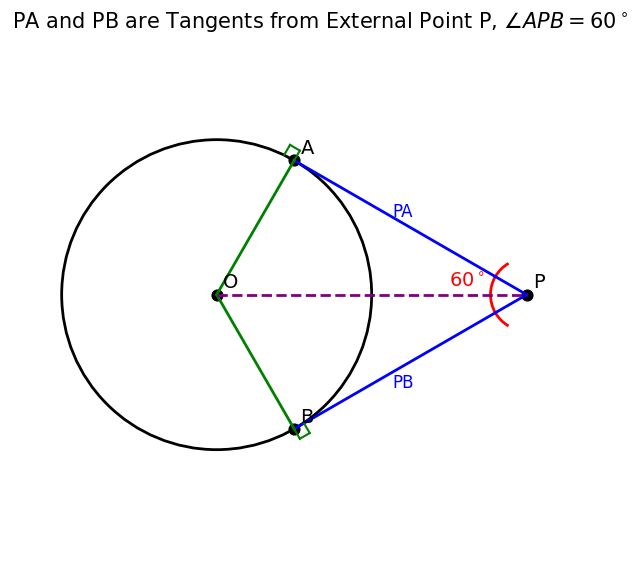
By Theorem 10.2, PA = PB. So △PAB is isosceles. Therefore ∠PAB = ∠PBA.
In △PAB: ∠PAB + ∠PBA + ∠APB = 180°
⇒ 2∠PAB + 60° = 180°
⇒ 2∠PAB = 120°
⇒ ∠PAB = 60°
By Theorem 10.1, ∠OAP = 90° (radius OA ⊥ tangent PA at A).
Therefore:
∠OAB = ∠OAP − ∠PAB = 90° − 60° = 30°
⇒ ∠OAB = 30°
Q3: Prove that the tangents drawn at the ends of a diameter of a circle are parallel to each other.
Solution: Given: Circle with centre O and diameter AB. PQ is tangent at A, and RS is tangent at B.
Prove: PQ ∥ RS.
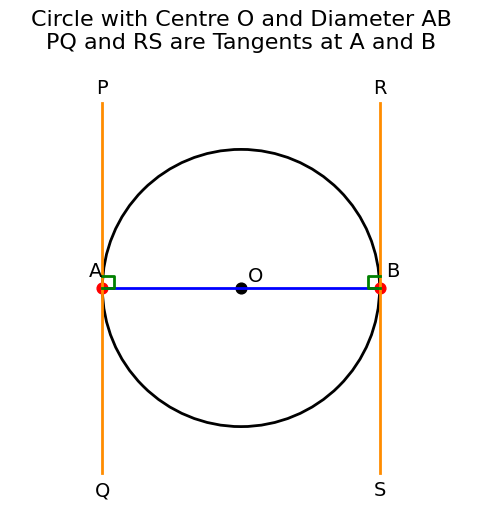
By Theorem 10.1, the tangent at any point is perpendicular to the radius at that point.
At point A: OA ⊥ PQ, so ∠OAP = 90° (i.e., ∠PAB = 90°)
At point B: OB ⊥ RS, so ∠OBR = 90° (i.e., ∠RBA = 90°)
∠PAB = ∠RBA = 90° (alternate interior angles formed by the transversal AB with lines PQ and RS)
Since alternate interior angles are equal, PQ ∥ RS.
The two tangents at the ends of the diameter are parallel.
Proved.
Q4: A quadrilateral ABCD is drawn to circumscribe a circle. Prove that AB + CD = AD + BC.
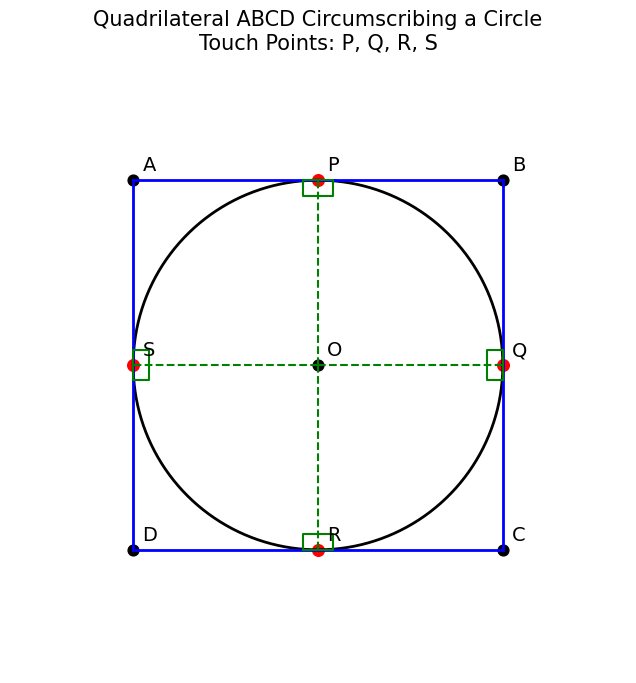
Solution: Given: Quadrilateral ABCD circumscribes a circle (i.e., all four sides are tangents to the circle). The circle touches the sides AB, BC, CD, DA at points P, Q, R, S respectively.
By Theorem 10.2, tangents from an external point to a circle are equal.
From vertex A (external point): AP = AS
From vertex B: BP = BQ
From vertex C: CQ = CR
From vertex D: DR = DS
Adding all four equations:
(AP + BP) + (CQ + DR) = (AS + DS) + (BQ + CR)
AB + CD = AD + BC
AB + CD = AD + BC
Click below to download your free Class 10 Maths Chapter 10: Circles PDF Notes perfect for last-minute CBSE board exam revision.
Frequently Asked Questions of Chapter 10: Circles Notes for Class 10 Maths
1. What is the difference between a tangent and a secant?
A tangent is a line that touches the circle at exactly one point, it does not enter the interior of the circle. A secant is a line that cuts through the circle and intersects it at two distinct points.
2. How do you find the length of a circle from an exterior point?
If P is the external point, O is the centre, r is the radius, and T is the point of tangency:
Length of tangent PT = √(OP² − r²)
3. How many points can be drawn from a point outside the circle?
Exactly two tangents can be drawn from a point outside the circle. These two tangents are equal in length.
4. What type of question come from chapter 10 in board exam?
Board exam questions from this chapter typically include: (1) Prove Theorem 10.1 or 10.2 (3–4 marks), (2) Calculate the length of a tangent using Pythagoras (2 marks), (3) Find angles formed between tangents and radii (2 marks), (4) Prove properties of quadrilaterals circumscribing a circle (4 marks), and (5) Case-study based questions (4–5 marks).
Numbers make sense when they're taught right. To see how Orchids The International School turns Maths from intimidating to intuitive, reach out to our admissions team.


Admissions Open for 2026-27
What type of concept pages would you prefer?
CBSE Schools In Popular Cities
- CBSE Schools in Bangalore
- CBSE Schools in Mumbai
- CBSE Schools in Pune
- CBSE Schools in Hyderabad
- CBSE Schools in Chennai
- CBSE Schools in Gurgaon
- CBSE Schools in Kolkata
- CBSE Schools in Indore
- CBSE Schools in Sonipat
- CBSE Schools in Delhi
- CBSE Schools in Rohtak
- CBSE Schools in Bhopal
- CBSE Schools in Aurangabad
- CBSE Schools in Jabalpur
- CBSE Schools in Jaipur
- CBSE Schools in Jodhpur
- CBSE Schools in Nagpur
- CBSE Schools in Ahmednagar
- CBSE School In Tumkur











Orchids The International School is one of India's leading chains of CBSE and ICSE schools, with 130+ schools across the country.