

Class 10 Maths Chapter 3 ‘Pair of Linear Equations in Two Variables’ Notes: Complete NCERT Guide for CBSE Board Exams
Pair of Linear Equations in Two Variables Class 10 Maths Notes are available in this article. This clear, student-friendly guide explains solving pairs of linear equations using graphing, substitution, elimination and cross-multiplication methods. Aligned with the NCERT syllabus and CBSE exam patterns, it explains when systems have one solution, no solution, or infinitely many solutions, and shows how to interpret intersections of lines visually and algebraically. You’ll find step-by-step solution for worked examples, shortcut tips for spotting inconsistent and dependent systems, and exam-smart strategies for checking answers quickly. These notes include quick revision bullets, practice problems with answers to build confidence before tests.
Know more about related topics:
- Class 10 Maths Mcqs Chapter 3 Pair Of Linear Equations In Two Variables
- Class 10 Maths Chapter 3 Pair Of Linear Equations In Two Variables Worksheets
- Important Questions Class 10 Maths Pair Of Linear Equations In Two Variables
- Assertion Reason Questions For Class 10 Maths Chapter 3 Pair Of Linear Equations In Two Variables
- Class 10 Maths Notes Chapter 2 Polynomials
Chapter 3: Pair of Linear Equations in Two Variables Notes for Class 10
1. What is a Linear Equation in Two Variables?
Before we get to pairs of equations, let us revisit the building block.
A linear equation in two variables is any equation of the form:
ax + by + c = 0
where:
-
x and y are the two variables (the unknowns we want to find)
-
a, b, and c are real numbers (constants)
-
a and b are not both zero simultaneously (at least one must be non-zero)
When you plot this equation on a graph, you always get a straight line.
Examples of linear equations in two variables:
2x + 3y = 12
x − y + 5 = 0
4x = 7y − 3
2. What is a Pair of Linear Equations in Two Variables?
When we have two linear equations in the same two variables (x and y), and we want to find values of x and y that satisfy both equations at the same time, we call it a system or pair of linear equations in two variables.
3. General Form and Key Terminology
General Form
The standard (general) form of a pair of linear equations in two variables is:
a₁x + b₁y + c₁ = 0 … (1)
a₂x + b₂y + c₂ = 0 … (2)
where a₁, a₂, b₁, b₂, c₁, c₂ are all real numbers, and:
-
a₁² + b₁² ≠ 0 (meaning a₁ and b₁ are not both zero)
-
a₂² + b₂² ≠ 0 (meaning a₂ and b₂ are not both zero)
Key Terms

4. Graphical Method of Solution
Every linear equation in two variables represents a straight line on the coordinate plane. So a pair of two linear equations represents two straight lines.
Steps to Solve Graphically:
-
Rewrite each equation in the slope-intercept form y = mx + c .
-
For each equation, find at least two coordinate points by substituting values of x.
-
Plot both lines on graph paper.
-
The point where the two lines intersect is the solution.
Worked Example
Solve graphically: 2x + y − 6 = 0 and 4x − 2y − 4 = 0
For 2x + y − 6 = 0 → y = 6 − 2x:
For 4x − 2y − 4 = 0 → y = 2x − 2:
Plotting these and extending the lines, they intersect at the point (2, 2).
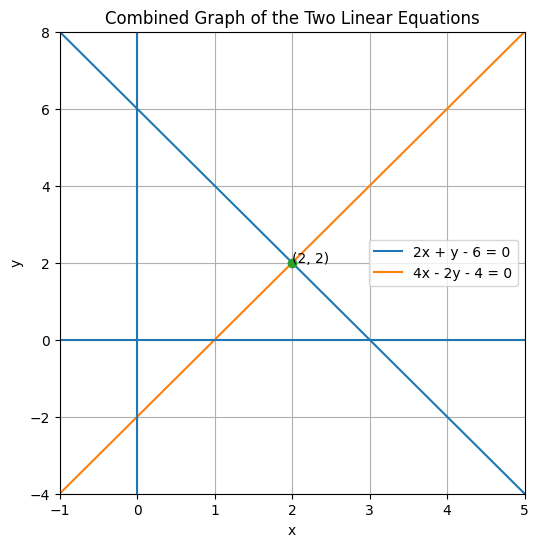
So x = 2 and y = 2 is the solution.
5. Types of Lines and Consistency Conditions
When two straight lines are drawn on a plane, exactly one of three things can happen:
Case 1: Lines Intersect at Exactly One Point
The two lines cross at a single point. This gives exactly one solution: the coordinates of the point of intersection. The system is consistent.
Condition: a₁/a₂ ≠ b₁/b₂
Example: x + y = 5 and x − y = 1 → intersect at (3, 2)
Case 2: Lines are Parallel (No Intersection)
The two lines never meet. There is no solution. The system is inconsistent.
Condition: a₁/a₂ = b₁/b₂ ≠ c₁/c₂
Example: 2x + y = 4 and 4x + 2y = 9
Check: a₁/a₂ = 2/4 = 1/2, b₁/b₂ = 1/2 = 1/2, c₁/c₂ = 4/9 ≠ 1/2
Since a₁/a₂ = b₁/b₂ ≠ c₁/c₂ → parallel lines → no solution.
Case 3: Lines are Coincident (Same Line)
When the two equations actually represent the same straight line, every point on the line is a solution, giving infinitely many solutions. The system is consistent and dependent.
Condition: a₁/a₂ = b₁/b₂ = c₁/c₂
Example: 2x + 4y = 8 and x + 2y = 4
Check: 2/1 = 4/2 = 8/4 → all ratios equal → coincident lines → infinite solutions.
6. Algebraic Methods of Solution
Algebraic methods give exact solutions and are preferred over the graphical method for board exam problems.
6.1 Substitution Method
Steps:
-
From either equation, express one variable in terms of the other.
-
Substitute this expression into the other equation.
-
Solve the resulting single-variable equation.
-
Substitute back to find the value of the other variable.
-
Write the solution as an ordered pair (x, y).
Solved Example
Solve: y − 2x = 1 and x + 2y = 12
Step 1: From equation (1): y = 2x + 1
Step 2: Substitute into equation (2):
x + 2(2x + 1) = 12
⇒ x + 4x + 2 = 12
⇒ 5x = 10
⇒ x = 2
Step 3: Substitute x = 2 back into y = 2x + 1:
y = 2(2) + 1 = 5
Solution: (2, 5)
Verify: y − 2x = 5 − 4 = 1 and x + 2y = 2 + 10 = 12.
6.2 Elimination Method
Here, we eliminate one variable by making its coefficients equal in both equations, then adding or subtracting.
Steps:
-
Multiply one or both equations by suitable constants so that the coefficients of one variable become equal.
-
Add or subtract the equations to eliminate that variable.
-
Solve the resulting equation for the remaining variable.
-
Substitute back to find the other variable.
Solved Example
Solve: x + 2y = 8 and 2x − 3y = 2
Step 1: Multiply equation (1) by 2:
2x + 4y = 16 … (3)
Step 2: Subtract equation (2) from equation (3):
2x + 4y = 16
2x − 3y = 2
(−) (+) (−)
─────────────────
7y = 14
⇒ y = 2
Step 3: Substitute y = 2 into equation (1):
x + 4 = 8 ⇒ x = 4
Solution: (4, 2)
6.3 Cross-Multiplication Method
The Formula
For the system:
a₁x + b₁y + c₁ = 0
a₂x + b₂y + c₂ = 0
The solution is given by:
x / (b₁c₂ − b₂c₁) = y / (c₁a₂ − c₂a₁) = 1 / (a₁b₂ − a₂b₁)
This gives:
x = (b₁c₂ − b₂c₁) / (a₁b₂ − a₂b₁)
y = (c₁a₂ − c₂a₁) / (a₁b₂ − a₂b₁)
Condition: a₁b₂ − a₂b₁ ≠ 0 (otherwise the lines are parallel or coincident)
Memory Aid
Write the coefficients in two rows. Cross-multiply diagonally:
b₁ c₁ a₁ b₁
b₂ c₂ a₂ b₂
-
For x: (b₁ × c₂) − (b₂ × c₁)
-
For y: (c₁ × a₂) − (c₂ × a₁)
-
Denominator: (a₁ × b₂) − (a₂ × b₁)
Solved Example
Solve: 2x + 3y + 5 = 0 and 4x − y − 3 = 0
Here: a₁ = 2, b₁ = 3, c₁ = 5, a₂ = 4, b₂ = −1, c₂ = −3
-
Numerator for x: b₁c₂ − b₂c₁ = (3)(−3) − (−1)(5) = −9 + 5 = −4
-
Numerator for y: c₁a₂ − c₂a₁ = (5)(4) − (−3)(2) = 20 + 6 = 26
-
Denominator: a₁b₂ − a₂b₁ = (2)(−1) − (4)(3) = −2 − 12 = −14
So: x = −4/−14 = 2/7
y = 26/−14 = −13/7
Solution: (2/7, −13/7)
7. Equations Reducible to a Pair of Linear Equations
Sometimes equations may look non-linear, but they can be transformed into a standard linear pair using substitution.
Equations involving 1/x and 1/y are the most common type in this section.
Example: Solve 2/x + 3/y = 4 and 5/x − 4/y = 9
Step 1: Substitute 1/x = u and 1/y = v
The system becomes:
2u + 3v = 4 … (1)
5u − 4v = 9 … (2)
Step 2: This is now a standard linear pair! Solve using elimination.
Multiply (1) by 4 and (2) by 3:
8u + 12v = 16 … (3)
15u − 12v = 27 … (4)
Add (3) and (4):
23u = 43 ⇒ u = 43/23
Substitute back: 2(43/23) + 3v = 4 ⇒ v = (4 − 86/23)/3 = 2/23
Step 3: Back-substitute:
u = 1/x = 43/23 ⇒ x = 23/43
v = 1/y = 2/23 ⇒ y = 23/2
8. Important Formulas at a Glance
Click below to download your free Class 10 Maths Chapter 3:Pair of Linear Equations in Two Variables PDF Notes perfect for last-minute CBSE board exam revision.
Download PDF - Class 10 Maths Chapter 3: Pair of Linear Equations in Two Variables Notes
Frequently Asked Questions of Notes for Chapter 3:Pair of Linear Equations in Two Variables
1. How many methods are there to solve a pair of linear equations?
There are four methods: the graphical method, the substitution method, the elimination method, and the cross-multiplication method.
2. What is a consistent and inconsistent system?
A consistent system has at least one solution (the lines intersect or coincide). An inconsistent system has no solution (the lines are parallel).
3. When does a pair of linear equations have infinitely many solutions?
When the two equations represent the same line, i.e., a₁/a₂ = b₁/b₂ = c₁/c₂. Every point on the line satisfies both equations.
4. What is the cross-multiplication method?
It is a direct formula method where x = (b₁c₂ − b₂c₁)/(a₁b₂ − a₂b₁) and y = (c₁a₂ − c₂a₁)/(a₁b₂ − a₂b₁). It is particularly useful when neither substitution nor elimination seems straightforward.
5. Is it possible for a linear equation to have no solution?
A pair of linear equations that can have no solution, when the two lines they represent are parallel.
Numbers make sense when they're taught right. To see how Orchids The International School turns Maths from intimidating to intuitive, reach out to our admissions team.


Admissions Open for 2026-27
What type of concept pages would you prefer?
CBSE Schools In Popular Cities
- CBSE Schools in Bangalore
- CBSE Schools in Mumbai
- CBSE Schools in Pune
- CBSE Schools in Hyderabad
- CBSE Schools in Chennai
- CBSE Schools in Gurgaon
- CBSE Schools in Kolkata
- CBSE Schools in Indore
- CBSE Schools in Sonipat
- CBSE Schools in Delhi
- CBSE Schools in Rohtak
- CBSE Schools in Bhopal
- CBSE Schools in Aurangabad
- CBSE Schools in Jabalpur
- CBSE Schools in Jaipur
- CBSE Schools in Jodhpur
- CBSE Schools in Nagpur
- CBSE Schools in Ahmednagar
- CBSE School In Tumkur











Orchids The International School is one of India's leading chains of CBSE and ICSE schools, with 110+ schools across the country.