

Class 10 Maths Chapter 2 Polynomials Notes | Free PDF Download
Class 10 Maths Chapter 2 Polynomials Notes Free PDF Download is prepared based on the latest CBSE and NCERT syllabus. These notes will help in school exams, board exams and quick revision. They help students to understand the chapter clearly, revise faster and prepare for exams with confidence.
Table of Contents
- Algebraic Expressions
- Important Terms in Polynomials
- Zeroes of a Polynomial
- Relationship Between Zeroes and Coefficients
- Quadratic Polynomial Graph
- Formation of Polynomial from Zeroes
- Division Algorithm for Polynomials
- Steps for Polynomial Long Division
- Important Formulas Algebraic Identities Used in Polynomials
- Solved Examples on Class 10 Chapter 2 Polynomials
- NCERT Based Questions on Class 10 Chapter 2 Polynomials
- Frequently Asked Questions on Class 10 Maths Chapter 2 Polynomials

Algebraic Expressions
A polynomial is an algebraic expression made up of variables and coefficients, combined using addition, subtraction, and multiplication. The powers of variables must always be whole numbers (0, 1, 2, 3...).
A polynomial is any expression that looks like this:
aₙxⁿ + aₙ₋₁xⁿ⁻¹ + ... + a₂x² + a₁x + a₀
Where:
-
x = variable
-
aₙ, aₙ₋₁... = coefficients (numbers in front of variable)
-
n = whole number (power/degree)
In a polynomial:
-
Powers of variables must be whole numbers (0, 1, 2, 3...)
-
No variable in the denominator
-
No variable under a square root
Know more about related topics:
Important Terms in Polynomials
1. Terms
Each part of a polynomial separated by + or - is called a term.
3x² + 2x - 5
Terms:
- First term: 3x²
- Second term: 2x
- Third term: -5
2. Coefficients
The number multiplied with the variable in each term.
In 3x²:
Coefficient = 3
Variable = x
Power = 2
In -7x:
Coefficient = -7
In 5 (constant term):
Coefficient = 5
3. Degree of a Polynomial
The highest power of the variable in a polynomial is called its degree.
3x² + 2x - 5 → Degree = 2 (highest power is 2)
4x³ - x + 1 → Degree = 3
7x⁵ - 2x² + x → Degree = 5
6 → Degree = 0 (constant polynomial)
3x → Degree = 1
4. Types Based on Degree
5. Types Based on Number of Terms
6. Standard Form of Polynomial
Writing polynomial with powers in descending order (highest to lowest):
Standard form of a quadratic polynomial:
ax² + bx + c
Where:
a ≠ 0
a, b, c are real numbers
a = coefficient of x²
b = coefficient of x
c = constant term
Zeroes of a Polynomial
The zeroes of a polynomial are the values of the variable that make the polynomial equal to zero. If you substitute a value of x in the polynomial and the answer comes out to be 0, then that value is a zero of the polynomial.
Formula:
If p(x) is a polynomial and p(a) = 0, then a is a zero of the polynomial p(x).
Example 1: Finding Zeroes of Linear Polynomial
Find the zero of p(x) = 2x + 4
Put p(x) = 0
2x + 4 = 0
2x = -4
x = -2
p(-2) = 2(-2) + 4 = -4 + 4 = 0
Zero of p(x) = 2x + 4 is x = -2
Example 2: Checking if a Value is a Zero
Check if x = 2 is a zero of p(x) = x² - 3x + 2
Put x = 2:
p(2) = (2)² - 3(2) + 2
p(2) = 4 - 6 + 2
p(2) = 0
Yes x = 2 is a zero
Check if x = 3 is a zero:
p(3) = (3)² - 3(3) + 2
p(3) = 9 - 9 + 2
p(3) = 2 ≠ 0
No x = 3 is NOT a zero.
Number of Zeroes
Geometrical Meaning of Zeroes
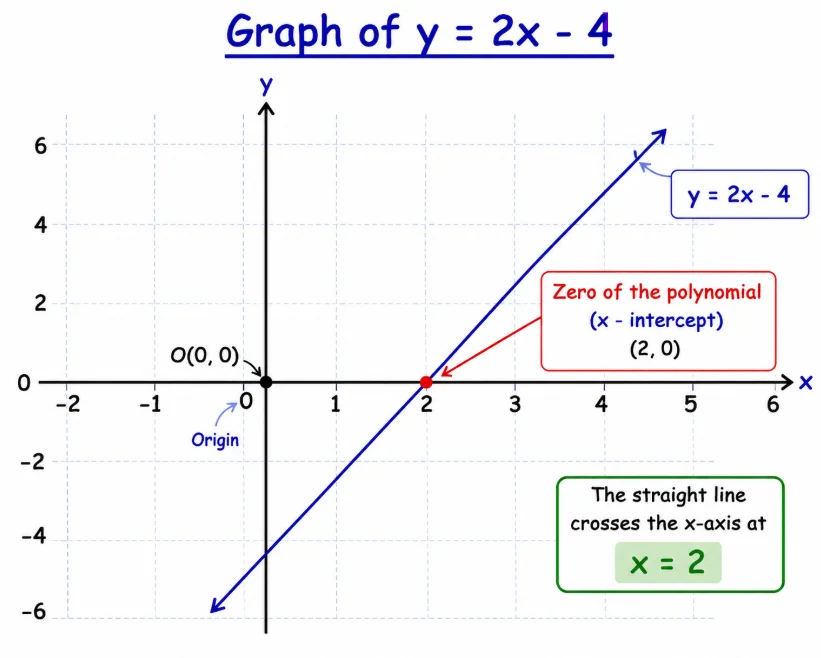
The zeroes of a polynomial are the x-coordinates of the points where the graph crosses or touches the x-axis.
Where the curve of y = p(x) meets the x-axis, those x values are the zeroes!
Linear Polynomial Graph:
p(x) = ax + b (straight line)
Graph: y = 2x - 4
The straight line:
- Crosses the x-axis at one point
- That point: set y = 0, x = 2
Number of zeroes = 1
(A straight line cuts x-axis at exactly one point)
Quadratic Polynomial Graph
p(x) = ax² + bx + c (parabola)
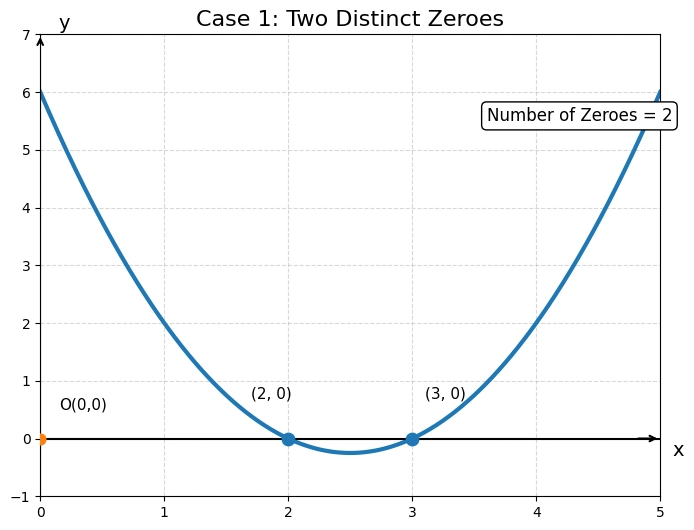
A parabola can cross the x-axis in three ways:
Case 1: Two distinct zeroes
The parabola cuts x-axis at two different points.
Number of zeroes = 2
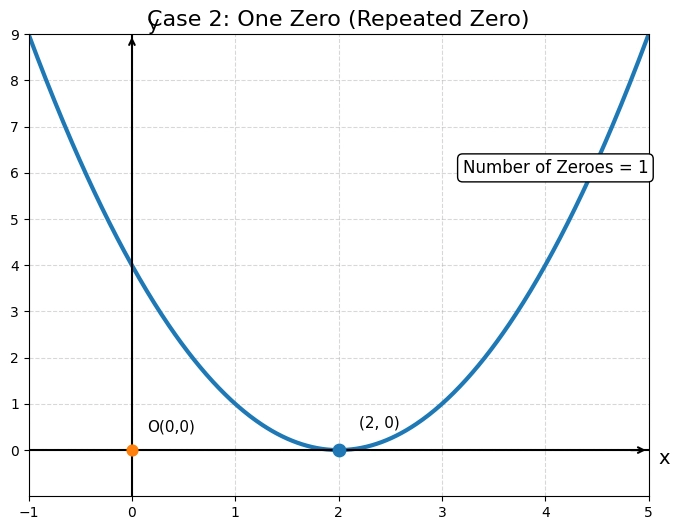
Case 2: One zero (repeated)
The parabola just touches the x-axis at one point.
Number of zeroes = 1
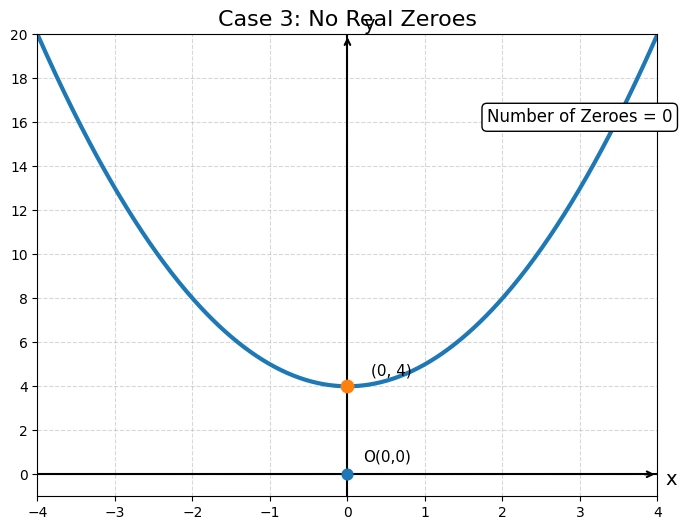
Case 3: No real zeroes
The parabola doesn't cross the x-axis at all.
Number of zeroes = 0
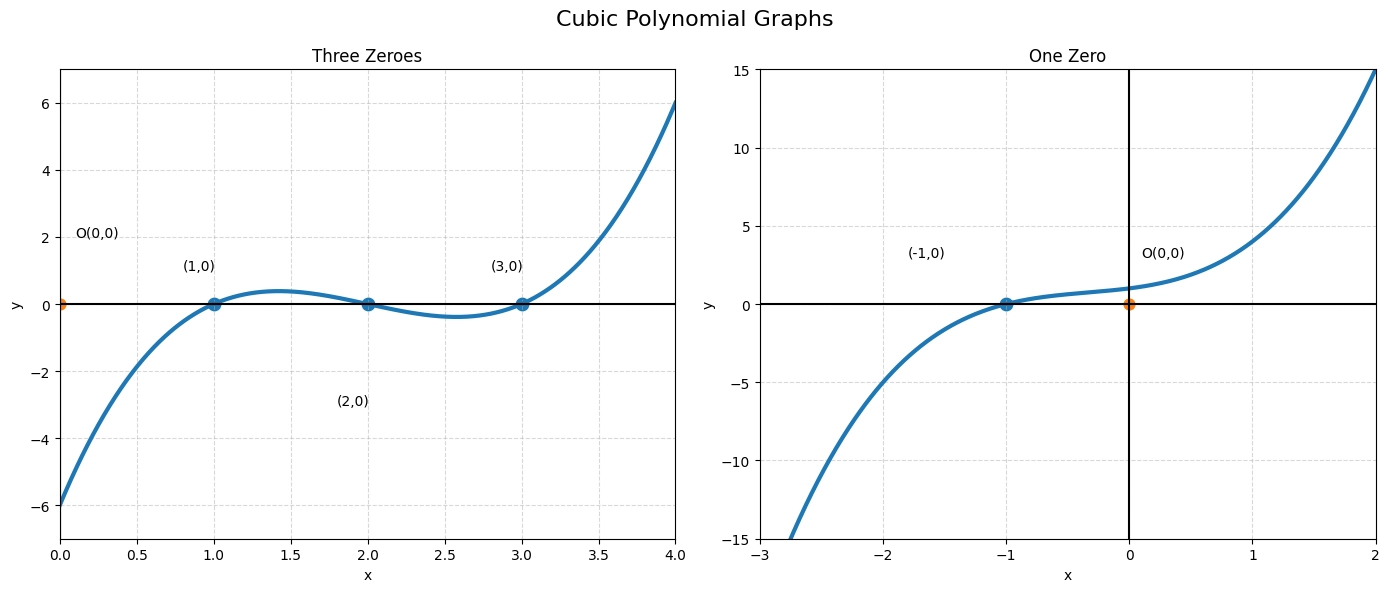
Cubic Polynomial Graph
p(x) = ax³ + bx² + cx + d
Can have 1, 2, or 3 zeroes
Relationship Between Zeroes and Coefficients
For Linear Polynomial
p(x) = ax + b
Zero = -b/a
If α is the zero:
α = -b/a
Example:
p(x) = 2x + 6
a = 2, b = 6
Zero = -b/a = -6/2 = -3
For Quadratic Polynomial
p(x) = ax² + bx + c
If α and β are the two zeroes:
Sum of zeroes:
α + β = -b/a
= -(coefficient of x) / (coefficient of x²)
Product of zeroes:
α × β = c/a
= (constant term) / (coefficient of x²)
Example: Find sum and product of zeroes of p(x) = 3x² - 5x + 2
a = 3, b = -5, c = 2
Sum of zeroes = -b/a = -(-5)/3 = 5/3
Product of zeroes = c/a = 2/3
First find actual zeroes:
3x² - 5x + 2 = 0
3x² - 3x - 2x + 2 = 0
3x(x - 1) - 2(x - 1) = 0
(3x - 2)(x - 1) = 0
x = 2/3 or x = 1
Sum = 2/3 + 1 = 5/3
Product = 2/3 × 1 = 2/3
For Cubic Polynomial
p(x) = ax³ + bx² + cx + d
If α, β, γ are the three zeroes:
Sum of zeroes:
α + β + γ = -b/a
Sum of product of zeroes taken two at a time:
αβ + βγ + γα = c/a
Product of all three zeroes:
α × β × γ = -d/a
Formula Table:
Formation of Polynomial from Zeroes
Quadratic Polynomial from Zeroes
Formula:
p(x) = x² - (sum of zeroes)x + (product of zeroes)
p(x) = x² - (α + β)x + (αβ)Example 1: Find a quadratic polynomial with zeroes 3 and -2.
Sum of zeroes = 3 + (-2) = 1
Product of zeroes = 3 × (-2) = -6
p(x) = x² - (1)x + (-6)
p(x) = x² - x - 6
Verification:
x² - x - 6 = 0
(x - 3)(x + 2) = 0
x = 3 or x = -2
Example 1: Find quadratic polynomial with zeroes 1/2 and -3.
Sum = 1/2 + (-3) = 1/2 - 3 = -5/2
Product = 1/2 × (-3) = -3/2
p(x) = x² - (-5/2)x + (-3/2)
p(x) = x² + 5x/2 - 3/2
Multiply by 2:
p(x) = 2x² + 5x - 3
Cubic Polynomial from Zeroes
Formula:
p(x) = x³ - (α+β+γ)x² + (αβ+βγ+γα)x - αβγ
Example 2: Find cubic polynomial with zeroes 1, 2, and 3.
Sum = 1 + 2 + 3 = 6
Sum of products = (1×2) + (2×3) + (3×1) = 2 + 6 + 3 = 11
Product = 1 × 2 × 3 = 6
p(x) = x³ - 6x² + 11x - 6
Division Algorithm for Polynomials
The Division Algorithm
When polynomial p(x) is divided by g(x):
p(x) = g(x) × q(x) + r(x)
Where:
p(x) = dividend
g(x) = divisor
q(x) = quotient
r(x) = remainder
Conditions:
Degree of r(x) < Degree of g(x)
OR r(x) = 0 (exact division)
This is same as:
Dividend = Divisor × Quotient + Remainder
Steps for Polynomial Long Division
Divide p(x) = x³ - 3x + 2 by g(x) = x - 1
Step 1: Divide first term of dividend by first term of divisor
x³ ÷ x = x²
Step 2: Multiply divisor by this term
x² × (x - 1) = x³ - x²
Step 3: Subtract from dividend
(x³ + 0x² - 3x + 2) - (x³ - x²)
= x² - 3x + 2
Step 4: Repeat with new expression
x² ÷ x = x ← next term of quotient
x × (x - 1) = x² - x
(x² - 3x + 2) - (x² - x)
= -2x + 2
Step 5: Repeat again
-2x ÷ x = -2
-2 × (x - 1) = -2x + 2
(-2x + 2) - (-2x + 2)
= 0 remainder.
Result:
Quotient = x² + x - 2
Remainder = 0
Verification:
(x - 1)(x² + x - 2)
= x³ + x² - 2x - x² - x + 2
= x³ - 3x + 2Remainder Theorem
If polynomial p(x) is divided by (x - a), the remainder equals p(a).
Remainder = p(a)
Example:
Find remainder when p(x) = x³ - 2x + 1 is divided by (x - 2)
Remainder = p(2) = (2)³ - 2(2) + 1
= 8 - 4 + 1
= 5
Factor Theorem
(x - a) is a factor of polynomial p(x) if and only if p(a) = 0.
If p(a) = 0. (x - a) is a factor of p(x)
If (x - a) is a factor p(a) = 0
Example:
Is (x - 2) a factor of p(x) = x² - 5x + 6?
p(2) = (2)² - 5(2) + 6
= 4 - 10 + 6
= 0
Since p(2) = 0, (x - 2) is a factor.
Important Formulas Algebraic Identities Used in Polynomials
(a + b)² = a² + 2ab + b²
(a - b)² = a² - 2ab + b²
(a + b)(a - b) = a² - b²
(a + b)³ = a³ + 3a²b + 3ab² + b³
(a - b)³ = a³ - 3a²b + 3ab² - b³
a³ + b³ = (a + b)(a² - ab + b²)
a³ - b³ = (a - b)(a² + ab + b²)
Quadratic Formula:
For ax² + bx + c = 0:
x = [-b ± √(b² - 4ac)] / 2a
Discriminant (D) = b² - 4ac
If D > 0 ,Two distinct real zeroes
If D = 0 ,One repeated zero
If D < 0 ,No real zeroes
Formula Tables:
Solved Examples on Class 10 Chapter 2 Polynomials
Example 1: Finding Zeroes of Quadratic
Question: Find the zeroes of p(x) = x² - 5x + 6 and verify the relationship between zeroes and coefficients.
Solution:
Step 1: Factorise the polynomial
x² - 5x + 6 = 0
x² - 3x - 2x + 6 = 0
x(x - 3) - 2(x - 3) = 0
(x - 2)(x - 3) = 0
x = 2 or x = 3
Step 2: Identify coefficients
a = 1, b = -5, c = 6
α = 2, β = 3
Step 3: Verify sum of zeroes
α + β = 2 + 3 = 5
-b/a = -(-5)/1 = 5
Step 4: Verify product of zeroes
αβ = 2 × 3 = 6
c/a = 6/1 = 6
Answer: Zeroes are 2 and 3. Relationship verified
Example 2: Finding Quadratic Polynomial from Zeroes
Question: Find a quadratic polynomial whose zeroes are 5 and -3.
Solution:
Given:
α = 5, β = -3
Step 1: Calculate sum of zeroes
α + β = 5 + (-3) = 2
Step 2: Calculate product of zeroes
αβ = 5 × (-3) = -15
Step 3: Form polynomial
p(x) = x² - (α + β)x + (αβ)
p(x) = x² - 2x + (-15)
p(x) = x² - 2x - 15
Verification:
x² - 2x - 15
= x² - 5x + 3x - 15
= x(x - 5) + 3(x - 5)
= (x + 3)(x - 5)
Zeroes: x = -3 and x = 5
Answer: Required polynomial is x² - 2x - 15.
Example 3: Cubic Polynomial Zeroes
Question: Verify that 2, -1, and -3 are zeroes of p(x) = x³ + 2x² - 5x - 6. Also verify the relationship between zeroes and coefficients.
Solution:
Verification of zeroes:
p(2) = (2)³ + 2(2)² - 5(2) - 6
= 8 + 8 - 10 - 6 = 0
p(-1) = (-1)³ + 2(-1)² - 5(-1) - 6
= -1 + 2 + 5 - 6 = 0
p(-3) = (-3)³ + 2(-3)² - 5(-3) - 6
= -27 + 18 + 15 - 6 = 0
All three are zeroes.
Verification of relationships:
α = 2, β = -1, γ = -3
a = 1, b = 2, c = -5, d = -6
Sum of zeroes:
α + β + γ = 2 + (-1) + (-3) = -2
-b/a = -2/1 = -2
Sum of products (two at a time):
αβ + βγ + γα = (2×-1) + (-1×-3) + (-3×2)
= -2 + 3 + (-6) = -5
c/a = -5/1 = -5
Product of zeroes:
αβγ = 2 × (-1) × (-3) = 6
-d/a = -(-6)/1 = 6
Answer: All relationships verified.
Example 4: Division Algorithm
Question: Divide p(x) = 2x³ - 11x² + 17x - 6 by g(x) = 2x - 1. Find quotient and remainder.
Solution:
Step 1: Divide first terms
2x³ ÷ 2x = x²
x² × (2x - 1) = 2x³ - x²
(2x³ - 11x²) - (2x³ - x²) = -10x²
Step 2: Bring down and repeat
-10x² ÷ 2x = -5x
-5x × (2x - 1) = -10x² + 5x
(-10x² + 17x) - (-10x² + 5x) = 12x
Step 3: Continue
12x ÷ 2x = 6
6 × (2x - 1) = 12x - 6
(12x - 6) - (12x - 6) = 0
Result:
Quotient = x² - 5x + 6
Remainder = 0
Verification:
(2x - 1)(x² - 5x + 6) + 0
= 2x³ - 10x² + 12x - x² + 5x - 6
= 2x³ - 11x² + 17x - 6
Example 5: Using Remainder Theorem
Question: Find the remainder when p(x) = x³ - 6x² + 2x - 4 is divided by (x - 3).
Solution:
Using Remainder Theorem:
Remainder = p(3)
p(3) = (3)³ - 6(3)² + 2(3) - 4
= 27 - 54 + 6 - 4
= -25
Answer: Remainder = -25.
Example 6: Discriminant Application
Question: Check the nature of zeroes of p(x) = 2x² - 3x + 5.
Solution:
a = 2, b = -3, c = 5
Discriminant = b² - 4ac
= (-3)² - 4(2)(5)
= 9 - 40
= -31
Since D = -31 < 0
No real zeroes exist
Answer: The polynomial has no real zeroes.
NCERT Based Questions on Class 10 Chapter 2 Polynomials
Section 1: Basic Concepts
Question 1: What is the degree of 5x⁴ - 3x² + 7x - 1?
Question 2: How many zeroes can a cubic polynomial have?
Question 3: Is x = -1 a zero of p(x) = x² + 2x + 1?
Question 4: Find the zero of p(x) = 3x - 9.
Question 5: Write the standard form of a cubic polynomial.
Section 2: Zeroes and Coefficients
Question 6: If the zeroes of x² + px + q are 3 and -4, find p and q.
Question 7: Find sum and product of zeroes of 5x² - 4x + 1.
Question 8: A quadratic polynomial has sum of zeroes = 6 and product = 8. Find the polynomial.
Question 9: If α and β are zeroes of 2x² - 5x + 3, find α² + β².
Question 10: Find the cubic polynomial with zeroes 1, -1, and 2.
Section 3: Division Algorithm
Question 11: Find remainder when x³ + 1 is divided by x + 1.
Question 12: Check if (x - 2) is a factor of x³ - 8.
Question 13: Divide 3x³ + x² + 2x + 5 by (x + 1).
Question 14: If p(x) = x³ - 4x² + x + 6, check if x = 3 is a zero.
Question 15: Find a and b if (x² - 4) is a factor of ax⁴ + 2x³ - 3x² + bx - 4.
Download PDF - Class 10 Maths Chapter 2 Polynomials Notes
Related Topics:
Numbers make sense when they're taught right. To see how Orchids The International School turns Maths from intimidating to intuitive, reach out to our admissions team.
Frequently Asked Questions on Class 10 Maths Chapter 2 Polynomials
1. What is a polynomial?
A polynomial is an algebraic expression made up of variables and coefficients combined using addition, subtraction, and multiplication, where the exponents of the variables are non-negative integers. For example, is a polynomial.
2. What is the degree of a polynomial?
The degree of a polynomial is the highest power of the variable in the polynomial.
3. What is a zero of a polynomial?
A zero of a polynomial is a value of the variable that makes the polynomial equal to zero.
4. How do you find the zero of a polynomial?
Set the polynomial equal to zero and solve for the variable.
5. What is a quadratic polynomial?
A quadratic polynomial is a polynomial of degree 2.
Example:
6. What is the relationship between zeroes and coefficients?
For a quadratic polynomial , if the zeroes are α\alpha and β\beta, then:
- Sum of zeroes =
- Product of zeroes =
This relationship helps in finding zeroes and forming polynomials.
7. Can a polynomial have more than one variable?
Yes, polynomials can have one or more variables.
8. How many zeroes can a quadratic polynomial have?
A quadratic polynomial has degree 2, so it can have at most two zeroes. These zeroes may be distinct, equal, or complex, depending on the polynomial.
9. Is Chapter 2 Polynomials important for CBSE boards?
Yes, Chapter 2 Polynomials is an important chapter in the CBSE Class 10 Maths syllabus. Questions based on zeroes of polynomials, relationships between zeroes and coefficients, and the division algorithm are frequently asked in school and board examinations. Thorough preparation of this chapter can help improve overall Mathematics scores.
Related Links


Admissions Open for 2026-27
What type of concept pages would you prefer?
CBSE Schools In Popular Cities
- CBSE Schools in Bangalore
- CBSE Schools in Mumbai
- CBSE Schools in Pune
- CBSE Schools in Hyderabad
- CBSE Schools in Chennai
- CBSE Schools in Gurgaon
- CBSE Schools in Kolkata
- CBSE Schools in Indore
- CBSE Schools in Sonipat
- CBSE Schools in Delhi
- CBSE Schools in Rohtak
- CBSE Schools in Bhopal
- CBSE Schools in Aurangabad
- CBSE Schools in Jabalpur
- CBSE Schools in Jaipur
- CBSE Schools in Jodhpur
- CBSE Schools in Nagpur
- CBSE Schools in Ahmednagar
- CBSE School In Tumkur











Orchids The International School is one of India's leading chains of CBSE and ICSE schools, with 110+ schools across the country.