

What are Different Types of Polynomials?
Classification of types of polynomials is either based on their degree or number of terms. Knowing different types of polynomials allows us to understand how the polynomial behaves, how many roots/zeros it will have and what method can be used to solve them. This knowledge is highly useful for building a solid foundation in advanced algebra. In this article, we will cover different types of polynomials in detail based on their degree and number of terms.
Table of Contents
- Introduction to Polynomials
- Types of Polynomials
- Types of Polynomials Based on Degree
- Types of Polynomials Based on Terms
- Solved Examples on Types of Polynomials
- Frequently Asked Questions on Types of Polynomials

Introduction to Polynomials
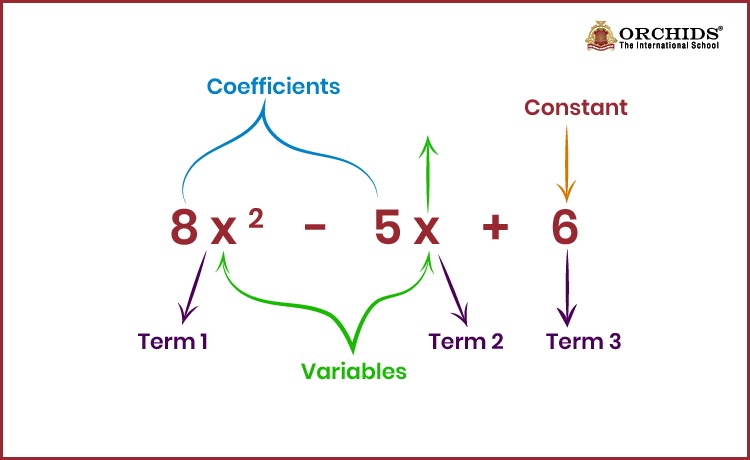
A polynomial is described as an algebraic expression consisting of constants, variables and coefficients joined together through addition or subtraction operation. In standard form a polynomial is represented as: P(x) = anxn + an−1xn−1 + an−2xn−2 + … + a1x + a0
where ai are the coefficients. In standard form polynomial terms are placed in decreasing order of their degree.
Types of Polynomials
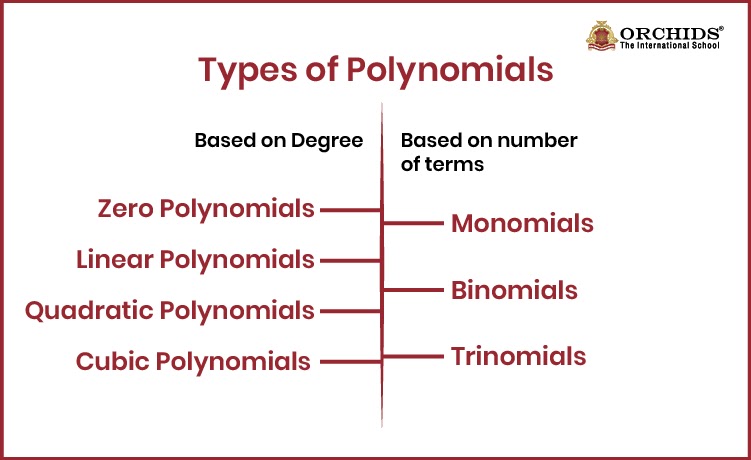
Polynomials are broadly classified into two different types based on their degree and number of terms. Let’s understand each of these in detail below.
Types of Polynomials Based on Degree
In a polynomial the degree of a polynomial is the highest exponent of a variable. Based on the degree of a polynomial, it can be classified into following types:
|
Constant |
f(x) = ax0 or a |
f(x) = 9 |
|
Linear |
f(x) = ax1 + b |
f(x) = 3x + 5 |
|
Quadratic |
f(x) = ax2 + bx + c |
f(x) = 5x2 + 7x + 3 |
|
Cubic |
f(x) = ax3 + bx2 + cx + d |
f(x) = 9x3 + 9x2 + 7x + 3 |
|
Quartic |
f(x) = ax4 + bx3 + cx2 + dx + e |
f(x) = 9x4 + x3 + 9x2 + 7x + 3 |
|
Quintic |
f(x) = ax5 + bx4 + cx3 + dx2 + ex + f |
f(x) = 4x5 + 9x4 + 4x3 + 6x2 + x + 2 |
Types of Polynomials Based on Terms
Based on the number of terms a polynomial can be classified as follows:
|
Monomial (One Term) |
f(x) = axn ; a ≠ 0 |
f(x) = 2x2 |
|
Binomial (2 Terms) |
f(x) = axp + bxq |
f(x) = 5x3 + 2x |
|
Trinomial (3 Terms) |
f(x) = axp + bx + c |
f(x) = 5x3 + 2x + 6 |
Solved Examples on Types of Polynomials
Example 1: Classify the given polynomials based on degree:
i) 4x + 7 ii) 3x2 iii) 8y4 + y3 + y
Solution:
i) 4x + 7 is a linear polynomial.
ii) 3x2 is a quadratic monomial.
iii) 8y4 + y3 + y is a quartic polynomial.
Example 2: State the number of terms and degree of the following polynomials and tell whether they are monomial, binomial or trinomial:
a) 5x2 - 3x + 1 b) 7y c) x2 + 9 d) -3
Solution:
a) 5x2 - 3x + 1 has 3 terms and degree = 2. It is a trinomial.
b) 7y has only one term and degree = 1. It is a monomial.
c) x2 + 9 has two terms and degree = 2. It is a binomial.
d) -3 is a constant or zero polynomial with one term and degree 0.
Example 3: Classify the given polynomials based on degree and terms together:
- 9z2 + 3z + 1
- 7y3 + y
- 5x
- 14x4
Solution:
9z2 + 3z + 1 is a quadratic trinomial.
7y3 + y is a cubic binomial.
5x is a linear monomial.
14x4 is a quartic monomial.
Example 4: Verify whether (x + 1)2 is a binomial or trinomial.
Solution:
(x + 1)2 = x2 + 2x + 1
Therefore, the given polynomial is a trinomial.
Know more about related topics:
Frequently Asked Questions on Types of Polynomials
1. What are different types of polynomials?
There are two different types of polynomials based on degree and number of terms:
|
|
2. What is the degree of a polynomial?
The degree of a polynomial is the highest exponent of a variable. For example: 4x2 + x = 8, is a polynomial with degree 2 and is known as quadratic polynomial.
3. Is Zero a polynomial?
The number zero is a special polynomial called constant polynomial.
Numbers make sense when they're taught right. To see how Orchids The International School turns Maths from intimidating to intuitive, reach out to our admissions team.


Admissions Open for 2026-27
What type of concept pages would you prefer?
CBSE Schools In Popular Cities
- CBSE Schools in Bangalore
- CBSE Schools in Mumbai
- CBSE Schools in Pune
- CBSE Schools in Hyderabad
- CBSE Schools in Chennai
- CBSE Schools in Gurgaon
- CBSE Schools in Kolkata
- CBSE Schools in Indore
- CBSE Schools in Sonipat
- CBSE Schools in Delhi
- CBSE Schools in Rohtak
- CBSE Schools in Bhopal
- CBSE Schools in Aurangabad
- CBSE Schools in Jabalpur
- CBSE Schools in Jaipur
- CBSE Schools in Jodhpur
- CBSE Schools in Nagpur
- CBSE Schools in Ahmednagar
- CBSE School In Tumkur











Orchids The International School is one of India's leading chains of CBSE and ICSE schools, with 130+ schools across the country.