

Class 10 Maths Chapter 6 Triangles Notes With Free PDF Download
Class 10 Maths Chapter 6 Triangles Notes Free PDF Download is prepared based on the latest CBSE and NCERT syllabus. These notes will help in school exams, board exams and quick revision. They help students to understand the chapter clearly, revise faster and prepare for exams with confidence.
Table of Contents
- What Are Similar Figures?
- Similar Triangles
- Basic Proportionality Theorem (BPT)
- Criteria for Similarity of Triangles
- Areas of Similar Triangles
- Pythagoras Theorem
- Solved Examples on Class 10 Maths Chapter 6 Triangles Notes
- Practice Questions on Class 10 Maths Chapter 6 Triangles Notes
- Important Table of Formulas
- Previous Years Important Questions on Class 10 Maths Chapter 6 Triangles Notes
- Frequently Asked Questions on Class 10 Maths Chapter 6 Triangles Notes

What Are Similar Figures?
Two figures are called similar if they have the same shape but not necessarily the same size.
- All circles are similar to each other
- All squares are similar to each other
- Equilateral triangles are always similar to each other
Similar vs Congruent
Example:
Two triangles ABC and DEF where:
Congruent: AB = DE, BC = EF, AC = DF (sides equal)
Similar: AB/DE = BC/EF = AC/DF (sides proportional)
Key Property of Similar Figures
When two figures are similar:
-
Corresponding angles are equal
-
Corresponding sides are proportional (in the same ratio)
If △ABC ~ △DEF (Triangle ABC similar to Triangle DEF)
Then:
∠A = ∠D
∠B = ∠E
∠C = ∠F
And:
AB/DE = BC/EF = AC/DF = k (constant ratio)
k is called the scale factor
Know more about related topics:
Similar Triangles
Two triangles are similar if:
-
Their corresponding angles are equal
-
Their corresponding sides are in the same ratio
Notation:
△ABC ~ △DEF means "Triangle ABC is similar to Triangle DEF"
Important: The order of letters matters! When writing ABC ~ DEF:
A corresponds to D
B corresponds to E
C corresponds to F
Understanding Scale Factor
The scale factor tells you how many times bigger or smaller one triangle is compared to the other.
If AB/DE = BC/EF = AC/DF = 2
This means Triangle ABC is 2 times bigger than Triangle DEF
Example:
△ABC ~ △PQR
AB = 6 cm, PQ = 3 cm
BC = 8 cm, QR = 4 cm
AC = 10 cm, PR = 5 cm
Ratio = 6/3 = 8/4 = 10/5 = 2
Scale factor = 2
Properties of Similar Triangles
Property 1: If △ABC ~ △DEF, then all three ratios are equal
AB/DE = BC/EF = CA/FD
Property 2: Similarity is reflexive
Every triangle is similar to itself
△ABC ~ △ABC
Property 3: Similarity is symmetric
If △ABC ~ △DEF, then △DEF ~ △ABC
Property 4: Similarity is transitive
If △ABC ~ △DEF and △DEF ~ △PQR
Then △ABC ~ △PQR
Basic Proportionality Theorem (BPT)
If a line is drawn parallel to one side of a triangle intersecting the other two sides at distinct points, then it divides the other two sides in the same ratio.
If in △ABC, DE || BC where D is on AB and E is on AC:
AD/DB = AE/EC
.webp "Basic Proportionality Theorem (BPT)")
DE || BC
Therefore: AD/DB = AE/EC
Proof of BPT
Given:
-
△ABC with DE || BC
-
D on AB, E on AC
To prove: AD/DB = AE/EC
Construction: Draw DM ⊥ AC and EN ⊥ AB. Join BE and CD.
Proof:
Area of △ADE = (1/2) × AD × EN ...(1)
Area of △BDE = (1/2) × DB × EN ...(2)
Dividing (1) by (2):
Area(△ADE)/Area(△BDE) = AD/DB ...(3)
Similarly:
Area of △ADE = (1/2) × AE × DM ...(4)
Area of △CDE = (1/2) × EC × DM ...(5)
Area(△ADE)/Area(△CDE) = AE/EC ...(6)
Since △BDE and △CDE are on the same base DE
and between the same parallels DE and BC:
Area(△BDE) = Area(△CDE) ...(7)
From (3), (6), and (7):
AD/DB = AE/EC (Proved!)
Converse of BPT
Theorem: If a line divides any two sides of a triangle in the same ratio, then the line is parallel to the third side.
Mathematical form:
If in △ABC:
AD/DB = AE/EC
Then DE || BC
Important Results from BPT
When DE || BC in △ABC:
Result 1: AD/DB = AE/EC
Result 2: AB/AD = AC/AE
(taking the whole side in numerator)
Result 3: DB/AB = EC/AC
Result 4: AD/AB = AE/AC
Solved Example on BPT
Example: In △ABC, DE || BC. AD = 4 cm, DB = 6 cm, AE = 3 cm. Find EC.
Solution:
By BPT:
AD/DB = AE/EC
4/6 = 3/EC
EC = (3 × 6)/4
EC = 18/4
EC = 4.5 cm
Answer: EC = 4.5 cm
Criteria for Similarity of Triangles
There are three important criteria to prove two triangles are similar. You don't need to check all six parts (3 sides + 3 angles). These shortcuts save time!
1. AA Similarity Criterion (Angle-Angle)
Theorem: If two angles of one triangle are equal to two angles of another triangle, then the two triangles are similar.
Condition:
If ∠A = ∠D and ∠B = ∠E
Then △ABC ~ △DEF
Why only two angles?
Because if two angles match, the third automatically matches too. (All angles of a triangle sum to 180°)
Example:
In △ABC and △DEF:
∠A = ∠D = 60°
∠B = ∠E = 70°
Therefore: ∠C = ∠F = 50° (automatically)
So △ABC ~ △DEF (by AA)
.webp "AA Similarity Criterion (Angle-Angle)")
70° 50° 70° 50°
△ABC ~ △DEF
2. SSS Similarity Criterion (Side-Side-Side)
Theorem: If the corresponding sides of two triangles are in the same ratio, then the triangles are similar.
Condition:
If AB/DE = BC/EF = CA/FD
Then △ABC ~ △DEF
Example:
In △ABC: AB = 4, BC = 6, CA = 8
In △DEF: DE = 2, EF = 3, FD = 4
Check:
AB/DE = 4/2 = 2
BC/EF = 6/3 = 2
CA/FD = 8/4 = 2
All ratios equal! → △ABC ~ △DEF (by SSS)
3. SAS Similarity Criterion (Side-Angle-Side)
Theorem: If one angle of a triangle equals one angle of another triangle and the sides including these angles are in the same ratio, then the triangles are similar.
Condition:
If AB/DE = AC/DF and ∠A = ∠D
Then △ABC ~ △DEF
Important: The equal angle must be the angle BETWEEN the proportional sides!
Example:
In △ABC and △DEF:
AB = 4, DE = 2 (ratio = 2)
AC = 6, DF = 3 (ratio = 2)
∠A = ∠D = 50°
The angle is between the proportional sides
→ △ABC ~ △DEF (by SAS)
Comparison of Criteria
Areas of Similar Triangles
The ratio of areas of two similar triangles equals the square of the ratio of their corresponding sides.
Mathematical form:
If △ABC ~ △DEF:
Area(△ABC)/Area(△DEF) = (AB/DE)² = (BC/EF)² = (CA/FD)²
If sides are in ratio 2:1, then areas are in ratio 4:1 (square of 2:1)
If sides are in ratio 3:2, then areas are in ratio 9:4
Proof of the Theorem
Given: △ABC ~ △DEF
To prove: Area(△ABC)/Area(△DEF) = (BC/EF)²
Construction: Draw AM ⊥ BC and DN ⊥ EF
Proof:
Area(△ABC) = (1/2) × BC × AM ...(1)
Area(△DEF) = (1/2) × EF × DN ...(2)
Dividing:
Area(△ABC)/Area(△DEF) = (BC × AM)/(EF × DN) ...(3)
Since △ABC ~ △DEF:
∠B = ∠E
In △ABM and △DEN:
∠AMB = ∠DNE = 90° (construction)
∠B = ∠E (given)
So △ABM ~ △DEN (AA)
Therefore: AM/DN = AB/DE = BC/EF ...(4)
Substituting (4) in (3):
Area(△ABC)/Area(△DEF) = (BC/EF) × (BC/EF) = (BC/EF)²
Results:
If △ABC ~ △DEF and AB/DE = k
Then:
Area(△ABC)/Area(△DEF) = k²
Perimeter(△ABC)/Perimeter(△DEF) = k
(Perimeters are in the same ratio as sides, not squared!)
Example on Areas
Example: △ABC ~ △DEF. If AB = 6 cm and DE = 4 cm, find the ratio of their areas.
Solution:
AB/DE = 6/4 = 3/2
Area ratio = (AB/DE)² = (3/2)² = 9/4
Area(△ABC) : Area(△DEF) = 9 : 4
Answer: Areas are in ratio 9:4
Pythagoras Theorem
In a right-angled triangle, the square of the hypotenuse equals the sum of squares of the other two sides.
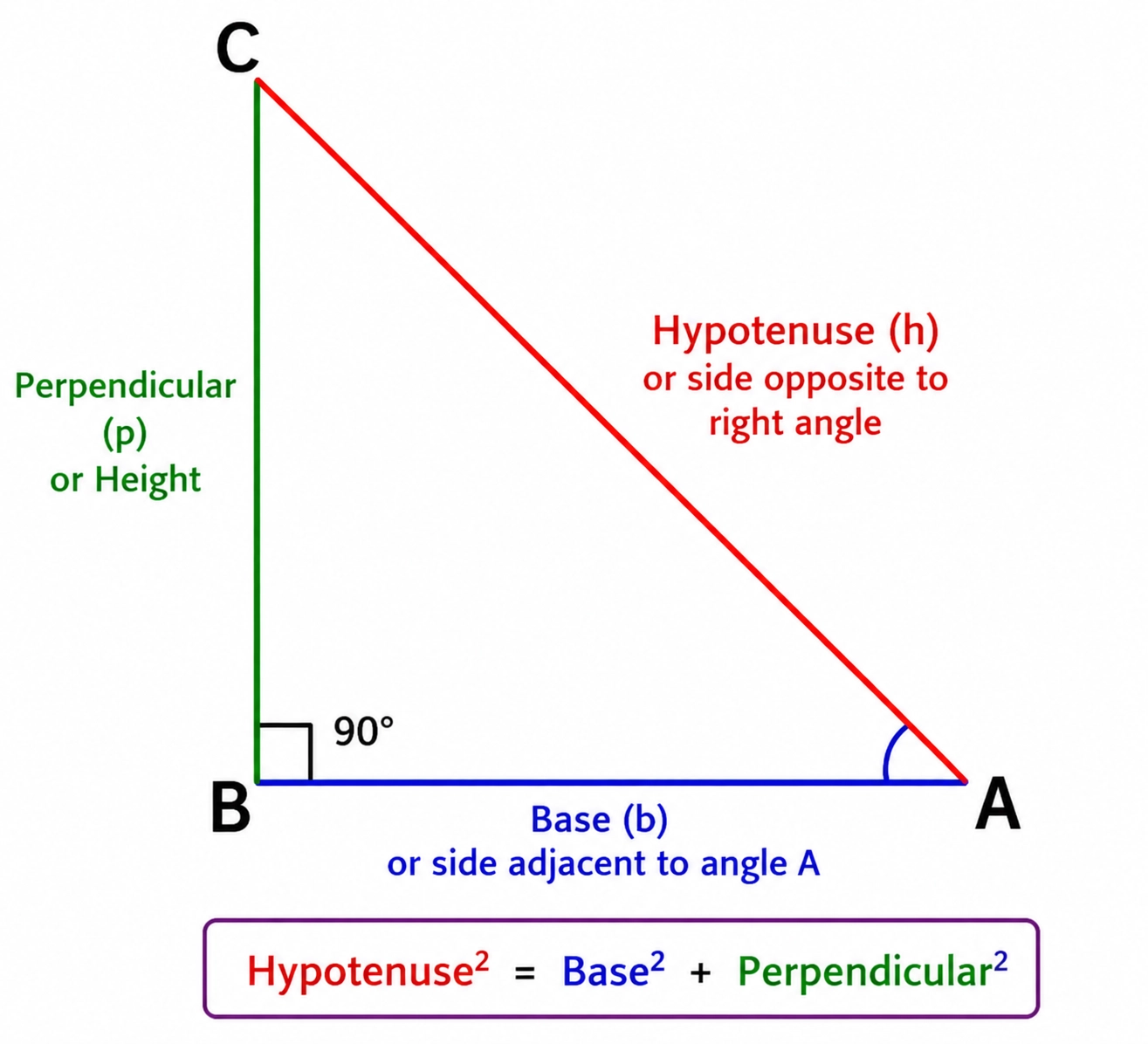
If ∠B = 90° in △ABC:
AC² = AB² + BC²
(Hypotenuse)² = (Base)² + (Height)²
AC² = AB² + BC²
Proof of Pythagoras Theorem
Given: △ABC, right-angled at B (∠B = 90°)
To prove: AC² = AB² + BC²
Construction: Draw BD ⊥ AC
Proof:
In △ADB and △ABC:
∠ADB = ∠ABC = 90°
∠A = ∠A (common)
By AA: △ADB ~ △ABC
Therefore: AD/AB = AB/AC
AB² = AD × AC ...(1)
In △BDC and △ABC:
∠BDC = ∠ABC = 90°
∠C = ∠C (common)
By AA: △BDC ~ △ABC
Therefore: DC/BC = BC/AC
BC² = DC × AC ...(2)
Adding (1) and (2):
AB² + BC² = AD × AC + DC × AC
AB² + BC² = AC(AD + DC)
AB² + BC² = AC × AC
AB² + BC² = AC²
(Proved!)
Converse of Pythagoras Theorem
Theorem: If in a triangle, the square of one side equals the sum of squares of the other two sides, then the angle opposite to the first side is a right angle.
Mathematical form:
If AC² = AB² + BC²
Then ∠B = 90°
Pythagorean Triplets
These are sets of three numbers that satisfy Pythagoras theorem.
Generating Pythagorean triplets:
For any number m > 1:
Triplet: (2m, m² - 1, m² + 1)
Example: m = 3
2m = 6, m² - 1 = 8, m² + 1 = 10
Check: 6² + 8² = 36 + 64 = 100 = 10²
Solved Examples on Class 10 Maths Chapter 6 Triangles Notes
Example 1: BPT Application
Question: In the figure, DE || BC. AD = 3 cm, DB = 5 cm, AE = 2.4 cm. Find EC.
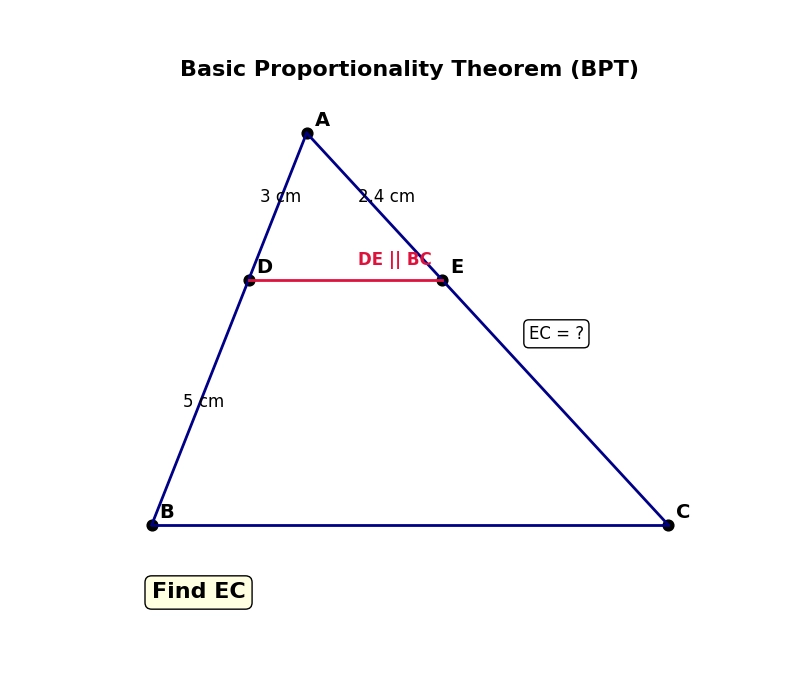
Solution:
By BPT:
AD/DB = AE/EC
3/5 = 2.4/EC
EC = (2.4 × 5)/3
EC = 12/3
EC = 4 cm
Answer: EC = 4 cm
Example 2: Check for Parallel Lines
Question: In △ABC, D and E are points on AB and AC. AD = 2, DB = 4, AE = 3, EC = 6. Is DE || BC?
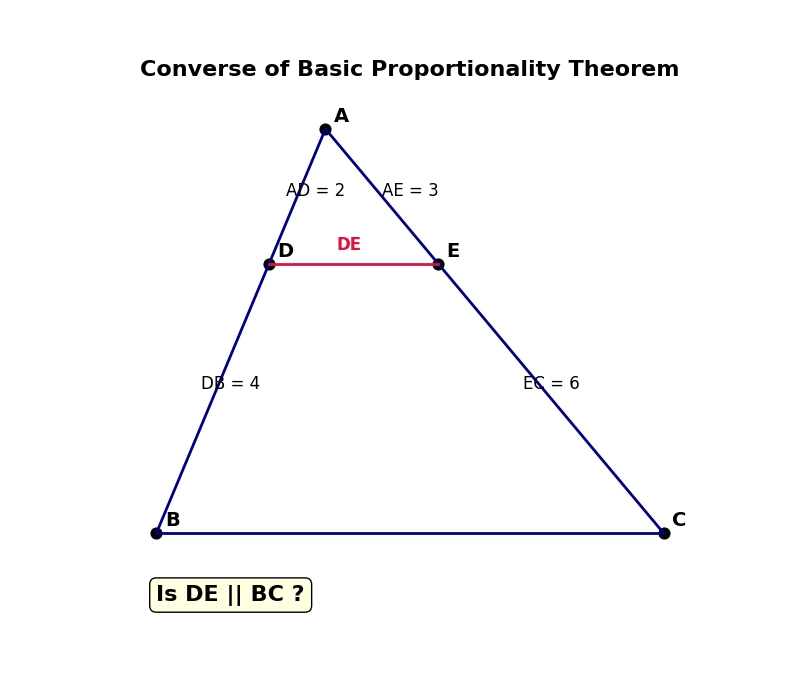
Solution:
AD/DB = 2/4 = 1/2
AE/EC = 3/6 = 1/2
Since AD/DB = AE/EC = 1/2
By Converse of BPT: DE || BC
Answer: Yes, DE || BC
Example 3: AA Similarity
Question: In △ABC and △DEF, ∠A = 50°, ∠B = 70°, ∠D = 50°, ∠E = 70°. Are the triangles similar? If yes, write the similarity.
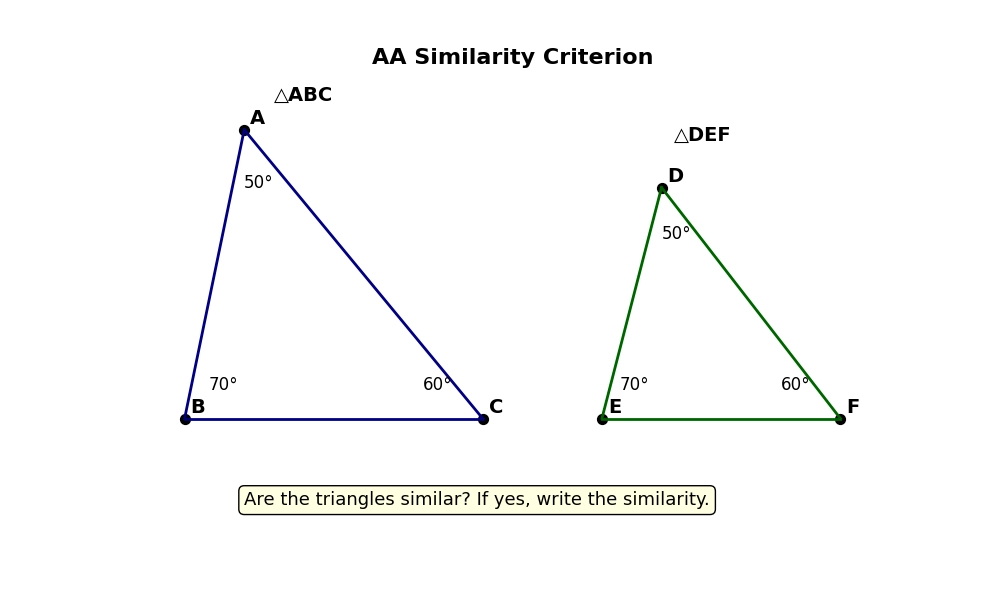
Solution:
In △ABC:
∠A = 50°, ∠B = 70°
∠C = 180° - 50° - 70° = 60°
In △DEF:
∠D = 50°, ∠E = 70°
∠F = 180° - 50° - 70° = 60°
∠A = ∠D = 50°
∠B = ∠E = 70°
By AA Criterion: △ABC ~ △DEF
Answer: Yes, △ABC ~ △DEF (by AA)
Example 4: SSS Similarity
Question: In △ABC, AB = 6 cm, BC = 9 cm, CA = 12 cm. In △DEF, DE = 4 cm, EF = 6 cm, FD = 8 cm. Are the triangles similar?
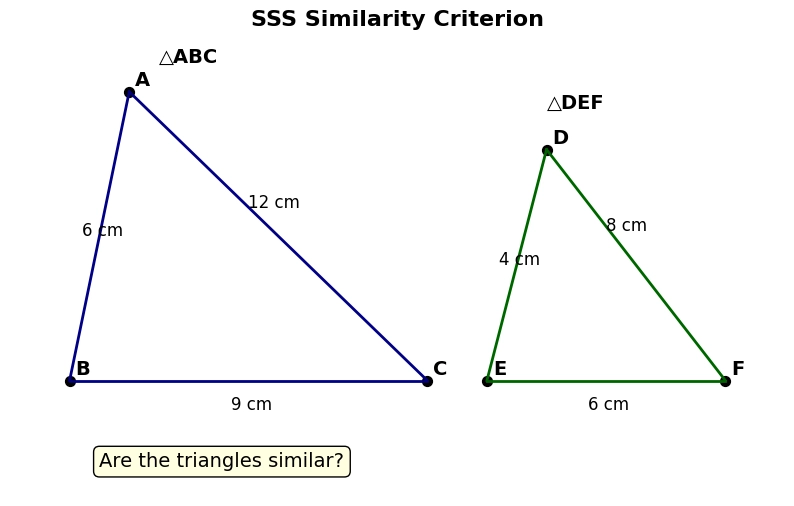
Solution:
AB/DE = 6/4 = 3/2
BC/EF = 9/6 = 3/2
CA/FD = 12/8 = 3/2
AB/DE = BC/EF = CA/FD = 3/2
By SSS Criterion: △ABC ~ △DEF
Answer: Yes, △ABC ~ △DEF (by SSS, ratio = 3/2)
Example 5: Area of Similar Triangles
Question: △ABC ~ △PQR. BC = 8 cm and QR = 6 cm. If area of △PQR = 36 cm², find area of △ABC.
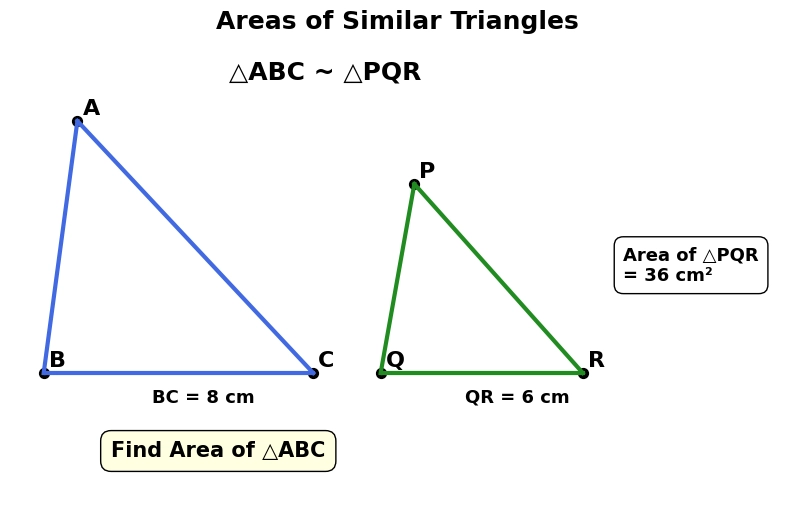
Solution:
Area(△ABC)/Area(△PQR) = (BC/QR)²
Area(△ABC)/36 = (8/6)²
Area(△ABC)/36 = 64/36
Area(△ABC) = 36 × 64/36
Area(△ABC) = 64 cm²
Answer: Area of △ABC = 64 cm²
Example 6: Pythagoras Theorem
Question: In △ABC, ∠B = 90°. AB = 7 cm, BC = 24 cm. Find AC.
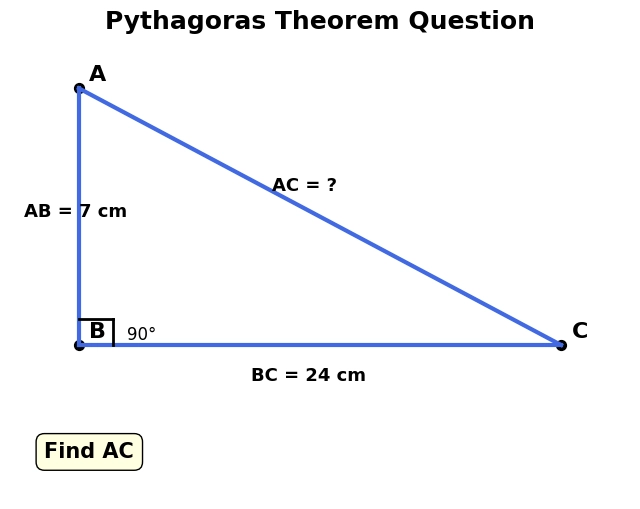
Solution:
By Pythagoras Theorem:
AC² = AB² + BC²
AC² = 7² + 24²
AC² = 49 + 576
AC² = 625
AC = √625
AC = 25 cm
Answer: AC = 25 cm
Example 7: Converse of Pythagoras
Question: A triangle has sides 11 cm, 60 cm, and 61 cm. Is it a right-angled triangle?
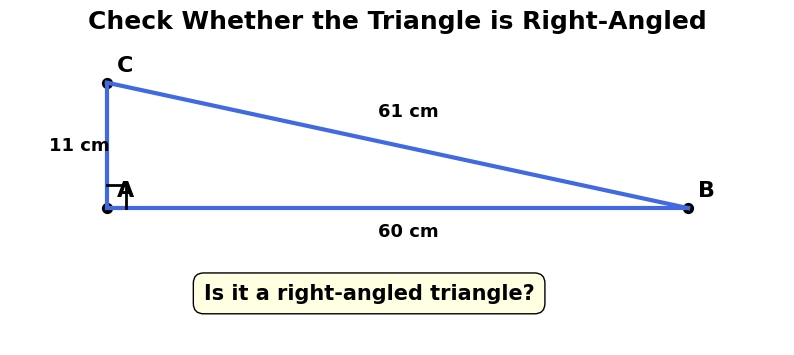
Solution:
Check: (Smallest sides)² + (Second side)²
= 11² + 60²
= 121 + 3600
= 3721
(Largest side)² = 61² = 3721
Since 11² + 60² = 61²
By Converse of Pythagoras:
This is a right angled triangle!
Answer: Yes, it's a right angled triangle (right angle opposite to side 61 cm)
Example 8: Combined Application
Question: In △ABC, ∠ABC = 90° and BD ⊥ AC. Prove that BD² = AD × DC.
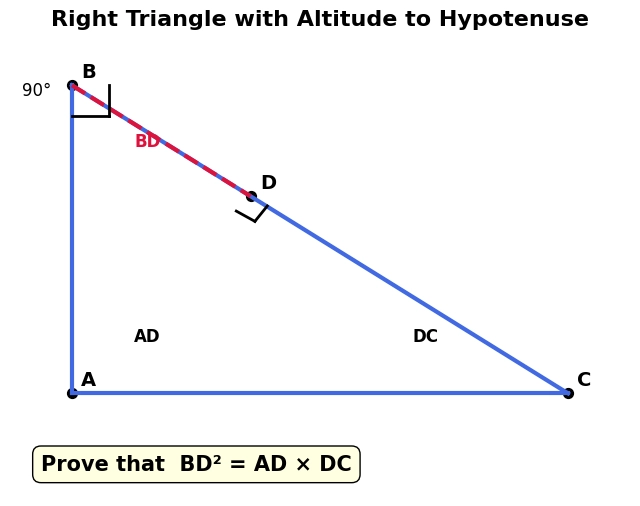
Solution:
In △ABD and △BCD:
∠ADB = ∠BDC = 90° (BD ⊥ AC)
In △ABD and △ABC:
∠ADB = ∠ABC = 90°
∠A is common
△ABD ~ △ABC (by AA)
Therefore: AD/BD = BD/BC ... (not what we need)
Better approach:
In △BDA and △CDB:
∠BDA = ∠CDB = 90°
∠ABD + ∠DBC = 90° (since ∠ABC = 90°)
∠ABD + ∠A = 90° (since ∠ADB = 90°)
Therefore ∠DBC = ∠A
So △BDA ~ △CDB (by AA)
Therefore: BD/CD = AD/BD
BD² = AD × DC (Proved!)
Example 9: Finding Missing Side Using Similarity
Question: In the given figure, △ACB ~ △APQ. If BC = 8 cm, PQ = 4 cm, BA = 6.5 cm. Find AQ.
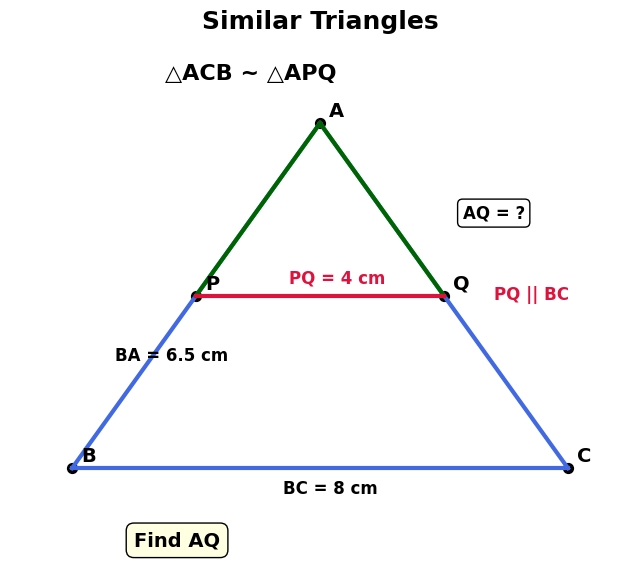
Solution:
△ACB ~ △APQ
Corresponding sides:
AC ↔ AP
CB ↔ PQ
BA ↔ QA
BC/PQ = BA/AQ
8/4 = 6.5/AQ
2 = 6.5/AQ
AQ = 6.5/2
AQ = 3.25 cm
Answer: AQ = 3.25 cm
Example 10: Three Stage Problem
Question: In right triangle ABC, right angled at C, M is the mid-point of hypotenuse AB. C is joined to M and produced to D such that DM = CM. Point D is joined to point B. Show that: a) △AMC ≅ △BMD b) ∠DBC is a right angle c) △DBC ≅ △ACB d) CM = (1/2)AB
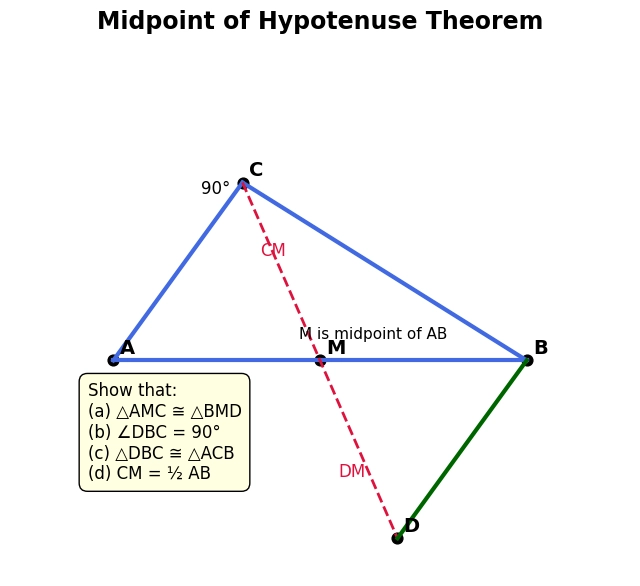
Solution:
Part a) △AMC ≅ △BMD:
In △AMC and △BMD:
AM = BM (M is mid-point of AB)
CM = DM (given)
∠AMC = ∠BMD (vertically opposite angles)
By SAS: △AMC ≅ △BMD
Part b) ∠DBC is right angle:
From part a): △AMC ≅ △BMD
Therefore: ∠ACM = ∠BDM (CPCT)
These are alternate angles for DB and AC with BC as transversal
Therefore: DB || AC
∠DBC + ∠ACB = 180° (co-interior angles)
∠DBC + 90° = 180°
∠DBC = 90°
Part c) △DBC ≅ △ACB:
BC = BC (common)
DB = AC (from part a, CPCT)
∠DBC = ∠ACB = 90°
By SAS: △DBC ≅ △ACB
Part d) CM = (1/2)AB:
From part c): DC = AB (CPCT)
But CM = DM = (1/2)DC = (1/2)AB
Therefore: CM = (1/2)AB (Proved)
Practice Questions on Class 10 Maths Chapter 6 Triangles Notes
Section 1: Basic Concepts
Question 1: State the Basic Proportionality Theorem.
Question 2: In △ABC, D and E are points on AB and AC. If AD/DB = AE/EC, what can you conclude?
Question 3: Two triangles are similar with sides in ratio 3:5. What is the ratio of their areas?
Question 4: State the AA similarity criterion.
Question 5: Find the Pythagorean triplet where one member is 20.
Section 2: BPT Problems
Question 6: In △ABC, DE || BC. If AD = 2.4 cm, DB = 3.6 cm and AC = 5 cm, find AE and EC.
Question 7: In △PQR, ST || QR. If PS = 3, SQ = 5, PT = 4.5 cm, find TR.
Question 8: In △ABC, DE || BC. If AD/AB = 2/5, find DE/BC.
Question 9: E and F are points on sides AB and AC of △ABC. EF || BC. If AE = 3.6 cm, EB = 2.4 cm, AC = 9 cm, find AF.
Question 10: In △ABC, DE || BC. BD = 9 cm, AD = 6 cm, AE = 8 cm. Find the length of EC.
Section 3: Similarity
Question 11: Prove that if a line divides two sides of a triangle proportionally, it is parallel to the third side.
Question 12: In △ABC and △DEF, AB/DE = BC/EF = CA/FD = 4/3. Are triangles similar? State the criterion.
Question 13: In right △ABC, ∠B = 90°. BD ⊥ AC. If AD = 9 and DC = 4, find BD.
Question 14: △ABC ~ △DEF. If AB = 12 cm, DE = 9 cm, find the ratio of their perimeters.
Question 15: The areas of two similar triangles are 64 cm² and 100 cm². If a side of the smaller triangle is 8 cm, find the corresponding side of the larger triangle.
Section 4: Pythagoras Theorem
Question 16: In △ABC, ∠C = 90°. AC = 5 cm, BC = 12 cm. Find AB.
Question 17: Check if triangle with sides 6, 8, 10 is right angled.
Question 18: A ladder 13 m long leans against a wall. If the foot of the ladder is 5 m from the wall, how high up the wall does it reach?
Question 19: In an equilateral triangle with side 2a, find the length of each altitude.
Question 20: In △ABC, AB = 9 cm, BC = 12 cm, AC = 15 cm. Is ∠B = 90°? Find the area.
Important Table of Formulas:
Similarity Criteria:
Important Ratios:
BPT: AD/DB = AE/EC (when DE || BC)
Area ratio: (side₁/side₂)²
Perimeter ratio: side₁/side₂
Scale factor: k = any corresponding side ratio
Pythagoras Theorem:
In right △ABC (∠B = 90°):
AC² = AB² + BC²
Hypotenuse² = Base² + Height²
Previous Years Important Questions on Class 10 Maths Chapter 6 Triangles Notes
1 Mark Questions:
-
State Basic Proportionality Theorem
-
Write the converse of Pythagoras theorem
-
If △ABC ~ △DEF and AB/DE = 3/4, find area ratio
2 Mark Questions:
-
In △ABC, DE || BC. Find missing sides using BPT
-
Check if given triangle is right-angled using converse of Pythagoras
-
Find the third side of right triangle using Pythagoras theorem
3 Mark Questions:
-
Prove BPT
-
Two similar triangles find sides or areas
-
Applications of Pythagoras theorem in real problems
4 Mark Questions:
-
Prove Pythagoras theorem using similarity
-
Complex problems combining BPT and similarity
-
Multi-step problems involving all concepts of chapter
Numbers make sense when they're taught right. To see how Orchids The International School turns Maths from intimidating to intuitive, reach out to our admissions team.
Frequently Asked Questions on Class 10 Maths Chapter 6 Triangles Notes
1. What is a triangle?
A triangle is a closed polygon with three sides, three vertices, and three angles.
2. What is the main concept covered in Class 10 Chapter 6 Triangles?
The chapter mainly focuses on the similarity of triangles and its applications.
3. What are similar triangles?
Two triangles are similar if their corresponding angles are equal and their corresponding sides are proportional.
4. What is the AA (Angle-Angle) similarity criterion?
If two angles of one triangle are equal to two angles of another triangle, the triangles are similar.
5. What is the SAS (Side-Angle-Side) similarity criterion?
If one angle of a triangle is equal to one angle of another triangle and the sides including those angles are proportional, then the triangles are similar.
6. What is the SSS (Side-Side-Side) similarity criterion?
If the corresponding sides of two triangles are proportional, then the triangles are similar.
7. What are the common topics asked in board exams from Triangles?
- Similarity criteria (AA, SAS, SSS)
- Basic Proportionality Theorem
- Converse of BPT
- Pythagoras Theorem
- Areas of similar triangles
8. What are common mistakes students make in Triangles?
- Using incorrect corresponding sides
- Confusing congruence and similarity
- Errors in applying proportionality ratios
- Calculation mistakes in theorem-based questions
9. How can I score full marks in Triangles?
Focus on theorem proofs, similarity criteria, diagram-based questions, and regular practice of board-level problems.
Related Links


Admissions Open for 2026-27
What type of concept pages would you prefer?
CBSE Schools In Popular Cities
- CBSE Schools in Bangalore
- CBSE Schools in Mumbai
- CBSE Schools in Pune
- CBSE Schools in Hyderabad
- CBSE Schools in Chennai
- CBSE Schools in Gurgaon
- CBSE Schools in Kolkata
- CBSE Schools in Indore
- CBSE Schools in Sonipat
- CBSE Schools in Delhi
- CBSE Schools in Rohtak
- CBSE Schools in Bhopal
- CBSE Schools in Aurangabad
- CBSE Schools in Jabalpur
- CBSE Schools in Jaipur
- CBSE Schools in Jodhpur
- CBSE Schools in Nagpur
- CBSE Schools in Ahmednagar
- CBSE School In Tumkur











Orchids The International School is one of India's leading chains of CBSE and ICSE schools, with 110+ schools across the country.