

Chapter 7 ‘Coordinate Geometry’ Notes for Class 10: Your Complete Guide
Chapter 7: Coordinate Geometry Notes for Class 10 offer a friendly, easy-to-follow guide to finding points, drawing graphs, and solving geometry problems using coordinates. Aligned with the NCERT syllabus and CBSE exam patterns, the chapter introduces the learners coordinate plane, ordered pairs, the distance formula, midpoint formula, and section formula with clear, step-by-step explanations. You’ll see how these tools help solve practical problems on collinearity, the area of triangles using coordinates, and equations of lines in forms such as slope–intercept and two-point form. The notes use relatable examples and worked solutions similar to exam questions, plus handy shortcuts for faster calculations and common error checks especially for signs and the order of coordinates.
Know more about related topics:
Chapter 7: Coordinate Geometry Notes for Class 10
1. Introduction to Coordinate Geometry
Coordinate Geometry (also called Cartesian Geometry or Analytical Geometry) is a branch of mathematics that uses a coordinate system, a grid with numbers, to describe the position of every point on a flat surface.
2. The Cartesian Coordinate System
The Cartesian coordinate system is named after the French mathematician René Descartes, who invented it in the 17th century.
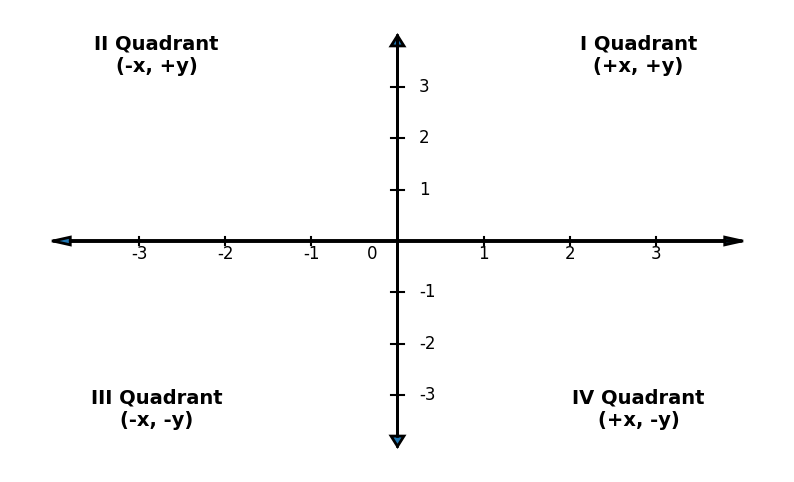
The system consists of two perpendicular number lines:
The X-axis: the horizontal line (runs left and right)
The Y-axis: the vertical line (runs up and down)
These two lines intersect at a point called the Origin, denoted by O, with coordinates (0, 0).
Representing a Point
Any point on this plane is written as an ordered pair (x, y), where:
x is the x-coordinate (also called the abscissa): it measures how far the point is from the Y-axis, moving horizontally.
y is the y-coordinate (also called the ordinate): it measures how far the point is from the X-axis, moving vertically.
Example: Point P(3, 2) is 3 units to the right of the Y-axis and 2 units above the X-axis.
3. Quadrants and Sign Convention
The X-axis and Y-axis divide the Cartesian plane into four regions called quadrants.

4. Distance Formula
The Distance Formula lets you calculate the exact distance between any two points on the Cartesian plane.
Derivation (The Pythagoras Connection)
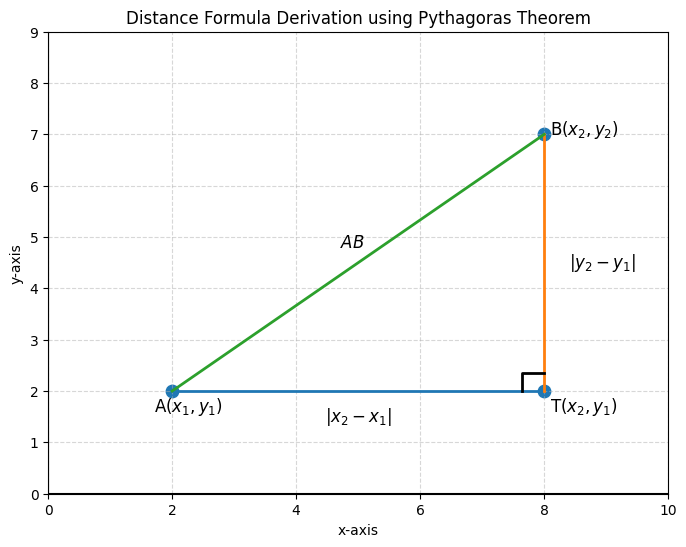
Let's say you have two points, A(x₁, y₁) and B(x₂, y₂), plotted on the Cartesian plane.
Draw a horizontal line from A and a vertical line from B. They meet at a point T(x₂, y₁). This creates a right-angled triangle ATB, with the right angle at T.
Now apply the Pythagoras Theorem:
AB² = AT² + BT²
Here:
AT = horizontal distance = |x₂ − x₁|
BT = vertical distance = |y₂ − y₁|
So:
AB² = (x₂ − x₁)² + (y₂ − y₁)²
Therefore, the Distance Formula is:
AB =
Solved Example: Find the distance between the points A(4, 3) and B(8, 6).
Solution: Using the distance formula:
AB = √[(8 − 4)² + (6 − 3)²]
AB = √[4² + 3²]
AB = √[16 + 9]
AB = √25
AB = 5 units
5. Distance of a Point from the Origin
This is a special case of the distance formula. If one of the points is the Origin O(0, 0) and the other is P(x, y), then:
Example: Distance of the point P(5, 12) from the origin:
OP = √(5² + 12²) = √(25 + 144) = √169 = 13 units
6. Section Formula (Internal Division)
If point P(x, y) divides the line segment joining A(x₁, y₁) and B(x₂, y₂) internally in the ratio m : n, then:
Solved Example: Find the coordinates of point P that divides the line segment joining A(2, −2) and B(−7, 4) in the ratio 1:2 internally.
Solution:
Here, (x₁, y₁) = (2, −2), (x₂, y₂) = (−7, 4), m = 1, n = 2
x = (1 × (−7) + 2 × 2) / (1 + 2) = (−7 + 4) / 3 = −3/3 = −1
y = (1 × 4 + 2 × (−2)) / (1 + 2) = (4 − 4) / 3 = 0/3 = 0
P = (−1, 0)
7. Midpoint Formula
The midpoint is a special case of the section formula where the ratio is 1 : 1, meaning the point divides the segment into two equal halves.
If M is the midpoint of the line segment joining A(x₁, y₁) and B(x₂, y₂), then:
Simply put: average the x-coordinates, average the y-coordinates.
Solved Example: Find the midpoint of the segment joining P(−3, 3) and Q(1, 4).
Solution:
x = (−3 + 1) / 2 = −2/2 = −1
y = (3 + 4) / 2 = 7/2
Midpoint = (−1, 7/2)
8. Points of Trisection
Trisection means dividing a line segment into three equal parts. If P and Q are the two trisection points of segment AB, then:
P divides AB in the ratio 1 : 2 (one-third from A)
Q divides AB in the ratio 2 : 1 (two-thirds from A, or one-third from B)
Solved Example: Find the points of trisection of the line segment joining A(2, −2) and B(−7, 4).
Solution:
For point P (ratio 1:2):
x = (1 × (−7) + 2 × 2) / (1 + 2) = (−7 + 4) / 3 = −1
y = (1 × 4 + 2 × (−2)) / 3 = (4 − 4) / 3 = 0
P = (−1, 0)
For point Q (ratio 2:1):
x = (2 × (−7) + 1 × 2) / (2 + 1) = (−14 + 2) / 3 = −4
y = (2 × 4 + 1 × (−2)) / 3 = (8 − 2) / 3 = 2
Q = (−4, 2)
Points of trisection: (−1, 0) and (−4, 2)
9. Centroid of a Triangle
The centroid is the point where all three medians of a triangle meet. A median connects a vertex to the midpoint of the opposite side. The centroid always divides each median in the ratio 2 : 1 from the vertex.
If a triangle has vertices A(x₁, y₁), B(x₂, y₂), and C(x₃, y₃), its centroid G is:
In simple terms: take the average of all three x-coordinates and all three y-coordinates.
Solved Example: Find the centroid of the triangle with vertices A(−1, −3), B(2, 1), and C(8, −4).
Solution:
x = (−1 + 2 + 8) / 3 = 9/3 = 3
y = (−3 + 1 + (−4)) / 3 = −6/3 = −2
Centroid G = (3, −2)
10. Area of a Triangle Using Coordinates
If the vertices of a triangle are A(x₁, y₁), B(x₂, y₂), and C(x₃, y₃), then:
Solved Example: Find the area of the triangle with vertices A(1, 2), B(4, 2), and C(3, 5).
Solution:
Area = (1/2) |x₁(y₂ − y₃) + x₂(y₃ − y₁) + x₃(y₁ − y₂)|
= (1/2) |1(2 − 5) + 4(5 − 2) + 3(2 − 2)|
= (1/2) |1(−3) + 4(3) + 3(0)|
= (1/2) |−3 + 12 + 0|
= (1/2) × 9
Area = 9/2 = 4.5 square units
11. Collinearity of Three Points
Three points are collinear if they all lie on the same straight line.
Method 1: Using the Area Formula:
If Area of △ABC = 0, then A, B, C are collinear.
x₁(y₂ − y₃) + x₂(y₃ − y₁) + x₃(y₁ − y₂) = 0
Method 2: Using the Distance Formula:
If AB + BC = AC (i.e., the sum of two distances equals the third), then the points are collinear.
Solved Example: Check whether A(3, 0), B(6, 4), and C(−1, 3) are collinear.
Solution (using area method):
Area = (1/2) |3(4 − 3) + 6(3 − 0) + (−1)(0 − 4)|
= (1/2) |3(1) + 6(3) + (−1)(−4)|
= (1/2) |3 + 18 + 4|
= (1/2) × 25
= 12.5 square units ≠ 0
Since area ≠ 0, the points are not collinear.
12. All Formulas at a Glance
Click below to download your free Class 10 Maths Chapter 7: Coordinate Geometry PDF Notes perfect for last-minute CBSE board exam revision.
Download PDF - Class 10 Maths Chapter 7: Coordinate Geometry Notes
Frequently Asked Questions of Chapter 7: Coordinate Geometry Notes
1. What is the Distance Formula for Class 10?
The distance between two points A(x₁, y₁) and B(x₂, y₂) is given by: AB = √[(x₂−x₁)² + (y₂−y₁)²]. This formula is derived using the Pythagoras theorem.
2. What is the Section Formula in coordinate geometry?
The Section Formula gives the coordinates of a point P(x, y) that divides the segment joining A(x₁, y₁) and B(x₂, y₂) internally in the ratio m:n. The formula is: x = (mx₂+nx₁)/(m+n) and y = (my₂+ny₁)/(m+n).
3. How is the midpoint formula different from the section formula?
The midpoint formula is a special case of the section formula where m = n = 1. It gives the coordinates of the exact centre of a line segment: ((x₁+x₂)/2, (y₁+y₂)/2).
4. How do you check if three points are collinear in coordinate geometry?
Substitute the three points in the area formula. If the area comes out to zero, the three points are collinear.
5. What is the centroid formula for a triangle?
The centroid of a triangle with vertices A(x₁,y₁), B(x₂,y₂), C(x₃,y₃) is: G = ((x₁+x₂+x₃)/3, (y₁+y₂+y₃)/3).
Numbers make sense when they're taught right. To see how Orchids The International School turns Maths from intimidating to intuitive, reach out to our admissions team.


Admissions Open for 2026-27
What type of concept pages would you prefer?
CBSE Schools In Popular Cities
- CBSE Schools in Bangalore
- CBSE Schools in Mumbai
- CBSE Schools in Pune
- CBSE Schools in Hyderabad
- CBSE Schools in Chennai
- CBSE Schools in Gurgaon
- CBSE Schools in Kolkata
- CBSE Schools in Indore
- CBSE Schools in Sonipat
- CBSE Schools in Delhi
- CBSE Schools in Rohtak
- CBSE Schools in Bhopal
- CBSE Schools in Aurangabad
- CBSE Schools in Jabalpur
- CBSE Schools in Jaipur
- CBSE Schools in Jodhpur
- CBSE Schools in Nagpur
- CBSE Schools in Ahmednagar
- CBSE School In Tumkur











Orchids The International School is one of India's leading chains of CBSE and ICSE schools, with 110+ schools across the country.