

Class 5 - Addition of Fractions: Step by Step Guide with Solved Examples
Addition of fractions is an important math skill. A fraction represents a part of a whole number. When we add fractions, we combine parts to make a larger part.
For example: if you eat 1/4 of a pizza and your friend eats 1/4 of the same pizza, together you have eaten 2/4 or 1/2 of the pizza.
-
Numerator: The top number in a fraction
-
Denominator: The bottom number in a fraction
- Fraction: A part of a whole number written as numerator/denominator
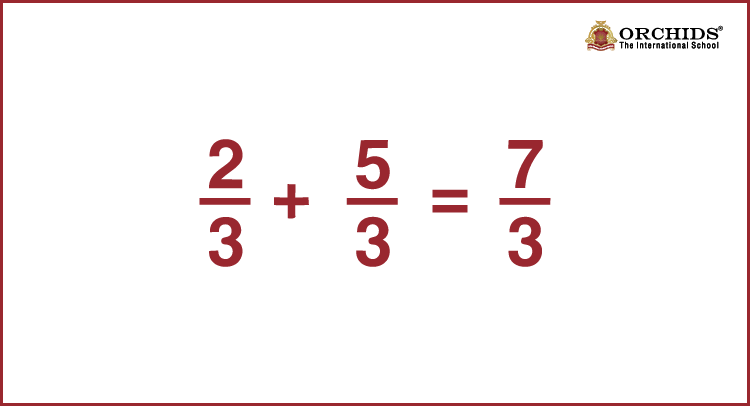
Table of Contents
- Addition of Fractions with the Same Denominators
- Addition of Fractions with Different Denominators
- Addition of Fraction and a Whole Number
- Adding Fractions with Variables
- Solved Examples on Addition of Fractions
- Practice Questions on Addition of Fractions
- Frequently Asked Questions on Addition Of Fractions

Addition of Fractions with the Same Denominators
If the fractions that have the same denominator. We can add directly the numerators by keeping the denominator common.
When denominators are the same, follow this simple rule:
-
Add only the numerators
-
Keep the denominator the same
-
Simplify if possible
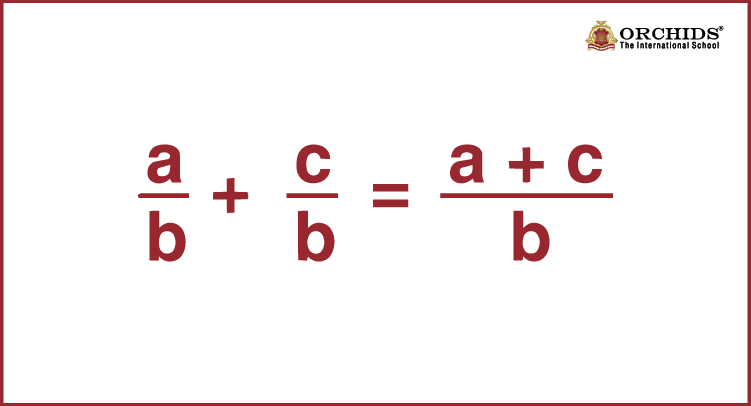
Formula: a/b + c/b = (a + c)/b
Example 1: Simple Addition of Like Fractions
Problem: 2/7 + 3/7 = ?
Solution:
-
Numerators: 2 + 3 = 5
-
Denominator: 7 (stays the same)
-
Answer: 5/7
Step by step:
-
Check denominators: Both are 7
-
Add numerators: 2 + 3 = 5
-
Write answer: 5/7
-
Check if we can simplify: No, 5/7 is in simplest form
Example 2: Addition with Simplification
Problem: 3/8 + 5/8 = ?
Solution:
-
Step 1: Add numerators: 3 + 5 = 8
-
Step 2: Keep denominator: 8
-
Step 3: Write fraction: 8/8
-
Step 4: Simplify: 8/8 = 1
Answer: 1 (or 8/8)
Know more about related topics:
Addition of Fractions with Different Denominators
When Two or more fractions with different denominators. Adding unlike fractions is more complex than adding like fractions.
To add fractions with different denominators, we must first make the denominators the same. We do this by finding the Least Common Denominator (LCD).
Steps to Follow:
-
Find the Least Common Denominator (LCD)
-
Convert each fraction to an equivalent fraction with the LCD
-
Add the numerators
-
Keep the new denominator
-
Simplify if needed
How to Find the LCD
The LCD is the smallest number that both denominators can divide into equally.
Example: For 1/4 and 1/6
-
Multiples of 4: 4, 8, 12, 16, 20...
-
Multiples of 6: 6, 12, 18, 24...
-
LCD = 12 (smallest common multiple)
Example 1: Adding Unlike Fractions
Problem: 1/3 + 1/4 = ?
Solution:
Step 1: Find LCD
-
Multiples of 3: 3, 6, 9, 12...
-
Multiples of 4: 4, 8, 12...
-
LCD = 12
Step 2: Convert to equivalent fractions
Step 3: Add the fractions
Answer: 7/12
Example 2: Adding Unlike Fractions with Larger Numbers
Problem: 2/5 + 3/7 = ?
Solution:
Step 1: Find LCD
-
Multiples of 5: 5, 10, 15, 20, 25, 30, 35...
-
Multiples of 7: 7, 14, 21, 28, 35...
-
LCD = 35
Step 2: Convert fractions
Step 3: Add
Step 4: Simplify
-
29 and 35 have no common factors
-
Answer remains 29/35
Answer: 29/35.
Addition of Fraction and a Whole Number
Any whole number can be written as a fraction with 1 as the denominator.
Examples:
-
2 = 2/1
-
5 = 5/1
-
10 = 10/1
Rule for Adding Fractions and Whole Numbers
-
Convert the whole number to a fraction (denominator = 1)
-
Find the LCD if needed
-
Add like you normally would
-
Simplify the answer
Example 1: Adding a Fraction to a Whole Number
Problem: 2 + 3/4 = ?
Solution:
Method 1 (Mixed Number):
-
Keep the whole number separate
-
-
-
Method 2 (Improper Fraction):
-
Convert 2 to a fraction: 2 = 8/4
-
Add:
-
Convert back to mixed number:
Answer:
Example 2: Multiple Whole Numbers and Fractions
Problem: 3 + 5/6 = ?
Solution:
Step 1: Convert whole number
Step 2: Add
Step 3: Convert to mixed number
Answer:
Example 3: Adding Multiple Fractions and Whole Numbers
Problem: 4 + 1/2 + 3/4 = ?
Solution:
Step 1: Convert whole number to fraction
-
4 = 4/1
Step 2: Find LCD for 1, 2, and 4
-
LCD = 4
Step 3: Convert all fractions
-
4/1 = 16/4
-
1/2 = 2/4
-
3/4 = 3/4
Step 4: Add
-
16/4 + 2/4 + 3/4 = 21/4
Step 5: Convert to mixed number
Answer:
Adding Fractions with Variables
Variables are letters (like x, y, a, b) that represent unknown numbers. When adding fractions with variables, the same rules apply.
- Like fractions with variables: Add numerators, keep denominator
- Unlike fractions with variables: Find LCD, convert, then add
- Treat variables as you would regular numbers
Example 1: Like Fractions with Variables
Problem: x/5 + 2/5 = ?
Solution:
Step 1: Check denominators
-
Both have denominator 5
Step 2: Add numerators
-
x + 2 = x + 2
Step 3: Write answer
-
(x + 2)/5
Answer: (x + 2)/5
Example 2: Unlike Fractions with Variables
Problem: x/3 + y/4 = ?
Solution:
Step 1: Find LCD
-
LCD of 3 and 4 = 12
Step 2: Convert fractions
-
x/3 = 4x/12
-
y/4 = 3y/12
Step 3: Add
-
4x/12 + 3y/12 = (4x + 3y)/12
Answer: (4x + 3y)/12
Example 3: Simplifying Variable Expressions
Problem: 2a/6 + 3a/6 = ?
Solution:
Step 1: Add numerators
-
2a + 3a = 5a
Step 2: Keep denominator
-
5a/6
Step 3: Simplify if possible
-
5a and 6 have no common factors
-
Answer: 5a/6
Answer: 5a/6
Example 4: Mixed Variable and Number Fractions
Problem: (x + 1)/4 + 3/4 = ?
Solution:
Step 1: Check denominators
-
Both are 4
Step 2: Add numerators
-
(x + 1) + 3 = x + 1 + 3 = x + 4
Step 3: Write answer
-
(x + 4)/4
Answer: (x + 4)/4
Solved Examples on Addition of Fractions
Example 1: Complex Unlike Fractions
Problem: 3/8 + 5/12 = ?
Solution:
Step 1: Find LCD
-
Multiples of 8: 8, 16, 24, 32...
-
Multiples of 12: 12, 24, 36...
-
LCD = 24
Step 2: Convert to equivalent fractions
-
3/8 = 3×3/8×3 = 9/24
-
5/12 = 5×2/12×2 = 10/24
Step 3: Add
-
9/24 + 10/24 = 19/24
Step 4: Check if simplified
-
GCD(19, 24) = 1, so it's already simplified
Answer: 19/24
Example 2: Three Fractions with Different Denominators
Problem: 1/2 + 1/3 + 1/6 = ?
Solution:
Step 1: Find LCD
-
Multiples of 2: 2, 4, 6, 8...
-
Multiples of 3: 3, 6, 9...
-
Multiples of 6: 6, 12...
-
LCD = 6
Step 2: Convert fractions
-
1/2 = 3/6
-
1/3 = 2/6
-
1/6 = 1/6
Step 3: Add all numerators
-
3/6 + 2/6 + 1/6 = 6/6
Step 4: Simplify
-
6/6 = 1
Answer: 1
Example 3: Mixed Numbers
Problem: 2 1/4 + 3 1/2 = ?
Solution:
Step 1: Convert mixed numbers to improper fractions
-
2 1/4 = 9/4
-
3 1/2 = 7/2
Step 2: Find LCD
-
LCD of 4 and 2 = 4
Step 3: Convert to equivalent fractions
-
9/4 = 9/4
-
7/2 = 14/4
Step 4: Add
-
9/4 + 14/4 = 23/4
Step 5: Convert back to mixed number
-
23/4 = 5 3/4
Answer: 5 3/4
Example 5: Word Problem
Problem: Sarah drinks 1/3 of a glass of milk in the morning and 1/4 of a glass in the evening. How much milk does she drink in total?
Solution:
Step 1: Identify what we need to add
-
Morning: 1/3
-
Evening: 1/4
-
Total: 1/3 + 1/4
Step 2: Find LCD
-
LCD of 3 and 4 = 12
Step 3: Convert
-
1/3 = 4/12
-
1/4 = 3/12
Step 4: Add
-
4/12 + 3/12 = 7/12
Answer: Sarah drinks 7/12 of a glass of milk in total.
Practice Questions on Addition of Fractions
1: Like Fractions (Same Denominator)
-
2/5 + 1/5 = ?
-
3/8 + 2/8 = ?
-
4/9 + 3/9 = ?
-
1/6 + 2/6 + 1/6 = ?
-
5/10 + 3/10 = ?
2: Unlike Fractions (Different Denominators)
-
1/2 + 1/3 = ?
-
2/3 + 1/6 = ?
-
3/4 + 1/8 = ?
-
1/5 + 1/10 = ?
-
2/5 + 3/7 = ?
3: Whole Numbers and Fractions
-
2 + 1/4 = ?
-
3 + 2/5 = ?
-
5 + 3/8 = ?
-
1 + 1/2 + 1/4 = ?
-
4 + 1/3 + 1/6 = ?
4: Mixed Numbers
-
1 1/2 + 2 1/4 = ?
-
2 2/3 + 1 1/3 = ?
-
3 1/4 + 2 3/8 = ?
-
4 1/5 + 2 2/5 = ?
-
1 1/6 + 2 1/3 + 1 1/2 = ?
5: Variables and Algebraic Fractions
-
x/4 + 2/4 = ?
-
a/3 + b/3 = ?
-
2x/5 + 3x/5 = ?
-
(x + 1)/6 + 2/6 = ?
-
x/2 + x/3 = ?
6: Word Problems
-
Cooking: A recipe needs 1/2 cup of flour and 1/4 cup of sugar. How much total dry ingredients do you need?
-
Distance: John walked 1/3 of a mile in the morning and 2/5 of a mile in the afternoon. How far did he walk in total?
-
Painting: Maya painted 3/8 of a wall on Monday and 1/4 of the wall on Tuesday. How much of the wall did she paint?
-
Time: It takes 1/4 hour to drive to the store and 1/3 hour to shop. How much time did Maria spend?
-
Money: Tom has 2 1/2 dollars and his friend gives him 1 3/4 dollars. How much money does he have now?
Numbers make sense when they're taught right. To see how Orchids The International School turns Maths from intimidating to intuitive, reach out to our admissions team.
Frequently Asked Questions on Addition Of Fractions
1. What is addition of fractions?
Addition of fractions means combining two or more fractional parts to form a larger fraction or a whole. It helps us find the total of parts of a whole.
2. How do you add fractions with the same denominator?
To add fractions with the same denominator, simply add the numerators and keep the denominator the same.
Example:
3. How do you add fractions with different denominators?
To add fractions with different denominators:
- Find the common denominator (LCM)
- Convert fractions into like fractions
- Add the numerators
Example:
4. How do you add fractions with whole numbers?
Write the whole number as a fraction, then add.
Example:
5. Why do we need a common denominator when adding fractions?
Because fractions must represent equal sized parts before combining. Without a common denominator, the pieces are not the same size, so they cannot be added correctly.
Related Links


Admissions Open for 2026-27
What type of concept pages would you prefer?
CBSE Schools In Popular Cities
- CBSE Schools in Bangalore
- CBSE Schools in Mumbai
- CBSE Schools in Pune
- CBSE Schools in Hyderabad
- CBSE Schools in Chennai
- CBSE Schools in Gurgaon
- CBSE Schools in Kolkata
- CBSE Schools in Indore
- CBSE Schools in Sonipat
- CBSE Schools in Delhi
- CBSE Schools in Rohtak
- CBSE Schools in Bhopal
- CBSE Schools in Aurangabad
- CBSE Schools in Jabalpur
- CBSE Schools in Jaipur
- CBSE Schools in Jodhpur
- CBSE Schools in Nagpur
- CBSE Schools in Ahmednagar
- CBSE School In Tumkur











Orchids The International School is one of India's leading chains of CBSE and ICSE schools, with 130+ schools across the country.