

Class 5 - Prime Factorisation: Definition, Methods, Solved Examples
Understanding prime factorization is important for solving mathematical problems based on HCF and LCM. To understand prime factorisation it is important to understand prime numbers. A prime number is a number that has exactly two factors: 1 and itself. If a factor of a number is a prime number, then it is called a prime factor of the number. Prime factorization is a way of representing a number as its prime factors. Let’s learn more about prime factorisation methods with examples below.
Table of Contents
- What is Prime Factorization
- Prime Factorization Method
- Solved Examples on Prime Factorization
- Frequently Asked Questions on Prime Factorisation

What is Prime Factorization
Prime factorisation is a method of representation of a number as a product of its prime factors
It helps us in breaking down a number into a product of its prime numbers. For example, the prime factorization of 24 is 2 × 2 × 2 × 3, which can also be written as 2³ × 3.
In simple words, if we decompose a number until we can no longer break it down except by using prime numbers, we get the prime factorization of that number.
Know more about related topics:
Prime Factorization Method
Factor-Tree Method:
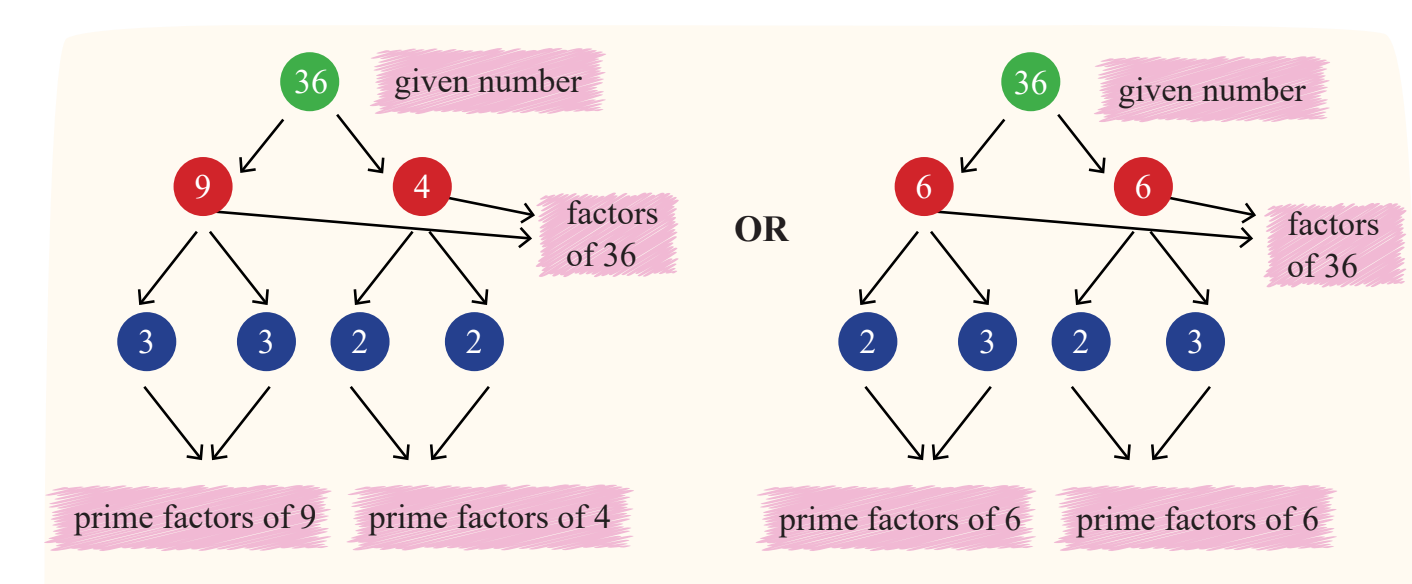
A factor tree is a diagram used to determine the prime factors of any number greater than 1.
Step 1: Find a pair of factors whose product is the given number and write them below the number.
Step 2: If one of the two factors is prime, keep it unchanged and repeat Step 1 for the composite
number. In case both the factors are composite numbers, then follow Step 1 for both the factors.
Step 3: Continue the process till you get all the factors as prime numbers.
For example: Prime factorisation of 36. The prime factors of 36 are 2 × 2 × 3 × 3.
Division Method:
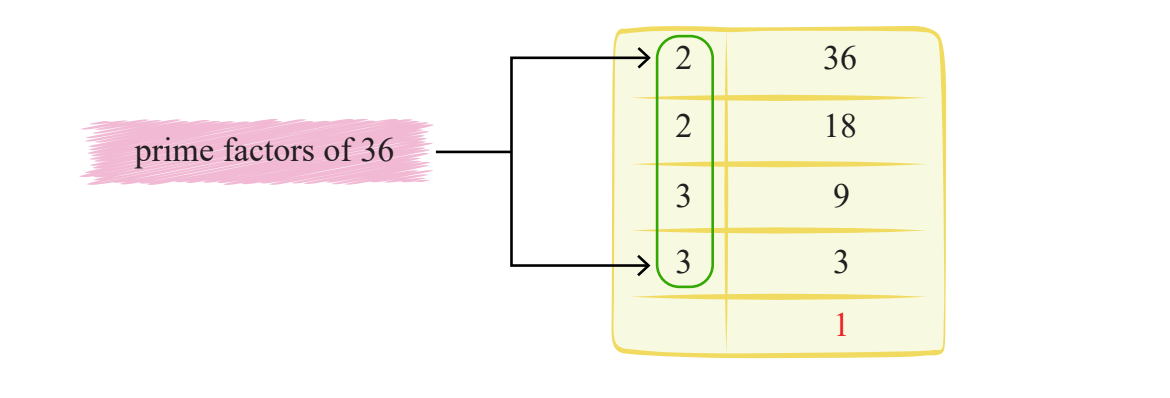
Step 1: Divide the given number by one of its prime factors and write the quotient below the number.
Step 2: Repeat Step 1 for the quotient obtained.
Step 3: Continue this process until you get 1 as the quotient.
Example 2: Show the prime factorisation of 36.
Solved Examples on Prime Factorization
Example 1: Prime Factorization of 50
Solution:
Step 1: Divide 50 by the least prime number, which is 2.
50 ÷ 2 = 25
Step 2: Divide 25 by the next smallest prime number, 5.
25 ÷ 5 = 5
Step 3: Divide 5 by 5.
5 ÷ 5 = 1
As we have reached 1, we stop.
So, the prime factorization of 50 is 2 × 5 × 5, or in exponential form: 2 × 5².
Example 2: Prime Factorization of 60.
Solution:
Step 1: Divide 60 by the least prime number, which is 2.
60 ÷ 2 = 30
Step 2: Divide 30 by 2 again.
30 ÷ 2 = 15
Step 3: Divide 15 by the next prime number, 3.
15 ÷ 3 = 5
Step 4: Divide 5 by 5.
5 ÷ 5 = 1
As we have reached 1, we stop.
So, the prime factorization of 60 is 2 × 2 × 3 × 5, or in exponential form: 2² × 3 × 5
Example 3: Prime Factorization of 15.
Solution:
Step 1: Divide 15 by the least prime number, which is 3.
15 ÷ 3 = 5
Step 2: Divide 5 by 5 again.
5 ÷ 5 = 1
As we have reached 1, we stop.
So, the prime factorization of 15 is 3 × 5 x 1.
Numbers make sense when they're taught right. To see how Orchids The International School turns Maths from intimidating to intuitive, reach out to our admissions team.
Frequently Asked Questions on Prime Factorisation
1. What is prime factorization?
Prime factorization is the process of breaking down a number into a product of prime numbers. A prime number is a number that has only two factors: 1 and itself. For example, the prime factorization of 30 is: 30 = 2 × 3 × 5. All these numbers (2, 3, and 5) are prime numbers.
2. What are the methods of prime factorisation?
The two main methods of prime factorisation are:
i) Division Method
ii) Factor-Tree Method
3. What is prime factor?
Prime factor is a prime number that has exactly 2 factors: 1 and itself.
Related Links


Admissions Open for 2026-27
What type of concept pages would you prefer?
CBSE Schools In Popular Cities
- CBSE Schools in Bangalore
- CBSE Schools in Mumbai
- CBSE Schools in Pune
- CBSE Schools in Hyderabad
- CBSE Schools in Chennai
- CBSE Schools in Gurgaon
- CBSE Schools in Kolkata
- CBSE Schools in Indore
- CBSE Schools in Sonipat
- CBSE Schools in Delhi
- CBSE Schools in Rohtak
- CBSE Schools in Bhopal
- CBSE Schools in Aurangabad
- CBSE Schools in Jabalpur
- CBSE Schools in Jaipur
- CBSE Schools in Jodhpur
- CBSE Schools in Nagpur
- CBSE Schools in Ahmednagar
- CBSE School In Tumkur











Orchids The International School is one of India's leading chains of CBSE and ICSE schools, with 110+ schools across the country.