

Class 7 - Types of Angles: Explained with Definitions and Solved Examples
Understanding the types of angles is a key part of Class 7 maths. It is an essential skill that helps build a strong foundation in geometry. An angle is formed when two rays meet at a common endpoint, and is measured in degrees. Based on their measure, angles are classified into different types such as acute, right, obtuse, straight, reflex, and complete angles. In this guide, you will learn about the different types of angles, their definitions, properties, and examples to strengthen your conceptual understanding.
Table of Contents
- What is an Angle?
- Types of Angles Based on Measurement
- Types of Angles Based on Rotation
- Types of Angle Pairs
- Angles formed by Transversal
- Solved Examples on Types of Angles
- Practice Questions on Types of Angles
- Frequently Asked Questions on Types of Angles

What is an Angle?
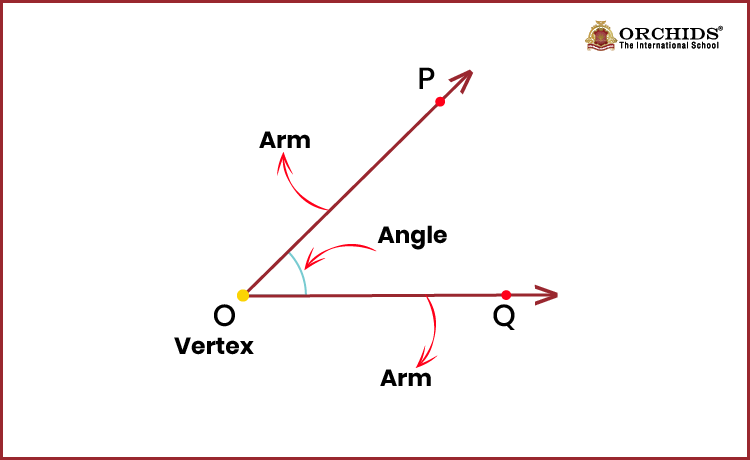
An angle is formed when two rays (called arms) meet at a common point called the vertex. The amount of "turn" between those two arms is measured in degrees (°).
The symbol ∠ is used to denote an angle.
Three things define every angle:
-
Vertex: the common endpoint where the two arms meet
-
Arms (or Sides: the two rays forming the angle
-
Measure: the amount of rotation between the arms, expressed in degrees
The angle can be named either ∠POQ or ∠QOP or ∠O. It can also be named using the number (or a small letter) in its interior. For example: ∠1
Depending on that measurement, angles are given different names and each type has unique properties.
Know more about related topics:
Types of Angles Based on Measurement
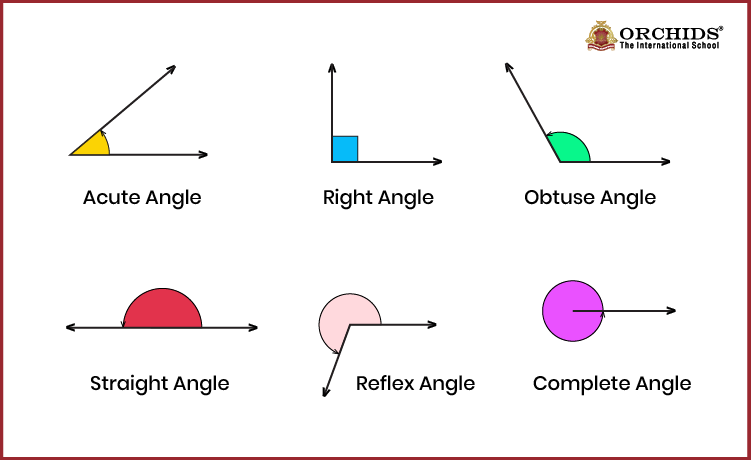
Angles are primarily classified based on their degree of measurement. There are the six main types of angles based on measurement.
-
Acute Angle: An acute angle is any angle that measures more than 0° but less than 90°. 0° < θ < 90°.An acute angle is less than 90°.
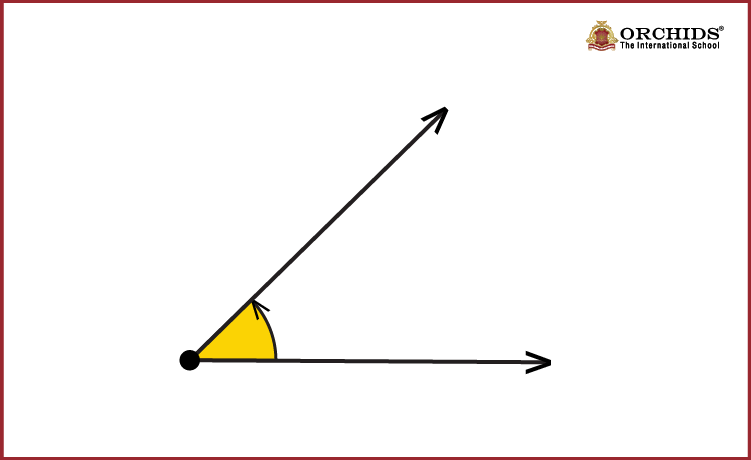
Examples: 30°, 45°, 60°, 85° -
Obtuse Angle: An obtuse angle is greater than 90° but less than 180°.
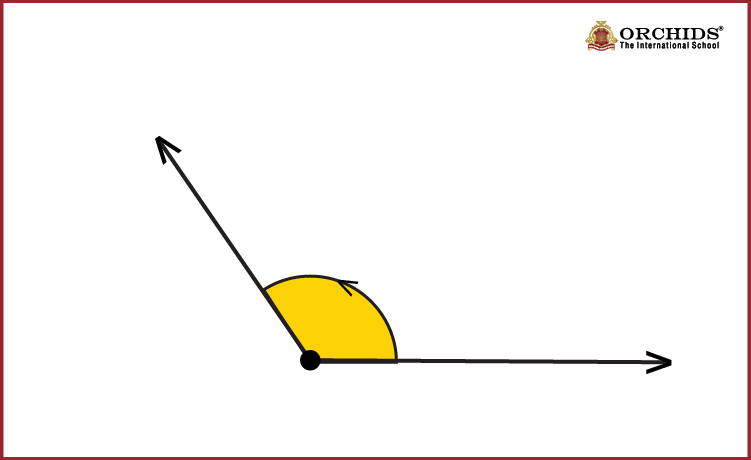
Examples: 100°, 135°, 150°, 170° -
Right Angle: A right angle measures exactly 90°. θ = 90°. It's always marked with a small square at the vertex.
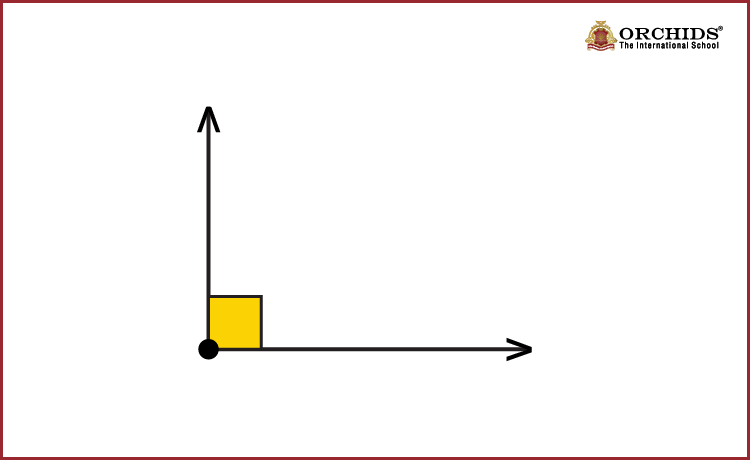
-
Straight Angle: A straight angle is equal to 180°. θ = 180°. Its two arms point in completely opposite directions, forming a straight line.
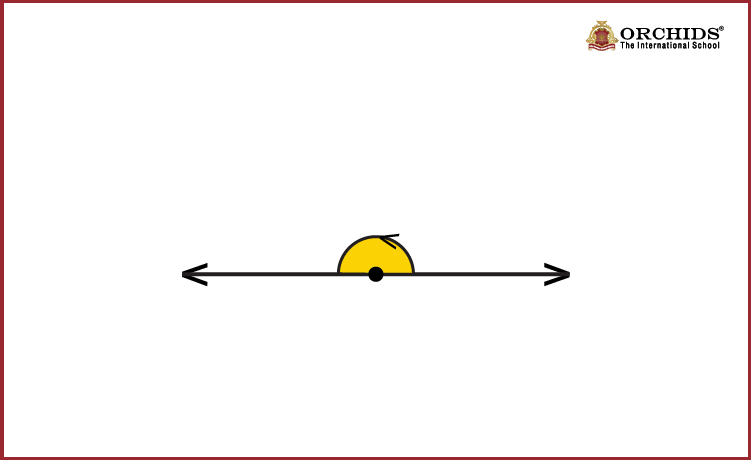
-
Complete Angle: A complete angle is equal to 360°. It is formed when one of the arms takes a complete rotation to form an angle.
-
Reflex Angle: A reflex angle is greater than 180° but less than 360°. 180° < θ < 360°. It's the bigger angle on the other side of an obtuse or acute angle.
Examples: 210°, 270°, 300°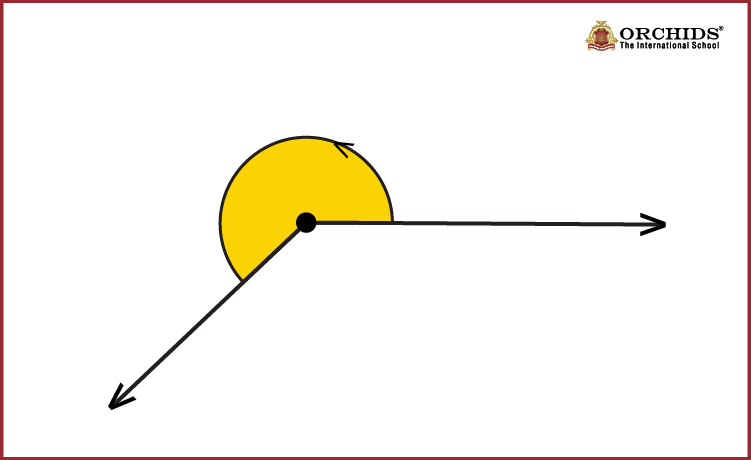
Types of Angles Based on Rotation
Angles can also be classified based on the direction of rotation from a starting ray. Based on rotation angles can be classified into two types of angles: Positive angle and negative angle.
-
Positive Angle : Counterclockwise rotation
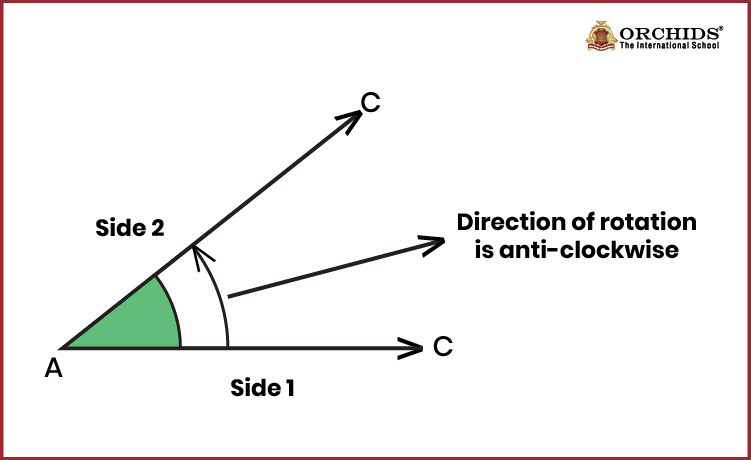
An angle measured in the anticlockwise direction from the initial arm is a positive angle. Most angles in standard geometry are positive. Example: +60°
-
Negative Angle: Clockwise rotation
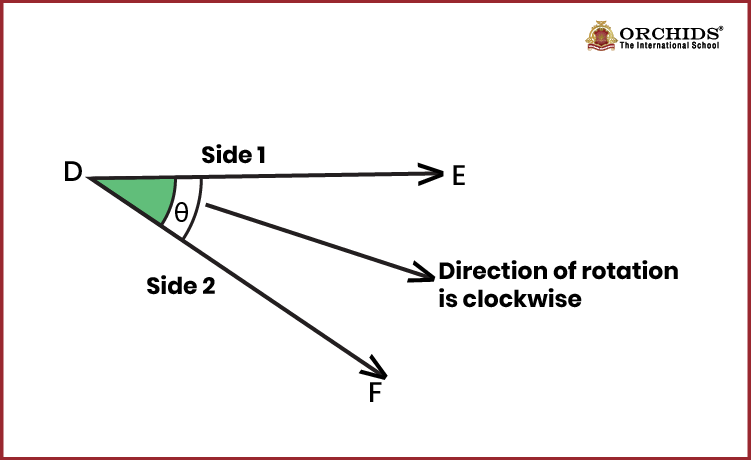
An angle measured in the clockwise direction is a negative angle. These come up in trigonometry. Example: −45° is the same position as +315°.
Types of Angle Pairs
Angle pairs are two angles that have a specific relationship based on their positions or the sum of their measures. Some common types include complementary, supplementary, adjacent, vertical, linear pair, corresponding, and alternate angles.
-
Complementary Angles
∠A + ∠B = 90°
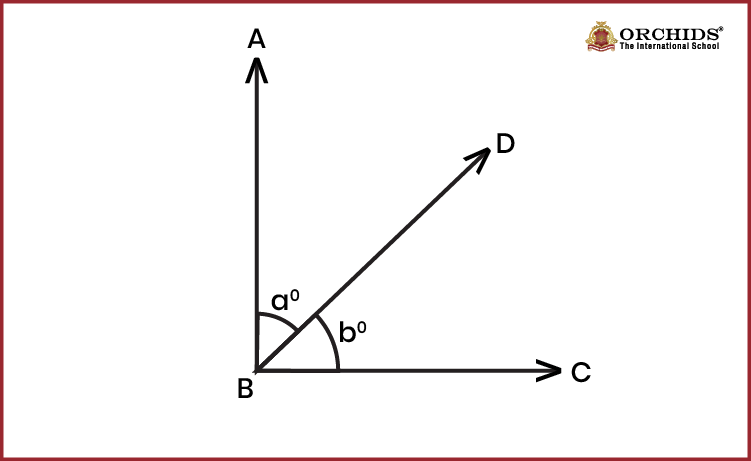
Two angles are said to be complementary if they add up to exactly 90°. For example, 30° and 60° are complementary. They don't need to be next to each other but they sum to 90°.
In the figure, ∠ABC = ∠ABD + ∠CBD = a + b = 90°
Therefore, ∠ABD and ∠CBD are complementary angles and ∠ABD
is a complement of ∠CBD and vice versa.
-
Supplementary Angles
∠A + ∠B = 180°
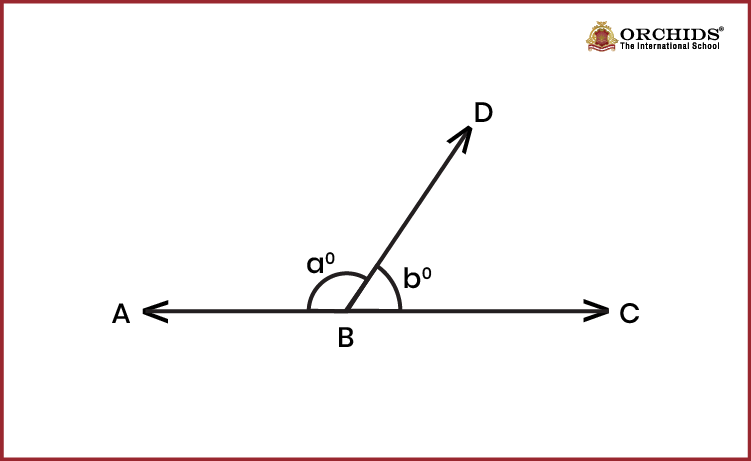
Two angles are supplementary if they add up to exactly 180°. Example: 110° and 70° are supplementary. Together, they form a straight line.
In the figure, ∠ABC = ∠ABD + ∠CBD = a + b = 180°
Therefore, ∠ABD and ∠CBD are supplementary angles and ∠ABD is a supplement of ∠CBD and vice versa.
-
Adjacent Angles
Adjacent angles share a common vertex and one common arm. Their non-common arms lie on either side of the shared arm.
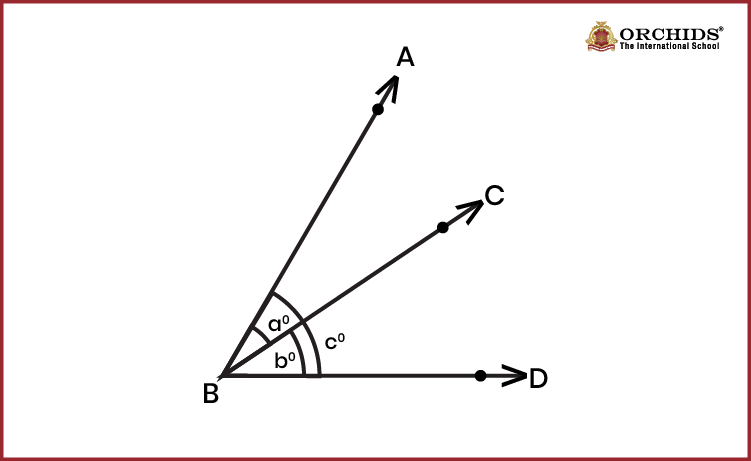
In the figure given, ∠ABC and ∠CBD are adjacent angles.The sum of two adjacent angles equals to the value of the bigger angle. In the above figure, ∠a and ∠b are adjacent angle, and ∠a + ∠b = ∠c
-
Linear Pair
A linear pair is a special case of adjacent angles where the non-common arms form a straight line. They always add up to 180°. Example: 1 and 2 form a linear pair. If two angles form a linear pair, they are supplementary.
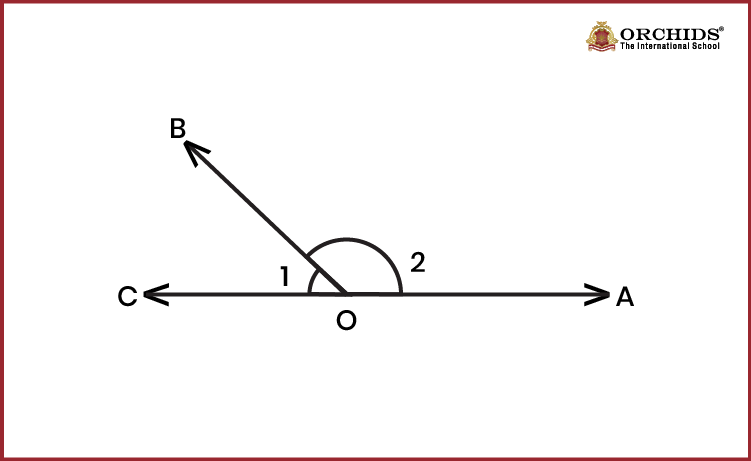
Therefore, ∠AOB + ∠BOC = 180° or 1 + 2 = 180°.
-
Vertically Opposite Angles
When two linesintersect,the angles on the opposite sides of the point of intersection are called vertically opposite angles. These angles are always equal.
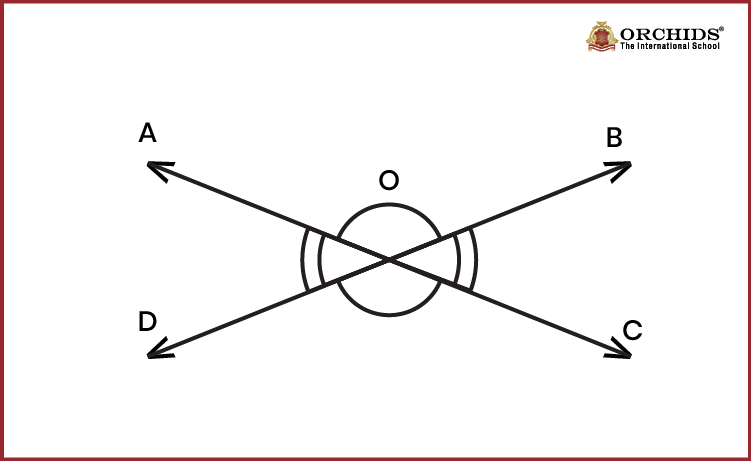
In the figure, the two pairs of vertically opposite angles are formed and they are equal.
∠AOB and ∠COD are vertically opposite angles and ∠AOB = ∠COD.
∠AOD and ∠BOC are vertically opposite angles and ∠AOD = ∠BOC.
Example: If two lines cross and one angle is 70°, the opposite angle is also 70°.
Angles formed by Transversal
A transversal is a line that crosses two or more other lines (usually parallel) at different points. This creates a series of angles at each intersection.
When a transversal crosses two parallel lines, eight angles are formed.
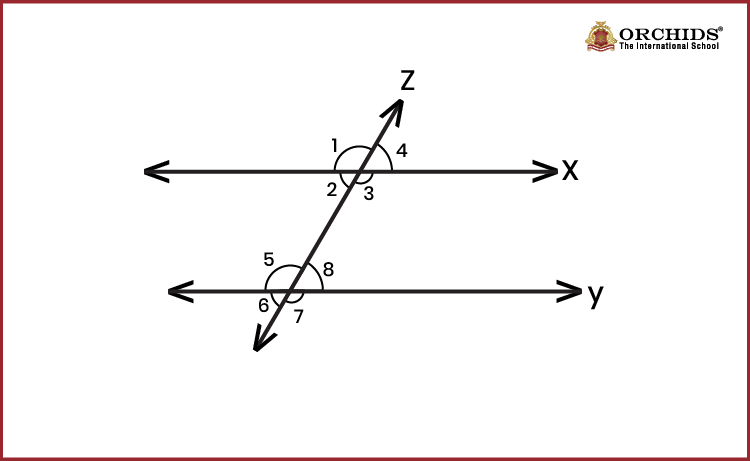
In the given figure, lines x and y are parallel i.e. x || y. The symbol || is read as “is parallel to.” Line z is the transversal.
The eight angles formed are classified as:
Solved Examples on Types of Angles
Example 1:The measure of two supplementary angles are (x + 30)° and (x + 10)°.Find the value of x.
Solution: Given (x + 30)° + (x + 10)° = 180° (supplementary angles)
x + 30° + x + 10° = 180°
x + x + 30° + 10° = 180°
2x + 40° = 180°
2x = 180° – 40° = 140°
2x = 140°
⸫ x = = 70°
Example 2:In the given figure ∠QOS = 67°,
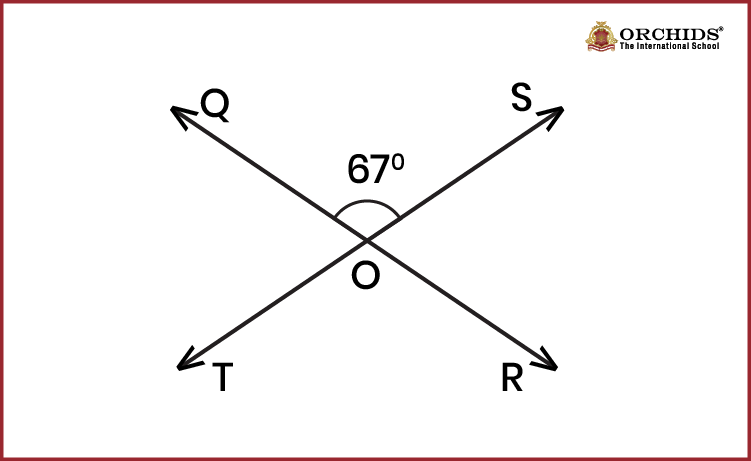
Find ∠ROT, ∠SOR and ∠QOT.
Solution: Given: ∠QOS =67°
∠QOS and ∠ROT are vertically opposite angles, so they are equal:
Therefore,∠ROT=67°
∠QOS and ∠SOR form a linear pair (they lie on a straight line), so they sum to 180°
∠SOR=180°−67°=113°
∠QOT is also a linear pair with ∠QOS, so ∠QOT=180° −67° =113°
Therefore, ∠ROT=67°, ∠SOR=113° and ∠QOT=113°.
Example 3: Find the value of x from the figure.
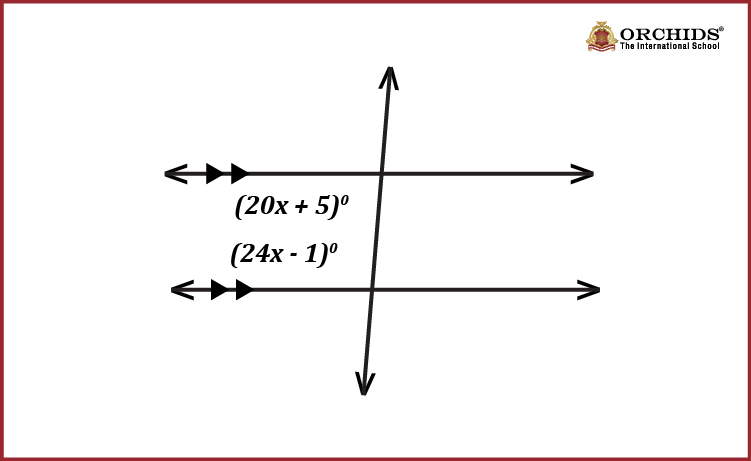
Solution: The given angles are same-side interior angles.
20x + 5° + 24x − 1° = 180°
44x + 4° = 180°
44x = 180°– 4°
44x = 176°
x = 176/44 = 4°.
Example 4:Find the value of x if angles (4x +3)° and 77° are complementary.
Solution: Complementary angles add up to 90°.
So,(4x + 3) + 77 = 90
4x + 80 = 90
4x = 10
x = 1/40 =2.5
Example 5: Find the value of y
Solution: The angles 70° and 2y° are corresponding angles.
corresponding angles are equal:
Therefore, 2y = 70
y = 70/2 = 35
Practice Questions on Types of Angles
-
Identify whether 89∘ is acute, right, or obtuse.
-
A and B are supplementary. Suppose, A = 60° and B = (2x + 20)°, then what is the value of x?
-
Given that PQS and SQR are supplementary and SQR = (x – 10)° and PQS = (x + 30)°. What is the value of PQS and SQR?
-
Find the complement of 75°.
-
The sum of two adjacent angles is 140°. If one angle is thrice the other, find the values of the two angles.
-
If one of the vertically opposite angles is 95° find the other three angles..
-
If one angle is 20°more than its complement, find the angle.
-
In intersecting lines, one angle is (x+20)° and its vertically opposite angle is (2x−10)°. Find x.
-
The sum of two adjacent angles is 120°. One angle is 20° more than the other. Find both angles.
-
Two parallel lines are cut by a transversal. If one angle is (5x−10)° and its corresponding angle is (3x+30)° find x.
Numbers make sense when they're taught right. To see how Orchids The International School turns Maths from intimidating to intuitive, reach out to our admissions team.
Frequently Asked Questions on Types of Angles
1. How many types of angles are there in geometry?
There are 6 main types based on measurement:complete, acute, right, obtuse, straight, and reflex angle.
2. What is the difference between acute and obtuse angle?
An acute angle is less than 90°. An obtuse angle is greater than 90° but less than 180°.
3. What are complementary and supplementary angles?
Two angles are said to be complementary if they add up to exactly 90° . Supplementary angles sum to 180°.
4. Can obtuse angles be supplementary?
No. For two angles to be supplementary, they must add up to 180°. Since an obtuse angle is already greater than 90°, two obtuse angles would sum up to more than 180°, which is not possible for supplementary pairs.
5. What are the types of angles formed when two parallel lines are cut by a transversal?
When a transversal crosses two parallel lines, it forms 8 angles. These include: corresponding angles, alternate interior angles, alternate exterior angles, and co-interior/same-side interior angles.
Related Links


Admissions Open for 2026-27
What type of concept pages would you prefer?
CBSE Schools In Popular Cities
- CBSE Schools in Bangalore
- CBSE Schools in Mumbai
- CBSE Schools in Pune
- CBSE Schools in Hyderabad
- CBSE Schools in Chennai
- CBSE Schools in Gurgaon
- CBSE Schools in Kolkata
- CBSE Schools in Indore
- CBSE Schools in Sonipat
- CBSE Schools in Delhi
- CBSE Schools in Rohtak
- CBSE Schools in Bhopal
- CBSE Schools in Aurangabad
- CBSE Schools in Jabalpur
- CBSE Schools in Jaipur
- CBSE Schools in Jodhpur
- CBSE Schools in Nagpur
- CBSE Schools in Ahmednagar
- CBSE School In Tumkur











Orchids The International School is one of India's leading chains of CBSE and ICSE schools, with 130+ schools across the country.