

Class 9 - Introduction to Coordinate Geometry
Coordinate geometry is an important part of mathematics that allows us to present any geometrical figures like lines, circles, curves, etc on a 2-dimensional plane along the X and Y axis. The points at which this object is placed is known as its coordinates. Everything on earth also has coordinates that help us locate that object on the map. We use two imaginary lines called longitude and latitude to represent any object on the coordinate system of earth. Understanding coordinate geometry is highly important as it has many significant applications in our life. In this article, we have covered the basic concepts of coordinate geometry with examples to help you understand this topic easily.
Table of Contents
- What is Cartesian Plane
- Coordinates of a Point
- What are Quadrants
- Solved Examples on Coordinate Geometry
- Frequently Asked Question Geometry

What is Cartesian Plane
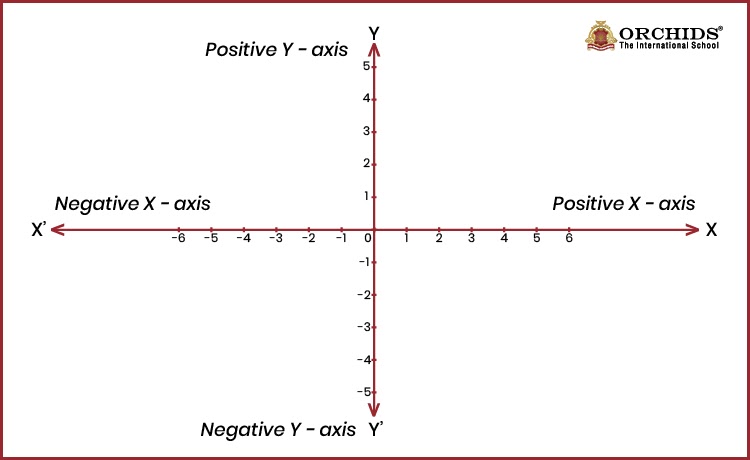
A Cartesian plane can be defined as a plane formed by intersection of two perpendicular lines. Understanding the cartesian plane also known as a coordinate plane is important for cartesian coordinate geometry. The plane is formed by two perpendicular lines called the axes of a plane that divide the plane into 4 parts. The horizontal axis is called the x-axis and the vertical axis is called the y-axis. The point at which both these lines intersect is called the origin ‘O’ which is represented as O(0,0) on the graph.
-
The positive numbers lie in the directions OX and OY. So they are called the positive directions of the x - axis and the y - axis, respectively.
-
The negative numbers lie in the direction OX′ and OY′. So OX′ and OY′ are called the negative directions of the x - axis and the y - axis, respectively.
Know more about related topics:
Coordinates of Point
Any point of a cartesian plane is represented using its x and y coordinates. It is written as P(x,y), where x is the distance from the y-axis and y is the distance from x-axis. These two values are called the coordinates of a point. Let’s consider P and Q are two points on a cartesian plane with coordinates P(3, 4) and Q(-6, -2) respectively then, x1 = 3 and y1 = 4 and x2 = -6 and y2 = -2 are called coordinates of P and Q respective that can be represented graphically on a coordinate plane:
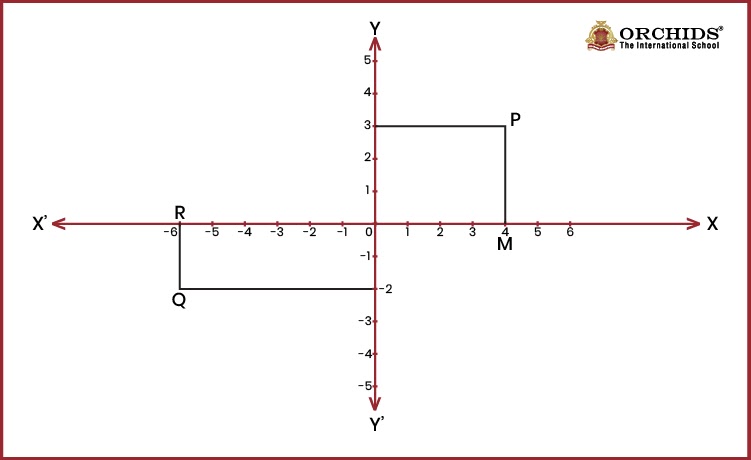
Abscissa: The x - coordinate of a point is called the abscissa.
Ordinates: The y - coordinate of a point is called the ordinate.
What are Quadrants
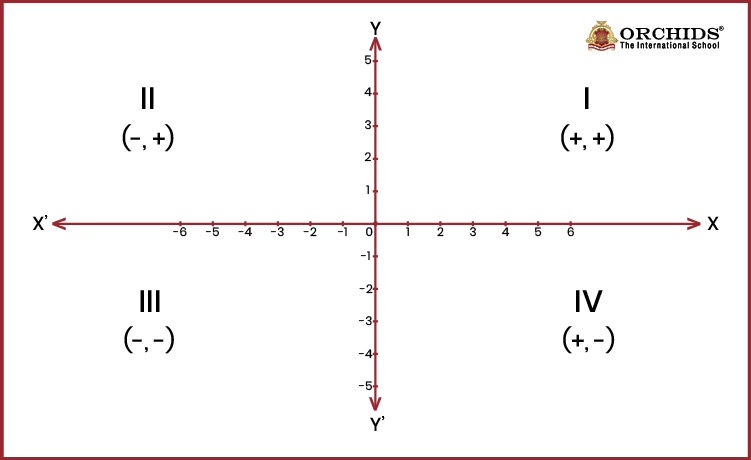
A quadrant is the area enclosed by the intersection of the x and y axis. When the x and y axis intersect perpendicularly they divide the plane into four equal parts called the four quadrants of a cartesian plane. Each point on the quadrants is represented through its x and y coordinates as: P(x, y).
Solved Examples on Coordinate Geometry
Example 1: Write the coordinates of the points A marked on the axes.
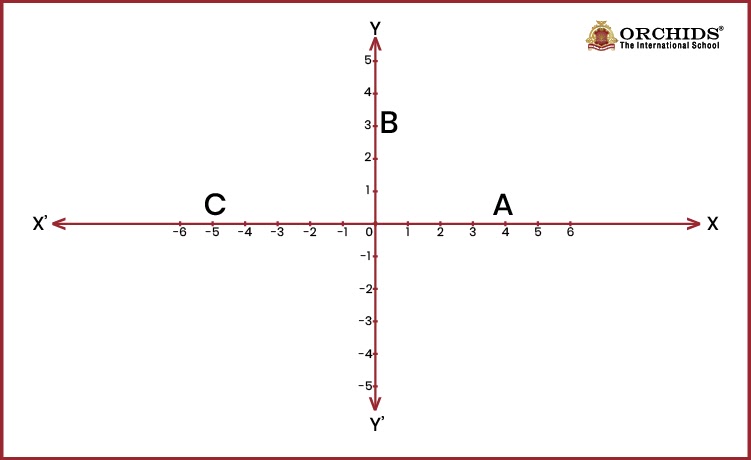
Solution: We can see in the graph that the point A is at a distance of + 4 units from the y - axis and at a distance zero from the x - axis.
Therefore, the x - coordinate of A is 4 and the y - coordinate is 0.
Hence, the coordinates of A are (4, 0).
Example 2: What are the coordinates of point B and C marked on the axes.
Solution: We can see in the graph that point B is at a distance of + 3 units from the x - axis and at a distance zero from the y - axis.
Therefore, the y - coordinate of B is 3 and the x - coordinate is 0.
Hence, the coordinates of B are (0, 3).
Similarly, the coordinates of C are (– 5, 0).
Numbers make sense when they're taught right. To see how Orchids The International School turns Maths from intimidating to intuitive, reach out to our admissions team.
Frequently Asked Question Geometry
1. What is a Cartesian plane?
A Cartesian plane can be defined as a plane formed by intersection of two perpendicular lines called the axes of a plane.
2. What is abscissa and ordinate in coordinate geometry?
Abscissa: The x - coordinate of a point is called the abscissa.
Ordinates: The y - coordinate of a point is called the ordinate.
Related Links


Admissions Open for 2026-27
What type of concept pages would you prefer?
CBSE Schools In Popular Cities
- CBSE Schools in Bangalore
- CBSE Schools in Mumbai
- CBSE Schools in Pune
- CBSE Schools in Hyderabad
- CBSE Schools in Chennai
- CBSE Schools in Gurgaon
- CBSE Schools in Kolkata
- CBSE Schools in Indore
- CBSE Schools in Sonipat
- CBSE Schools in Delhi
- CBSE Schools in Rohtak
- CBSE Schools in Bhopal
- CBSE Schools in Aurangabad
- CBSE Schools in Jabalpur
- CBSE Schools in Jaipur
- CBSE Schools in Jodhpur
- CBSE Schools in Nagpur
- CBSE Schools in Ahmednagar
- CBSE School In Tumkur











Orchids The International School is one of India's leading chains of CBSE and ICSE schools, with 110+ schools across the country.