

HOTS Questions on Class 9 Maths Chapter 6 Measuring Space: Perimeter and Area
HOTS Questions on Class 9 Maths Chapter 6 Measuring Space: Perimeter and Area help students understand shapes, boundaries, and space in a simple way. They improve knowledge of perimeter, area, and formulas for triangles, rectangles, squares, circles, and other figures. This chapter builds a strong base for solving geometry problems and improving math skills. A downloadable PDF is also available for easy revision and practice.
HOTS Questions Based on Perimeter Concepts
Q1. The perimeter of a rectangular field is 320 m. Its length is 20 m more than its breadth. Find the length and breadth of the field.
Solution: Let breadth = b, so length = b + 20.
Perimeter = 2(l + b) = 320,
so l + b = 160. Substituting,
(b + 20) + b = 160,
giving 2b = 140,
so b = 70 m and l = 90 m.
Q2. A square sheet of metal has a side of 18 cm. It is melted and recast into a rectangular strip of length 24 cm without any loss of material in terms of the total boundary length used. Find the breadth of the rectangle if the two shapes have equal perimeters.
Solution: Perimeter of square = 4 x 18 = 72 cm.
This equals the rectangle's perimeter
so 2(24 + b) = 72, giving 24 + b = 36, so b = 12 cm.
Q3. A piece of wire bent into an equilateral triangle has a side of 12 cm. The same wire is straightened and then bent into a square. Find the side of the square.
Solution: Perimeter of the triangle = 3 x 12 = 36 cm.
This same length of wire forms the square, so 4 x side = 36, giving side = 9 cm.
Q4. The perimeter of an isosceles triangle is 50 cm. Each of its two equal sides is 4 cm longer than its base. Find the length of all three sides.
Solution: Let the base = x, so each equal side = x + 4.
Perimeter: x + 2(x + 4) = 50, so 3x + 8 = 50, 3x = 42, x = 14 cm.
The equal sides are each 18 cm. The three sides are 14 cm, 18 cm, and 18 cm.
Q5. A rectangular plot has a perimeter of 100 m. Suppose both its length and breadth are increased by 5 m each. A student claims the new perimeter will be 140 m. Check whether this claim is correct, and explain your reasoning.
Solution: Increasing both length and breadth by 5 m each increases the perimeter by 2(5) + 2(5) = 20 m, regardless of the original dimensions, because perimeter = 2(l + b).
So the new perimeter is 100 + 20 = 120 m, not 140 m. The student's claim is incorrect; the correct new perimeter is 120 m.
Q6. Two square fields have sides in the ratio 3:4. If the perimeter of the smaller field is 96 m, find the perimeter of the larger field.
Solution: For squares, perimeter is directly proportional to the side, so the ratio of perimeters equals the ratio of sides, which is 3:4. If the smaller perimeter (3 parts) is 96 m, one part is 32 m, so the larger perimeter (4 parts) is 128 m.

HOTS Questions Based on Area Calculations
Q7. The length and breadth of a rectangular garden are in the ratio 4:3, and its area is 1200 m squared. Find its dimensions, and the cost of fencing it at Rs 50 per metre.
Solution: Let length = 4k and breadth = 3k.
Area = 4k x 3k = 12k squared = 1200, so k squared = 100, k = 10.
Length = 40 m, breadth = 30 m.
Perimeter = 2(40 + 30) = 140 m.
Fencing cost = 140 x 50 = Rs 7000.
Q8. A square room has a side of 6 m. It is to be paved with square tiles of side 30 cm. Find the number of tiles needed. If 10 percent extra tiles must be ordered to allow for breakage, find the total number of tiles to be ordered.
Solution: Room side = 6 m = 600 cm, tile side = 30 cm.
Tiles needed along one side = 600 / 30 = 20.
so total tiles = 20 x 20 = 400. Extra 10 percent = 40 tiles. Total tiles to order = 440.
Q9. A wall is 10 m long and 4 m high. It has one door of size 2 m by 1 m and two windows, each 1.5 m by 1 m. Find the area to be painted, and the cost of painting at Rs 12 per square metre.
Solution: Wall area = 10 x 4 = 40 m squared.
Door area = 2 x 1 = 2 m squared.
Total window area = 2 x (1.5 x 1) = 3 m squared.
Area to paint = 40 - 2 - 3 = 35 m squared. Painting cost = 35 x 12 = Rs 420.
Q10. A path of uniform width 2 m runs all around the outside of a rectangular park measuring 50 m by 30 m. Find the area of the path.
Solution: Outer dimensions including the path = (50 + 2 + 2) x (30 + 2 + 2) = 54 x 34 = 1836 m squared.
Inner park area = 50 x 30 = 1500 m squared.
Path area = 1836 - 1500 = 336 m squared.
Q11. A rectangular lawn measures 30 m by 20 m. Two paths, each 2 m wide, cross each other at right angles in the middle of the lawn, one running the full length and the other the full breadth. Find the area of the paths and the area of the lawn that remains for grass.
Solution: Path along the length: 30 x 2 = 60 m squared. Path along the breadth: 20 x 2 = 40 m squared.
The two paths overlap in a 2 m by 2 m square in the middle, which is counted twice, so subtract 4 m squared once.
Total path area = 60 + 40 - 4 = 96 m squared. Total lawn area = 30 x 20 = 600 m squared. Remaining grass area = 600 - 96 = 504 m squared.
Q12. A rectangular plot has an area of 528 m squared and a perimeter of 92 m. Find its length and breadth.
Solution: Let length = l and breadth = b. l + b = 92/2 = 46, and l x b = 528.
The two numbers that add to 46 and multiply to 528 are 24 and 22. So length = 24 m and breadth = 22 m.
HOTS Questions Based on Composite Figures
Q13. A room is L-shaped, made up of a 6 m by 4 m rectangle joined to a 3 m by 2 m rectangle, as shown below. Find the total floor area of the room.
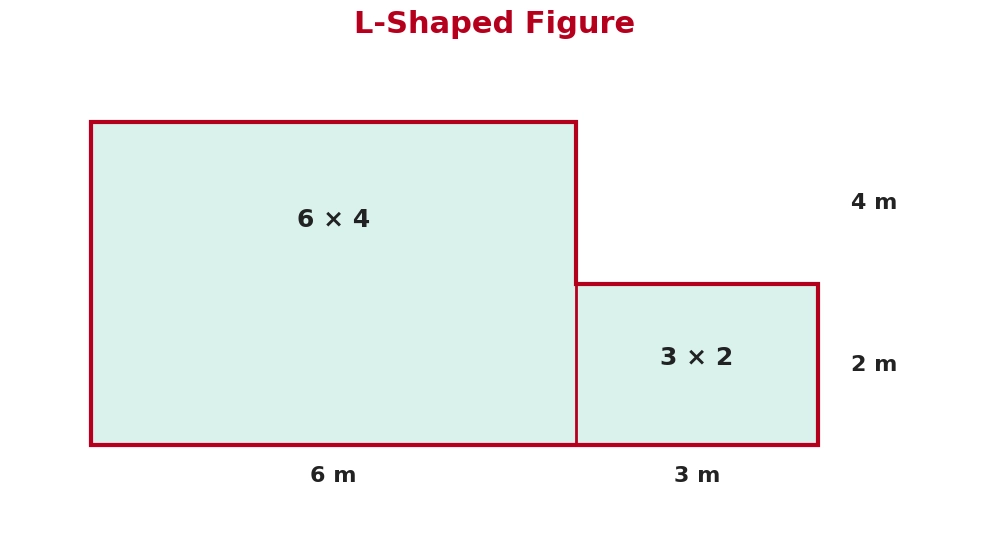
Solution: Area = area of first rectangle + area of second rectangle = (6 x 4) + (3 x 2) = 24 + 6 = 30 m squared.
Q14. A figure is made of a square of side 14 cm with a semicircle attached on one of its sides, where the diameter of the semicircle equals the side of the square. Find the total area of the figure. Use pi = 22/7.
Solution: Area of square = 14 x 14 = 196 cm squared.
Radius of semicircle = 7 cm. Area of semicircle = 0.5 x 22/7 x 7 x 7 = 77 cm squared.
Total area = 196 + 77 = 273 cm squared.
Q15. A rectangular field measures 60 m by 40 m. A circular pond of radius 7 m lies inside it. Find the area of the field that is not covered by the pond.
Solution: Area of field = 60 x 40 = 2400 m squared.
Area of pond = 22/7 x 7 x 7 = 154 m squared. Area not covered by the pond = 2400 - 154 = 2246 m squared.
Q16. A square sheet has a side of 20 cm. A quarter-circle of radius 5 cm is cut away from each of its four corners. Find the area that remains.
Solution: Area of square sheet = 20 x 20 = 400 cm squared. The four quarter-circles together make one full circle of radius 5 cm, with area 22/7 x 5 x 5 = 550/7, which is about 78.57 cm squared. Remaining area = 400 - 78.57 = 321.43 cm squared (approximately).
Q17. A rectangle ABCD has AB = DC = 12 cm and BC = AD = 8 cm. A right-angled triangle BCE is attached on the outside of side BC, with the right angle at C, CE = 6 cm, and BE = 10 cm, as shown. Find (i) the total area of the figure and (ii) the perimeter of the outer boundary of the figure.
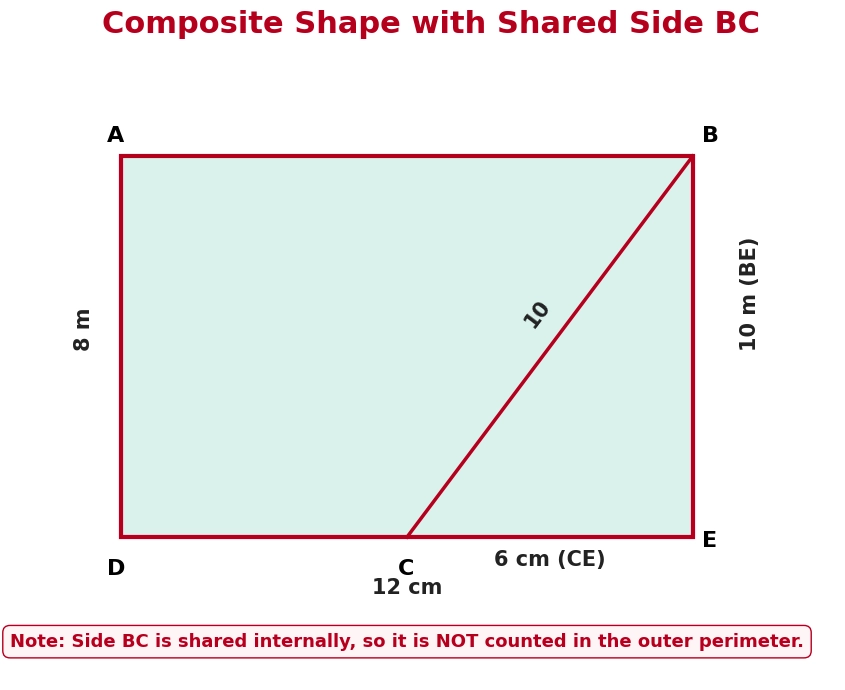
Solution: (i) Area = area of rectangle + area of triangle = (12 x 8) + (0.5 x 6 x 8) = 96 + 24 = 120 cm squared.
(ii) Side BC is shared between the rectangle and the triangle, so it lies inside the figure and is not part of the outer boundary. Perimeter = AB + BE + EC + CD + DA = 12 + 10 + 6 + 12 + 8 = 48 cm. A common mistake here is to also add BC, which gives a wrong total of 56 cm.
Q18. A window frame is shaped like a rectangle of 1.2 m by 1 m, topped with a semicircle whose diameter is 1.2 m. Find (i) the total area of the frame and (ii) the length of the outer boundary, that is, the perimeter excluding the shared straight line where the rectangle meets the semicircle. Use pi = 3.14.
Solution: Radius of semicircle = 0.6 m. (i) Area of rectangle = 1.2 x 1 = 1.2 m squared. Area of semicircle = 0.5 x 3.14 x 0.6 x 0.6 = 0.5652 m squared. Total area = 1.2 + 0.5652 = 1.7652 m squared, which is about 1.77 m squared. (ii) Outer boundary = two vertical sides of the rectangle (1 m each) + the bottom side (1.2 m) + the curved arc of the semicircle (pi x r = 3.14 x 0.6 = 1.884 m). The top straight edge of the rectangle is shared with the semicircle's diameter, so it is left out. Perimeter = 1 + 1 + 1.2 + 1.884 = 5.084 m, which is about 5.08 m.
HOTS Questions Based on Real-Life Applications of Perimeter and Area
Q19. A circular flower bed has a diameter of 14 m. It is surrounded by a path of uniform width 3.5 m. Find the area of the path, and the cost of gravelling it at Rs 25 per square metre. Use pi = 22/7.
Solution: Radius of flower bed = 7 m. Outer radius including the path = 7 + 3.5 = 10.5 m. Area of path = 22/7 x (10.5 squared - 7 squared) = 22/7 x (110.25 - 49) = 22/7 x 61.25 = 192.5 m squared. Cost of gravelling = 192.5 x 25 = Rs 4812.50.
Q20. A rectangular park measures 80 m by 60 m. A 5 m wide jogging track runs all around its inside, just within the boundary. Find the area of the track and the area left for the lawn at the centre.
Solution: Area of park = 80 x 60 = 4800 m squared. Since the track is 5 m wide on all sides inside the boundary, the inner lawn measures (80 - 10) x (60 - 10) = 70 x 50 = 3500 m squared. Area of track = 4800 - 3500 = 1300 m squared.
Q21. A square garden has a side of 30 m. A straight path is built along its diagonal, dividing it into two right-angled triangular sections, one for flowers and one for vegetables. Find the area of each section, and the length of the diagonal path. Take the square root of 2 as 1.414.
Solution: Area of square garden = 30 x 30 = 900 m squared. The diagonal splits it into two equal triangles, so each section is 450 m squared. Diagonal = side x square root of 2 = 30 x 1.414 = 42.42 m.
Q22. A hall has a floor measuring 12 m by 9 m. It is to be covered using rectangular tiles measuring 60 cm by 30 cm. Find the minimum number of tiles required.
Solution: Convert tile size to metres: 0.6 m by 0.3 m, giving a tile area of 0.18 m squared. Floor area = 12 x 9 = 108 m squared. Number of tiles = 108 / 0.18 = 600 tiles.
Q23. A room's floor is shaped like a trapezium, with parallel sides of 8 m and 5 m and a perpendicular distance of 4 m between them. Find the area of the floor and the cost of flooring it at Rs 350 per square metre.
Solution: Area of trapezium = 0.5 x (sum of parallel sides) x height = 0.5 x (8 + 5) x 4 = 0.5 x 13 x 4 = 26 m squared. Flooring cost = 26 x 350 = Rs 9100.
Q24. A wall is 8 m long and 4 m high. It has one door measuring 2 m by 1 m. The rest of the wall needs plastering at Rs 45 per square metre. Find the total plastering cost.
Solution: Area of wall = 8 x 4 = 32 m squared. Area of door = 2 x 1 = 2 m squared. Area to be plastered = 32 - 2 = 30 m squared. Cost = 30 x 45 = Rs 1350.
Download Free PDF: HOTS Questions on Class 9 Chapter 6 - Measuring Space: Perimeter and Area
Download PDF - HOTS Questions on Class 9 Maths Chapter 6 Measuring Space Perimeter and Area pdf
Frequently Asked Questions on HOTS Questions on Class 9 Maths Chapter 6 Measuring Space: Perimeter and Area
1. Which formulas are most important for HOTS questions?
Important formulas include:
- Rectangle: Area = Length × Breadth
- Rectangle: Perimeter = 2 × (Length + Breadth)
- Square: Area = Side²
- Square: Perimeter = 4 × Side
- Triangle: Area = Half × Base × Height
2. What are common mistakes students make in perimeter and area questions?
Common mistakes include:
- Confusing perimeter with area
- Using incorrect units
- Applying the wrong formula
- Making arithmetic errors
- Ignoring given conditions
3. What skills do HOTS questions develop?
These questions help develop:
- Critical thinking
- Logical reasoning
- Mathematical modeling
- Problem-solving skills
- Application of concepts
4. Can one figure have the same perimeter but a different area?
Yes. Different shapes can have the same perimeter but different areas depending on their dimensions.
5. Why is unit conversion important in perimeter and area problems?
Unit conversion ensures that all measurements are in the same unit before calculations are performed, helping avoid incorrect answers.
6. How can diagrams improve performance in HOTS questions?
Diagrams help students visualize the problem, understand the given information, and choose the correct method of solution.
Numbers make sense when they're taught right. To see how Orchids The International School turns Maths from intimidating to intuitive, reach out to our admissions team.


Admissions Open for 2026-27
What type of concept pages would you prefer?
CBSE Schools In Popular Cities
- CBSE Schools in Bangalore
- CBSE Schools in Mumbai
- CBSE Schools in Pune
- CBSE Schools in Hyderabad
- CBSE Schools in Chennai
- CBSE Schools in Gurgaon
- CBSE Schools in Kolkata
- CBSE Schools in Indore
- CBSE Schools in Sonipat
- CBSE Schools in Delhi
- CBSE Schools in Rohtak
- CBSE Schools in Bhopal
- CBSE Schools in Aurangabad
- CBSE Schools in Jabalpur
- CBSE Schools in Jaipur
- CBSE Schools in Jodhpur
- CBSE Schools in Nagpur
- CBSE Schools in Ahmednagar
- CBSE School In Tumkur











Orchids The International School is one of India's leading chains of CBSE and ICSE schools, with 110+ schools across the country.