

CMXX Roman Numerals: Rules, Solved Examples & Practice Questions
CMXX Roman numeral represent the number 920 in the Roman numeral system. This numeral is formed by combining 900 (CM) and 20 (XX). Where the subtraction rule is applied, placing a smaller numeral before a larger one indicates subtraction, while adding smaller numerals after larger ones adds their value. Understanding how to read and write CMXX helps students grasp the logic of Roman numerals, improve number recognition, and see how historical number systems are still used today in clocks, book chapters, movie titles, and dates. Learning CMXX also strengthens logical thinking and makes working with Roman numerals easier and more meaningful.
Table of Contents
- How to Write CMXX Roman Numeral in Numbers?
- Numbers Related to CMXX Roman Numerals
- Basic Rules for Writing Roman Numerals
- Solved Examples on CMXX Roman Numeral
- Practice Questions on CMXX Roman Numeral
- Conclusion
- Frequently Asked Questions on CMXX Roman Numerals

How to Write CMXX Roman Numeral in Numbers?
To convert CMXX Roman numerals into numbers, we need to understand the value of each Roman numeral symbol and then add or subtract them according to Roman numeral rules.
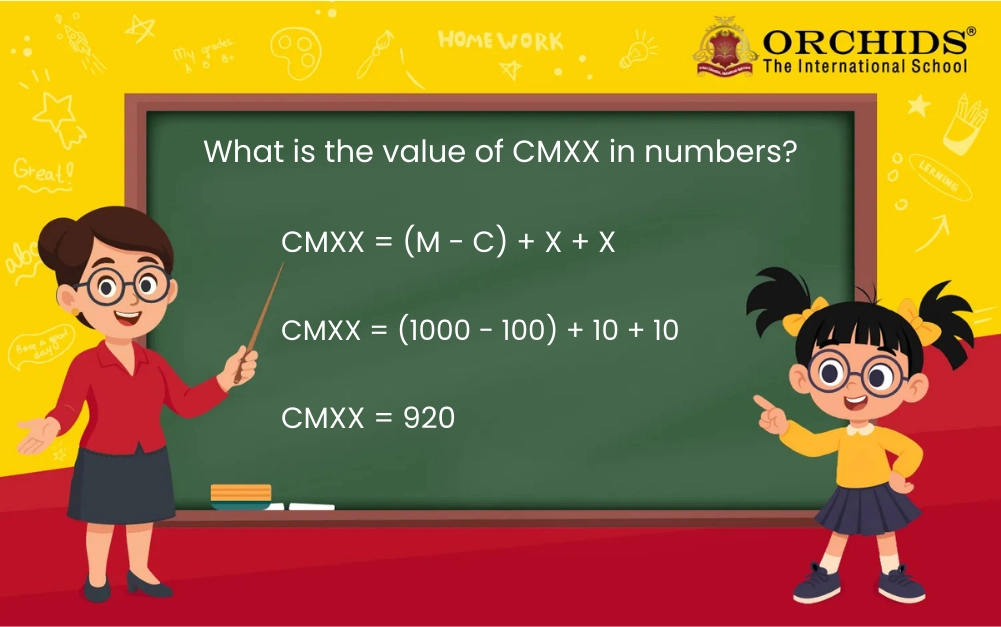
Let us break the Roman numeral CMXX into individual symbols:
CMXX = (M - C) + X + X = CM + XX
Now replace each symbol with its numerical value:
-
C = 100
-
M = 1000
-
X = 10
-
X = 10
Next, apply the subtraction rule where a smaller number comes before a larger number (C before M).
CM = 1000 − 100 = 900
Then add the remaining values:
CMXX = (1000 - 100) + 10 + 10 = 900 + 20 = 920
Therefore, the number represented by CMXX in Roman numerals is 920.
Read More
Numbers Related to CMXX Roman Numerals
|
Roman Numerals |
Roman Numeral Expression |
Expanded Form |
Numbers |
|
CMXV |
(M − C) + X + V |
1000 − 100 + 10 + 5 |
915 |
|
CMXVI |
(M − C) + X + V + I |
1000 − 100 + 10 + 5 + 1 |
916 |
|
CMXVII |
(M − C) + X + V + I + I |
1000 − 100 + 10 + 5 + 1 + 1 |
917 |
|
CMXVIII |
(M − C) + X + V + I + I + I |
1000 − 100 + 10 + 5 + 1 + 1 + 1 |
918 |
|
CMXIX |
(M − C) + X + (X − I) |
1000 − 100 + 10 + (10 − 1) |
919 |
|
CMXX |
(M − C) + X + X |
1000 − 100 + 10 + 10 |
920 |
|
CMXXI |
(M − C) + X + X + I |
1000 − 100 + 10 + 10 + 1 |
921 |
|
CMXXII |
(M − C) + X + X + I + I |
1000 − 100 + 10 + 10 + 1 + 1 |
922 |
|
CMXXIII |
(M − C) + X + X + I + I + I |
1000 − 100 + 10 + 10 + 1 + 1 + 1 |
923 |
|
CMXXIV |
(M − C) + X + X + (V − I) |
1000 − 100 + 10 + 10 + (5 − 1) |
924 |
|
CMXXV |
(M − C) + X + X + V |
1000 − 100 + 10 + 10 + 5 |
925 |
Basic Rules for Writing Roman Numerals
1. Know the symbols: I = 1, V = 5, X = 10, L = 50, C = 100, D = 500, M = 1000.
2. Subtraction rule: A smaller numeral before a larger one means subtract.
Example: CM = 1000 − 100 = 900
3. Addition rule: A smaller or equal numeral after a larger one means add.
Example: XX = 10 + 10 = 20
4. Combine values: CM + XX = 900 + 20 = 920
So, CMXX = 920. Simple, clear, and easy to follow.
Solved Examples on CMXX Roman Numeral
Example 1: Find the sum of CMXX and LXXXV.
Solution:
First, convert the Roman numerals into numbers.
-
CMXX = 900 + 20 = 920
-
LXXXV = 80 + 5 = 85
Now add the numbers:
-
920 + 85 = 1005
Convert 1005 into Roman numerals:
1005 = 1000 + 5
= M + V
= MV
Therefore, CMXX + LXXXV = MV.
Example 2: A library recorded CMXX books last year and CL books this year. Find the total number of books in Roman numerals.
Solution:
Convert the Roman numerals into numbers.
-
CMXX = 920
-
CL = 150
Now add them:
-
920 + 150 = 1070
Convert 1070 into Roman numerals:
1070 = 1000 + 70
= M + LXX
= MLXX
Therefore, the total number of books is MLXX.
Example 3: Find the Difference Between CMXX and CCXL.
Solution:
Convert the Roman numerals into numbers.
-
CMXX = 920
-
CCXL = 240
Now subtract:
-
920 − 240 = 680
Convert 680 into Roman numerals:
680 = 500 + 100 + 80
= D + C + LXXX
= DCLXXX
Therefore, CMXX − CCXL = DCLXXX.
Example 4: Find the Product of CMXX and II.
Solution:
First, convert CMXX into numbers.
-
CMXX = 920
-
II = 2
Now multiply:
-
920 × 2 = 1840
Convert 1840 into Roman numerals:
1840 = 1000 + 800 + 40
= M + DCCC + XL
= MDCCCXL
Therefore, CMXX × II = MDCCCXL.
Example 5: A company produced CMXX units in a month. If the total production is divided equally into XL groups, find the number of units in each group. Write the answer in Roman numerals.
Solution:
Convert the Roman numerals into numbers.
-
CMXX = 920
-
XL = 40
Now divide:
920 ÷ 40 = 23
Convert 23 into Roman numerals:
23 = 20 + 3
= XX + III
= XXIII
Therefore, each group will have XXIII units.
Practice Questions on CMXX Roman Numeral
- Write the Roman numeral CMXX in standard number form. What number does it represent?
- Convert the number 920 into Roman numerals and explain how the symbols combine to form CMXX.
- Add CMXX and LXXX. Write the final answer in Roman numerals.
- Subtract CC from CMXX. What is the result in Roman numerals?
- A school collected CMXX notebooks for donation and later added LX more. Find the total number of notebooks in Roman numerals.
- What is the value of CMXX + X? Write the answer in Roman numerals.
- Subtract XX from CMXX and express the result in Roman numerals.
- What number comes just after CMXX? Write it in Roman numerals.
- Find the difference between CMXX and D. Write the answer in Roman numerals.
- Divide CMXX by X. Write the quotient in Hindu-Arabic numerals.
Conclusion
CMXX Roman numerals represent the number 920 in the Roman numeral system. It is formed by combining CM (900) and XX (20) using the standard Roman numeral rules. Understanding how CMXX Roman numerals are written helps students learn how larger numbers are created using both addition and subtraction principles. Practising numbers like 920 in Roman numerals improves number recognition skills and makes it easier for learners to read and write Roman numerals correctly in mathematics and everyday contexts.
Understand CMXX Roman numerals with simple explanations and step-by-step learning at Orchids International School.
Numbers make sense when they're taught right. To see how Orchids The International School turns Maths from intimidating to intuitive, reach out to our admissions team.
Frequently Asked Questions on CMXX Roman Numerals
1. What is the value of CMXX in Roman numerals?
The Roman numeral CMXX represents the number 920. To find its value, we break it into parts: CM = 900 and XX = 20. Adding them together gives 900 + 20 = 920. Therefore, CMXX in Roman numerals equals 920.
2. How do you convert CMXX into numbers?
To convert CMXX Roman numerals to numbers, split the numeral into smaller groups. 'CM' means 1000 − 100 = 900, and XX means 10 + 10 = 20. When these values are added, the result is 920.
3. Why is 920 written as CMXX in Roman numerals?
In Roman numeral rules, a symbol cannot be repeated more than three times in a row. Writing 900 as DCCCC would break this rule. Instead, the subtraction rule is used, where C (100) is placed before M (1000) to represent 900, which is written as CM. Adding XX (20) gives CMXX, which represents 920.
4. Which Roman numerals come before and after CMXX?
The number before 920 is 919, which is written as CMXIX in Roman numerals. The number after 920 is 921, which is written as CMXXI. These numerals help show the sequence of numbers around CMXX.
5. What is the remainder when CMXX is divided by XI?
First convert the Roman numerals to numbers: CMXX = 920 and XI = 11. When 920 is divided by 11, the remainder is 7. In Roman numerals, 7 is written as VII. Therefore, the remainder is VII.
Related Links


Admissions Open for 2026-27
What type of concept pages would you prefer?
CBSE Schools In Popular Cities
- CBSE Schools in Bangalore
- CBSE Schools in Mumbai
- CBSE Schools in Pune
- CBSE Schools in Hyderabad
- CBSE Schools in Chennai
- CBSE Schools in Gurgaon
- CBSE Schools in Kolkata
- CBSE Schools in Indore
- CBSE Schools in Sonipat
- CBSE Schools in Delhi
- CBSE Schools in Rohtak
- CBSE Schools in Bhopal
- CBSE Schools in Aurangabad
- CBSE Schools in Jabalpur
- CBSE Schools in Jaipur
- CBSE Schools in Jodhpur
- CBSE Schools in Nagpur
- CBSE Schools in Ahmednagar
- CBSE School In Tumkur











Orchids The International School is one of India's leading chains of CBSE and ICSE schools, with 110+ schools across the country.