

Complementary Angles Questions
Complementary Angles Questions is a helpful topic for students in learning how to find missing angles, basic equations and angle relationships in geometry. Complementary Angles Solution Regular practice builds confidence and accuracy for school exams and competitive tests. Complementary angles always add up to 90 °. These exercises help you apply the concept to various cases.
Complementary Angles Questions with Answers
Formula for Complementary Angles
Angle 1 + Angle 2 = 90°
If one angle = x, then its complement = 90° − x
Q1: One angle is 35°. Find its complement.
2D Diagram: Draw a right-angle corner (like the corner of a square). Inside the right angle, draw a line dividing it into two parts. Label one part 35° and the other "?°."
Solution: Missing angle = 90° − 35° = 55°
Q2: One angle is 72°. Find its complementary angle.
Solution: 90° − 72° = 18°
Q3: One angle is 45°. Find its complement.
Solution: 90° − 45° = 45°
Both angles are equal two 45° angles are complementary to each other.
Q4: Find the complement of 83°.
Solution: 90° − 83° = 7°
Q5: Which pairs are complementary? (a) 40° and 50° (b) 60° and 40° (c) 30° and 60°
Solution: (a) 40 + 50 = 90 Complementary (b) 60 + 40 = 100 Not complementary (c) 30 + 60 = 90 Complementary
Q6: ___° and 67° are complementary. Find the missing angle. Solution: 90 − 67 = 23°
Q7: 38° and ___° are complementary. Find the missing angle. Solution: 90 − 38 = 52°

Complementary Angles Algebra Questions
Solve for x
Q1: Two complementary angles are (3x + 5)° and (2x − 10)°. Find x and both angles.
Solution: (3x + 5) + (2x − 10) = 90 5x − 5 = 90 5x = 95 x = 19
Angle 1 = 3(19) + 5 = 62° Angle 2 = 2(19) − 10 = 28°
Check: 62 + 28 = 90°
Q2: Two complementary angles are (x + 15)° and (x − 5)°. Find x.
Solution: (x + 15) + (x − 5) = 90 2x + 10 = 90 2x = 80 x = 40
Angles: 55° and 35°
Q3: One complementary angle is three times the other. Find both.
Solution: Let smaller angle = x. Larger = 3x.
x + 3x = 90 4x = 90 x = 22.5°
Angles: 22.5° and 67.5°
Q4: The complement of an angle is 20° more than the angle itself. Find the angle.
Solution: Let angle = x. Complement = 90 − x.
90 − x = x + 20 70 = 2x x = 35°
Complement = 90 − 35 = 55°
Q5: Two complementary angles are in ratio 2 : 3. Find both.
Solution: 2k + 3k = 90 5k = 90 k = 18
Angles = 36° and 54°
Q6: Two complementary angles are in ratio 1 : 5. Find both angles.
Solution: k + 5k = 90 6k = 90 k = 15
Angles = 15° and 75°
Diagram Based Complementary Angles Questions
Q1: A right angle is divided into two parts by a ray. One part is 28°. Find the other.
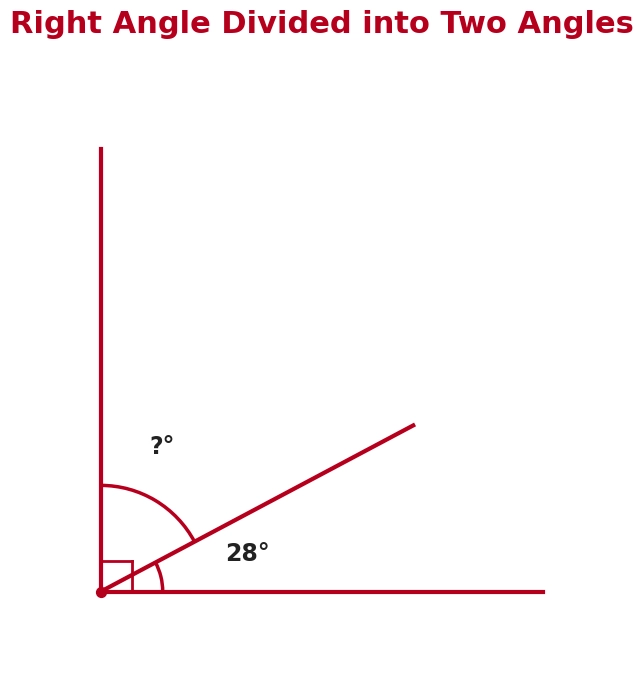
Solution: 28 + ? = 90 ? = 62°
Q2: In a right-angled triangle, one acute angle is 52°. Find the other acute angle.
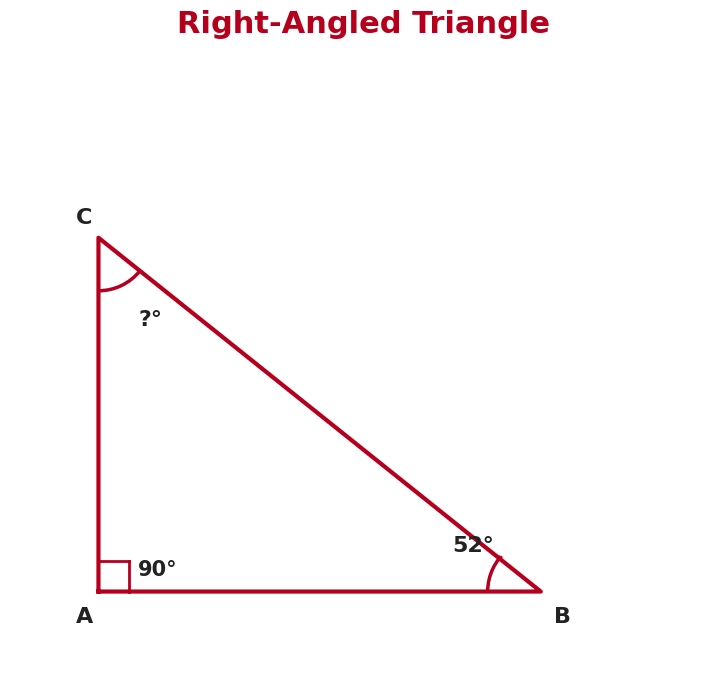
Solution: The two acute angles in a right-angled triangle are always complementary.
90 − 52 = 38°
Q3: Two angles together form a right angle. One angle is (4x)° and the other is (x + 5)°. Find both.
Solution: 4x + x + 5 = 90 5x = 85 x = 17
Angles: 4(17) = 68° and 17 + 5 = 22°
Check: 68 + 22 = 90°
Q4: Ray OC divides right angle AOB into two parts. Angle AOC = 3 × Angle COB. Find each angle.
Solution: Let angle COB = x. Then angle AOC = 3x.
3x + x = 90 4x = 90 x = 22.5°
Angle COB = 22.5°, Angle AOC = 67.5°
Complementary Angles Word Problems
Q1: A ladder leans against a wall making an angle of 62° with the ground. What angle does it make with the wall?
Solution: The angle with the wall + angle with the ground = 90° (right-angle triangle).
Angle with wall = 90 − 62 = 28°
Q2: A ramp rises at 18° from the ground. What angle does it make with a vertical wall at the top?
Solution: 18 + angle with wall = 90 Angle with wall = 72°
Q3: In a right-angled triangle ABC (right angle at C), angle A = (2x + 10)° and angle B = (x + 5)°. Find x and both angles.
Solution: A + B = 90 (complementary in a right triangle)
(2x + 10) + (x + 5) = 90 3x + 15 = 90 3x = 75 x = 25
Angle A = 60°, Angle B = 30°
Q4: Angle P and Angle Q are complementary. Angle Q and Angle R are also complementary. Prove Angle P = Angle R.
Solution: P + Q = 90 →P = 90 − Q Q + R = 90 → R = 90 − Q
Both P and R equal (90° − Q). Therefore P = R.
Complements of the same angle are always equal.
Multiple Choice Questions on Complementary Angles
Q1: Complement of 55° is: (a) 125° (b) 35° (c) 45° (d) 135°
Answer: (b) 35°
Q2: Two equal complementary angles. Each measures: (a) 90° (b) 60° (c) 45° (d) 30°
Answer: (c) 45°
Q3: Which pair is complementary? (a) 50°, 40° (b) 60°, 30° (c) 70°, 20° (d) 80°, 10°
Answer: (b) 60° + 30° = 90° (also (a), (c), (d) all are complementary ) All four options are complementary pairs.
Q4: Complement of an angle is four times itself. The angle is: (a) 18° (b) 20° (c) 22° (d) 24°
Answer: (a) 18° x + 4x = 90 → 5x = 90 → x = 18.
Q5: Two complementary angles are in ratio 4:5. The larger angle is: (a) 40° (b) 45° (c) 50° (d) 54°
Answer: (c) 50° 4k + 5k = 90 → k = 10. Larger = 5 × 10 = 50°.
Q6: If angle A = (x + 10)° and its complement = (2x − 4)°, find x: (a) 25 (b) 27 (c) 28 (d) 30
Answer: (c) 28 (x + 10) + (2x − 4) = 90 → 3x + 6 = 90 → x=28.
Q7: The complement of (90° − x) is: (a) x (b) 90°−x (c) 180°−x (d) x−90°
Answer: (a) x 90 − (90−x) = x.
Q8: If supplement of angle A = 130°, what is the complement of angle A? (a) 40° (b) 50° (c) 60° (d) 70°
Answer: (a) 40° A = 180−130 = 50°. Complement = 90 − 50 = 40°.
Download PDF - Practice Questions On Complementary Angles
Read more: Complementary Angles Supplementary Angles
Frequently Asked Questions on Complementary Angles Questions
1. What are complementary angles?
Complementary angles are two angles whose measures add up to 90°.
2. How do you identify complementary angles?
Add the two angle measures. If their sum is 90°, they are complementary angles.
3. What is the formula for complementary angles?
Angle 1 + Angle 2 = 90°
4. How do you find a missing complementary angle?
Subtract the given angle from 90°.
Example: If one angle is 35°, the other angle is 90° − 35° = 55°.
5. Can complementary angles be equal?
Yes. If both angles are 45°, they are complementary because 45° + 45° = 90°.
6. Are complementary angles always adjacent?
No. Complementary angles may or may not be adjacent. They only need to add up to 90°.
7. What is the difference between complementary and supplementary angles?
Complementary angles add up to 90°, while supplementary angles add up to 180°.
Numbers make sense when they're taught right. To see how Orchids The International School turns Maths from intimidating to intuitive, reach out to our admissions team.


Admissions Open for 2026-27
What type of concept pages would you prefer?
CBSE Schools In Popular Cities
- CBSE Schools in Bangalore
- CBSE Schools in Mumbai
- CBSE Schools in Pune
- CBSE Schools in Hyderabad
- CBSE Schools in Chennai
- CBSE Schools in Gurgaon
- CBSE Schools in Kolkata
- CBSE Schools in Indore
- CBSE Schools in Sonipat
- CBSE Schools in Delhi
- CBSE Schools in Rohtak
- CBSE Schools in Bhopal
- CBSE Schools in Aurangabad
- CBSE Schools in Jabalpur
- CBSE Schools in Jaipur
- CBSE Schools in Jodhpur
- CBSE Schools in Nagpur
- CBSE Schools in Ahmednagar
- CBSE School In Tumkur











Orchids The International School is one of India's leading chains of CBSE and ICSE schools, with 110+ schools across the country.