

How to Construct a 60° Angle: Step-by-Step Instructions
How to construct a 60 degree angle is an important geometry topic that helps learners understand the basics of angle construction using simple tools like a ruler and compass. This concept builds strong foundational skills in mathematics by showing how to make an exact 60 degree angle through clear and step-by-step geometric methods. It is useful for students because it improves accuracy, develops problem-solving skills, and supports learning in school exams and practical geometry work. In this guide, you’ll learn about the simple and accurate method to construct a 60 degree angle.
Table of Contents
- How to Construct a 60° Angle
- Constructing Related Angles From 60° Angle
- Common Mistakes to Avoid
- Frequently Asked Questions of How to Construct a 60° Angle

How to Construct a 60° Angle
Material Required to Construct a 60° Angle:
-
A pencil
-
A ruler or straightedge (for drawing straight lines only)
-
A pair of compasses that can hold its width steady
Step-by-Step: How to Construct a 60 Degree Angle
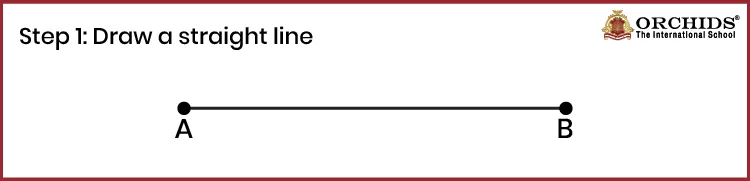
Step 1: Draw a straight line
Using your ruler, draw a straight line and mark one end A. This will be one arm of your 60° angle. Mark the other end B (the length doesn't matter, it just needs to be long enough to work with).
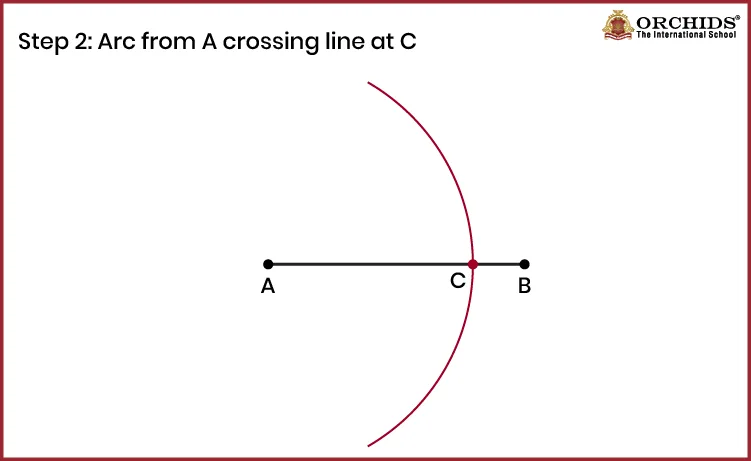
Step 2: Open your compass and draw an arc from A
Put the compass point on A and open it to any width you like. Swing an arc that crosses the line AB. Call the point where it crosses the line C.
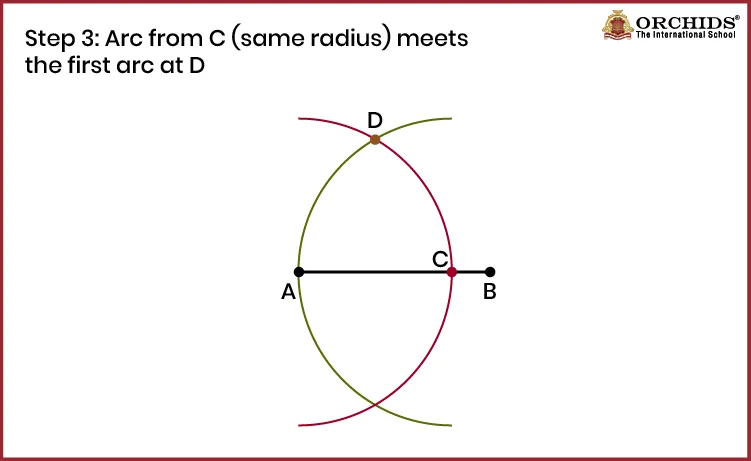
Step 3: Without changing the compass width, draw an arc from C
Move the compass point to C, keeping the exact same width you set in Step 2. Draw another arc, this one should cross over the first arc you drew. Call that intersection point D.
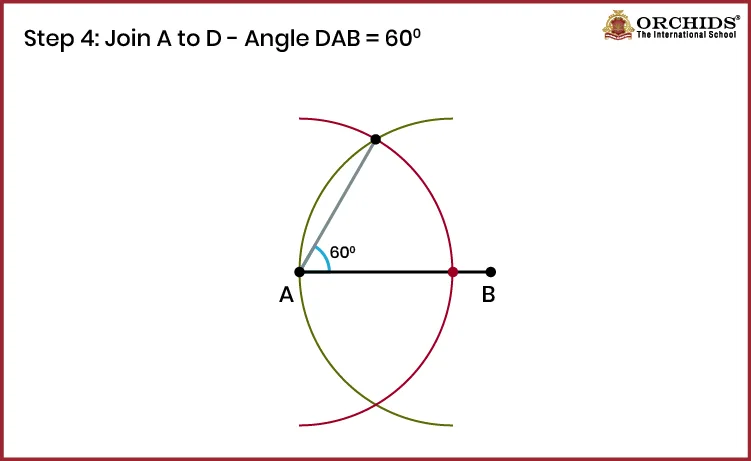
Step 4: Join A to D
Using your ruler, draw a line from A through D. The angle between this new line and your original line AB is exactly 60°. ∠DAB = 60°.
Constructing Related Angles From 60° Angle
Once you know how to construct a 60° angle, you can use it as a base to generate several other common angles easily.
-
30°: construct a 60° angle, then bisect it (draw two more arcs of equal width from A and D and join their intersection back to A). Half of 60° is 30°.
-
120°: construct a 60° angle, then construct a second, identical 60° angle on the other side of the same arc, so the two sit next to each other along the line. Together they make 120°.
-
15°: bisect a 30° angle.
Common Mistakes to Avoid
-
Changing the compass width between arcs. This is the single biggest cause of a wrong answer. Set it once in Step 2 and don't touch it again until Step 4 is done.
-
Using a blunt pencil. A thick pencil line adds real error to a small diagram.
-
Erasing the construction arcs. The arcs are the evidence that you constructed the angle rather than just drawing an approximate line.
-
Making the radius too small. A 1-2 cm compass width makes the intersection points cramped and hard to read accurately. Aim for 6 - 7 cm.
-
Confusing ‘construct’ with 'draw'. If a question says 'construct', a protractor is not an acceptable method.
Frequently Asked Questions of How to Construct a 60° Angle
1. Do I need a specific compass width to get 60°?
No. Any width works, as long as you keep it exactly the same for both arcs (Steps 2 and 3).
2. What's the difference between constructing and drawing an angle?
Drawing usually means using a protractor to measure and mark an angle. Constructing means using only a compass and straightedge.
3. Is this the same method used for constructing an equilateral triangle?
Yes. If you complete the triangle by drawing a line from B to D as well, you have a full equilateral triangle ABD.
4. What tools are needed to construct a 60° angle?
To construct a 60° angle, you need a compass, a ruler, a pencil, and a clean sheet of paper.
5. Can a 60° angle be used to construct other angles?
Yes, a 60° angle can be used as a base to construct other angles such as 30°, 120° and 150° using simple geometric methods.
Numbers make sense when they're taught right. To see how Orchids The International School turns Maths from intimidating to intuitive, reach out to our admissions team.


Admissions Open for 2026-27
What type of concept pages would you prefer?
CBSE Schools In Popular Cities
- CBSE Schools in Bangalore
- CBSE Schools in Mumbai
- CBSE Schools in Pune
- CBSE Schools in Hyderabad
- CBSE Schools in Chennai
- CBSE Schools in Gurgaon
- CBSE Schools in Kolkata
- CBSE Schools in Indore
- CBSE Schools in Sonipat
- CBSE Schools in Delhi
- CBSE Schools in Rohtak
- CBSE Schools in Bhopal
- CBSE Schools in Aurangabad
- CBSE Schools in Jabalpur
- CBSE Schools in Jaipur
- CBSE Schools in Jodhpur
- CBSE Schools in Nagpur
- CBSE Schools in Ahmednagar
- CBSE School In Tumkur











Orchids The International School is one of India's leading chains of CBSE and ICSE schools, with 110+ schools across the country.