

Euclid’s Axioms
Euclid's axioms are basic assumptions that form the foundations of Euclidean geometry. Euclid's axioms were proposed by the ancient Greek mathematician Euclid of Alexandria in his geometrical work ‘Elements’. These axioms explain how points, lines, and shapes built the entire structure of geometry. In this guide, you will learn about the axioms along with examples to help understand their real-life applications.
Table of Contents

What is an Axiom
An axiom is a self-evident or universally recognised truth. They are statements that are assumed to be true without requiring formal proof. Axioms apply to all of mathematics, not just geometry. The axioms deal with general mathematical concepts (equality, addition, subtraction, ...), while the postulates deal specifically with geometry.
Know more about related topics:
What are Euclid's Axioms
Axioms are universal truths that do not require proofs. Euclid stated seven axioms that laid the foundations of geometry that we know now.
Here are the seven axioms stated by Euclid:
-
Axiom 1: Things which are equal to the same thing are equal to one another.
If p = q and q = r, then p = r
-
Axiom 2: If equals are added to equals to equals, the wholes are equal.
If ∠A = ∠B and ∠C is added to both, then ∠A + ∠C = ∠B + ∠C
-
Axiom 3: If equals are subtracted from equals, the remainders are equal.
If ∠A = ∠B, ∠C is subtracted from both, then ∠A - ∠C = ∠B - ∠C.
-
Axiom 4: Things that coincide with one another are equal to one another.
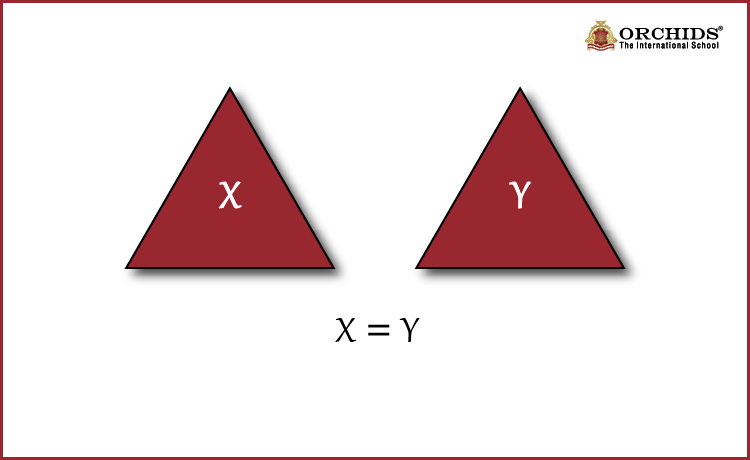
The ∆X coincides exactly with the ∆Y. Hence, ∆X = ∆Y. -
Axiom 5: The whole is greater than the part.
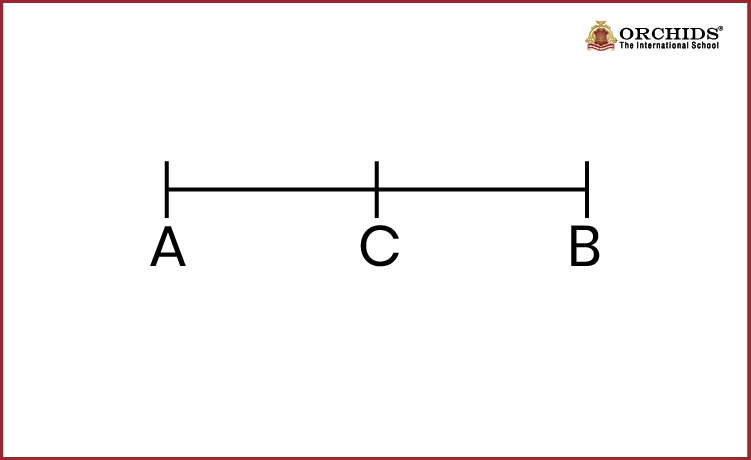
AB > AC. -
Axiom 6: Things which are double of the same things are equal to one another.
If radii r1 = r2 , then diameters d1 = d2
-
Axiom 7: Things which are halves of the same things are equal to one another.
If diameters d1 = d2, then radii r1 = r2.
Numbers make sense when they're taught right. To see how Orchids The International School turns Maths from intimidating to intuitive, reach out to our admissions team.
Frequently Asked Questions on Euclid's Axioms
1. How many axioms did Euclid state?
Euclid stated 7 axioms that deal with general mathematical ideas like addition, subtraction, coincidence, and comparing quantities
2. What is the difference between an axiom and a postulate?
Axioms and postulates are statements that are accepted as true without formal proof. The axioms deal with general mathematical concepts, while the postulates deal specifically with geometry.
3. What is the superposition principle (Axiom 4)?
Axiom 4 says that things that coincide with one another are equal to one another. It forms the basis of congruency. If one figure can be placed exactly on top of another point-to-point, then the figures are equal.
Related Links


Admissions Open for 2026-27
What type of concept pages would you prefer?
CBSE Schools In Popular Cities
- CBSE Schools in Bangalore
- CBSE Schools in Mumbai
- CBSE Schools in Pune
- CBSE Schools in Hyderabad
- CBSE Schools in Chennai
- CBSE Schools in Gurgaon
- CBSE Schools in Kolkata
- CBSE Schools in Indore
- CBSE Schools in Sonipat
- CBSE Schools in Delhi
- CBSE Schools in Rohtak
- CBSE Schools in Bhopal
- CBSE Schools in Aurangabad
- CBSE Schools in Jabalpur
- CBSE Schools in Jaipur
- CBSE Schools in Jodhpur
- CBSE Schools in Nagpur
- CBSE Schools in Ahmednagar
- CBSE School In Tumkur











Orchids The International School is one of India's leading chains of CBSE and ICSE schools, with 110+ schools across the country.