

Euclid’s Postulates
Euclid's five postulates are foundational assumptions upon which the entire Euclidean geometry is built. Euclid's postulates were proposed by the ancient Greek mathematician Euclid of Alexandria. These five postulates explain how points, lines, and shapes behave in space. In this guide, you will learn about the five postulates along with examples to help understand their real-life applications.
Table of Contents
- What is a Postulate?
- What are Euclid's Five Postulates?
- Solved Examples on Euclid's Five Postulates
- Frequently Asked Questions on Euclid's Five Postulates

What is a Postulate
Postulates in mathematics are statements in geometry that are valid without being tested or proved. They are basic structures from which lemmas and theorems are derived. They are statements that are accepted as true without proof.
Know more about related topics:
What are Euclid's Five Postulates
A postulate is a statement accepted as true without proof, serving as a starting point for further reasoning and arguments in geometry.
Euclid's five postulates are the following:
-
Postulate 1: A straight line can be drawn from any one point to any other point.
This postulate tells us that at least one straight line passes through two distinct points, but does not specify that there cannot be more than one such line. Euclid, throughout his work, assumed that there is a unique line joining two distinct points.
-
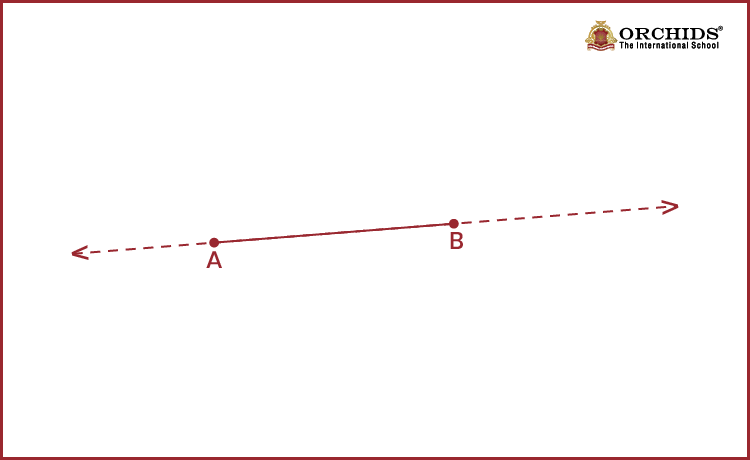
Postulate 2: A terminated line (line segment) can be further produced indefinitely on either side to form a line.
-
This postulate says that a line segment can be extended on either side to form a line.
-
Postulate 3: A circle can be drawn with any centre and any radius.
- Postulate 4: All right angles are equal to one another.
- Postulate 5 (Parallel Postulate): If a straight line falling on two straight lines makes the interior angles on the same side of it taken together less than two right angles, then the two straight lines, if produced indefinitely, meet on that side on which the sum of angles is less than two right angles.
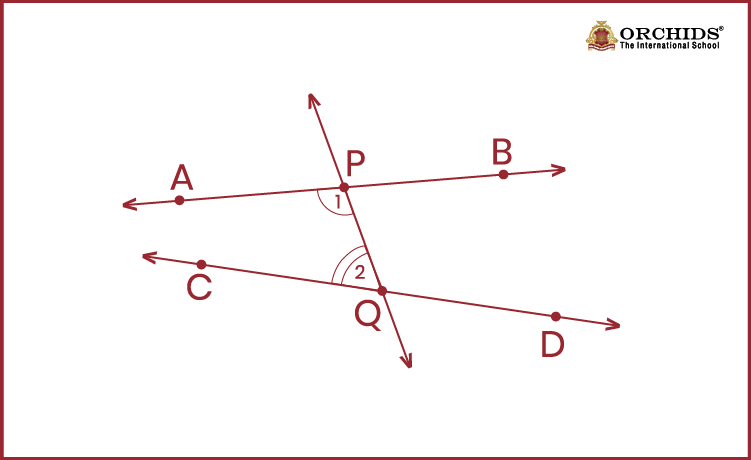
In the above figure, we can observe that line PQ intersects lines AB and CD, forming interior angles. The sum of ∠1 and ∠2 is less than 180° on the left side of PQ. ∴ Lines AB and CD will eventually intersect on the left side of PQ.
Solved Examples on Euclid's Five Postulates
Example 1: A line segment AB has length 9 cm. Can it be extended to a line of length 120 cm?
Solution: Yes. A line segment AB of length 9 cm can be extended to a line of length 120 cm using Euclid's second postulate
Example 2: Two lines are cut by a transversal. The co-interior angles on the left side are 35° and 86°. Do the lines meet on the left?
Solution: 35° + 86° = 121° < 180°.
∴ by Euclid's 5th postulate, the lines will meet on the left side.
Example 3: A transversal cuts two lines, making co-interior angles of 70° and 110° on one side. Are the lines parallel?
Solution: 70° + 110° = 180°. ∴ By Euclid's 5th postulate, the lines will be parallel to each other.
Numbers make sense when they're taught right. To see how Orchids The International School turns Maths from intimidating to intuitive, reach out to our admissions team.
Frequently Asked Questions on Euclid's Five Postulates
1. Can Euclid's postulates be proved?
No. Euclid's postulates cannot be proved. They are basic assumptions accepted without proof.
2. Does the fifth postulate imply the existence of parallel lines?
Yes. If the sum of the interior angles adds up to exactly 180°, then the lines will never meet. They will be parallel.
3. Can more than one line pass through two distinct points?
Euclid's first postulate suggests that a straight line can be drawn from any one point to any other point. But it doesn't talk about the uniqueness of the line. An addition axiom in Euclid's geometry ensures that the line is unique.
Related Links


Admissions Open for 2026-27
What type of concept pages would you prefer?
CBSE Schools In Popular Cities
- CBSE Schools in Bangalore
- CBSE Schools in Mumbai
- CBSE Schools in Pune
- CBSE Schools in Hyderabad
- CBSE Schools in Chennai
- CBSE Schools in Gurgaon
- CBSE Schools in Kolkata
- CBSE Schools in Indore
- CBSE Schools in Sonipat
- CBSE Schools in Delhi
- CBSE Schools in Rohtak
- CBSE Schools in Bhopal
- CBSE Schools in Aurangabad
- CBSE Schools in Jabalpur
- CBSE Schools in Jaipur
- CBSE Schools in Jodhpur
- CBSE Schools in Nagpur
- CBSE Schools in Ahmednagar
- CBSE School In Tumkur











Orchids The International School is one of India's leading chains of CBSE and ICSE schools, with 130+ schools across the country.