

Statistics: Important Questions and Answers for Class 10
Important questions for Class 10 Maths Chapter 14 Statistics are available in this article, carefully prepared according to the latest CBSE exam pattern and syllabus guidelines. Students preparing for the CBSE Class 10 board exams can practice these important Statistics questions to strengthen their concepts and improve their chances of scoring high marks in the examination.This chapter holds significant weightage in the Maths exam, especially for long-answer and application-based questions. To help students prepare effectively, our subject experts provides well-structured questions along with clear and detailed solutions. By practicing these important questions for Class 10 Maths Statistics, students can revise the entire chapter thoroughly, improve problem-solving skills.
Table of Contents
- Key Concepts on Triangles for Class 10
- Section A: 1-Mark Questions (MCQ & Very Short Answer)
- Section B: 2-Mark Questions (Short Answer)
- Section C: 3-Mark Questions
- Section D: 5-Mark Questions (Long Answer & Word Problems)
- Section E: Previous Year Questions (PYQs) with Solutions
- Exam Tips & Common Mistakes to Avoid
- Frequently Asked Questions on Statistics Class 10

Key Concepts of Statistics for Class 10
Before jumping into questions, let's quickly revisit what each measure tells us:
- Mean (Average)
The mean is the sum of all observations divided by the total number of observations. For grouped data, you calculate it using either the Direct Method, the Assumed Mean Method, or the Step Deviation Method. The step deviation method is especially useful when the midpoints are large or have a common factor.
- Median
The median is the middle value when data is arranged in order. For grouped data, you first find the cumulative frequencies, identify which class contains the n/2 th observation, and then apply the median formula. The median is particularly useful when the data has extreme values (outliers), because unlike the mean, it isn't distorted by them.
- Mode
The mode is the value that appears most frequently. For grouped data, the modal class is the class with the highest frequency, and you apply the mode formula using the frequencies of the classes adjacent to it.
- Empirical Relationship
Empirical relationship between these three measures that is directly tested in board exams:
Mode = 3 × Median − 2 × Mean
- Cumulative Frequency & Ogive
A cumulative frequency table adds up frequencies as you go from one class interval to the next. When you plot this on a graph, you get an ogive (a cumulative frequency curve). The point where the ‘less than’ and ‘more than’ ogives intersect gives you the median.
Know more about related topics:
Section A: Short Answer Questions (1–2 Marks)
These important questions help students test their understanding of basic definitions, the empirical formula, and simple calculations. Many of these concepts are commonly asked as repeated questions in board exams, and students can expect around 2–3 similar questions in the final paper.
Q1: In a continuous frequency distribution, the median of the data is 24. If each observation is increased by 4, what is the new median?
Solution: When every observation is increased by a fixed number, the median shifts by the same amount.
Current median = 24
New Median = 24 + 4 = 28
Q2: Find the mean of the first 10 natural numbers.
Solution: First 10 natural numbers: 1, 2, 3, 4, 5, 6, 7, 8, 9, 10
Mean = (1 + 2 + 3 + 4 + 5 + 6 + 7 + 8 + 9 + 10) / 10 = 55 / 10 = 5.5
Q3: If Mode = 80 and Mean = 110, find the Median using the empirical formula.
Solution: Given Mode = 80 and Mean = 110
Using: Mode = 3 × Median − 2 × Mean
⇒ 80 = 3 × Median − 2 × 110
⇒ 80 = 3 × Median − 220
⇒ 3 × Median = 300
⇒ Median = 100
Q4: If Mode and Mean of a data are 15x and 18x respectively, find the Median.
Solution: Given, mode = 15x and mean = 18x
Mode = 3 × Median − 2 × Mean
⇒ 15x = 3 × Median − 2(18x)
⇒ 15x = 3 × Median − 36x
⇒ 3 × Median = 51x
⇒ Median = 17x
Q5: Find the value of y if the median of the following data (arranged in ascending order) is 63:
20, 24, 42, y, y + 2, 73, 75, 80, 99
Solution: Total observations = 9 (odd), so the median is the 5th term = y + 2.
⇒ y + 2 = 63
⇒ y = 61
Q6: While checking 20 observations, 125 was wrongly recorded as 25. The wrong mean was 60. Find the correct mean.
Solution: Wrong sum = 20 × 60 = 1200
Correct sum = 1200 − 25 + 125 = 1300
⇒ Correct Mean = 1300 / 20 = 65
Q7: Construct the cumulative frequency distribution for the data below:
Class: 12.5–17.5, 17.5–22.5, 22.5–27.5, 27.5–32.5, 32.5–37.5
Frequency: 2, 22, 19, 14, 13
Solution:
Section B: Long Answer Questions (3–5 Marks)
Q1 · Find the mean of daily wages of 50 workers using the step-deviation method:
Solution: Let assumed mean A = 150, class width h = 20.
uᵢ = (xᵢ − 150) / 20
x̄ = A + h × (Σfᵢuᵢ / Σfᵢ) = 150 + 20 × (−12/50) = 150 − 4.8 = ₹145.20
Q2: The following table shows the ages of 100 patients admitted to a hospital. Find the median age.
Solution:
n = 80, so n/2 = 40. The cumulative frequency just exceeding 40 is 61, in class 35–45.
Median class: 35–45
l = 35, cf = 38, f = 23, h = 10
Median = l + [(n/2 − cf) / f] × h
= 35 + [(40 − 38) / 23] × 10
= 35 + (2/23) × 10
= 35 + 0.87 = 35.87 years
Q3: The following data gives the distribution of total monthly household expenditure of 200 families. Find the modal monthly expenditure.
Solution: The class with the highest frequency (40) is 1500–2000. This is the modal class.
l = 1500, f₁ = 40, f₀ = 24, f₂ = 33, h = 500
Mode = l + [(f₁ − f₀) / (2f₁ − f₀ − f₂)] × h
= 1500 + [(40 − 24) / (2×40 − 24 − 33)] × 500
= 1500 + [16 / 23] × 500
= 1500 + 347.83
= ₹1847.83
Q4: The following distribution shows the marks obtained by 100 students in a maths test. Find the mean and mode, and verify the empirical relationship.
Solution:
Step 1: Find the Mean (Assumed Mean Method, A = 25)
Mean = A + (Σfᵢdᵢ / Σfᵢ) = 25 + (320/100) = 25 + 3.2 = 28.2
Step 2: Find the Mode
Modal class = 20–30 (highest frequency = 35)
l = 20, f₁ = 35, f₀ = 12, f₂ = 30, h = 10
Mode = 20 + [(35−12) / (2×35−12−30)] × 10 = 20 + [23/28] × 10 = 20 + 8.21 = 28.21
Step 3: Find Median (n/2 = 50; cf just above 50 is 55 in class 20–30)
l = 20, cf = 20, f = 35, h = 10
Median = 20 + [(50−20)/35] × 10 = 20 + 8.57 = 28.57
Verify: 3 × Median − 2 × Mean = 3 × 28.57 − 2 × 28.2 = 85.71 − 56.4 = 29.31
Mode ≈ 28.21 (close; empirical relation holds approximately, as expected for real distributions)
Mean = 28.2, Mode ≈ 28.21, Median ≈ 28.57
Section C: Important MCQ Questions (1 Mark each)
MCQs appear in Section A of the CBSE board paper. These test whether you understand the concepts clearly, not just the formulas.
1. If the maximum number of students scored 52 marks out of 80, then 52 is the _____ of the data.
(A) Mean (B) Median
(C) Mode (D) Range
Answer: (C) The most frequently occurring score is the mode.
2. The mean of seven observations is 17. The mean of the first four is 15 and the last four is 18. The fourth observation is:
(A) 14 (B) 13
(C) 12 (D) 10
Answer: (B) Sum of first 4 = 60
The last 4 = 72
All 7 = 119.
Fourth observation = 60 + 72 − 119 = 13.
3. If the mean of 2, 9, x + 6, 2x + 3, 5, 10, 5 is 7, then the value of x is:
(A) 9 (B) 6
(C) 5 (D) 3
Answer: (D) Sum = 2+9+x+6+2x+3+5+10+5 = 40+3x.
Mean = (40+3x)/7 = 7
⇒ 40+3x = 49
⇒ x = 3.
4. If mode and mean of a data are 15x and 18x respectively, the median is:
(A) x (B) 11x
(C) 17x (D) 34x
Answer: (C) 15x = 3M − 2(18x)
⇒ 3M = 51x
⇒ M = 17x.
5. Which of the following cannot be determined graphically from an ogive?
(A) Median (B) Mode
(C) Quartiles (D) Mean
Answer: (D) Mean cannot be read directly from a cumulative frequency graph (ogive). Median, quartiles, and approximately even the mode can be estimated.
6. For a given data with 70 observations, the ‘less than’ ogive and ‘more than’ ogive intersect at (20.5, 35). The median of the data is:
(A) 35 (B) 20.5
(C) 70 (D) 17.5
Answer: (B) The x-coordinate of the intersection point of the two ogives gives the median.
Section D: Important Case-Based Questions
Case Study 1: Rainfall Data Across India
The India Meteorological Department records seasonal rainfall (in mm) across 24 sub-divisions. The data is given below:
(i) Write the modal class.
Answer: The class with maximum frequency is 600–800 (freq = 7). Therefore, modal class = 600–800.
(ii)(a) Find the median of the data.
Cumulative frequencies: 2, 7, 14, 18, 21, 24
n = 24, n/2 = 12. CF just exceeding 12 is 14
⇒ Median class = 600–800.
l = 600, cf = 7, f = 7, h = 200
⇒Median = 600 + [(12−7)/7] × 200 = 600 + 142.86 = 742.86 mm
(iii) How many sub-divisions had at least 800 mm of rainfall?
Answer: Frequencies for 800–1000, 1000–1200, 1200–1400 = 4 + 3 + 3 = 10 sub-divisions.
Case Study 2: Vocational Training Programme
A government skill development programme enrolled participants across different age groups. The data below shows the number of participants per age group:
(A) What is the lower limit of the modal class?
Answer: Highest frequency = 20 (class 30–35).
Lower limit = 30.
(B) Find the median class.
Total participants = 65.
n/2 = 32.5.
Cumulative frequencies: 10, 25, 37, 57, 65
CF just exceeding 32.5 is 37
⇒ Median class = 25–30.
Section E: Previous Year Questions (CBSE Board) in Statistics
CBSE 2025: If the mode of some observations is 10 and the sum of mean and median is 25, find the mean and median respectively.
Solution: Let median = M and mean = x̄. So M + x̄ = 25, i.e., M = 25 − x̄.
Mode = 3M − 2x̄
10 = 3(25 − x̄) − 2x̄
10 = 75 − 3x̄ − 2x̄
5x̄ = 65 → x̄ = 13
Median = 25 − 13 = 12
Mean = 13, Median = 12
CBSE 2025: The lengths of 40 leaves of a plant are measured correct to the nearest mm and given in the following table. Find the median length.
Solution:
These are inclusive (discontinuous) intervals. Convert to exclusive by subtracting 0.5 from lower limits and adding 0.5 to upper limits:
117.5–126.5, 126.5–135.5, 135.5–144.5, 144.5–153.5, 153.5–162.5, 162.5–171.5, 171.5–180.5
Cumulative frequencies: 3, 8, 17, 29, 34, 38, 40
n = 40, n/2 = 20.
CF just exceeding 20 is 29
⇒ Median class = 144.5–153.5
l = 144.5, cf = 17, f = 12, h = 9
⇒ Median = 144.5 + [(20−17)/12] × 9
= 144.5 + (3/12) × 9
= 144.5 + 2.25 = 146.75 mm
CBSE 2024: The following distribution shows the marks of 230 students. If the median marks are 46, find the values of x and y.
Solution
Total = 230
⇒ 12 + 30 + x + 65 + y + 25 + 18 = 230
⇒ x + y = 80 … (i)
Median = 46 lies in class 40–50 (median class).
Cumulative frequency before 40–50 = 12 + 30 + x = 42 + x
l = 40, cf = 42 + x, f = 65, h = 10, n/2 = 115
⇒ 46 = 40 + [(115 − (42+x)) / 65] × 10
⇒ 6 = [(73 − x) / 65] × 10
⇒ 6 × 65 = 10(73 − x)
⇒ 390 = 730 − 10x
⇒ 10x = 340
⇒ x = 34
From (i): y = 80 − 34 = 46
x = 34, y = 46
CBSE Sample Paper 2025
The distribution of monthly income of families is given below:
Draw both ogives and estimate the median income graphically.
Solution: N=50
N/2 = 50/2
=25
After drawing the less than ogive and more than ogive on the same graph paper, the two curves intersect at point P.
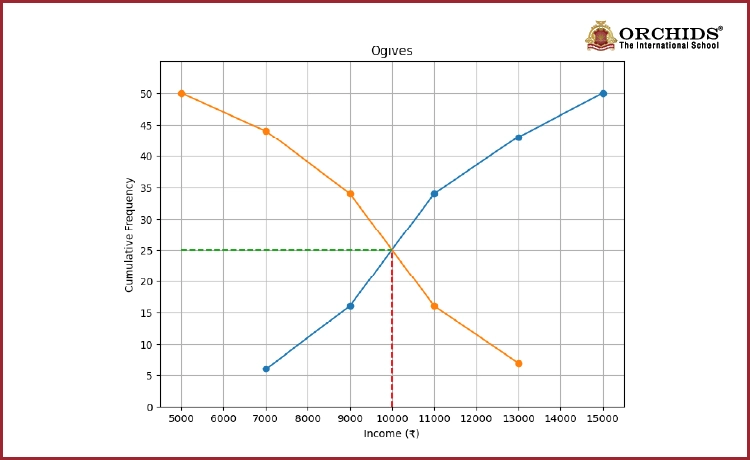
From point P:
Draw a perpendicular from P to the x-axis.
The foot of the perpendicular meets the x-axis at 10000.
Hence,
Median Income = ₹10000
Exam Tips & Common Mistakes to Avoid in Statistics
-
Always draw the frequency table: Even if the question doesn't ask for it, making a clear table with midpoints, frequencies, and derived columns saves you from mistakes.
-
Identify the correct class first: For median and mode, identifying the median class or modal class is the critical first step. Get this wrong and everything else is wrong.
-
Use empirical relation freely: If any two of mean, median, mode are given, use Mode = 3(Median) − 2(Mean) directly.
-
Remember for Ogive: Plot ‘less than’ ogive using upper class limits. Plot ‘more than’ ogive using lower class limits. Their intersection = median.
-
Watch discontinuous intervals: For data like 118–126, 127–135, convert to continuous (117.5–126.5, etc.) before applying the median formula.
Numbers make sense when they're taught right. To see how Orchids The International School turns Maths from intimidating to intuitive, reach out to our admissions team.
Frequently Asked Questions on Statistics Class 10
1. What are the main topics covered in Class 10 Statistics?
The chapter mainly covers mean, median, mode, cumulative frequency, and graphical representation of data.
2. What type of questions are commonly asked from Statistics?
Board exams usually include formula-based problems, case-study questions, and data interpretation questions from grouped frequency distributions.
3. What is cumulative frequency in Statistics?
Cumulative frequency is the running total of frequencies obtained by continuously adding frequencies of successive classes.
4. What is the difference between mean, median, and mode?
Mean is the average value, median is the middle value, and mode is the value that occurs most frequently in a data set.
5. What are cumulative frequency graphs?
Cumulative frequency graphs, also called ogives, are graphs used to represent cumulative frequencies visually.
Related Links


Admissions Open for 2026-27
What type of concept pages would you prefer?
CBSE Schools In Popular Cities
- CBSE Schools in Bangalore
- CBSE Schools in Mumbai
- CBSE Schools in Pune
- CBSE Schools in Hyderabad
- CBSE Schools in Chennai
- CBSE Schools in Gurgaon
- CBSE Schools in Kolkata
- CBSE Schools in Indore
- CBSE Schools in Sonipat
- CBSE Schools in Delhi
- CBSE Schools in Rohtak
- CBSE Schools in Bhopal
- CBSE Schools in Aurangabad
- CBSE Schools in Jabalpur
- CBSE Schools in Jaipur
- CBSE Schools in Jodhpur
- CBSE Schools in Nagpur
- CBSE Schools in Ahmednagar
- CBSE School In Tumkur











Orchids The International School is one of India's leading chains of CBSE and ICSE schools, with 110+ schools across the country.