

Important Questions on Introduction to Graphs for Class 8
Introduction to Graphs Class 8 Important Questions are available in this Maths article. Introduction to Graphs Class 8 Important Questions are very useful to solve the problems easily. This article helps the students to know the key questions and answers about Introduction to Graphs. Graphs visually represent data using points, lines, and axes to show relationships clearly. Our subject experts have provided detailed solutions for these problems based on the CBSE syllabus and the NCERT textbook. This material helps students revise the chapter easily and perform well in the final examination.
Table of Contents
- Introduction to Graphs for Class 8 - Important Questions and Answers
- Most Repeated Board Questions on Introduction to Graphs
- Most Common Examination Questions (Board Exams)
- Frequently Asked Questions on Important Questions on Introduction to Graphs for Class 8

Introduction to Graphs for Class 8 - Important Questions and Answers
This exercise introduces the basic idea of graphs and how to plot points on a grid.
Question 1: What is a Graph? Define It Simply
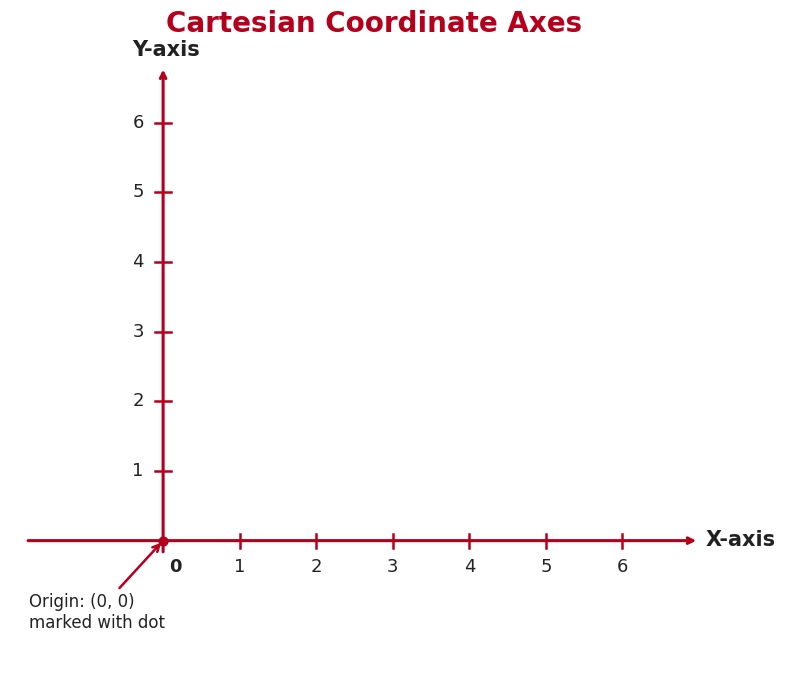
Answer: A graph is a picture that shows information using lines, points, or bars. It uses two lines called axes to create a grid where we can place points to show data.
Types of graphs:
-
Bar graphs (show amounts using bars)
-
Pie charts (show parts of a whole)
-
Line graphs (show how something changes over time)
-
Scatter plots (show relationship between two things)
Question 2: What is a Coordinate System? Explain Axes and Origin
Answer: A coordinate system is a grid made using two lines called axes. These axes help us locate any point on the graph.
The two axes:
-
Horizontal axis (X-axis): This line goes left and right. We measure distance along this line.
-
Vertical axis (Y-axis): This line goes up and down. We measure height along this line.
The origin:
-
The origin is where the two axes meet. This point is at position (0, 0).
-
It's like the center point or starting point of our graph.
Quadrants: The axes divide the graph into 4 sections called quadrants. In Class 8, we mainly work with the first quadrant where both x and y values are positive.
Question 3: What Are Coordinates? How Do We Write Them?
Answer: Coordinates are a pair of numbers that tell us exactly where a point is located on a graph.
How to write coordinates: We write coordinates as (x, y) where:
-
x is the distance along the horizontal axis (left or right)
-
y is the distance along the vertical axis (up or down)
Examples of coordinates:
-
(2, 3) means: move 2 units right, then 3 units up
-
(1, 4) means: move 1 unit right, then 4 units up
-
(3, 1) means: move 3 units right, then 1 unit up
-
(5, 2) means: move 5 units right, then 2 units up
Important rule: Always read x-coordinate first, then y-coordinate.
Question 4: Plot the Following Points on a Graph: (1, 2), (2, 4), (3, 1), (4, 3)
Solution: To plot these points, follow these steps for each point:
-
For point (1, 2):
-
Start at origin (0, 0)
-
Move 1 unit right along x-axis
-
Move 2 units up along y-axis
-
Mark the point
-
For point (2, 4):
-
Start at origin (0, 0)
-
Move 2 units right along x-axis
-
Move 4 units up along y-axis
-
Mark the point
-
For point (3, 1):
-
Start at origin (0, 0)
-
Move 3 units right along x-axis
-
Move 1 unit up along y-axis
-
Mark the point
-
For point (4, 3):
-
Start at origin (0, 0)
-
Move 4 units right along x-axis
-
Move 3 units up along y-axis
-
Mark the point
All four points are now plotted on the graph.
Question 5: Read the Coordinates of Points from a Graph
Instruction: Given a graph with marked points, read their coordinates.
How to read coordinates:
-
Look at where the point is located
-
Check its distance from origin along x-axis (left or right)
-
Check its distance from origin along y-axis (up or down)
-
Write coordinates as (x, y)
Example: If a point is 3 units right and 2 units up from origin, its coordinates are (3, 2) If a point is 5 units right and 4 units up from origin, its coordinates are (5, 4)
Question 6: Which Coordinate Comes First, X or Y? Why?
Answer: The x-coordinate comes first. We always write (x, y).
Why? This is a standard agreement in mathematics. Just like we read from left to right in English, we follow the same order for coordinates. X comes before Y alphabetically, so x-coordinate comes before y-coordinate.
Memory trick: Think of "x" as horizontal (left-right) and "y" as vertical (up-down). Since we read left to right before up and down, x comes first.
Question 7: What is a Straight Line Graph? When Do We Use It?
Answer: A straight line graph shows the relationship between two quantities that have a constant relationship. The points on the graph form a straight line.
When we use straight line graphs:
-
To show how distance changes with time
-
To show how temperature changes day by day
-
To show how cost changes with quantity
-
To show how marks increase with study hours
-
To show any relationship that changes at a constant rate
Characteristics:
-
All points lie on a straight line
-
The relationship is consistent (doesn't jump or change)
-
Easy to predict future values by extending the line
Question 8: Make a Table of Values and Draw a Straight Line Graph for y = 2x
Solution: First, make a table by choosing different values for x and calculating y = 2x:
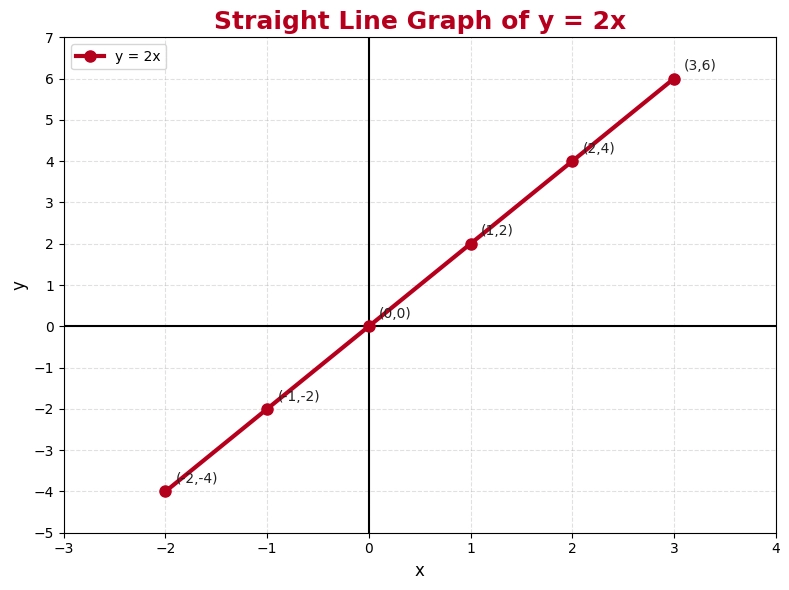
If x = 0, then y = 2(0) = 0, Point: (0, 0)
If x = 1, then y = 2(1) = 2, Point: (1, 2)
If x = 2, then y = 2(2) = 4, Point: (2, 4)
If x = 3, then y = 2(3) = 6, Point: (3, 6)
If x = 4, then y = 2(4) = 8, Point: (4, 8)
If x = 5, then y = 2(5) = 10, Point: (5, 10)
Table:
x | 0 | 1 | 2 | 3 | 4 | 5
y | 0 | 2 | 4 | 6 | 8 | 10
To draw the graph:
-
Plot all these points on graph paper
-
Join them with a straight line
-
You should get a straight line passing through the origin
Question 9: Identify If the Following Points Lie on the Line y = 3x: (1, 3), (2, 5), (2, 6), (3, 9)
Solution: To check if a point lies on the line y = 3x, substitute the x-value and see if we get the given y-value.
For (1, 3): If x = 1, then y = 3(1) = 3 Given point: (1, 3) YES, this point lies on the line
For (2, 5): If x = 2, then y = 3(2) = 6 Given point: (2, 5) NO, this point does NOT lie on the line
For (2, 6): If x = 2, then y = 3(2) = 6 Given point: (2, 6) YES, this point lies on the line
For (3, 9): If x = 3, then y = 3(3) = 9 Given point: (3, 9) YES, this point lies on the line
Answer: Points (1, 3), (2, 6), and (3, 9) lie on the line. Point (2, 5) does not.
Question 10: What is Slope in a Line Graph? How Does It Affect the Graph?
Answer: The slope is the steepness of a line. It tells us how much y changes when x changes.
Slope formula: Slope = Change in y / Change in x = (y₂ - y₁) / (x₂ - x₁)
What slope means:
-
Steep slope: Line goes up quickly (big change in y for small change in x)
-
Gentle slope: Line goes up slowly (small change in y for small change in x)
-
Positive slope: Line goes up as you move right
-
Negative slope: Line goes down as you move right
-
Zero slope: Line is horizontal (flat)
Example: For the line y = 2x:
-
When x changes by 1, y changes by 2
-
So the slope is 2
-
The line goes up steeply
For the line y = x:
-
When x changes by 1, y changes by 1
-
So the slope is 1
-
The line goes up less steeply than y = 2x
Question 11: Draw a Graph of y = x + 2 and Identify Its Key Features
Solution: First, make a table:
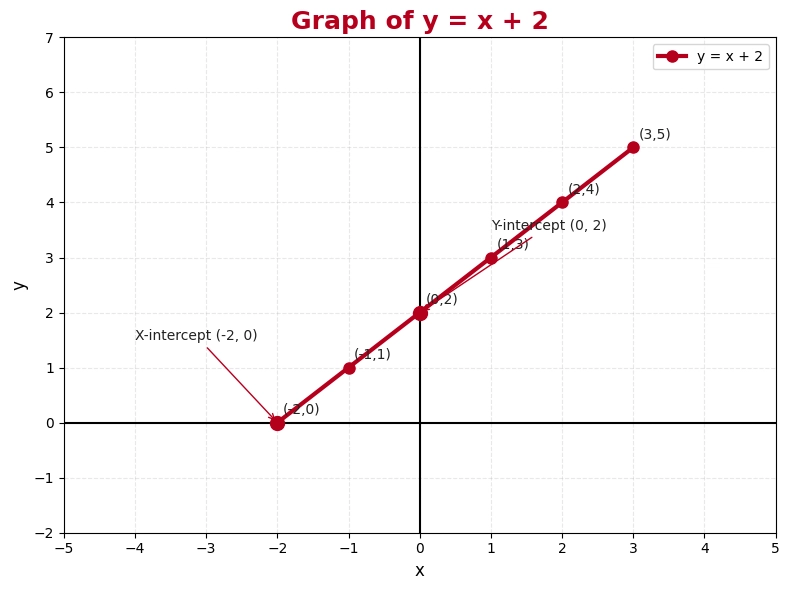
If x = 0, then y = 0 + 2 = 2, Point: (0, 2)
If x = 1, then y = 1 + 2 = 3, Point: (1, 3)
If x = 2, then y = 2 + 2 = 4, Point: (2, 4)
If x = 3, then y = 3 + 2 = 5, Point: (3, 5)
If x = 4, then y = 4 + 2 = 6, Point: (4, 6)
Key features:
-
Y-intercept: The point where line crosses y-axis = (0, 2)
-
Slope: The line goes up 1 unit for every 1 unit right = 1
-
Direction: The line goes up from left to right
-
Type of relationship: Linear (straight line)
Question 12: Interpret a Line Graph Showing Distance vs Time
Instruction: Given a line graph showing how distance changes with time, answer questions about it.
How to interpret:
-
Read the title to understand what is being shown
-
Check the axes to understand what x and y represent
-
Look at the shape - is line going up, down, or flat?
-
Calculate slope to understand the speed of change
-
Make predictions by extending the line
Example questions we might answer:
-
At what time did they reach a certain distance?
-
How far did they travel in a certain time?
-
What was the speed of travel?
-
Did the speed change during the journey?
Question 13: How Do We Read Information from a Bar Graph?
Answer: To read information from a bar graph, follow these steps:
-
Read the title - This tells you what the graph is about
-
Check the axes labels - Understand what each axis represents
-
Look at the scale - Understand the numbers on the axes
-
Find the relevant bar - Look for the category you're interested in
-
Read the height - See how tall or long the bar is
-
Compare - Compare different bars to see which is higher/lower
Example: If a bar graph shows "Favorite Sports of 50 Students" with bars for Cricket, Football, and Basketball:
-
The height of each bar shows how many students like that sport
-
A tall bar means more students like it
-
A short bar means fewer students like it
Question 14: What Information Can We Get from a Pie Chart?
Answer: From a pie chart, we can get:
Direct information:
-
What fraction or percentage each part takes
-
Which part is the biggest (largest slice)
-
Which part is the smallest (smallest slice)
-
How many total items are involved
Comparative information:
-
Compare different parts
-
See which part is about double another
-
See which part is about half another
How to read a pie chart:
-
Read the title to understand the topic
-
Look at the legend to understand what each slice represents
-
Compare slice sizes to see which is biggest/smallest
-
Read the percentages or fractions if given
-
Calculate actual amounts if total is known
Example: If a pie chart shows "How 100 students spend their time":
-
Sleep: 40% (40 students)
-
Study: 30% (30 students)
-
Play: 20% (20 students)
-
Other: 10% (10 students)
We can see that sleep takes the biggest part and other activities take the smallest.
Question 15: Compare Bar Graphs and Line Graphs. When Should We Use Each?
Answer: Both graphs show information, but they're used differently:
Bar Graphs:
-
Use bars of different heights
-
Show amounts that can be compared
-
Good for comparing categories (like favorite colors, sports, subjects)
-
Can compare many categories easily
-
Don't show continuous change
Line Graphs:
-
Use dots connected by lines
-
Show how something changes over time
-
Good for showing trends (temperature over days, sales over months)
-
Show whether values are going up or down
-
Can show continuous change
When to use Bar Graphs:
-
Comparing different items (brands, colors, subjects)
-
Showing separate categories
-
Data doesn't happen in order
When to use Line Graphs:
-
Showing change over time
-
Showing trends and patterns
-
Data happens in sequence (days, months, years)
-
Want to see if values are increasing or decreasing
Most Repeated Board Questions on Introduction to Graphs
Question 1: Plotting Points on Coordinate Plane
Question 2: Reading Coordinates from Graph
Question 3: Creating Table and Drawing Line Graph
Question 4: Checking If Point Lies on Line
Question 5: Interpreting Data Graphs
Question 6: Finding Slope of Line
Question 7: Distance-Time Graph Analysis
Question 8: Comparing Multiple Graphs
Question 9: Real-World Graph Application
Question 10: Choosing Appropriate Graph Type
Most Common Examination Questions (Board Exams)
1 - 2 Mark Questions (Very Frequently Asked):
-
Write the coordinates of origin Answer: (0, 0)
-
If a point is 3 units right and 4 units up, what are its coordinates? Answer: (3, 4)
-
In which quadrant is the point (2, 3) located? Answer: First quadrant
-
What does y-axis represent? Answer: Vertical axis / height / vertical distance
-
What does x-axis represent? Answer: Horizontal axis / distance / horizontal distance
-
Is the point (2, 5) on the line y = 2x + 1? Answer: Yes (because 5 = 2(2) + 1 = 5)
-
Name one type of graph Answer: Bar graph / Pie chart / Line graph
-
When should we use a line graph? Answer: To show change over time
-
What is the slope of the line y = 3x? Answer: 3
-
How many points define a unique straight line? Answer: 2 points
3 - 4 Mark Questions (Frequently Asked):
-
Plot the points (1, 2), (2, 4), (3, 6) and draw the line Solution: Table, Plot, Draw line through points
-
Create a table for y = 2x for x = 0 to 3 Solution: Calculate y for each x, Make table, Show results
-
Does (3, 7) lie on y = 2x + 1? Solution: Substitute, Calculate: 7 = 2(3) + 1 = 7,Yes
-
Find slope between (1, 2) and (3, 8) Solution: (8-2)/(3-1) = 6/2 = 3
-
Interpret: A graph shows sales increasing. What does this mean? Solution: Sales are going up, Business is doing well, More customers buying
-
Draw a bar graph for given frequency table Solution: Create axes, Mark bars with correct heights, Add labels
-
Which graph shows change over time best? Solution: Line graph (with reason)
-
A distance-time graph is horizontal. What does this mean? Solution: No distance covered, Object is stationary/stopped
-
Compare two line graphs for best-selling product Solution: Compare slopes and final values, Determine which is higher
-
Read coordinates of points from given graph Solution: Count units and write (x, y) for each point
5 - 6 Mark Questions (Less Frequent but Important):
-
Draw graph of y = x + 3 and find 3 properties Solution: Make table, Plot, Find slope, Find intercept, Describe line
-
Interpret real graph: Temperature vs Days Solution: Read graph, Identify max/min, Find trend, Make prediction
-
Compare cost for two products using graphs Solution: Draw both graphs, Compare slopes and points, Determine cheaper option
-
Create and interpret distance-time graph for journey Solution: Make table, Draw graph, Calculate speed, Describe journey
-
Analyze multiple graphs and find pattern Solution: Compare all graphs, Identify similarities, Explain patterns
-
Explain why different graphs show same data differently Solution: Show examples, Compare visual impacts, Explain scale effects
-
Project the value using line graph trend Solution: Identify trend, Extend line, Read projected value, Verify with calculation
-
Create pie chart and bar graph from same data and compare Solution: Make both graphs, Compare information shown, Explain when to use each
-
Interpret speed from distance-time graph Solution: Read graph, Calculate speed from points, Explain meaning
-
Design experiment to collect data and present with graph Solution: Plan experiment, Collect data, Make table, Draw appropriate graph, Explain
Frequently Asked Questions on Important Questions on Introduction to Graphs for Class 8
1. What is a graph in mathematics?
A graph is a visual representation of data that helps us understand and compare information easily.
2. Why are graphs important in Class 8 Maths?
Graphs help students organize data, identify patterns, and interpret information quickly.
3. What are the main types of graphs taught in Class 8?
The main types of graphs include:
- Bar Graphs
- Line Graphs
- Pie Charts
- Histograms
4. What is a line graph?
A line graph represents data points connected by straight lines to show changes over time.
5. How do you plot points on a graph?
Plot points by locating the x-coordinate on the horizontal axis and the y-coordinate on the vertical axis, then marking their intersection.
6. What are the most important graph questions for Class 8 exams?
Important questions include:
- Reading data from graphs
- Drawing bar graphs
- Plotting points
- Interpreting line graphs
- Comparing data using graphs
Numbers make sense when they're taught right. To see how Orchids The International School turns Maths from intimidating to intuitive, reach out to our admissions team.


Admissions Open for 2026-27
What type of concept pages would you prefer?
CBSE Schools In Popular Cities
- CBSE Schools in Bangalore
- CBSE Schools in Mumbai
- CBSE Schools in Pune
- CBSE Schools in Hyderabad
- CBSE Schools in Chennai
- CBSE Schools in Gurgaon
- CBSE Schools in Kolkata
- CBSE Schools in Indore
- CBSE Schools in Sonipat
- CBSE Schools in Delhi
- CBSE Schools in Rohtak
- CBSE Schools in Bhopal
- CBSE Schools in Aurangabad
- CBSE Schools in Jabalpur
- CBSE Schools in Jaipur
- CBSE Schools in Jodhpur
- CBSE Schools in Nagpur
- CBSE Schools in Ahmednagar
- CBSE School In Tumkur











Orchids The International School is one of India's leading chains of CBSE and ICSE schools, with 130+ schools across the country.