

Class 9 Maths Chapter 5 ‘I’m Up and Down, and Round and Round’ Notes: Complete Guide for CBSE Board Exams
Chapter 5: I’m Up and Down, and Round and Round clear NCERT-aligned notes to master circle geometry are available in this article. This chapter develops a solid foundation in circle geometry and related straight-line concepts. Starting with key definitions, symmetries of a circle the core topics cover chords and the angles they subtend, midpoints and perpendicular bisectors of chords, the distance of a chord from the centre, angles subtended by arcs, and the concyclicity of points. Each concept is explained step-by-step with CBSE-style explanation, clear constructions, and diagram-based reasoning. Ideal for Class 9 students preparing for board exams and unit tests, these concise notes include revision bullets, common mistakes to avoid, practice problems with solutions, and shortcut strategies to improve accuracy and speed.
Table of Contents
- Key Definitions
- Symmetries of a Circle
- How Many Circles Can Pass Through Given Points?
- Chords and the Angles They Subtend
- Midpoints and Perpendicular Bisectors of Chords
- Distance of Chords from the Centre
- Angles Subtended by an Arc
- Concyclicity of Points
- Frequently Asked Questions of Chapter 5: I’m Up and Down, and Round and Round Notes for Class 9

Key Definitions
-
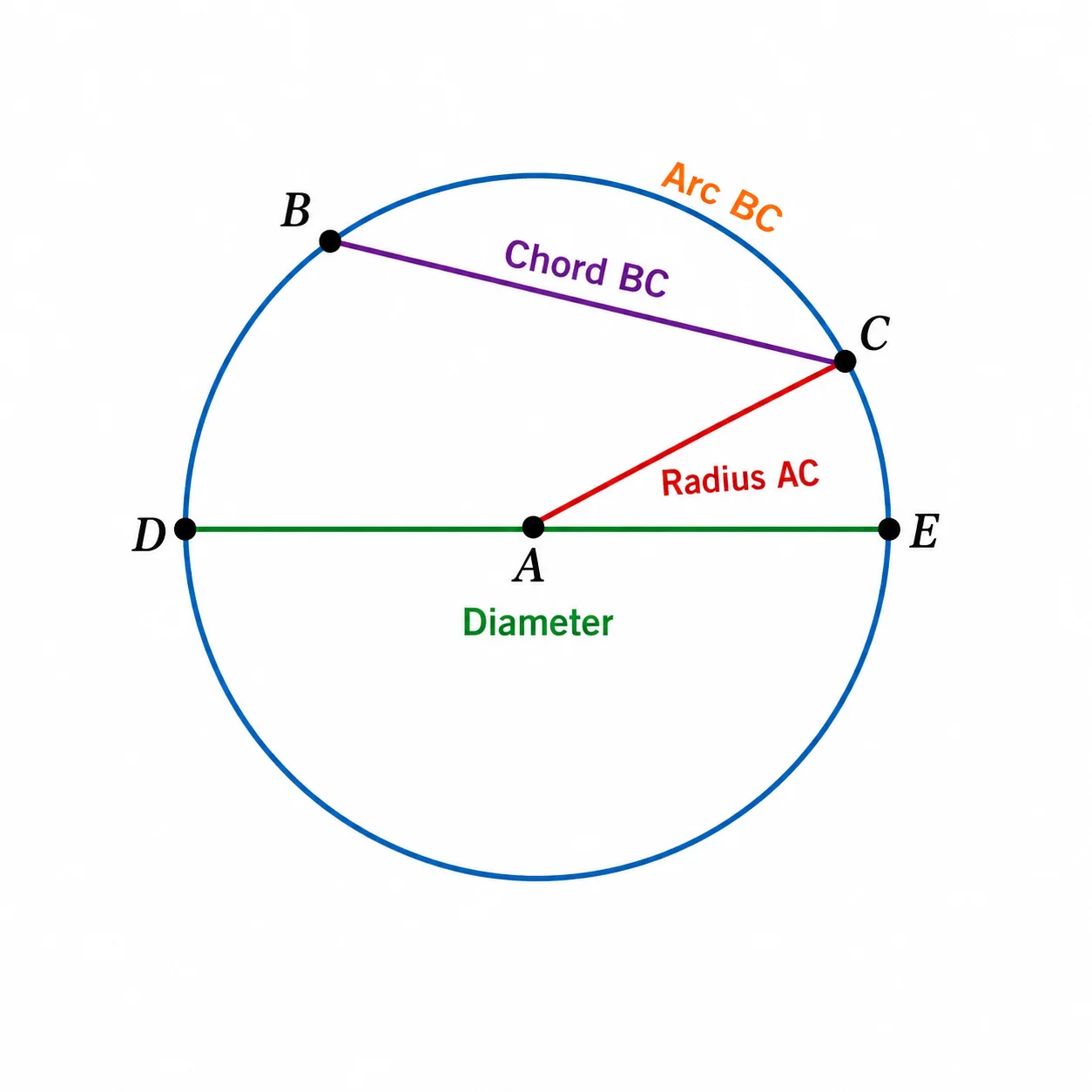
Circle: A circle is the set of all points in a plane that are equidistant from a fixed point called the centre. The constant distance is called the radius.
-
Radius: The distance from the centre to any point on the circle. All radii of the same circle are equal.
-
Chord: A line segment joining any two points on the circle. Example: if B and C are on the circle, BC is a chord.
-
Diameter: A chord that passes through the centre. It is the longest chord and equal to twice the radius (d = 2r).
-
Arc: A connected portion of the circle between two points. The larger part is the major arc; the smaller is the minor arc.
-
Central Angle: The angle subtended by a chord (or arc) at the centre of the circle.
-
Circumcircle: The unique circle that passes through all three vertices of a triangle. Its centre is the circumcentre.
-
Cyclic Quadrilateral: A quadrilateral whose four vertices all lie on a circle. Also called a cyclic 4-gon.
-
Concyclic: Points that all lie on the same circle are said to be concyclic.
Know more about related topics:
- Class 9 Maths Mcqs Chapter 5 Im Up And Down And Round And Round
- Class 9 Maths Case Study Chapter 5 Im Up And Down And Round And Round
- Important Questions Class 9 Maths Im Up And Down And Round And Round
- Assertion Reason Questions For Class 9 Maths Chapter 5 Im Up And Down And Round And Round
- Arithmetic Progression
Symmetries of a Circle
There are two types of symmetry in a circle:
1. Rotational symmetry: rotate by any angle about the centre; the circle maps onto itself.
2. Reflection symmetry: every diameter is a line of reflection symmetry. Since there are infinitely many diameters, a circle has infinitely many lines of reflection symmetry.
How Many Circles Can Pass Through Given Points?
Through 1 point: Infinitely many circles (any circle that passes through that point).
Through 2 points A and B: Infinitely many. If a circle passes through A and B, its centre must be equidistant from A and B, meaning the centre lies on the perpendicular bisector of AB. Every single point on that perpendicular bisector is equidistant from A and B, so each such point can serve as the centre of a different circle through A and B.
The smallest circle through two points A and B has its centre at the midpoint of AB (so AB is a diameter), with radius = AB/2.
Through 3 non-collinear points: Exactly ONE circle.
Theorem 1: There is a unique circle passing through three non-collinear points.
Let the three points be A, B, C (not on a straight line). Draw the perpendicular bisectors of AB and AC. Since A, B, C are non-collinear, these two perpendicular bisectors are not parallel, they intersect at exactly one point O. This O is equidistant from all three points (OA = OB = OC), so it's the unique centre of the unique circle through A, B, C.
The circle through the three vertices of a triangle is its circumcircle, and the point O is the circumcentre.
Where does the circumcentre lie?
• Acute-angled triangle: circumcentre is inside the triangle.
• Obtuse-angled triangle: circumcentre is outside the triangle.
• Right-angled triangle: circumcentre lies at the midpoint of the hypotenuse.
What if the 3 points are collinear? No circle can pass through 3 collinear (straight-line) points. The perpendicular bisectors of two segments on the same line are parallel and never meet so there's no common point that could serve as a centre.
Chords and the Angles They Subtend
Theorem 2: Equal chords of a circle subtend equal angles at the centre.
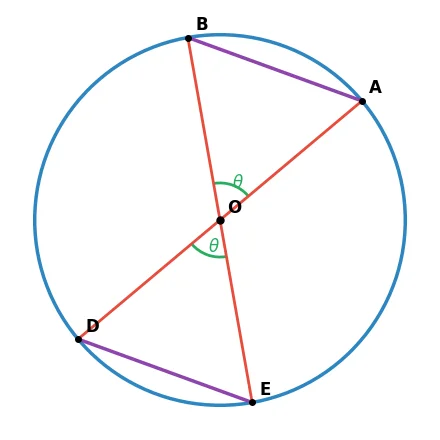
Proof: Let AB and DE be chords with AB = DE.
Since CA = CB = CD = CE = radius (r)
Triangles CAB and CDE have three equal sides (SSS congruence).
Therefore ∠ACB = ∠DCE.
Theorem 3 (Converse of Theorem 2)
Chords of a circle that subtend equal angles at the centre are equal.
Proof idea: Given ∠ACB = ∠DCE. Since AC = BC = DC = EC = r, by SAS congruence △ACB ≅ △DCE.
Hence AB = ED.
Midpoints and Perpendicular Bisectors of Chords
Theorem 4: The line joining the centre of a circle and the midpoint of a chord is perpendicular to the chord.
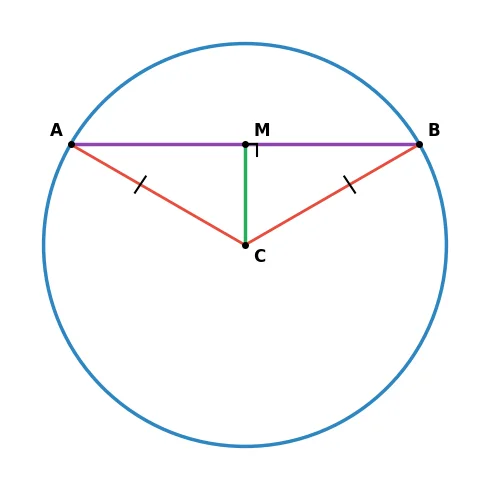
Proof: Let AB be a chord, M its midpoint, C the centre.
△CAB is isosceles (CA = CB = r).
M is the midpoint of AB, so AM = BM.
By SAS congruence, △CMA ≅ △CMB, giving ∠CMA = ∠CMB.
Since these two angles together make 180° (they are on a straight line), each equals 90°. So CM ⊥ AB.
Theorem 5 (Converse of Theorem 4)
The perpendicular from the centre of a circle to a chord bisects the chord.
Proof: Given CM ⊥ AB, then ∠CMA = ∠CMB = 90°.
In right triangles CMA and CMB, CM is common and CA = CB = r.
By RHS congruence, AM = BM
Distance of Chords from the Centre
Theorem 6
Chords of a circle having the same length are all at the same distance from the centre.
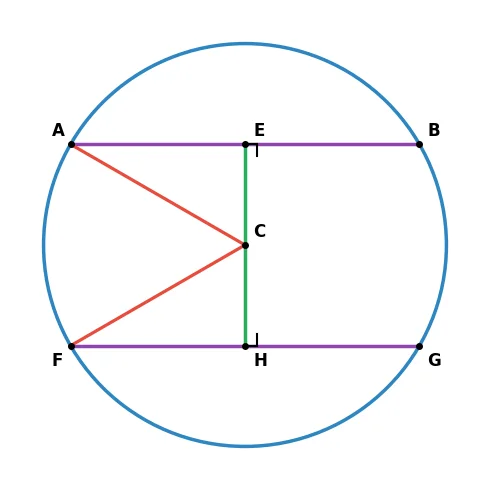
Proof: Let AB = FG.
Drop perpendiculars CE and CH from centre C to chords AB and FG.
△CEA and △CHF are right triangles with hypotenuse CA = CF (= radius) and equal half-chords.
AE = FH, since AB = FG and E, H are midpoints.
By RHS congruence, CE = CH.
Theorem 7 (Converse of Theorem 6)
Chords of a circle that are equidistant from the centre have equal length.
Theorem 8
If AB and DE are two chords of a circle and AB > DE, then the distance from the centre to AB is less than the distance from the centre to DE. (Longer chord is closer to the centre.)
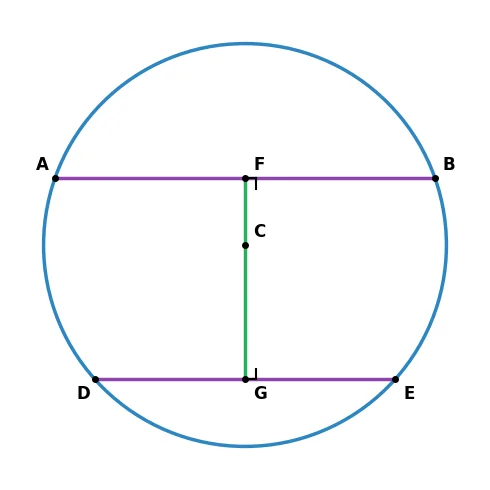
Proof: Drop perpendiculars CF and CG to AB and DE.
CF² + AF² = r² = CG² + GD².
Since AB > DE, AF > GD (as F and G are midpoints).
So AF² > GD², which gives CF² < CG², i.e., CF < CG.
Note:
-
Chord Length Formula
Chord = 2√(r² − d²)
Where
r = radius, d = perp. distance
-
Distance from Centre
d = √(r² − (chord/2)²)
Angles Subtended by an Arc
Two points A and B on a circle divide it into two arcs. The smaller one is the minor arc, and the larger one is the major arc. The central angle subtended by an arc is the angle swept at the centre as we move along that arc.
Theorem 9: The Inscribed Angle Theorem
The angle subtended by an arc at the centre of the circle is double the angle subtended by the same arc at any point on the circle outside the arc.
Proof: Let AFB be an arc. Let C be the centre, D a point outside the arc.
Extend DC to meet the arc at E.
△DCB is isosceles (CB = CD), so ∠CBD = ∠CDB.
By the exterior angle theorem, ∠BCE = 2∠BDC.
Similarly, for △ADC: ∠ACE = 2∠CDA.
Adding: ∠BCA = ∠BCE + ∠ACE = 2∠BDA.
Important Corollary
The angle subtended by a diameter at any point on the circle is always 90°. (Angle in a semicircle is a right angle.)
Concyclicity of Points
Theorem 10
If a line segment AB joining two points A, B subtends equal angles at two other points C, D that lie on the same side of AB, then all four points A, B, C, D lie on a single circle (are concyclic).
Proof: Suppose A, B, C are non-collinear. By Theorem 1 there is a unique circle through A, B and C. We will prove that D also lies on this circle. Draw the circle through A, B and C. Assume, for contradiction, that D does not lie on the circle; then D is either outside it or inside it. Join A to D.
If D lies outside the circle, the line AD meets the circle again at a point E. If D lies inside the circle, extend AD to meet the circle at E. In either case, the points C and E lie on the same arc determined by the chord AB, so ∠ACB = ∠AEB (angles in the same segment).
Now the two cases:
If D is outside the circle, then ∠AEB is an exterior angle of triangle BED, so ∠AEB > ∠ADB. But ∠AEB = ∠ACB (angles in the same segment) and ∠ACB = ∠ADB (given). Thus ∠ACB > ∠ACB, a contradiction.
If D is inside the circle, then ∠ADB is an exterior angle of triangle BED, and a similar argument again leads to a contradiction.
Since both possibilities (D outside or inside) produce contradictions, D cannot be outside or inside the circle. Therefore D must lie on the circle through A, B and C.
Theorem 11
The sum of two opposite angles of a cyclic quadrilateral is 180°.
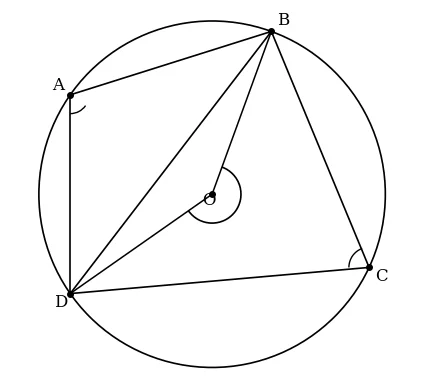
Proof: In cyclic quadrilateral ABCD
Consider arc BCD; point A is on the circle and it lies outside the arc BCD. So ∠BAD is half the angle that arc BCD subtends at the centre O.
So, ∠BAD = 1/2 (reflex angle BOD).
∠BAD = ½ (reflex ∠BOD) and ∠BCD = ½ (∠BOD).
Together: ∠BAD + ∠BCD = ½ × 360° = 180°.
Theorem 12 (Converse of Theorem 11)
If two opposite angles of a quadrilateral add up to 180°, then the four vertices lie on a circle (the quadrilateral is cyclic).
Click below to download your free Class 9 Chapter 5: I’m Up and Down, and Round and Round PDF Notes perfect for last-minute CBSE board exam revision.
Download PDF - Class 9 Chapter 5: I’m Up and Down, and Round and Round Notes
Frequently Asked Questions of Chapter 5: I’m Up and Down, and Round and Round Notes for Class 9
1. What is the difference between a chord and a diameter?
A chord is any line segment joining two points on a circle. A diameter is a special chord that passes through the centre and it is the longest possible chord.
2. How many circles can pass through three given points?
If the three points are non-collinear (not on a straight line), exactly one circle passes through them. If the three points are collinear (on the same line), no circle can pass through all three.
3. Where does the circumcentre lie for different types of triangles?
For an acute-angled triangle, the circumcentre lies inside the triangle. For an obtuse-angled triangle, it lies outside the triangle. For a right-angled triangle, the circumcentre lies exactly at the midpoint of the hypotenuse.
4. What is the inscribed angle theorem?
The theorem states that the angle subtended by an arc at the centre is double the angle it subtends at any point on the remaining part of the circle.
Numbers make sense when they're taught right. To see how Orchids The International School turns Maths from intimidating to intuitive, reach out to our admissions team.


Admissions Open for 2026-27
What type of concept pages would you prefer?
CBSE Schools In Popular Cities
- CBSE Schools in Bangalore
- CBSE Schools in Mumbai
- CBSE Schools in Pune
- CBSE Schools in Hyderabad
- CBSE Schools in Chennai
- CBSE Schools in Gurgaon
- CBSE Schools in Kolkata
- CBSE Schools in Indore
- CBSE Schools in Sonipat
- CBSE Schools in Delhi
- CBSE Schools in Rohtak
- CBSE Schools in Bhopal
- CBSE Schools in Aurangabad
- CBSE Schools in Jabalpur
- CBSE Schools in Jaipur
- CBSE Schools in Jodhpur
- CBSE Schools in Nagpur
- CBSE Schools in Ahmednagar
- CBSE School In Tumkur











Orchids The International School is one of India's leading chains of CBSE and ICSE schools, with 130+ schools across the country.