

Case Study Questions on Chapter 5 ‘Im Up and Down and Round and Round’ for Class 9 Maths
This set of case-study questions for Chapter 5: I'm Up and Down and Round and Round offers short, focused problem scenarios designed to build exam-ready skills in motion and circular geometry topics covered in Class 9. Step-by-step solutions show clear reasoning, highlight key formula use, and point out typical traps students face during tests.A free PDF with answer keys and timed practice sets is included for offline revision, classroom worksheets, and homework ideal for quick revision and targeted skill building before tests.
Know more about related topics:
- Class 9 Maths Mcqs Chapter 5 Im Up And Down And Round And Round
- Class 9 Maths Notes Chapter 5 Im Up And Down And Round And Round
- Important Questions Class 9 Maths Im Up And Down And Round And Round
- Assertion Reason Questions For Class 9 Maths Chapter 5 Im Up And Down And Round And Round
- Class 9 Maths Case Study Chapter 6 Measuring Space Perimeter And Area
Case Study Questions Class 9 Chapter 5: I'm Up and Down, and Round and Round With Answers
CBSE's case-based questions usually give you a short passage describing a real situation, sometimes with a small figure, followed by 4 - 5 questions of increasing difficulty, a couple of MCQs to check basic understanding, a short-answer question that needs a calculation, and a longer question that asks you to interpret or justify your answer.
Case Study 1: The Giant Wheel at the Fair
Read the passage and answer the questions below.
A travelling fair has set up a giant wheel with centre O and a radius of 21 m. Two cabins, A and B, are fixed on the rim such that the straight-line distance AB between them is also 21 m. An engineer wants to check the wheel's balance by drawing a line from the centre O straight down to the midpoint M of the chord AB.
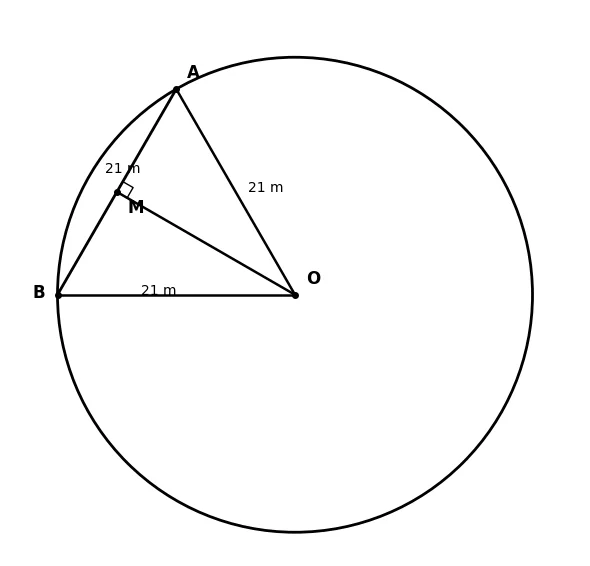
Q1. What is the length of the longest possible chord that can be drawn in this wheel?
(a) 21 m (b) 35 m
(c) 42 m (d) Cannot be determined
Q2. Since AB = 21 m, which is equal to the radius, what is the measure of ∠AOB?
Q3. The line OM drawn from the centre to the midpoint of chord AB makes what angle with AB?
(a) 45° (b) 60°
(c) 75° (d) 90
Q4. After the wheel completes one full rotation, an observer notices it looks identical to its starting position at several points along the way. This property of the circle is called:
Q5. How many lines of reflection symmetry does the rim of the wheel (the circle) have?
Solution:
Q1: (c) 42 m
The longest chord of any circle is its diameter, which is twice the radius. Here, 2 × 21 m = 42 m.
Q2. Since OA = OB = AB = 21 m, triangle OAB has all three sides equal, making it equilateral. Every angle in an equilateral triangle measures 60°, so ∠AOB = 60°.
(d) 90°
Q3. This follows directly from the theorem that the line joining the centre of a circle to the midpoint of a chord is always perpendicular to that chord.
Q4. Complete rotational symmetry
A circle looks exactly the same no matter what angle you rotate it through around its centre. This is its defining symmetry, distinct from shapes like a square that only repeat at fixed angles such as 90°.
Q5. Every diameter of a circle is a line of reflection symmetry. Since a circle has infinitely many diameters, it has infinitely many lines of symmetry.
Case Study 2: The Cycle Wheel Spokes
Read the passage and answer the questions below.
A bicycle wheel has a radius of 13 cm, with its centre at O. Two spokes connect the centre to two points P and Q on the rim, and the straight-line chord PQ measures 24 cm. Another pair of spokes connects O to two more rim points, R and S, where the chord RS also measures 24 cm.
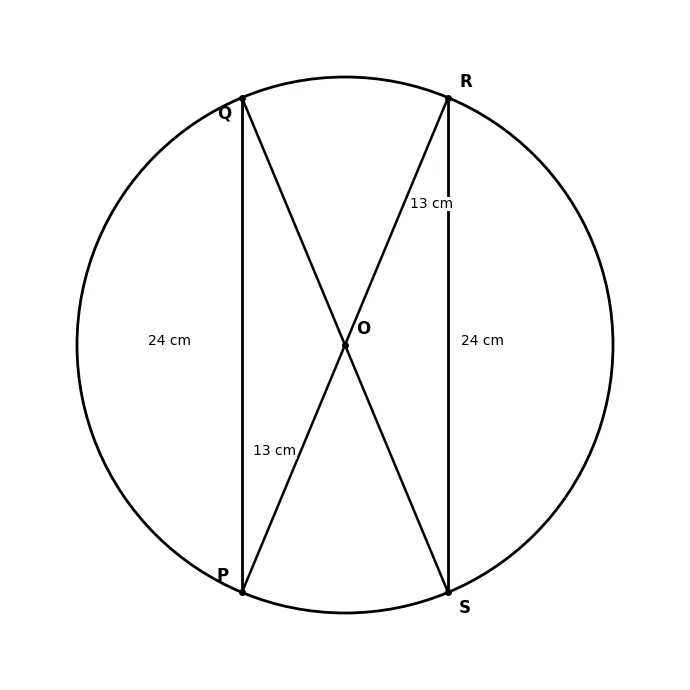
Q1. The perpendicular distance of chord PQ from the centre O is ______ cm.
Q2. Without calculating anything new, what can you say about the distance of chord RS from the centre?
Q3. Since PQ = RS, what can be said about the angles ∠POQ and ∠ROS that these chords subtend at the centre?
Q4. A third spoke pair forms a chord TU that is found to be farther from the centre than PQ. What can you conclude about TU's length compared to PQ?
Q5. What is the length of the diameter of this bicycle wheel?
Solution:
Q1. 5 cm
The perpendicular from the centre bisects PQ, giving a half-chord of 12 cm. Using the Baudhāyana–Pythagoras theorem on the right triangle formed by the radius, the perpendicular, and the half-chord: 13² = d² + 12², so d² = 169 − 144 = 25, giving d = 5 cm.
Q2. This is the theorem that chords of equal length in the same circle are always equidistant from the centre. Since RS = PQ = 24 cm, both chords sit exactly 5 cm from O.
Q3. They must be equal
Equal chords always subtend equal angles at the centre of the same circle.
Q4. TU is shorter than PQ
Of any two unequal chords in a circle, the one farther from the centre is always the shorter one. So a chord placed beyond PQ's distance from O must be shorter than 24 cm.
Q5. The diameter is always twice the radius, so 2 × 13 cm = 26 cm.
Case Study 3: The Cyclic Garden Plot
Read the passage and answer the questions below.
A municipal garden is laid out in the shape of quadrilateral ABCD, and a circular walking track runs exactly along its boundary, touching all four corners A, B, C and D. The gardener measures ∠A = 110°. The other two angles are given in terms of x: ∠B = (3x + 10)° and ∠D = (2x − 10)°.
Q1. What is the measure of ∠C?
(a) 70° (b) 80°
(c) 90° (d) 110°
Q2. Using ∠B + ∠D = 180°, find the value of x.
Q3. What are the actual measures of ∠B and ∠D?
Q4. Side CD of the garden is extended beyond D to a point E outside the track. What is the measure of the exterior angle ∠ADE?
Q5. Could ABCD ever be a parallelogram-shaped garden while still fitting this circular track?
Solution:
Q1. (a) 70°
In any cyclic quadrilateral, opposite angles add up to 180°. Since ∠A + ∠C = 180°, ∠C = 180° − 110° = 70°.
Q2. (3x + 10) + (2x − 10) = 180 simplifies to 5x = 180, so x = 36.
Q3. Substituting x = 36: ∠B = 3(36) + 10 = 118°, and ∠D = 2(36) − 10 = 62°.
∠B = 118°, ∠D = 62°
Q4. In a cyclic quadrilateral, the exterior angle at any vertex always equals the interior angle at the opposite vertex. Since ∠ADE is exterior at D, it must equal the opposite interior angle ∠ABC = ∠B = 118°.
Q5. A parallelogram needs opposite angles to be equal, while a cyclic quadrilateral needs opposite angles to be supplementary. The only shape that satisfies both at once is a rectangle, where every angle is 90°. Since this garden's angles (110°, 118°, 70°, 62°) aren't even equal in opposite pairs, it isn't a parallelogram at all.

Download Free PDF - Case Study: Class 9 Chapter 5 - I'm Up and Down and Round and Round
Download PDF - Class 9 Chapter 5: Im Up and Down and Round and Round Case Study
Frequently Asked Questions of Chapter 5: Im Up and Down and Round and Round Case Study for Class 9
1. How many marks are case study questions worth in CBSE Class 9 exams?
Case study questions typically carry 4 marks as a set, made up of 4 to 5 sub-questions, usually a mix of MCQs and one short-answer question, all based on a single real-life passage.
2. What's the difference between the angle subtended at the centre and at the circumference?
The angle ‘subtended at the centre’ is measured at point O, the circle's centre, looking out at an arc's two endpoints. The angle ‘at the circumference’ is measured from any other point sitting on the circle itself. The centre angle is always exactly double the circumference angle for the same arc.
3. Can a parallelogram ever be inscribed in a circle?
A parallelogram can be inscribe in a circle only if it's a rectangle.
4. How many circles can pass through two given points?
Infinitely many. Every point on the perpendicular bisector of the segment joining the two points can serve as a centre, so there's no upper limit to how many circles can be drawn, though the smallest one has the segment itself as its diameter.
5. How to find the length of a chord in a circle?
Chord length = 2√(r² − d²).
Where:
r = radius of the circle
d = perpendicular distance from the center of the circle to the chord
Numbers make sense when they're taught right. To see how Orchids The International School turns Maths from intimidating to intuitive, reach out to our admissions team.


Admissions Open for 2026-27
What type of concept pages would you prefer?
CBSE Schools In Popular Cities
- CBSE Schools in Bangalore
- CBSE Schools in Mumbai
- CBSE Schools in Pune
- CBSE Schools in Hyderabad
- CBSE Schools in Chennai
- CBSE Schools in Gurgaon
- CBSE Schools in Kolkata
- CBSE Schools in Indore
- CBSE Schools in Sonipat
- CBSE Schools in Delhi
- CBSE Schools in Rohtak
- CBSE Schools in Bhopal
- CBSE Schools in Aurangabad
- CBSE Schools in Jabalpur
- CBSE Schools in Jaipur
- CBSE Schools in Jodhpur
- CBSE Schools in Nagpur
- CBSE Schools in Ahmednagar
- CBSE School In Tumkur











Orchids The International School is one of India's leading chains of CBSE and ICSE schools, with 130+ schools across the country.