

I’m Up and Down, and Round and Round for Class 9: Important Questions for Complete Revision
Important questions on ‘I’m Up and Down, and Round and Round’ for Class 9 are available in this Maths article to help students understand key concepts related to vertical and circular motion in a simple way. These questions focus on important ideas such as up-and-down movements, round-and-round motion, and their real-life applications with solved examples and exam-oriented explanations. Whether you follow the standard NCERT textbook or Ganita Manjari, this material supports quick revision and better exam preparation
Table of Contents
- Key Concepts of Important Questions on I’m Up and Down, and Round and Round for Class 9
- Important Questions on I’m Up and Down, and Round and Round for Class 9
- Frequently Asked Questions of I’m Up and Down, and Round and Round for Class 9

Key Concepts of Important Questions on I’m Up and Down, and Round and Round for Class 9
This chapter has 12 theorems.
T1: Perpendicular from Centre to Chord
The perpendicular from the centre of a circle to a chord bisects the chord. Converse: the line from the centre bisecting a chord is perpendicular to it.
T2: Equal Chords are equidistant.
Equal chords of a circle (or congruent circles) are equidistant from the centre. And vice versa, chords equidistant from the centre are equal.
T3: Unique Circle through Three Non-Collinear Points
There is one and only one circle passing through three non-collinear points.
T4: Equal Chords ↔ Equal Arcs
In the same circle (or equal circles), equal chords subtend equal arcs; and equal arcs correspond to equal chords.
T5: Central Angle = 2 × Inscribed Angle
The angle subtended by an arc at the centre is double the angle subtended by it at any point on the remaining part of the circle.
T6: Angles in the Same Segment are Equal
Angles in the same segment of a circle (subtended by the same arc) are equal.
T7: Angle in a Semicircle = 90°
The angle subtended by a diameter (semicircle) at any point on the circle is a right angle (90°). Converse is also true.
T8: Converse of T6
If a line segment subtends equal angles at two points on the same side, those two points and the endpoints of the segment are concyclic.
T9: Sum of Angles in a Cyclic Quadrilateral
The sum of opposite angles in a cyclic quadrilateral is 180°. i.e., ∠A + ∠C = 180° and ∠B + ∠D = 180°.
T10: Condition for a Cyclic Quadrilateral
If the sum of opposite angles of a quadrilateral is 180°, it is cyclic (all four vertices lie on a circle).
T11: Exterior Angle of a Cyclic Quadrilateral
An exterior angle of a cyclic quadrilateral equals the interior opposite angle.
T12: Converse of T10
If the exterior angle of a quadrilateral equals the interior opposite angle, the quadrilateral is cyclic.
Know more about related topics:
- Assertion Reason Questions For Class 9 Maths Chapter 5 Im Up And Down And Round And Round
- Class 9 Maths Case Study Chapter 5 Im Up And Down And Round And Round
- Class 9 Maths Mcqs Chapter 5 Im Up And Down And Round And Round
- Class 9 Maths Notes Chapter 5 Im Up And Down And Round And Round
- Arithmetic Progression
Important Questions on I’m Up and Down, and Round and Round for Class 9
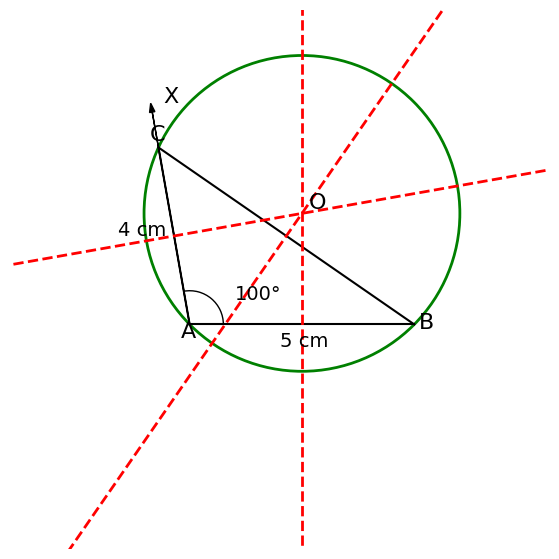
Q1: Draw ΔABC with AB = 5 cm, ∠A = 100°, AC = 4 cm. Draw the circumcircle of ΔABC. Is the centre inside or outside the triangle?
Solution:
Steps of Construction:
Draw the line segment AB = 5 cm.
At point A, construct ∠BAC = 100°.
On the ray AX, mark point C such that AC = 4 cm.
Join C to B. Then ΔABC is formed.
Draw the perpendicular bisector of AB.
Draw the perpendicular bisector of AC and BC.
Let these bisectors meet at O. This point O is the circumcentre.
With centre O and radius OA, draw the circle through A, B and C. This is the circumcircle.
Q2: How many circles can pass through three non-collinear points?
Solution: Exactly one. Three non-collinear points determine a unique circle, the circumcircle of the triangle formed by those three points. If the three points were collinear (on a straight line), no circle could pass through all three.
Q3: ABCD is a cyclic quadrilateral. If ∠A = 70°, find ∠C.
Solution: ∠A + ∠C = 180° (opposite angles of cyclic quadrilateral)
70° + ∠C = 180°
⇒ ∠C = 110°
∴ ∠C = 110°
Q4: The perpendicular from the centre O of a circle bisects a chord AB at M. If OA = 5 cm and OM = 3 cm, find the length of chord AB.
Solution: By Pythagoras: AM² = OA² − OM² = 25 − 9 = 16
AM = √16 = 4 cm
AB = 2 × AM = 8 cm (perpendicular from centre bisects chord)
∴ AB = 8 cm
Q5: Two equal chords of a circle are at distances 4 cm and d cm from the centre. What is the value of d?
Solution: d = 4 cm. Equal chords are equidistant from the centre. So if one equal chord is 4 cm from the centre, the other must also be 4 cm away.
Q6: Prove that angles in the same segment of a circle are equal.
Solution: Given: A circle with centre O. Chord AB. Points P and Q on the same (major) segment. To prove: ∠APB = ∠AQB.
∠AOB = 2∠APB (∵ angle at centre = 2 × angle at circumference, arc AB)
Similarly: ∠AOB = 2∠AQB (same arc AB, point Q also on major arc)
∴ 2∠APB = 2∠AQB
∴ ∠APB = ∠AQB (Hence proved)
Q7: In the figure, O is the centre of a circle and ∠BOC = 100°. Find ∠BAC, where A is a point on the major arc.
Solution: Given: ∠BOC = 100° (angle at centre, subtended by arc BC)
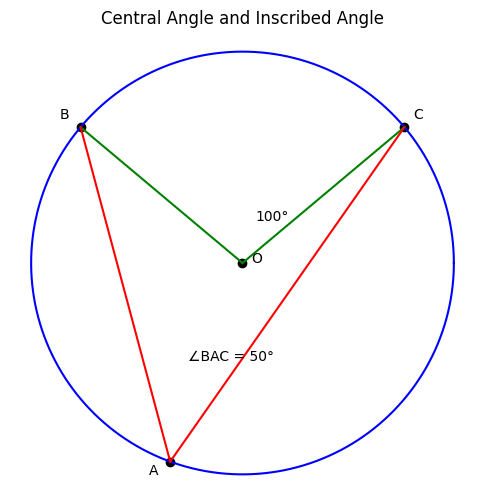
Reflex ∠BOC: 360° − 100° = 260° (angle at centre for major arc BC)
∠BAC = (1/2) × ∠BOC (∵ Central Angle = 2 × Inscribed Angle)
∠BAC = 100° ÷ 2 = 50°
∴ ∠BAC = 50°
Q8:ABCD is a cyclic quadrilateral in which ∠A = 3x and ∠C = x. Find both angles.
Solution: ∠A + ∠C = 180°(∵ sum of opposite angles in a cyclic quadrilateral is 180°)
3x + x = 180°
⇒ 4x = 180°
⇒ x = 45°
∠A = 3 × 45° = 135°
∠C = 45°
∴ ∠A = 135° and ∠C = 45°
Q9: A chord of a circle of radius 10 cm is at a distance of 6 cm from the centre. Find the length of the chord.
Solution: Radius (OA) = 10 cm
Distance from centre (OM) = 6 cm
By Pythagoras: AM² = OA² − OM² = 100 − 36 = 64
⇒ AM = 8 cm
Chord AB = 2 × AM = 16 cm (perpendicular bisects chord, Theorem 1)
∴ Length of chord = 16 cm
Q10: In a circle with centre O, ∠AOB = 60° (where A and B are on the circle). If AB = 7 cm, find OA.
Solution: Given ∠AOB = 60° and OA = OB (radii)
Triangle OAB is equilateral (Isosceles + 60° at apex ⇒ all angles 60°)
OA = AB = OB
∴ OA = 7 cm
Q 11: Prove that the angle subtended by an arc at the centre is double the angle subtended by it at any point on the remaining part of the circle.
Solution: Given: Arc PQ of a circle with centre O. Point R on the remaining arc. To Prove: ∠POQ = 2∠PRQ.
Construction: Join RO and extend it to a point A (outside the circle on the other side).
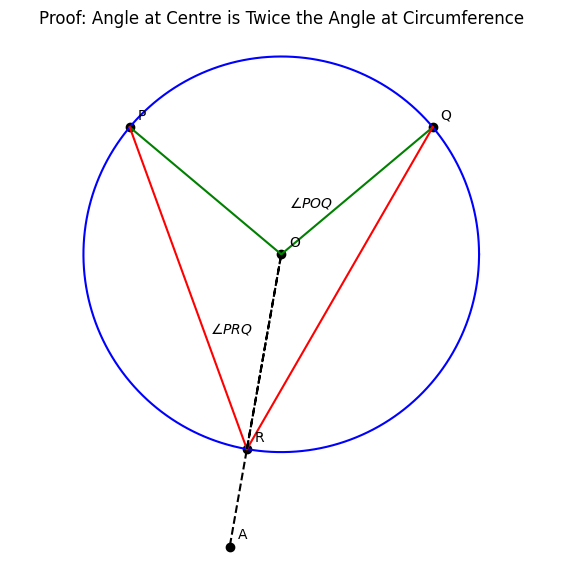
In triangle OPR: OP = OR (radii of same circle, radii are equal)
∴ ∠OPR = ∠ORP (angles opposite equal sides)
∠POA = ∠OPR + ∠ORP = 2∠ORP (exterior angle of triangle = sum of interior opposite angles)
Similarly, in triangle OQR: ∠QOA = 2∠ORQ
∴ ∠POA + ∠QOA = 2∠ORP + 2∠ORQ, adding both results
∴ ∠POQ = 2∠PRQ (Hence proved)
Q12: Prove that opposite angles of a cyclic quadrilateral sum to 180°.
Solution: Given: Cyclic quadrilateral ABCD with centre O.
To Prove: ∠BAD + ∠BCD = 180° and ∠ABC + ∠ADC = 180°.
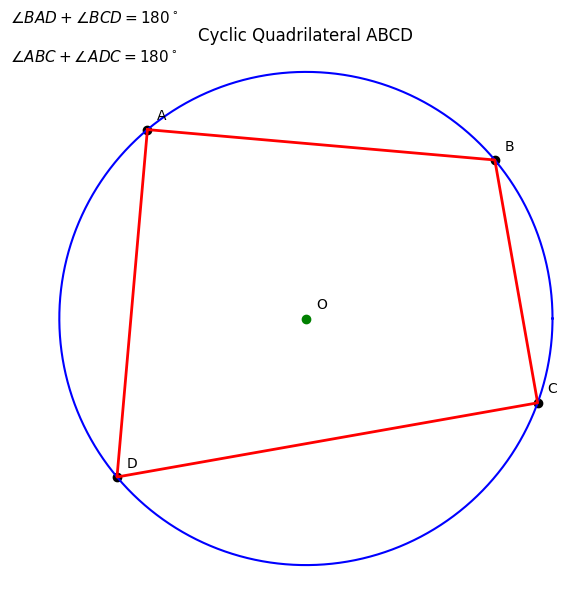
Arc BCD subtends ∠BAD at point A on the remaining arc (inscribed angle on major arc)
The same arc BCD subtends angle ∠BOD at centre O (central angle on same arc)
∴ ∠BOD = 2∠BAD … (i)
Arc BAD subtends reflex ∠BOD at centre and ∠BCD at circumference (inscribed angle theorem)
∴ Reflex ∠BOD = 2∠BCD
∠BOD + Reflex ∠BOD = 360°
From (i) and (ii): 2∠BAD + 2∠BCD = 360°
∴ ∠BAD + ∠BCD = 180° (Hence proved)
Q13: In a circle with centre O, chords AB and CD are equal. Prove that the arcs AB and CD are also equal.
Solution: Given: Circle with centre O. AB = CD (equal chords). To Prove: Arc AB = Arc CD.
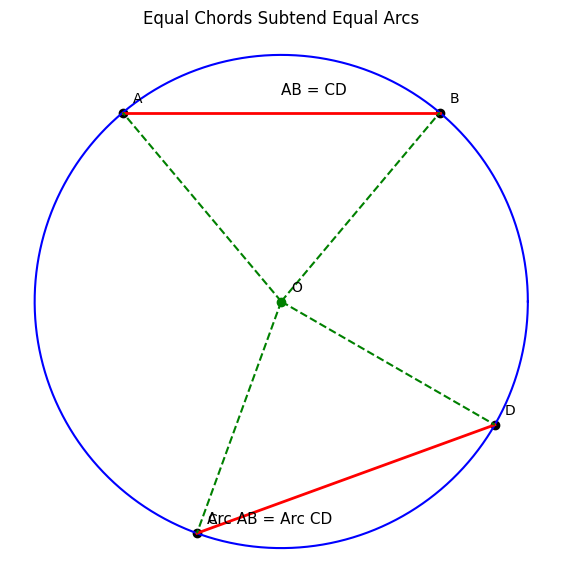
In triangles AOB and COD: OA = OC (radii), OB = OD (radii), AB = CD (given)
∴ △AOB ≅ △COD (SSS congruence rule)
∴ ∠AOB = ∠COD (corresponding parts of congruent triangles)
Equal central angles correspond to equal arcs in the same circle
∴ Arc AB = Arc CD (Hence proved)
Q14: ABCD is a cyclic quadrilateral. ∠A = 5x + 10° and ∠C = 3x + 20°. ∠B = 4y − 10° and ∠D = 2y + 30°. Find the values of x and y.
Solution: ∠A + ∠C = 180°
(5x + 10) + (3x + 20) = 180
8x + 30 = 180
⇒ 8x = 150
⇒ x = 18.75°
∠B + ∠D = 180°
⇒ (4y − 10) + (2y + 30) = 180
6y + 20 = 180 ⇒ 6y = 160 ⇒ y = 26.67°
∴ x = 18.75° and y ≈ 26.67°
Numbers make sense when they're taught right. To see how Orchids The International School turns Maths from intimidating to intuitive, reach out to our admissions team.
Frequently Asked Questions of I’m Up and Down, and Round and Round for Class 9
1. What is Chapter 5 of Ganita Manjari actually about?
Chapter 5 is the circles chapter of Ganita Manjari, and unlike the old NCERT textbook which presented circle theorems in a more formulaic way, this chapter builds each result from first principles using triangle congruence, symmetry arguments, and activity-based discovery.
2. What does ‘angles in the same segment are equal’ mean, and how is it used in questions?
If two points A and B are on a circle, and you pick any other two points P and Q on the same arc, then ∠APB = ∠AQB. In exam questions, this is typically used to find unknown angles in a figure where two inscribed angles subtend the same chord.
3. How are central angle and an inscribed angle related?
The circle is double the angle subtended by the same arc at any point on the remaining part of the circle.
4. What type of questions are asked from ‘I’m Up and Down, and Round and Round’?
The chapter includes conceptual questions, activity-based problems, diagram-based questions, and application-oriented exercises.
Related Links


Admissions Open for 2026-27
What type of concept pages would you prefer?
CBSE Schools In Popular Cities
- CBSE Schools in Bangalore
- CBSE Schools in Mumbai
- CBSE Schools in Pune
- CBSE Schools in Hyderabad
- CBSE Schools in Chennai
- CBSE Schools in Gurgaon
- CBSE Schools in Kolkata
- CBSE Schools in Indore
- CBSE Schools in Sonipat
- CBSE Schools in Delhi
- CBSE Schools in Rohtak
- CBSE Schools in Bhopal
- CBSE Schools in Aurangabad
- CBSE Schools in Jabalpur
- CBSE Schools in Jaipur
- CBSE Schools in Jodhpur
- CBSE Schools in Nagpur
- CBSE Schools in Ahmednagar
- CBSE School In Tumkur











Orchids The International School is one of India's leading chains of CBSE and ICSE schools, with 130+ schools across the country.