

Exploring The World of Numbers: Important Questions and Answers for Class 9
In this Maths article we have compiled Important Questions on The World of Numbers for Class 9. Students can revise important concepts and solve some problems on different kinds of numbers easily with Important Questions on The World of Numbers for Class 9.
It includes natural numbers, whole numbers, integers, rational and irrational numbers, representation on number line and basic operations as per CBSE syllabus and NCERT book for Class 9. This material is useful for quick revision and better performance in exams.
Table of Contents
- Exercise 1: Types of Numbers: Rational and Irrational Important Questions
- Exercise 2: Finding Rational Numbers Between Two Numbers Questions
- Exercise 3: Decimal Expansions Important Questions for Class 9
- Exercise 4: Real Numbers on the Number Line Questions and Answers
- Exercise 5: Operations on Irrational Numbers Important Questions
- Exercise 6: Rationalisation of the Denominator Questions for Class 9
- Exercise 7: Laws of Exponents Important Questions and Answers
- Frequently Asked Questions of The World of Numbers for Class 9

Exercise 1: Types of Numbers: Rational and Irrational Important Questions
Q1.1 Are the square roots of all positive integers irrational? Give a counterexample if not.
Answer: No, not all square roots of positive integers are irrational. For example, √16 = 4 is a rational number. Only perfect squares give rational square roots.
Q1.2 Classify the following numbers as rational or irrational:
(i) √23 (ii) √225 (iii) 0.3796 (iv) 7.478478... (v) 1.101001000100001...
Answer:
(i) √23 - Irrational (∵ 23 is not a perfect square)
(ii) √225 = 15 - Rational (∵ 225 = 15²)
(iii) 0.3796 - Rational (∵ terminating decimal)
(iv) 7.478478... = 7.4̄7̄8̄ - Rational (∵ repeating/recurring decimal)
(v) 1.101001000100001... - Irrational (∵ the pattern never repeats; each group has one more zero)
Q1.3 What is the product of a rational number and an irrational number?
(a) Always an integer
(b) Always a rational number
(c) Always an irrational number
(d) Sometimes rational, sometimes irrational
Answer: (c) Always an irrational number
Example: 2 × √3 = 2√3, which is irrational. Note: The rational number must be non-zero. (0 × √3 = 0, which is rational
Q1.4: Prove that 3 + 2√5 is irrational.
Answer: Assume 3 + 2√5 is rational, say equal to r.
Then 2√5 = r − 3, so √5 = (r − 3)/2.
The right side is rational. But √5 is irrational, which is a contradiction because of our assumption that r is rational.
Therefore, 3 + 2√5 is irrational.
Know more about related topics:
Exercise 2: Finding Rational Numbers Between Two Numbers Questions
Q2.1 Find five rational numbers between 3/5 and 4/5.
Answer:
Multiply both by 6/6 (5 + 1 = 6 to get a gap of at least 5 integers between them)
3/5 = 18/30 and 4/5 = 24/30
Five rational numbers: 19/30, 20/30, 21/30, 22/30, 23/30
Q2.2 Find three irrational numbers between 5/7 and 9/11.
Answer: 5/7 = 0.714285... and 9/11 = 0.8181...
Three irrational numbers in between:
0.720720072000... (digits follow a non-repeating pattern)
0.730730073000...
0.808008000800008…
Exercise 3: Decimal Expansions Important Questions for Class 9
Q3.1 Show that 0.333... = 0.3̄ can be expressed as p/q.
Answer: Let x = 0.3333...
Multiply both sides by 10:
10x = 3.3333...
Subtract: 10x − x = 3.3333... − 0.3333...
⇒ 9x = 3
⇒ x = 3/9 = 1/3
So 0.333... = 1/3, where p = 1, q = 3, and q ≠ 0.
Q3.2 Express 0.6̄ in the form p/q.
Answer: Let x = 0.6666...
⇒ 10x = 6.6666...
⇒ 9x = 6
⇒ x = 6/9 = ⅔
Q3.3 What is the maximum number of digits in the repeating block of 1/17? Verify by division.
Answer: For a fraction 1/p (where p is a prime not equal to 2 or 5), the maximum length of the repeating block is (p − 1).
So for 1/17, the maximum repeating block length = 16 digits.
On performing long division: 1/17 = 0.0588235294117647...
The repeating block is 0588235294117647, which has exactly 16 digits.
Exercise 4: Real Numbers on the Number Line Questions and Answers
Q4.1 Locate √3 on the number line.
Answer: Steps :
Mark point O at 0.
Mark point A at 1 unit from O.
At A, draw a perpendicular line upward.
Take AB = √2 units.
Now triangle OAB is a right triangle.
Using:
OB²=OA²+AB²
Substitute values:
OB2=12+(2)2
So, OB2=1+2=3
Therefore,
OB=3
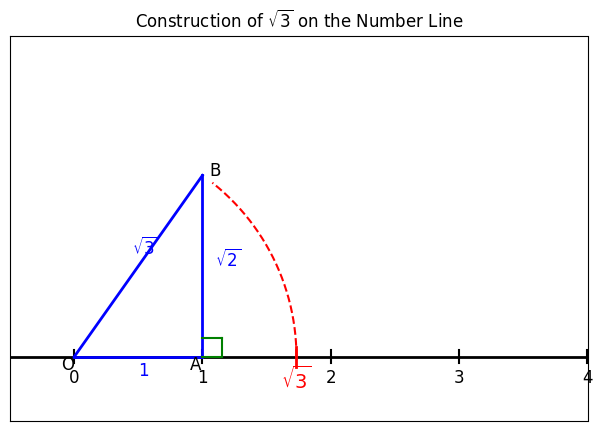
With O as center and radius OB, draw an arc cutting the number line.
The point where the arc cuts the number line represents: √3
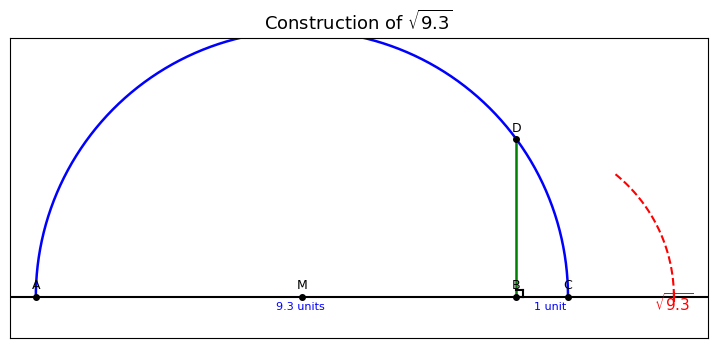
Q4.2 Represent √9.3 on the number line.
Answer: Steps
Draw a line segment AB = 9.3 units.
Extend AB to point C such that BC = 1 unit. So AC = 10.3 units.
Find the midpoint M of AC.
Draw a semicircle with centre M and radius MA.
At point B, draw a perpendicular to AC. Let it meet the semicircle at D.
BD = √(AB × BC) = √(9.3 × 1) = √9.3
With B as centre and BD as radius, draw an arc to meet the number line, that point represents √9.3.
Exercise 5: Operations on Irrational Numbers Important Questions
Q5.1 Add 2√2 + 5√3 and √2 − 3√3.
Answer: (2√2 + 5√3) + (√2 − 3√3)
= (2 + 1)√2 + (5 − 3)√3
= 3√2 + 2√3
Q5.2 Simplify the following: (√3 + √7)(√3 − √7)
Answer: Using the identity (a + b)(a − b) = a² − b²:
(√3 + √7)(√3 − √7) = (√3)² − (√7)² = 3 − 7 = −4
Q5.3 Simplify: (√5 + √2)²
Answer: Using (a + b)² = a² + 2ab + b²:
(√5 + √2)² = (√5)² + 2·√5·√2 + (√2)²
= 5 + 2√10 + 2
= 7 + 2√10
Exercise 6: Rationalisation of the Denominator Questions for Class 9
Q6.1 Simplify by rationalising: (√6 − √5) / (√6 + √5)
Answer: Multiply by (√6 − √5) / (√6 − √5):
= (√6 − √5)² / [(√6)² − (√5)²]
= (6 − 2√30 + 5) / (6 − 5)
= (11 − 2√30) / 1
= 11 − 2√30
Q6.2 If x = 3 − 2√2, find √x − 1/√x.
Answer: x = 3 − 2√2 = 2 − 2√2 + 1 = (√2 − 1)²
So √x = √2 − 1 (taking positive root)
⇒ 1/√x = 1/(√2 − 1)
= (√2 + 1) / [(√2 − 1)(√2 + 1)]
= (√2 + 1)/1 = √2 + 1
⇒ √x − 1/√x = (√2 − 1) − (√2 + 1) = −2
Exercise 7: Laws of Exponents Important Questions and Answers
Q7.1 Find the value of .
Answer:
=
=
=
=
=
= 4
Q7.2 If , prove that z = xy/(x + y).
Answer: Let = k
Then
Since 6 = 2 × 3:
So 1/z = 1/x + 1/y = (x + y)/(xy)
Therefore z = xy/(x + y)
Q7.3 Evaluate:
Answer: 64 = 2⁶ and 8 = 2³
=
=
=
=
= 1
Numbers make sense when they're taught right. To see how Orchids The International School turns Maths from intimidating to intuitive, reach out to our admissions team.
Frequently Asked Questions of The World of Numbers for Class 9
1. What is the difference between The World of Numbers (Ganita Manjari) and Number Systems (Standard NCERT)?
Both cover the same concepts: rational numbers, irrational numbers, real numbers, decimal expansions, representation on number line, and laws of exponents. Ganita Manjari is the new NCERT alternative textbook introduced for CBSE. The concepts and question types are aligned; only the presentation differs slightly.
2. Is the number line representation important?
Yes, it's a common 3-mark question. Practice locating √2, √3, and decimal numbers like 3.765 using the geometric method and successive magnification.
3. What is decimal expansion of rational numbers?
Decimal expansions of rational numbers can be terminating (like 0.25) or non-terminating repeating (like 0.333…)
4. Is √2 a rational number?
No, √2 is an irrational number because its decimal expansion is non-terminating and non-repeating.
Related Links


Admissions Open for 2026-27
What type of concept pages would you prefer?
CBSE Schools In Popular Cities
- CBSE Schools in Bangalore
- CBSE Schools in Mumbai
- CBSE Schools in Pune
- CBSE Schools in Hyderabad
- CBSE Schools in Chennai
- CBSE Schools in Gurgaon
- CBSE Schools in Kolkata
- CBSE Schools in Indore
- CBSE Schools in Sonipat
- CBSE Schools in Delhi
- CBSE Schools in Rohtak
- CBSE Schools in Bhopal
- CBSE Schools in Aurangabad
- CBSE Schools in Jabalpur
- CBSE Schools in Jaipur
- CBSE Schools in Jodhpur
- CBSE Schools in Nagpur
- CBSE Schools in Ahmednagar
- CBSE School In Tumkur











Orchids The International School is one of India's leading chains of CBSE and ICSE schools, with 130+ schools across the country.