

Class 9 Maths Chapter 3 The World of Numbers Notes with PDF Download
Class 9 Maths Chapter 3 The World of Numbers Notes Free PDF Download is prepared based on the latest CBSE and NCERT syllabus. These notes will help in school exams, board exams, and quick revision. They help students understand the chapter clearly, revise faster, and prepare for exams with confidence.
Table of Contents
- Introduction to The World of Numbers
- Key Terms to Remember
- Number System Revision Notes
- Rational Numbers Revision Notes
- Irrational Numbers Revision Notes
- Real Numbers Revision Notes
- Important Concepts from the Chapter
- Properties of Real Numbers
- Important Rules to Remember
- Number System Summary Table
- Solved Examples for Quick Revision
- Frequently Asked Questions on Class 9 Maths Chapter 3 The World of Numbers Notes

Introduction to The World of Numbers
What Is the Number System?
The number system is an organised framework that classifies all numbers into groups based on their properties. Just like objects in the real world are sorted into categories, numbers are sorted into sets natural numbers, whole numbers, integers, rational numbers, irrational numbers, and real numbers. Each set contains the previous one, forming a nested structure.
Importance of Numbers
Numbers are the building blocks of all mathematics. Without understanding how different numbers are related, it becomes impossible to work in algebra, geometry, or any higher topic. Chapter 3 of Class 9 Maths lays this foundation clearly so that students can move confidently into the rest of the course.
Know more about related topics:
Key Terms to Remember
Natural Numbers
Natural numbers are the counting numbers: 1, 2, 3, 4, 5… They start at 1 and go on forever. They do not include zero, negative numbers, or fractions. Symbol: ℕ.
Whole Numbers
Whole numbers are natural numbers with the addition of zero: 0, 1, 2, 3, 4… The only difference from natural numbers is the presence of 0. Symbol: W.
Integers
Integers include all whole numbers and all negative whole numbers: …−3, −2, −1, 0, 1, 2, 3… They do not include fractions or decimals. Symbol: ℤ.
Rational Numbers
A rational number is any number that can be written as a fraction p/q, where p and q are both integers and q is not zero. The decimal form of a rational number either terminates (ends) or repeats in a pattern. Symbol: ℚ. Examples: ½, −4, 0.75, 0.333…
Irrational Numbers
An irrational number cannot be written as a fraction p/q for any integers p and q. Its decimal expansion is non-terminating and non-repeating it goes on forever with no pattern. Symbol: ℚ′ or Q̄. Examples: √2, π, √3, e.
Real Numbers
Real numbers form the complete number system they include every rational number and every irrational number. Every point on the number line corresponds to exactly one real number. Symbol: ℝ.
Number System Revision Notes
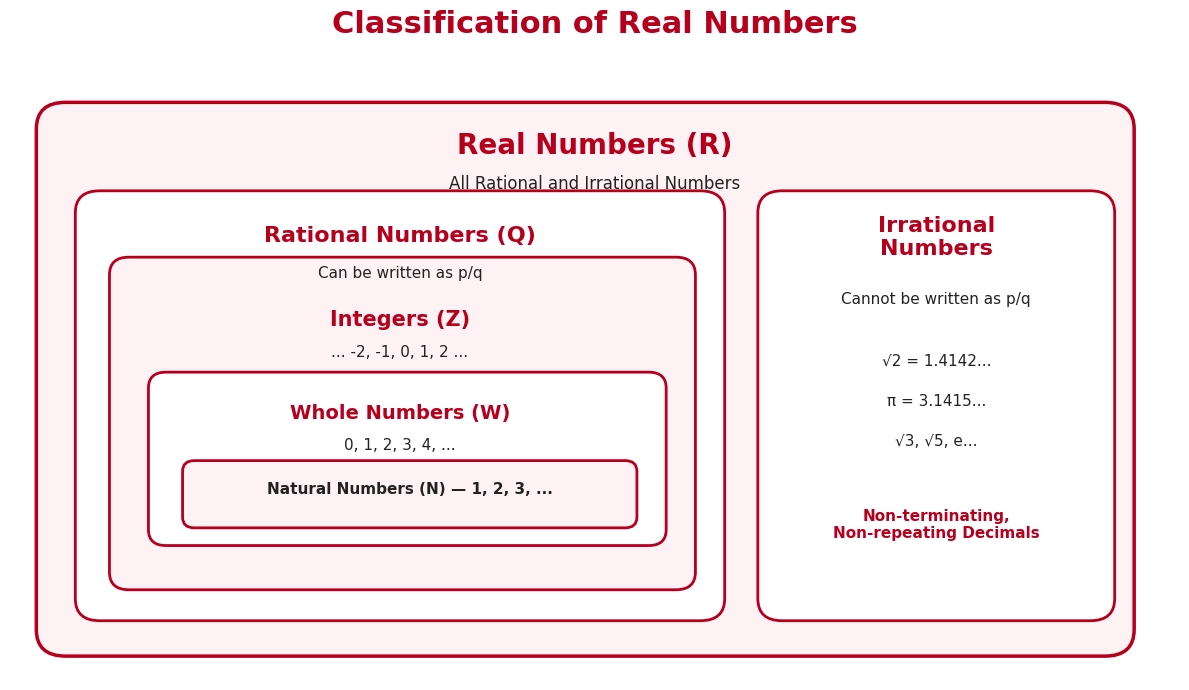
The structural diagram below shows how each type of number fits inside the larger categories like a set of nested boxes
 .
.
Classification of Numbers
The diagram above shows the hierarchy clearly. Natural numbers sit deepest inside the structure. Every natural number is also a whole number. Every whole number is also an integer. Every integer is also a rational number. Rational numbers and irrational numbers together form the complete set of real numbers.
Relationship Between Different Types of Numbers
The key relationship to memorise: ℕ ⊂ W ⊂ ℤ ⊂ ℚ ⊂ ℝ. The symbol ⊂ means "is a subset of." Irrational numbers sit alongside rational numbers within real numbers but share no overlap with them a number is either rational or irrational, never both.
Rational Numbers Revision Notes
Definition of Rational Numbers
A rational number is any number that can be expressed in the form p/q, where p and q are integers and q ≠ 0. The word rational comes from ratio it is a number that can be expressed as a ratio of two integers.
Properties of Rational Numbers
Rational numbers are closed under addition, subtraction, multiplication, and division (except dividing by zero). The sum, difference, and product of any two rational numbers is always another rational number. Between any two rational numbers, there are infinitely many other rational numbers this is called the density property.
Examples of Rational Numbers
-
Integers: −5 = −5/1
-
Fractions: 3/7, −2/9
-
Terminating decimals: 0.25 = 1/4
-
Repeating decimals: 0.666… = 2/3
-
Zero: 0 = 0/1
Irrational Numbers Revision Notes
Definition of Irrational Numbers
An irrational number is a real number that cannot be written as a fraction p/q for any integers p and q. It is impossible to express it exactly as a ratio of two whole numbers. The word irrational means "not a ratio."
Examples of Irrational Numbers
-
√2, √3, √5, √7 (square roots of non-perfect squares)
-
π (pi) the ratio of a circle's circumference to its diameter
-
e (Euler's number) the base of natural logarithms
-
φ (golden ratio) = (1 + √5)/2
Note: √4 = 2 is rational. √9 = 3 is rational. Only square roots of non-perfect squares are irrational.
Decimal Representation of Irrational Numbers
The decimal expansion of an irrational number never ends and never repeats. This is the simplest test: if you cannot find a repeating block in the decimal, the number is irrational.
-
√2 = 1.41421356237… (never ends, no repeating block)
-
π = 3.14159265358… (never ends, no repeating block)
-
Compare to 1/3 = 0.333… (repeats so it is rational)
Real Numbers Revision Notes
Definition of Real Numbers
Real numbers are the complete collection of all numbers that can be placed on a number line. The formal definition: ℝ = ℚ ∪ ℚ′, meaning real numbers are the union of rational and irrational numbers. Every number you encounter in Class 9 Maths is a real number.
Representation of Real Numbers
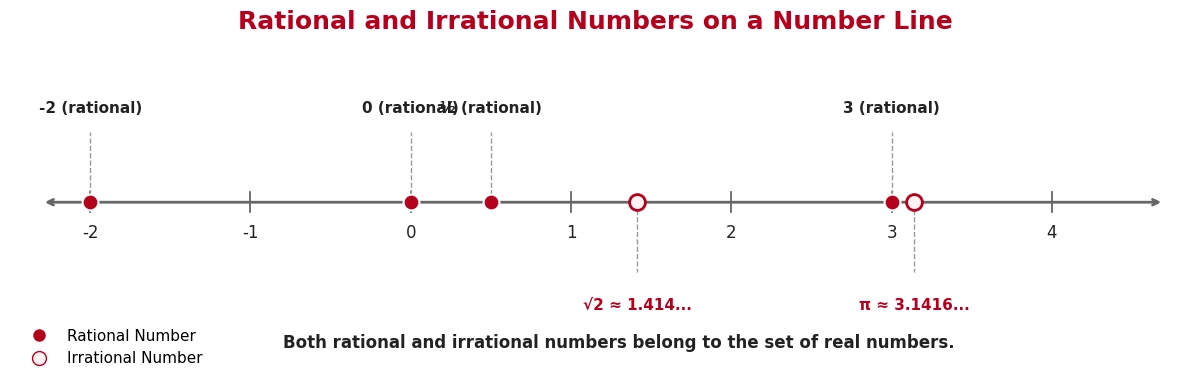
Real numbers are represented on a straight, endless line called the real number line (or simply the number line). Every real number corresponds to exactly one point, and every point corresponds to exactly one real number. There are no gaps the line is completely filled.
Real Numbers on the Number Line
The diagram below shows rational and irrational numbers placed on the same number line.
Important Concepts from the Chapter
Rational and Irrational Numbers Together Form Real Numbers
This is one of the most commonly tested ideas in Chapter 3. Students must clearly remember that the real number set R is made up of two non-overlapping groups: rational numbers (Q) and irrational numbers. There is no number that belongs to both groups at the same time. This can be written as:
R = Q ∪ (Irrational Numbers)
Q ∩ Irrational = Empty Set (no overlap)
In plain words:
Real Numbers = Rational Numbers + Irrational Numbers
Number Line Representation
Students are often asked to locate irrational numbers like √2 or √3 on a number line. This is done using the Pythagoras theorem. For example, to locate √2, draw a right-angled triangle with both legs of length 1 unit. The hypotenuse of that triangle will have a length of √2 units. Transfer this length to the number line using a compass to mark the exact position.
This method shows that even irrational numbers have precise, definite positions on the number line they are not vague or approximate. This is a key insight from the chapter.
Decimal Expansion of Numbers
Understanding decimal expansions is a commonly tested concept in board exams. Here is a quick summary of how to identify the type of number from its decimal form:
• Decimal ends after a few digits: the number is rational (e.g., 0.75 = 3/4)
• Decimal has a block that keeps repeating: the number is rational (e.g., 0.666... = 2/3)
• Decimal goes on forever with no repeating block: the number is irrational (e.g., π, √2)
Properties of Real Numbers
Closure Property
The closure property states that when you perform an operation on two real numbers, the result is also a real number. For real numbers a and b:
• a + b is a real number
• a − b is a real number
• a × b is a real number
• a ÷ b is a real number, as long as b ≠ 0
Commutative Property
The commutative property applies to addition and multiplication. It means the order of the two numbers does not change the result.
• a + b = b + a (Example: 3 + 5 = 5 + 3 = 8)
• a × b = b × a (Example: 4 × 6 = 6 × 4 = 24)
Note: Subtraction and division are not commutative. For instance, 7 − 3 ≠ 3 − 7.
Associative Property
The associative property applies to addition and multiplication. It means the way numbers are grouped in brackets does not change the result.
• (a + b) + c = a + (b + c) (Example: (2 + 3) + 4 = 2 + (3 + 4) = 9)
• (a × b) × c = a × (b × c) (Example: (2 × 3) × 4 = 2 × (3 × 4) = 24)
Distributive Property
The distributive property connects multiplication with addition or subtraction. It is very useful for simplifying expressions.
• a × (b + c) = a × b + a × c
• a × (b − c) = a × b − a × c
Example: 3 × (4 + 5) = 3 × 4 + 3 × 5 = 12 + 15 = 27
Important Rules to Remember
Identifying Rational Numbers
A number is rational if any one of the following is true:
• It can be written as p/q where p and q are integers and q ≠ 0
• Its decimal expansion terminates (e.g., 0.5, 1.25, 3.75)
• Its decimal expansion is non-terminating but repeating (e.g., 0.333..., 0.142857142857...)
• It is a whole number, a negative integer, or zero
Identifying Irrational Numbers
A number is irrational if:
• It cannot be written as p/q for any pair of integers p and q
• Its decimal expansion is non-terminating and non-repeating
• It is the square root of a non-perfect square (√2, √3, √5, √7, √10, etc.)
• It is a known constant like π or Euler's number e
Quick Check: √9 = 3 (rational), √4 = 2 (rational), but √2 ≈ 1.414... (irrational). Always check if the square root simplifies to a whole number first.
Understanding Decimal Expansions
TYPE OF DECIMAL → TYPE OF NUMBER
Terminating → Rational
e.g. 0.5, 1.25, 3.0
Non-terminating → Rational
Repeating e.g. 0.333..., 0.142857...
Non-terminating → Irrational
Non-Repeating e.g. √2, √3, π
Number System Summary Table
Comparison of Different Types of Numbers
Solved Examples for Quick Revision
Example on Rational Numbers
Example 1:
Question: Is 0.6 repeating (i.e., 0.666...) a rational number?
Solution:
Let x = 0.666...
Then 10x = 6.666...
Subtracting: 10x − x = 6.666... − 0.666...
9x = 6
x = 6/9 = 2/3
Since 2/3 is in p/q form with integers p = 2, q = 3, and q ≠ 0,
the number 0.666... is a rational number.
Example 2:
Question: Express 1.75 as a rational number in p/q form.
Solution:
1.75 = 175/100 = 7/4
Here p = 7, q = 4, both are integers, and q ≠ 0.
So 1.75 is a rational number. Its decimal terminates, confirming this.
Example on Irrational Numbers
Example 3:
Question: Show that √5 is irrational.
Solution (by contradiction):
Assume √5 is rational. Then √5 = p/q in lowest terms.
So 5 = p²/q², meaning p² = 5q².
This means 5 divides p², so 5 divides p. Let p = 5m.
Then (5m)² = 5q² → 25m² = 5q² → q² = 5m².
This means 5 divides q² and therefore 5 divides q.
But then 5 divides both p and q contradicting the assumption
that p/q is in lowest terms. So √5 cannot be rational.
Therefore √5 is irrational.
Example 4:
Question: Is π/2 rational or irrational?
Solution:
π is irrational. Dividing an irrational number by a non-zero
rational number gives an irrational number.
2 is rational and non-zero.
Therefore π/2 is irrational.
Example on Real Numbers
Example 5:
Question: Classify each of the following as rational or irrational:
(a) √16 (b) √12 (c) 3.14 (d) 0.010010001... (e) -7
Solution:
(a) √16 = 4 → rational (perfect square)
(b) √12 = 2√3 → irrational (√3 is irrational)
(c) 3.14 = 314/100 = 157/50 → rational (terminating decimal)
(d) 0.010010001... → irrational (non-terminating, non-repeating)
(e) -7 = -7/1 → rational (integer is a rational number)
Chapter 3 The World of Numbers Notes with PDF
Download PDF - Class 9 Maths Chapter 3 The World of Numbers Notes
Numbers make sense when they're taught right. To see how Orchids The International School turns Maths from intimidating to intuitive, reach out to our admissions team.
Frequently Asked Questions on Class 9 Maths Chapter 3 The World of Numbers Notes
1. What are real numbers with examples?
Real numbers are all numbers that can be represented on a number line. They include natural numbers, whole numbers, integers, rational numbers, and irrational numbers.
Examples: 5, -3, 0, 1/2, √2, π
2. What is the real number system?
The real number system is the collection of all rational and irrational numbers. It includes every number that can be located on a number line.
3. What is the difference between rational and irrational numbers?
Rational numbers can be expressed as a fraction of two integers, while irrational numbers cannot be expressed as a fraction and have non-terminating, non-repeating decimal expansions.
4. What are the types of real numbers?
The main types of real numbers are:
- Natural Numbers
- Whole Numbers
- Integers
- Rational Numbers
- Irrational Numbers
5. How do you identify a real number?
A number is a real number if it can be represented on a number line. Both rational and irrational numbers are real numbers.
6. What are some examples of irrational numbers?
Common examples of irrational numbers include:
- √2
- √3
- √5
- π
- e
Related Links


Admissions Open for 2026-27
What type of concept pages would you prefer?
CBSE Schools In Popular Cities
- CBSE Schools in Bangalore
- CBSE Schools in Mumbai
- CBSE Schools in Pune
- CBSE Schools in Hyderabad
- CBSE Schools in Chennai
- CBSE Schools in Gurgaon
- CBSE Schools in Kolkata
- CBSE Schools in Indore
- CBSE Schools in Sonipat
- CBSE Schools in Delhi
- CBSE Schools in Rohtak
- CBSE Schools in Bhopal
- CBSE Schools in Aurangabad
- CBSE Schools in Jabalpur
- CBSE Schools in Jaipur
- CBSE Schools in Jodhpur
- CBSE Schools in Nagpur
- CBSE Schools in Ahmednagar
- CBSE School In Tumkur











Orchids The International School is one of India's leading chains of CBSE and ICSE schools, with 130+ schools across the country.