

MXC Roman Numerals
MXC Roman numerals represent the number 1090 in the Roman numeral system. It is created by combining M (1000) and XC (90). In Roman numerals, XC follows the subtraction rule, where X (10) is placed before C (100) to represent 100 − 10 = 90. When these values are added together, the expanded form becomes MXC = 1000 + 90 = 1090. Understanding MXC Roman numerals helps students learn how Roman numeral symbols work together using both addition and subtraction rules. Roman numerals are widely seen in clock faces, book chapters, movie titles, outlines, and historical events, making them an important and interesting part of learning about number systems.
Table of Contents
- How to Write MXC Roman Numerals in Numbers?
- Numbers Related to MXC Roman Numerals
- Basic Rules for Writing Roman Numerals
- Solved Examples on MXC Roman Numerals
- Practice Questions on MXC Roman Numerals
- Conclusion
- Frequently Asked Questions on MXC Roman Numerals

How to Write MXC Roman Numerals in Numbers?
The Roman numeral MXC can be converted into numbers by applying the standard rules used in the Roman numeral system. In this method, we identify the value of each symbol and then apply addition or subtraction based on their order.
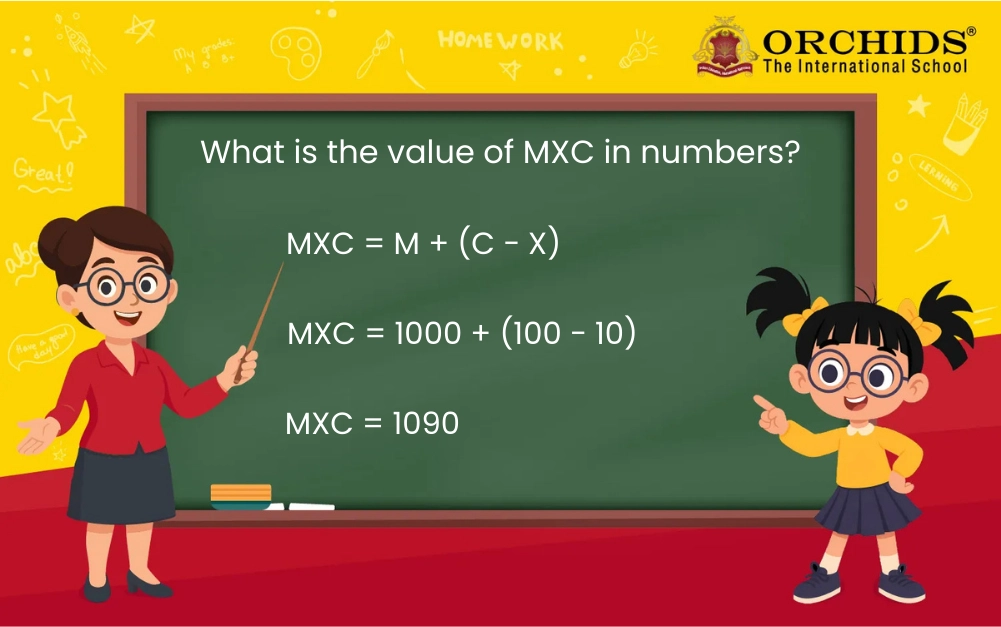
First, separate the symbols and write their numerical values:
- MXC = M + (C − X)
- MXC = M + XC
Now replace each Roman symbol with its value:
- M = 1000
- C = 100
- X = 10
Since X comes before C, we apply the subtraction rule:
- MXC = 1000 + (100 − 10)
- MXC = 1000 + 90
- MXC = 1090
Therefore, MXC Roman numerals equal 1090 in numbers.
Know more about related topics:
Numbers Related to MXC Roman Numerals
Basic Rules for Writing Roman Numerals
1. Understand the Roman numeral symbols: Roman numerals are formed using seven main symbols: I (1), V (5), X (10), L (50), C (100), D (500), and M (1000).
2. Identify the symbols in MXC: The numeral MXC is made up of three symbols: M, X, and C.
3. Write the values of each symbol:
- M = 1000
- X = 10
- C = 100
4. Apply the subtraction rule where needed: When a smaller numeral appears before a larger numeral, it is subtracted. In XC, the value of X (10) is subtracted from C (100).
5. Calculate the value of MXC: First, evaluate XC = 100 − 10 = 90. Then add M = 1000. So, MXC = 1000 + 90 = 1090.
Solved Examples on MXC Roman Numerals
Example 1: Find the quotient of MXC and MC.
Solution:
First, convert the Roman numerals into numbers.
- MXC = 1000 + 90 = 1090
- MC = 1000 + 100 = 1100
Now divide the numbers:
- 1090 ÷ 1100 = 0 (quotient)
Since the result is 0, there is no Roman numeral for zero in the Roman numeral system.
Therefore, MXC ÷ MC = 0 (Roman numerals do not represent zero).
Example 2: Find the product of MXC and III.
Solution:
Convert the Roman numerals into numbers.
- MXC = 1000 + 90 = 1090
- III = 3
Now multiply the numbers:
- 1090 × 3 = 3270
Convert 3270 back into Roman numerals:
- 3000 = MMM
- 200 = CC
- 70 = LXX
So, 3270 = MMMCCLXX
Therefore, MXC × III = MMMCCLXX
Example 3: Find the sum of MXC and CD.
Solution:
Convert the Roman numerals into numbers.
- MXC = 1090
- CD = 400
Now add the numbers:
- 1090 + 400 = 1490
Convert 1490 into Roman numerals:
- 1000 = M
- 400 = CD
- 90 = XC
So, 1490 = MCDXC
Therefore, MXC + CD = MCDXC
Example 4: Find the difference between MXC and CC.
Solution:
Convert the Roman numerals into numbers.
- MXC = 1090
- CC = 200
Now subtract the numbers:
1090 − 200 = 890
Convert 890 into Roman numerals:
- 800 = DCCC
- 90 = XC
So, 890 = DCCCXC
Therefore, MXC − CC = DCCCXC
Example 5: A museum recorded MXC visitors on Monday and CCC visitors on Tuesday. How many visitors came to the museum in total on both days?
Solution:
Convert the Roman numerals into numbers.
- MXC = 1090
- CCC = 300
Now add the numbers:
- 1090 + 300 = 1390
Convert 1390 back into Roman numerals:
- 1000 = M
- 300 = CCC
- 90 = XC
So, 1390 = MCCCXC
Therefore, the total number of visitors is MCCCXC in Roman numerals.
Practice Questions on MXC Roman Numerals
1. Add the Roman numerals MXC and C. Write the final answer in Roman numerals.
2. Subtract L from MXC. What is the result in Roman numerals?
3. Multiply MXC by II. Convert the final answer back into Roman numerals.
MXC by X. Write the quotient in Roman numerals.
5. Arrange the following Roman numerals from smallest to greatest: XC, MXC, D, C.
Conclusion
MXC Roman numerals represent the number 1090. It is created by combining M (1000) with XC (90), where X is placed before C to show subtraction (100 − 10) according to Roman numeral rules. Understanding how MXC Roman numerals are formed helps students learn how larger numbers can be written clearly using both addition and subtraction principles in the Roman numeral system.
Learn and explore MXC Roman numerals with simple explanations and step-by-step learning at Orchids International School.
Numbers make sense when they're taught right. To see how Orchids The International School turns Maths from intimidating to intuitive, reach out to our admissions team.
Frequently Asked Questions on MXC Roman Numerals
1. How is MXC converted into a number?
To convert MXC into a number, we separate the Roman symbols and apply the Roman numeral rules:
- M = 1000
- XC = 90 (because X is placed before C, meaning 100 − 10)
Now add the values: 1000 + 90 = 1090. So, MXC represents the number 1090.
2. Why is 1090 written as MXC?
In Roman numerals, certain numbers follow the subtraction rule. Instead of writing 90 as LXXXX, the correct form is XC, where X (10) comes before C (100) to show 100 − 10 = 90. When we combine M (1000) and XC (90), we get MXC, which equals 1090.
3. Is MXC an even or odd number?
The Roman numeral MXC equals 1090. Since 1090 ends in 0 and is divisible by 2, it is an even number.
4. What are the Roman numerals immediately before and after MXC?
The numbers around MXC (1090) are:
-
Before MXC: MLXXXIX (1089)
-
After MXC: MXCI (1091)
5. What is the value of MXC + MXC?
Since MXC = 1090, adding it to itself gives 1090 + 1090 = 2180
In Roman numerals, 2180 is written as MMCLXXX.
Related Links


Admissions Open for 2026-27
What type of concept pages would you prefer?
CBSE Schools In Popular Cities
- CBSE Schools in Bangalore
- CBSE Schools in Mumbai
- CBSE Schools in Pune
- CBSE Schools in Hyderabad
- CBSE Schools in Chennai
- CBSE Schools in Gurgaon
- CBSE Schools in Kolkata
- CBSE Schools in Indore
- CBSE Schools in Sonipat
- CBSE Schools in Delhi
- CBSE Schools in Rohtak
- CBSE Schools in Bhopal
- CBSE Schools in Aurangabad
- CBSE Schools in Jabalpur
- CBSE Schools in Jaipur
- CBSE Schools in Jodhpur
- CBSE Schools in Nagpur
- CBSE Schools in Ahmednagar
- CBSE School In Tumkur











Orchids The International School is one of India's leading chains of CBSE and ICSE schools, with 110+ schools across the country.