

Real Numbers Questions and Answers with Free PDF
Real Numbers is the first chapter of Class 10 Maths and one of the most important topics for your CBSE board exam. This chapter covers everything from Euclid's Division Lemma to the Fundamental Theorem of Arithmetic, rational and irrational numbers, HCF, LCM, and decimal expansions. The solutions are prepared to help students understand the concepts clearly and perform better in school and board exams. A free PDF is also available for easy offline practice and quick revision.
Real Numbers Questions and Answers
Question 1: What are real numbers? Give two examples each of rational and irrational numbers.
Answer:
Real numbers are the collection of all rational and irrational numbers. Every point on the number line represents a real number.
Rational number examples:
3/4 = 0.75 (terminating decimal)
-2/5 = -0.4 (terminating decimal)
Irrational number examples:
√2 = 1.41421... (non-terminating, non-recurring)
π = 3.14159... (non-terminating, non-recurring)
Real numbers = Rational ∪ Irrational
Question 2: Show that √2 is irrational.
Answer:
Proof by contradiction:
Assume √2 is rational. Then √2 = p/q where p and q are integers with no common factor (HCF = 1).
Squaring both sides:
2 = p²/q²
p² = 2q² ...(1)
This means p² is even, so p is even.
Let p = 2m for some integer m.
Substituting in (1):
(2m)² = 2q²
4m² = 2q²
q² = 2m²
This means q² is even, so q is even.
But if both p and q are even, their HCF ≠ 1. This contradicts our assumption.
Therefore √2 is irrational.
Question 3: Classify the following as rational or irrational: √4, √7, 22/7, π, 0.1
Answer:
√4 = 2 = 2/1 → Rational
√7 = 2.6457... (non-terminating, non-recurring) → Irrational
22/7 = 3.142857... (non-terminating but recurring) → Rational
π = 3.14159... (non-terminating, non-recurring) → Irrational
0.1 = 0.111... = 1/9 → Rational
Many students confuse 22/7 with π. They are not equal 22/7 is rational, π is irrational.
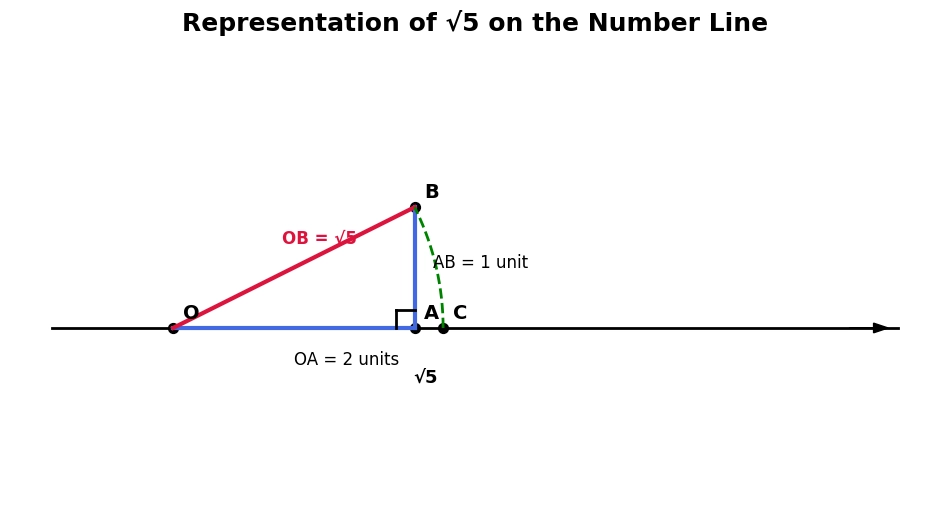
Question 4: Represent √5 on the number line.
Answer:
Step 1: Draw a number line
Step 2: Mark point O at 0 and A at 2
Step 3: At A, draw perpendicular AB of length 1 unit
Step 4: Join OB
Using Pythagoras:
OB² = OA² + AB² = 4 + 1 = 5
OB = √5
Step 5: With O as center and radius OB,
draw an arc cutting the number line at C
Point C represents √5 on the number line.
Question 5: State Euclid's Division Lemma. Find q and r when a = 56 and b = 9.
Answer:
Euclid's Division Lemma: For any two positive integers a and b, there exist unique integers q and r such that:
a = bq + r, where 0 ≤ r < b
Finding q and r for a = 56, b = 9:
56 ÷ 9 = 6 remainder 2
So: 56 = 9 × 6 + 2
q = 6, r = 2
Verification: 9 × 6 + 2 = 54 + 2 = 56
Question 6: Use Euclid's Division Algorithm to find HCF of 870 and 225.
Answer:
Step-by-step using Euclid's Algorithm:
Step 1: Apply lemma to 870 and 225
870 = 225 × 3 + 195
Step 2: Apply lemma to 225 and 195
225 = 195 × 1 + 30
Step 3: Apply lemma to 195 and 30
195 = 30 × 6 + 15
Step 4: Apply lemma to 30 and 15
30 = 15 × 2 + 0
Remainder = 0,
The last non-zero remainder is 15.
HCF(870, 225) = 15
Verification:
870 = 15 × 58
225 = 15 × 15
Question 7: Find HCF of 135 and 225 using Euclid's Division Algorithm.
Answer:
Since 225 > 135:
225 = 135 × 1 + 90
Apply to 135 and 90:
135 = 90 × 1 + 45
Apply to 90 and 45:
90 = 45 × 2 + 0
Remainder = 0,
HCF(135, 225) = 45
Question 8: Show that every positive even integer is of the form 2q and every positive odd integer is of the form 2q + 1.
Answer: Let n be any positive integer. By Euclid's Lemma with b = 2:
n = 2q + r, where 0 ≤ r < 2
So r = 0 or r = 1
Case 1: r = 0 → n = 2q (even number)
Case 2: r = 1 → n = 2q + 1 (odd number)
Since every integer is either even or odd:
-
Every even integer = 2q
-
Every odd integer = 2q + 1
Question 9: Prove that any positive integer is of the form 3q, 3q+1, or 3q+2.
Answer:
Let n be any positive integer. By Euclid's Lemma with b = 3:
n = 3q + r, where 0 ≤ r < 3
Possible values of r: 0, 1, 2
Case 1: r = 0 → n = 3q
Case 2: r = 1 → n = 3q + 1
Case 3: r = 2 → n = 3q + 2
Therefore any positive integer must be of the form 3q, 3q+1, or 3q+2.
Question 10: Express 156 as a product of prime factors.
Answer:
Using prime factorisation (factor tree method):
156 ÷ 2 = 78
78 ÷ 2 = 39
39 ÷ 3 = 13
13 is prime
156 = 2 × 2 × 3 × 13
156 = 2² × 3 × 13
Verification: 2² × 3 × 13 = 4 × 3 × 13 = 4 × 39 = 156
Question 11: Find HCF and LCM of 6, 72, and 120 using prime factorisation method.
Answer:
Step 1: Prime factorisation
6 = 2 × 3
72 = 2³ × 3²
120 = 2³ × 3 × 5
Step 2: Find HCF
HCF = Product of lowest powers of common primes
HCF = 2¹ × 3¹ = 6
Step 3: Find LCM
LCM = Product of highest powers of all primes
LCM = 2³ × 3² × 5 = 8 × 9 × 5 = 360
Answer: HCF = 6, LCM = 360
Question 12: The HCF of 306 and 657 is 9. Find their LCM.
Answer:
Using the formula:
HCF × LCM = Product of two numbers
9 × LCM = 306 × 657
9 × LCM = 201,042
LCM = 201,042 ÷ 9
LCM = 22,338
Answer: LCM = 22,338
Question 13: Check whether 6ⁿ can end with the digit 0 for any natural number n.
Answer:
For a number to end with digit 0, it must be divisible by 10, which means it must have both 2 and 5 as prime factors.
Prime factorisation of 6ⁿ:
6ⁿ = (2 × 3)ⁿ = 2ⁿ × 3ⁿ
6ⁿ contains only prime factors 2 and 3.
It does NOT contain 5 as a factor.
Therefore 6ⁿ can never end with digit 0 for any natural number n.
Question 14: Without actual division, determine if 13/3125 has a terminating decimal expansion. If yes, find it.
Answer:
Check the denominator:
3125 = 5⁵
Denominator = 5⁵ = 2⁰ × 5⁵
Since the denominator has only factors of 2 and 5, it is a terminating decimal.
Finding the decimal:
13/3125 = 13/5⁵
Multiply numerator and denominator by 2⁵:
= (13 × 32)/(5⁵ × 2⁵)
= 416/100000
= 0.00416
Answer: 13/3125 = 0.00416 (terminating)
Question 15: Write the condition for p/q to have a terminating decimal expansion.
Answer:
A rational number p/q (in lowest terms, HCF(p,q) = 1) has a terminating decimal expansion if and only if:
The denominator q is of the form 2ⁿ × 5ᵐ
Where n and m are non-negative integers (0, 1, 2, 3...)
Examples:
7/8 = 7/2³ → Terminating (0.875)
3/6 = 1/2 → Terminating (0.5)
1/7 → 7 is not of form 2ⁿ × 5ᵐ → Non-terminating
Question 16: Classify the following as terminating or non-terminating recurring:
17/8, 15/1600, 29/343, 23/2³ × 5²
Answer:
17/8:
8 = 2³ (only factor of 2)
Terminating
17/8 = 2.125
15/1600:
1600 = 2⁶ × 5²
Terminating
29/343:
343 = 7³ (contains 7, not of 2ⁿ × 5ᵐ form)
Non-terminating recurring
23/(2³ × 5²):
Denominator = 2³ × 5²
Terminating
Question 17: Express 0.6̄ as a fraction in simplest form.
Answer:
Let x = 0.6 = 0.6666...
Multiply both sides by 10:
10x = 6.6666... = 6.6
Subtract original:
10x - x = 6.6 - 0.6
9x = 6
x = 6/9 = 2/3
Answer: 0.6 = 2/3
Question 18: Express 0.47̄ as a fraction.
Answer:
Let x = 0.47 = 0.4777...
Multiply by 10:
10x = 4.777... = 4.7 ...(1)
Multiply by 100:
100x = 47.777... = 47.7 ...(2)
Subtract (1) from (2):
90x = 43
x = 43/90
Answer: 0.47 = 43/90
Question 19: Verify the closure property of irrational numbers under addition with an example showing it does NOT always hold.
Answer:
Claim: Sum of two irrational numbers is NOT always irrational.
Counterexample:
Let a = √3 and b = -√3
Both √3 and -√3 are irrational numbers.
a + b = √3 + (-√3) = 0
But 0 is a rational number.
Therefore irrational numbers are NOT closed under addition. The sum of two irrational numbers can be rational.
Example where sum IS irrational:
√2 + √3 = 2.414... + 1.732... = irrational
Question 20: State and verify the distributive property with real numbers. Use a = 2, b = √3, c = √5.
Answer:
Distributive Property:
a × (b + c) = (a × b) + (a × c)
Verification:
LHS = 2 × (√3 + √5)
= 2√3 + 2√5
RHS = (2 × √3) + (2 × √5)
= 2√3 + 2√5
LHS = RHS
Distributive property holds for real numbers.
Question 21: Rationalise the denominator of 1/(√7 - √6).
Answer:
Multiply numerator and denominator by the conjugate (√7 + √6):
= 1/(√7 - √6) × (√7 + √6)/(√7 + √6)
= (√7 + √6)/((√7)² - (√6)²)
= (√7 + √6)/(7 - 6)
= (√7 + √6)/1
= √7 + √6
Answer: 1/(√7 - √6) = √7 + √6
Question 22: Simplify: (√5 + √2)/(√5 - √2)
Answer:
Multiply by conjugate (√5 + √2):
= (√5 + √2)² / ((√5)² - (√2)²)
= (5 + 2√10 + 2) / (5 - 2)
= (7 + 2√10) / 3
Answer: (7 + 2√10)/3
Question 23: State the theorem on decimal expansion of rational numbers. Classify 35/50 and 17/6.
Answer:
Theorem: Let x = p/q be a rational number where HCF(p,q) = 1. Then:
-
x has a terminating decimal if q = 2ⁿ × 5ᵐ
-
x has a non-terminating recurring decimal if q has prime factors other than 2 and 5
Classifying 35/50:
35/50 = 7/10 (simplified, HCF = 5)
10 = 2¹ × 5¹ (only 2 and 5 factors)
Terminating decimal
7/10 = 0.7
Classifying 17/6:
6 = 2 × 3 (contains factor 3)
Non-terminating recurring
17/6 = 2.8333... = 2.83
Question 24: Given that HCF(306, 657) = 9, find LCM(306, 657). Also verify using prime factorisation.
Answer:
Using formula:
LCM = (306 × 657) / HCF
LCM = (306 × 657) / 9
LCM = 201042 / 9
LCM = 22338
Verification using prime factorisation:
306 = 2 × 3² × 17
657 = 3² × 73
HCF = 3² = 9
LCM = 2 × 3² × 17 × 73
= 2 × 9 × 17 × 73
= 22338
Answer: LCM = 22338
Question 25: Prove that 3 + 2√5 is irrational.
Answer:
Proof by contradiction:
Assume 3 + 2√5 is rational.
Then 3 + 2√5 = p/q where p and q are integers, q ≠ 0, HCF(p,q) = 1.
2√5 = p/q - 3
2√5 = (p - 3q)/q
√5 = (p - 3q)/2q
Since p, q, 3 are integers, (p - 3q)/2q is a rational number.
Therefore our assumption was wrong, and 3 + 2√5 is irrational.

Formula Table
Read more: Important Questions on Real Numbers - Class 10
Practice Questions on Real Numbers
1. Identify whether the following numbers are rational or irrational:
2. Find the HCF of 36 and 48 using prime factorization.
3. Find the LCM of 20 and 30.
4. Express the decimal number 0.125 as a fraction in simplest form.
5. Find the square root of 196.
6. Check whether the number () is a real number.
7. Using Euclid’s Division Lemma, divide 29 by 5 and find:
- Quotient
- Remainder
8. Write any five examples of integers and real numbers.
9. Simplify the following:
10. Determine whether the following statement is true or false:
“Every whole number is a real number.”
Download PDF - Real Numbers Questions and Answers
Related topics:
Frequently Asked Questions on Real Numbers Questions and Answers
1. What are real numbers?
Real numbers are all numbers that can be represented on the number line, including natural numbers, whole numbers, integers, fractions, decimals, rational numbers, and irrational numbers.
2. What are the types of real numbers?
Real numbers are divided into:
- Rational numbers
- Irrational numbers
3. What are rational numbers?
Rational numbers are numbers that can be written in the form:
where pp and qq are integers.
4. What are irrational numbers?
Irrational numbers cannot be written as fractions and have non-terminating, non-repeating decimals. Examples:
5. Is zero a real number?
Yes, zero is a real number because it lies on the number line.
6. Are negative numbers real numbers?
Yes, all negative integers and negative decimals are real numbers.
7. What is the difference between rational and irrational numbers?
Rational numbers can be written in the form , where . Irrational numbers cannot be expressed in this form and have non-terminating, non-repeating decimal expansions.
8. How do I identify a rational number?
A number is rational if it can be written as a fraction of two integers with a non-zero denominator.
9. Why is √2 an irrational number?
√2 is irrational because it cannot be expressed as a ratio of two integers. Its decimal expansion is non-terminating and non-repeating.
10. What is Euclid's Division Lemma?
Euclid's Division Lemma states that for any two positive integers and, there exist unique integers andsuch that:
11. Is √25 a real number?
Answer: Yes, is a real number because:
Since 5 lies on the number line, it is a real number.
12. Is π (pi) a rational or irrational number?
Answer: π is an irrational number because its decimal form never ends and never repeats.
Approximate value:$\pi \approx 3.14159$
13. Find the square root of 144.
Answer:
Therefore, the square root of 144 is 12.
Numbers make sense when they're taught right. To see how Orchids The International School turns Maths from intimidating to intuitive, reach out to our admissions team.


Admissions Open for 2026-27
What type of concept pages would you prefer?
CBSE Schools In Popular Cities
- CBSE Schools in Bangalore
- CBSE Schools in Mumbai
- CBSE Schools in Pune
- CBSE Schools in Hyderabad
- CBSE Schools in Chennai
- CBSE Schools in Gurgaon
- CBSE Schools in Kolkata
- CBSE Schools in Indore
- CBSE Schools in Sonipat
- CBSE Schools in Delhi
- CBSE Schools in Rohtak
- CBSE Schools in Bhopal
- CBSE Schools in Aurangabad
- CBSE Schools in Jabalpur
- CBSE Schools in Jaipur
- CBSE Schools in Jodhpur
- CBSE Schools in Nagpur
- CBSE Schools in Ahmednagar
- CBSE School In Tumkur











Orchids The International School is one of India's leading chains of CBSE and ICSE schools, with 110+ schools across the country.