

Relation Between Factors and Multiples
Understanding the relationship between factors and multiples is useful in solving many problems. These two are inversly related to each other through the multiplication and division operation. Let's learn each of these in detail and their relationship with each other with the help of examples.
Table of Contents
- Factors and Their Properties
- Multiples and Their Properties
- Relationship Between Factors and Multiples
- Solved Examples
- Frequently Asked Questions

Factors and Their Properties
Factors are numbers which divide a given number completely, leaving the remainder as zero.
Properties of Factors:
1. Every number is a factor of itself.
2. 1 is the factor of every number.
3. The factor of a number is always less than or equal to the number.
4. Every factor of a number divides it completely.
5. A number is always a factor of infinite numbers.
6. Every number has a few number of factors. The number of factors will not exceed the number.
Know more about related topics:
Multiples and Their Properties
Multiples are numbers which are obtained by multiplying the given number with any number other than zero.
Properties of Multiples:
1. Every number is a multiple of each of its factors.
2. The multiple of a number is always greater than or equal to the number itself.
3. A number can be a multiple of more than one number.
4. The number of multiples of a number is infinite.
Relationship Between Factors and Multiples
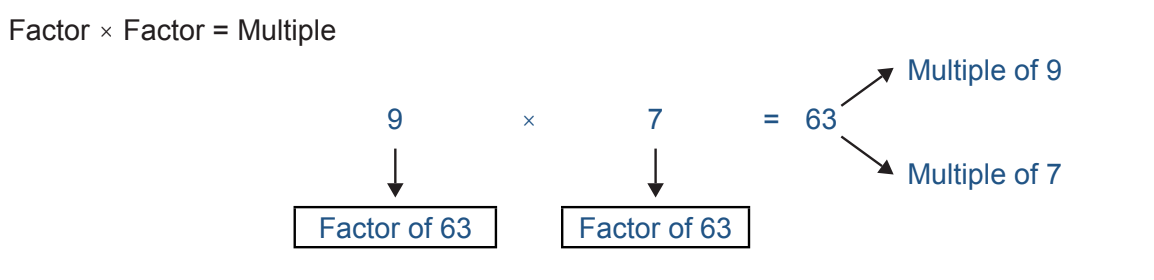
The relationship between factors and multiples can be represented with a simple equation:
Factor A × Factor B = Multiple C
where ‘A’ and ‘B’ are the factors that multiply together to form multiple C.
These two numbers can divide C evenly and C is the product of A and B. It can be divided evenly by both A and B.
A factor is a "building block" of a number, while a multiple is the "result" of multiplying that number by an integer.
Solved Examples on Factors and Multiples
Example 1. List the factors for the following numbers.
a. 36
b. 27
c. 40
d. 48
Solution:
a). Starting from 1, we need to check for all those numbers which divide 36 completely.
36 = 1 × 36
36 = 2 × 18
36 = 3 × 12
36 = 4 × 9 36 = 6 × 6
Factors of 36 are 1, 2, 3, 4, 6, 9, 12, 18, 36.
b). Starting from 1, we need to check for all those numbers which divide 27 completely.
27 = 1 × 27
27 = 3 × 9
Factors of 27 are 1, 3, 9, 27.
c). Starting from 1, we need to check for all those numbers which divide 40 completely.
40 = 1 × 40
40 = 2 × 20
40 = 4 × 10
40 = 5 × 8
Factors of 40 are 1, 2, 4, 5, 8, 10, 20, 40.
d. Starting from 1, we need to check for all those numbers which divide 48 completely.
48 = 1 × 48
48 = 2 × 24
48 = 3 × 16
48 = 4 × 12
48 = 6 × 8
Factors of 48 are 1, 2, 3, 4, 6, 8, 12, 16, 24, 48.
Example 2. Write the first five multiples of the following.
a. 12 b. 17
Solution:
a. Let’s list down all the multiples of 12:
12 × 1 = 12
12 × 2 = 24
12 × 3 = 36
12 × 4 = 48
12 × 5 = 60
The first five multiples of 12 are 12, 24, 36, 48, 60.
b. Let’s list down all the multiples of 17:
17 × 1 = 17
17 × 2 = 34
17 × 3 = 51
17 × 4 = 68
17 × 5 = 85
The first five multiples of 17 are 17, 34, 51, 68, 85.
Numbers make sense when they're taught right. To see how Orchids The International School turns Maths from intimidating to intuitive, reach out to our admissions team.
Frequently Asked Questions
1. How are factors and multiples related?
Factors and multiples are inversly related to each other through multiplication and division operation.
2. What is the difference between a factor and a multiple?
Factors of a number are numbers that evenly divide a number without a reminder.
Multiples of a number are numbers obtained by multiplying that number with other integers.
3. Can a number be both factor and multiple by itself?
Yes, every number is both factor and multiple of itself.
Related Links


Admissions Open for 2026-27
What type of concept pages would you prefer?
CBSE Schools In Popular Cities
- CBSE Schools in Bangalore
- CBSE Schools in Mumbai
- CBSE Schools in Pune
- CBSE Schools in Hyderabad
- CBSE Schools in Chennai
- CBSE Schools in Gurgaon
- CBSE Schools in Kolkata
- CBSE Schools in Indore
- CBSE Schools in Sonipat
- CBSE Schools in Delhi
- CBSE Schools in Rohtak
- CBSE Schools in Bhopal
- CBSE Schools in Aurangabad
- CBSE Schools in Jabalpur
- CBSE Schools in Jaipur
- CBSE Schools in Jodhpur
- CBSE Schools in Nagpur
- CBSE Schools in Ahmednagar
- CBSE School In Tumkur











Orchids The International School is one of India's leading chains of CBSE and ICSE schools, with 110+ schools across the country.