

Types of Right Angle Triangles
Types of Right angled triangles Explain the different kinds of triangles that have exactly one angle of 90 degrees. A triangle with a right angle is also called a right-angled triangle or a right triangle. There are mainly two types of right angled triangles: scalene right triangle and isosceles right triangle. The isosceles right triangle has equal angles and sides. The scalene right triangle has different angles and sides. Understanding Types of Right Angled Triangles helps students learn geometry better and solve problems in trigonometry more easily.
Table of Contents
- What Is a Right Angle Triangle?
- Why Is It Called a Right Triangle?
- Parts of a Right Angle Triangle
- Diagram of a Right Angle Triangle
- Properties of a Right Angle Triangle
- Pythagoras Theorem and Right Angle Triangles
- Formula for a Right Angle Triangle
- Types of Right Angle Triangles
- Right Angle Triangle Examples
- Solved Problems on Right Angle Triangles
- Difference Between Right Triangle and Other Triangles
- Right Triangle vs Acute Triangle
- Right Triangle vs Obtuse Triangle
- Right Triangle vs Equilateral Triangle
- Frequently Asked Questions on Right Angle Triangles

What Is a Right Angle Triangle?
A right angle triangle is a triangle that has one interior angle equal to exactly 90 degrees. That single 90-degree angle is called the right angle, and it is usually marked with a small square symbol in diagrams. The other two angles in the triangle are always acute each one is less than 90 degrees and together they add up to 90 degrees as well.
Why Is It Called a Right Triangle?
The word "right" here comes from the Latin word rectus, meaning upright or straight. When one side of the triangle stands perfectly upright (perpendicular) to another side, it forms a right angle. That perpendicular relationship between two sides is the defining feature of every right triangle.
Parts of a Right Angle Triangle
Hypotenuse
The hypotenuse is the longest side of a right angle triangle. It always sits opposite the 90-degree angle. No matter how you tilt or rotate the triangle, the side facing the right angle is always the hypotenuse. It is always longer than either of the other two sides.
Base
The base is the horizontal side of the right angle triangle the side on which the triangle appears to rest. In calculations, any side can be called the base depending on the orientation, but in standard position the base is the bottom side that meets the perpendicular at the right angle.
Perpendicular
The perpendicular is the vertical side that stands upright from the base. It meets the base at exactly 90 degrees. Together, the base and the perpendicular are the two shorter sides that form the right angle between them.
Diagram of a Right Angle Triangle
.webp "Diagram of a Right Angle Triangle")
In the diagram above, vertex B carries the right angle (the small square). Side AB is the perpendicular it stands upright. Side BC is the base it runs horizontally. Side AC is the hypotenuse it stretches diagonally from one end of the base to the top of the perpendicular and is always the longest of the three sides. The two angles at A and C are both acute, and they always sum to exactly 90 degrees.
Properties of a Right Angle Triangle
One Angle Is 90 Degrees
Every right triangle has exactly one angle equal to 90 degrees. This is what makes it a right triangle in the first place. If even one angle changes to be slightly more or less than 90 degrees, the triangle is no longer a right triangle.
Hypotenuse Is the Longest Side
The hypotenuse is always opposite the right angle and is always the longest side. It is longer than the base and longer than the perpendicular. This is a fixed rule that holds for every right triangle without exception.
Sum of Interior Angles
Like all triangles, the three interior angles of a right triangle always add up to 180 degrees. Since one angle is 90 degrees, the remaining two angles must together equal 90 degrees. So both of the other angles are always acute (each less than 90 degrees).
Relationship Between Sides
The three sides of a right triangle share a precise mathematical relationship: the square of the hypotenuse equals the sum of the squares of the other two sides. This relationship is known as the Pythagorean theorem and is the most important property specific to right triangles.
Pythagoras Theorem and Right Angle Triangles
Statement of Pythagoras Theorem: For any right angle triangle with legs of length a and b, and hypotenuse c: a² + b² = c²
if you square the perpendicular and square the base, and add those two values together, the result always equals the square of the hypotenuse.
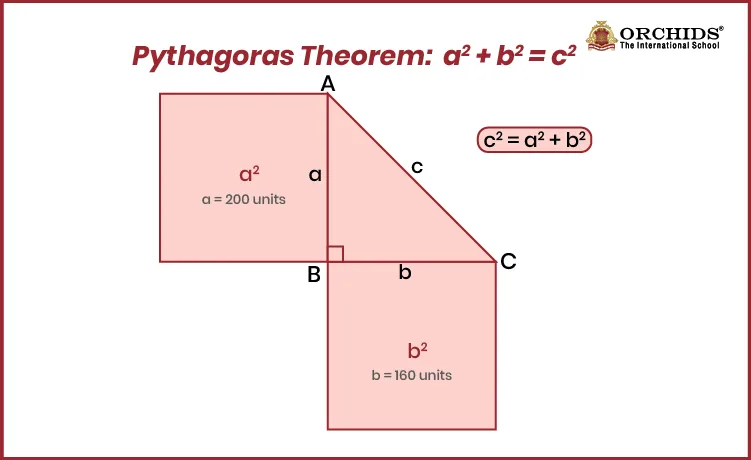
In the diagram above, a square is drawn on each of the two shorter sides (a and b). The area of the square on the hypotenuse (c²) is always equal to the total area of the other two squares added together. This visual makes the theorem intuitive: the hypotenuse "contains" the combined measurement of both legs.
If a = 3 and b = 4, then c² = 9 + 16 = 25, so c = 5. The triangle with sides 3, 4, and 5 is the most famous right triangle example and is called a Pythagorean triple.
Formula for a Right Angle Triangle
Pythagoras Formula
c = √(a² + b²)
Use this to find the hypotenuse when both legs are known. To find a missing leg, rearrange: a = √(c² − b²).
Area Formula
The area of a right angle triangle is straightforward because the base and height are simply the two legs — they already meet at a right angle, so no extra calculation is needed.
Area = ½ × base × height
or equivalently: A = ½ × b × h
For example, if base = 8 cm and height = 6 cm, then Area = ½ × 8 × 6 = 24 cm².
Perimeter Formula
The perimeter is the total length of all three sides added together.
Perimeter = a + b + c
where a = perpendicular, b = base, and c = hypotenuse.
For the 3-4-5 triangle: Perimeter = 3 + 4 + 5 = 12 units.
Types of Right Angle Triangles
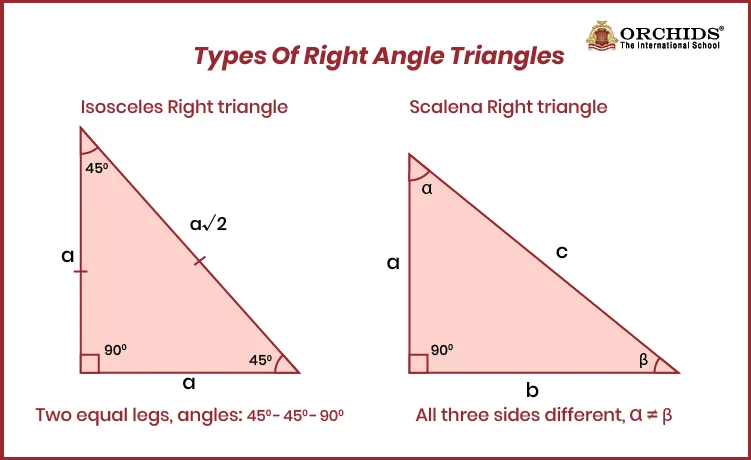
Isosceles Right Triangle
An isosceles right triangle has two sides that are equal in length. These two equal sides are the legs (the perpendicular and the base). Because the legs are equal, the two acute angles are also equal each one measures exactly 45 degrees. The angles in an isosceles right triangle are always 45°−45°−90°. If each leg has length a, then by Pythagoras the hypotenuse equals a√2. For example, if each leg is 5 cm, the hypotenuse is 5√2 ≈ 7.07 cm.
Scalene Right Triangle
A scalene right triangle has all three sides of different lengths. One angle is 90 degrees, but the other two angles are unequal for example, 30° and 60°, or 37° and 53°. The 3−4−5 triangle and the 5−12−13 triangle are both well-known scalene right triangles. Because the sides and angles are all different, these triangles are much more common in real-life engineering and construction problems.
Right Angle Triangle Examples
Example 1:
A right triangle has a base of 5 cm and a perpendicular of 12 cm. Find the hypotenuse.
Using Pythagoras:
c² = 5² + 12²
= 25 + 144 = 169
c² = 169
c = √169 = 13 cm.
This is a classic Pythagorean triple: 5, 12, 13.
Example 2:
A right triangle has a hypotenuse of 10 cm and one leg of 6 cm. Find the other leg.
a² = c² − b²
= 100 − 36
a² = 64,
a = √64
so a = 8 cm.
Example 3:
Find the area of a right triangle with base = 9 cm and height = 4 cm.
Area = ½ × 9 × 4 = 18 cm².
Solved Problems on Right Angle Triangles
Finding the Hypotenuse
Problem: A ladder leans against a wall. The base of the ladder is 6 m from the wall, and the wall is 8 m high. How long is the ladder?
Solution: Here, base = 6 m, perpendicular = 8 m, hypotenuse = ladder length.
c² = 6² + 8²
= 36 + 64
c² = 100
c = √100 = 10 m
The ladder is 10 metres long.
Finding a Missing Side
Problem: The hypotenuse of a right triangle is 26 cm. One leg is 10 cm. Find the other leg.
Solution:
a² = c² − b²
= 26² − 10²
= 676 − 100
a² = 576
a = √576 = 24 cm
Finding the Area
Problem: A triangular field has a right angle at one corner. The two sides meeting at the right angle are 30 m and 40 m. Find the area of the field.
Solution: Area = ½ × base × height = ½ × 40 × 30 = 600 m²
Difference Between Right Triangle and Other Triangles
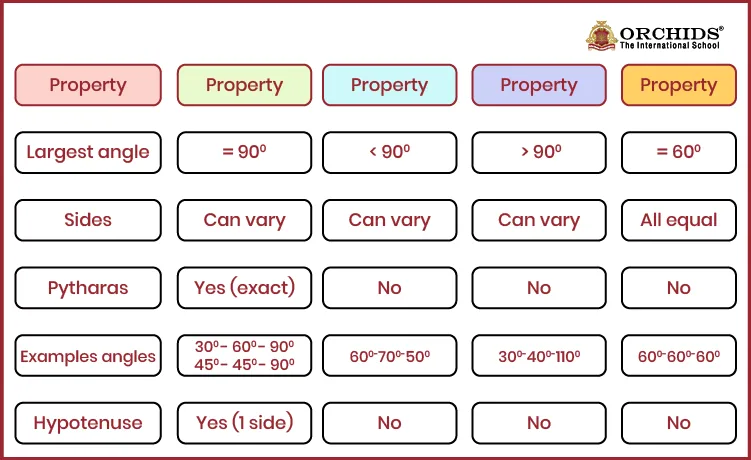
Right Triangle vs Acute Triangle
An acute triangle has all three angles less than 90 degrees. No angle reaches 90 degrees, and no angle exceeds it. A right triangle has exactly one angle equal to 90 degrees. The Pythagorean theorem a² + b² = c² holds exactly only for right triangles. For an acute triangle, a² + b² is greater than c² (where c is the longest side). The hypotenuse the side opposite the right angle exists only in a right triangle.
Right Triangle vs Obtuse Triangle
An obtuse triangle has one angle greater than 90 degrees. It is the opposite extreme from the acute triangle. For an obtuse triangle with longest side c, a² + b² is less than c². A right triangle sits exactly between these two: it is the precise boundary point where a² + b² equals c². No obtuse triangle has a hypotenuse in the mathematical sense.
Right Triangle vs Equilateral Triangle
An equilateral triangle has all three sides equal and all three angles equal to 60 degrees. It is always acute and can never be a right triangle. The right angle triangle, by contrast, always has unequal sides (at minimum the hypotenuse must differ from the legs) and never has all angles equal. The Pythagorean theorem does not apply to equilateral triangles. An equilateral triangle is the most symmetrical of all triangles; a right triangle is the most practically useful for calculation and construction.
Related Topics:
Frequently Asked Questions on Right Angle Triangles
1. What is a right angle triangle?
A right angle triangle is a triangle that has one angle equal to 90°. The side opposite the right angle is called the hypotenuse.
2. What are the sides of a right angle triangle?
A right angle triangle has three sides:
- Hypotenuse: the longest side opposite the right angle
- Perpendicular (Height) : one side forming the right angle
- Base: the other side forming the right angle
3. What is the hypotenuse?
The hypotenuse is the longest side of a right angle triangle and lies opposite the 90° angle.
4. What is the formula for a right triangle?
The fundamental formula for a right triangle is given by the Pythagoras Theorem:
5. What is Pythagoras Theorem?
Pythagoras Theorem states that in a right angle triangle, the square of the hypotenuse is equal to the sum of the squares of the other two sides.
6. How do you find the area of a right triangle?
The area of a right triangle is calculated using:
7. Can a right triangle be isosceles?
Yes. A right triangle can be isosceles if its two shorter sides are equal. In this case, the two acute angles are each 45°.
8. Can a right triangle be equilateral?
No. An equilateral triangle has all three angles equal to 60°, so it cannot contain a 90° angle.
9. What is the difference between a right triangle and an obtuse triangle?
A right triangle has one angle exactly 90°, whereas an obtuse triangle has one angle greater than 90°. A triangle cannot be both right and obtuse at the same time.
Numbers make sense when they're taught right. To see how Orchids The International School turns Maths from intimidating to intuitive, reach out to our admissions team.


Admissions Open for 2026-27
What type of concept pages would you prefer?
CBSE Schools In Popular Cities
- CBSE Schools in Bangalore
- CBSE Schools in Mumbai
- CBSE Schools in Pune
- CBSE Schools in Hyderabad
- CBSE Schools in Chennai
- CBSE Schools in Gurgaon
- CBSE Schools in Kolkata
- CBSE Schools in Indore
- CBSE Schools in Sonipat
- CBSE Schools in Delhi
- CBSE Schools in Rohtak
- CBSE Schools in Bhopal
- CBSE Schools in Aurangabad
- CBSE Schools in Jabalpur
- CBSE Schools in Jaipur
- CBSE Schools in Jodhpur
- CBSE Schools in Nagpur
- CBSE Schools in Ahmednagar
- CBSE School In Tumkur











Orchids The International School is one of India's leading chains of CBSE and ICSE schools, with 130+ schools across the country.