

Table of 750
The multiplication table of 750 explains how the number 750 increases when multiplied step by step. It supports a better understanding of multiplication sequences and faster problem-solving. Learners can download the Table of 750 PDF to practise the table at any time.
Table of 750 Chart
In the Table of 750 chart, the multiples are systematically aligned to show how the number grows with each step. This format promotes accuracy and supports confident learning during practice.
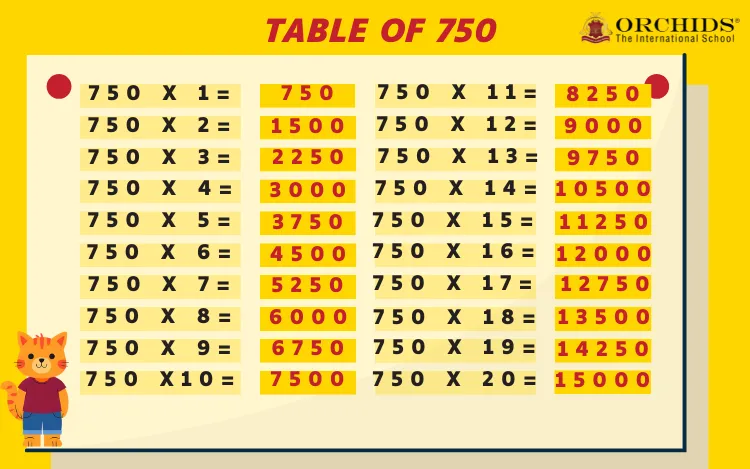

Multiplication Table of 750
In the multiplication table of 750, results increase consistently with each step, making number patterns easy to observe. This presentation aids learners in memorising the table and applying it effectively in real-life calculations.
| Multiplicand | Operation | Multiplier | Result | |
| 750 | x | 1 | = | 750 |
| 750 | x | 2 | = | 1500 |
| 750 | x | 3 | = | 2250 |
| 750 | x | 4 | = | 3000 |
| 750 | x | 5 | = | 3750 |
| 750 | x | 6 | = | 4500 |
| 750 | x | 7 | = | 5250 |
| 750 | x | 8 | = | 6000 |
| 750 | x | 9 | = | 6750 |
| 750 | x | 10 | = | 7500 |
| 750 | x | 11 | = | 8250 |
| 750 | x | 12 | = | 9000 |
| 750 | x | 13 | = | 9750 |
| 750 | x | 14 | = | 10500 |
| 750 | x | 15 | = | 11250 |
| 750 | x | 16 | = | 12000 |
| 750 | x | 17 | = | 12750 |
| 750 | x | 18 | = | 13500 |
| 750 | x | 19 | = | 14250 |
| 750 | x | 20 | = | 15000 |
The Table of 750 PDF is ready for download, providing a simple way for learners to practise regularly. This convenient format supports repeated use and enhances memorisation of the table.
Know more about related topics:
Download the Table of 750
How Do You Read the Multiplication Table of 750?
Examine the table carefully from the first to the last multiple, noting the steady growth of the numbers. This strategy supports better understanding and helps learners apply the table confidently.
750 times 1 is 750
750 times 2 is 1500
750 times 3 is 2250
750 times 4 is 3000
750 times 5 is 3750
750 times 6 is 4500
750 times 7 is 5250
750 times 8 is 6000
750 times 9 is 6750
750 times 10 is 7500
750 times 11 is 8250
750 times 12 is 9000
750 times 13 is 9750
750 times 14 is 10,500
750 times 15 is 11,250
750 times 16 is 12,000
750 times 17 is 12,750
750 times 18 is 13,500
750 times 19 is 14,250
750 times 20 is 15,000
Table of 750 in Words
Here, the multiples of 750 are written in words to support learners in understanding and memorising large numbers. This approach combines mathematical learning with improved comprehension skills.
Seven hundred fifty times one is seven hundred fifty
Seven hundred fifty times two is one thousand five hundred
Seven hundred fifty times three is two thousand two hundred fifty
Seven hundred fifty times four is three thousand
Seven hundred fifty times five is three thousand seven hundred fifty
Seven hundred fifty times six is four thousand five hundred
Seven hundred fifty times seven is five thousand two hundred fifty
Seven hundred fifty times eight is six thousand
Seven hundred fifty times nine is six thousand seven hundred fifty
Seven hundred fifty times ten is seven thousand five hundred
Seven hundred fifty times eleven is eight thousand two hundred fifty
Seven hundred fifty times twelve is nine thousand
Seven hundred fifty times thirteen is nine thousand seven hundred fifty
Seven hundred fifty times fourteen is ten thousand five hundred
Seven hundred fifty times fifteen is eleven thousand two hundred fifty
Seven hundred fifty times sixteen is twelve thousand
Seven hundred fifty times seventeen is twelve thousand seven hundred fifty
Seven hundred fifty times eighteen is thirteen thousand five hundred
Seven hundred fifty times nineteen is fourteen thousand two hundred fifty
Seven hundred fifty times twenty is fifteen thousand
Table of 750 Using Repeated Addition
In the table of 750, repeated addition highlights how numbers increase in a predictable pattern by adding 750 repeatedly. This technique helps learners visualise multiplication as a series of sums for better understanding.
|
Multiplication |
Repeated Addition |
Result |
|
750 × 1 |
750 |
750 |
|
750 × 2 |
750 + 750 |
1500 |
|
750 × 3 |
750 + 750 + 750 |
2250 |
|
750 × 4 |
750 + 750 + 750 + 750 |
3000 |
|
750 × 5 |
750 + 750 + 750 + 750 + 750 |
3750 |
|
750 × 6 |
750 + 750 + 750 + 750 + 750 + 750 |
4500 |
|
750 × 7 |
750 + 750 + 750 + 750 + 750 + 750 + 750 |
5250 |
|
750 × 8 |
750 + 750 + 750 + 750 + 750 + 750 + 750 + 750 |
6000 |
|
750 × 9 |
750 + 750 + 750 + 750 + 750 + 750 + 750 + 750 + 750 |
6750 |
|
750 × 10 |
750 + 750 + 750 + 750 + 750 + 750 + 750 + 750 + 750 + 750 |
7500 |
Solved Problems on the Table of 750
1. A factory produces 750 bottles daily. How many bottles are produced in 6 days?
Solution: Each day, the factory produces 750 bottles. Multiply by 6 to get:
750 × 6 = 4500
So, 4500 bottles are produced in 6 days.
2. A classroom has 750 students. How many students are there in 7 classrooms?
Solution: Each classroom has 750 students. Multiplying by 7 gives:
750 × 7 = 5250
Therefore, there are 5250 students in 7 classrooms.
3. A baker bakes 750 cupcakes per day. How many cupcakes are there in 10 days?
Solution: 750 cupcakes daily × 10 days = 7500 cupcakes
So, 7500 cupcakes are baked in 10 days.
4. A stadium has 750 seats. How many seats are there in 4 stadiums?
Solution: Each stadium has 750 seats. Multiplying by 4 gives:
750 × 4 = 3000
Therefore, 4 stadiums have 3000 seats altogether.
5. A company packs 750 toys per box. How many toys are there in 5 boxes?
Solution: Each box has 750 toys. Multiply by 5 to find the total:
750 × 5 = 3750
So, 5 boxes contain 3750 toys in total.
Learn More Multiplication Tables
Numbers make sense when they're taught right. To see how Orchids The International School turns Maths from intimidating to intuitive, reach out to our admissions team.
Frequently Asked Questions on Table of 750
1. Why is the Table of 750 important?
The Table of 750 helps learners work with round numbers and apply multiplication in practical situations like total bottles, cupcakes, or seats.
2. How do I calculate 750 × 7 easily?
Multiply the hundreds first: 700 × 7 = 4900, then the remaining 50 × 7 = 350, and add: 4900 + 350 = 5250.
3. Can repeated addition help with the Table of 750?
Yes, adding 750 repeatedly is an easy way to visualise multiplication for beginners.
4. How can I memorise the Table of 750 quickly?
Focus on the multiples of 750 increasing steadily: 750, 1500, 2250… Practise in sequences of 2–3 multiples at a time.
5. Where can I use the Table of 750 in daily life?
It’s useful for calculating total bottles, students, cupcakes, or toys across multiple batches or sections.
Related Links


Admissions Open for 2026-27
What type of concept pages would you prefer?
CBSE Schools In Popular Cities
- CBSE Schools in Bangalore
- CBSE Schools in Mumbai
- CBSE Schools in Pune
- CBSE Schools in Hyderabad
- CBSE Schools in Chennai
- CBSE Schools in Gurgaon
- CBSE Schools in Kolkata
- CBSE Schools in Indore
- CBSE Schools in Sonipat
- CBSE Schools in Delhi
- CBSE Schools in Rohtak
- CBSE Schools in Bhopal
- CBSE Schools in Aurangabad
- CBSE Schools in Jabalpur
- CBSE Schools in Jaipur
- CBSE Schools in Jodhpur
- CBSE Schools in Nagpur
- CBSE Schools in Ahmednagar
- CBSE School In Tumkur











Orchids The International School is one of India's leading chains of CBSE and ICSE schools, with 110+ schools across the country.