

Triangles on the same base and between the same parallels
Triangles on the same base and between the same parallels have equal areas. This concept uses the principle of base and height to compare triangles easily. In this guide, we will learn about the theorem, its proof, and related examples for easy understanding of the concept.
Table of Contents
- Theorem on Triangles on the Same Base and Between Same Parallels
- Solved Examples on Triangles on the Same Base and Between the Same Parallels
- Frequently Asked Questions on Triangles with Same Base and Between the Same Parallel Lines

Theorem on Triangles on the Same Base and Between the Same Parallels
Theorem: Triangles on the same base and between the same parallels have the same area.
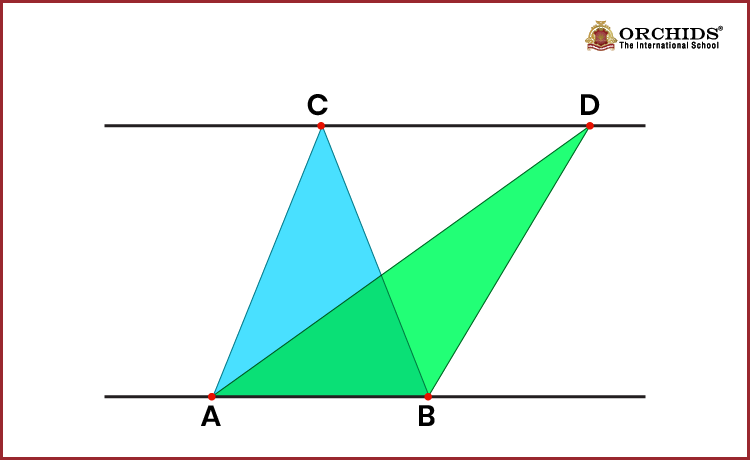
Here, the areas of ∆ABC and ∆ABD are equal. Both triangles have the same base AB and are under the same parallel lines.
Proof:
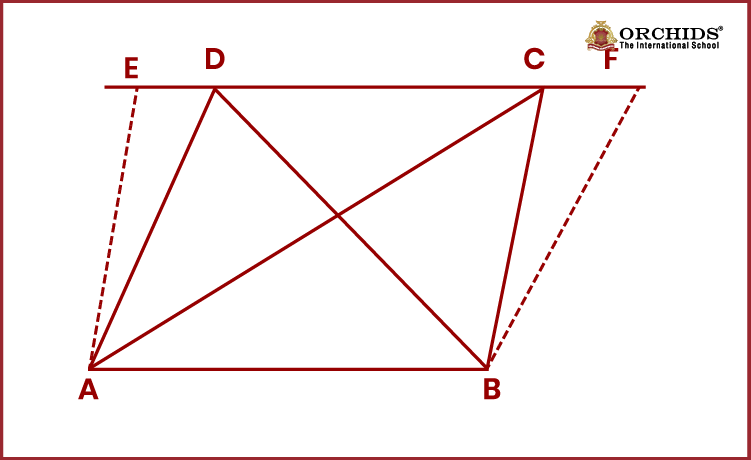
Let ABC and ABD be two triangles with same base and between same parallel lines.
Draw BF ∥ AD and AE ∥ BC
In ABFD,
AB ∥ DF (given as AB ∥ EF), and BF ∥ AD (by construction)
Hence, ABFD is a parallelogram.
Similarly, ABCE is a parallelogram.
ABFD and ABCE are parallelograms on the same base and between the same parallels.
∴ ar(ABFD) = ar(ABCE) (∵ area of parallelograms on the same base and between the same parallels are equal). --------- (1)
In parallelogram ABFD, since the diagonal divides the parallelogram into two congruent triangles
∆ABD ≅ ∆FBD
∴ ar (ABD) = ar (FBD) (∵ area of congruent triangles is equal)
∴ ar (ABFD) = 2 ar (ABD) ---------- (2)
Similarly, in parallelogram ABCE, ∆ABC ≅ ∆AEC.
∴ ar(ABC) = ar(AEC)
∴ ar (ABCE) = 2 ar (ABC) --------- (3)
From (1), ar(ABFD) = ar(ABCE)
From (2) and (3), 2 ar(ABD) = 2 ar(ABC).
⇒ ar(ABD) = ar(ABC)
Hence proved.
NOTE: The converse of the theorem holds, i.e., ΔABC and ΔABD are on the same base BC such that ar(ΔABC) = ar(ΔABD). Then AB ∥ EF
Know more about related topics:
Solved Examples on Triangles on the Same Base and Between the Same Parallels
Example 1: ΔABC and ΔDBC are on the same base BC. A and D are on the same side of BC such that AD ∥ BC. If BC = 16 cm and the distance between BC and AD is 3 cm, find the area of each triangle.
Solution: Given that ΔABC and ΔDBC are on the same base, BC, and between the same parallel lines.
∴ ar(ABC) = ar(DBC)
ar(ABC) = (½)bh = (½) × 16 × 3 = 24 cm²
∴ The area of each triangle is 24 cm².
Example 2: ΔPQR has base QR = 12 cm and height from P = 8 cm. ΔSQR has the same base QR, and ar(ΔSQR) = ar(ΔPQR). Find the height from S to QR.
Solution: ΔPQR has base QR = 12 cm and height from P = 8 cm.
ΔSQR has the same base QR, and ar(ΔSQR) = ar(ΔPQR).
∴ Both triangles are between the same parallel lines, and PS ∥ QR.
ar (PQR ) = (½) × 12 × 8 = 48 cm²
ar (SQR) = (½) × 12 × h = 48 cm²
∴ h = 8 cm.
Hence, the height from S to QR is 8 cm.
Numbers make sense when they're taught right. To see how Orchids The International School turns Maths from intimidating to intuitive, reach out to our admissions team.
Frequently Asked Questions on Triangles with Same Base and Between the Same Parallel Lines
1. What is the main theorem for triangles on the same base and parallel?
Triangles on the same base and between the same parallels are equal in area.
2. Are triangles with the same base and parallel lines congruent?
No, triangles with the same base and parallel lines need not be congruent, but they have equal area.
3. What is the converse of this theorem?
The converse of the theorem states that two triangles having equal area and on the same base lie between the same parallel lines.
4. Do triangles with the same base always have the same area?
No. Triangles on the same base need not have the same area. They will have the same area only when they are on the same base and between the same parallel lines.
Related Links


Admissions Open for 2026-27
What type of concept pages would you prefer?
CBSE Schools In Popular Cities
- CBSE Schools in Bangalore
- CBSE Schools in Mumbai
- CBSE Schools in Pune
- CBSE Schools in Hyderabad
- CBSE Schools in Chennai
- CBSE Schools in Gurgaon
- CBSE Schools in Kolkata
- CBSE Schools in Indore
- CBSE Schools in Sonipat
- CBSE Schools in Delhi
- CBSE Schools in Rohtak
- CBSE Schools in Bhopal
- CBSE Schools in Aurangabad
- CBSE Schools in Jabalpur
- CBSE Schools in Jaipur
- CBSE Schools in Jodhpur
- CBSE Schools in Nagpur
- CBSE Schools in Ahmednagar
- CBSE School In Tumkur











Orchids The International School is one of India's leading chains of CBSE and ICSE schools, with 110+ schools across the country.