

Trigonometric Ratios
Trigonometric ratios are the ratios of the sides of a right-angled triangle with respect to its acute angles. The six trigonometric ratios sine (sin), cosine (cos), tangent (tan), cotangent (cot), cosecant (cosec), and secant (sec) form the foundation of trigonometry. Each ratio connects a specific angle to two sides of the triangle, making it possible to calculate unknown sides and angles with ease.
A trigonometric ratio is a ratio of any two sides of a right-angled triangle with respect to one of its acute angles.
Every right angled triangle has three sides:
- Opposite side: The side directly opposite from the angle you are working with
- Adjacent side: The side right next to the angle, excluding the hypotenuse
- Hypotenuse: The longest side of the triangle, always opposite the right angle
Using these three sides, six trigonometric ratios are defined:
|
Ratio |
Full Name |
Formula |
|---|---|---|
|
sin θ |
Sine |
Opposite / Hypotenuse |
|
cos θ |
Cosine |
Adjacent / Hypotenuse |
|
tan θ |
Tangent |
Opposite / Adjacent |
|
cosec θ |
Cosecant |
Hypotenuse / Opposite |
|
sec θ |
Secant |
Hypotenuse / Adjacent |
|
cot θ |
Cotangent |
Adjacent / Opposite |
The first three, sin, cos, and tan, are the ones used most often. The remaining three (cosec, sec, cot) are simply their reciprocals. So cosec θ = 1/sin θ, sec θ = 1/cos θ, and cot θ = 1/tan θ.
These six ratios stay constant for a given angle, no matter how large or small the triangle is. That consistency is what makes them so powerful. The angle alone determines the ratio, and the ratio reveals the sides.
Table of Contents
- Trigonometric Ratios Formulas
- Trigonometric Ratios Table
- Trigonometric Ratios of Complementary Angles Identities
- Sum, Difference, and Product Trigonometric Ratios Identities
- Examples on Trigonometric Ratios
- Practice Questions on Trigonometric Ratios
- Frequently Asked Questions on Trigonometric Ratios

Trigonometric Ratios Formulas
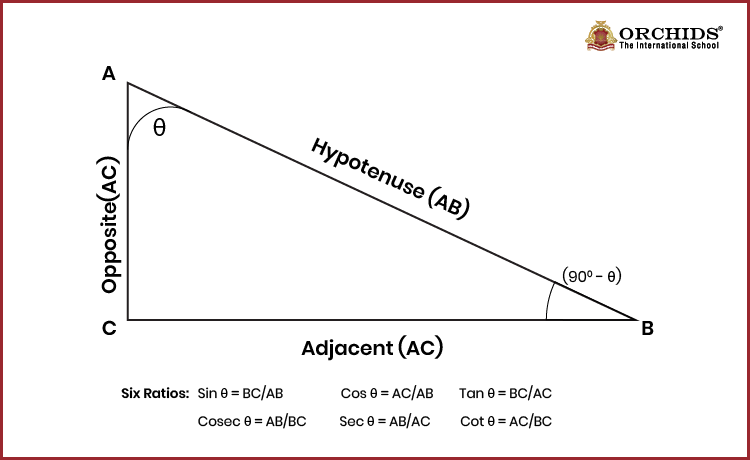
Trigonometric ratios are simply the ratios between the sides of a right angled triangle. When you have a right angled triangle and pick one of the acute angles (call it θ), the three sides get specific names:
- Hypotenuse: the longest side, opposite the right angle
- Opposite: the side facing your chosen angle θ
- Adjacent: the side next to your angle θ (that isn't the hypotenuse)
From these three sides, you get six ratios, and those are the six trigonometric functions.
The Six Ratios
- Sine (sin θ) = Opposite ÷ Hypotenuse
- Cosine (cos θ) = Adjacent ÷ Hypotenuse
- Tangent (tan θ) = Opposite ÷ Adjacent
- Cosecant (cosec θ) = Hypotenuse ÷ Opposite (the flip of sine)
- Secant (sec θ) = Hypotenuse ÷ Adjacent (the flip of cosine)
- Cotangent (cot θ) = Adjacent ÷ Opposite (the flip of tangent)
The easiest way to remember the first three is the phrase SOH CAH TOA: Sin = Opposite / Hypotenuse, Cos = Adjacent / Hypotenuse, Tan = Opposite / Adjacent.
Key Relationships
- tan θ = sin θ ÷ cos θ: tangent is just sine divided by cosine
- sin²θ + cos²θ = 1: the most important identity in all of trigonometry, directly from Pythagoras
- 1 + tan²θ = sec²θ: comes from dividing the above identity by cos²θ
- 1 + cot²θ = cosec²θ: comes from dividing by sin²θ
- Any ratio multiplied by its reciprocal always gives 1 (for example, sin θ × cosec θ = 1)
Know more about related topics:
Trigonometric Ratios Table
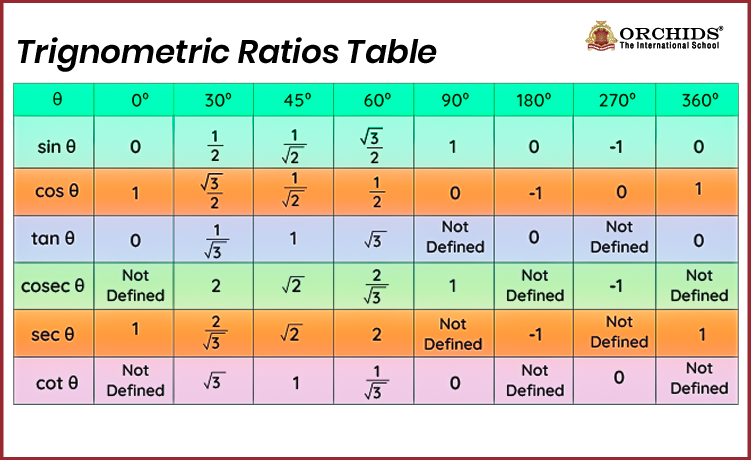
There are five standard angles you need to know by heart: 0°, 30°, 45°, 60°, and 90°.
The sine row follows the pattern √0/2, √1/2, √2/2, √3/2, √4/2 simplified. The cosine row is just the sine row written backwards. Tangent = sine ÷ cosine, and the last three rows are just the reciprocals of the first three. Any value with a zero in the denominator is "undefined."
Trigonometric Ratios of Complementary Angles Identities
Two angles are complementary when they add up to 90°. In a right triangle, the two acute angles are always complementary. There's a beautiful pattern here — the sine of any angle equals the cosine of its complement, and vice versa. This is actually where the word "cosine" comes from it means "complement's sine."
The six identities are:
- sin(90° − θ) = cos θ, and cos(90° − θ) = sin θ
- tan(90° − θ) = cot θ, and cot(90° − θ) = tan θ
- sec(90° − θ) = cosec θ, and cosec(90° − θ) = sec θ
Practical use: If you see sin 65° / cos 25°, notice that 65° + 25° = 90°, so sin 65° = cos 25°. The expression becomes cos 25° / cos 25° = 1. No calculation needed.
Sum, Difference, and Product Trigonometric Ratios Identities
These tell you how to expand a trig ratio of two angles added or subtracted together:
- sin(A + B) = sin A cos B + cos A sin B
- sin(A − B) = sin A cos B − cos A sin B
- cos(A + B) = cos A cos B − sin A sin B
- cos(A − B) = cos A cos B + sin A sin B
A critical warning: sin(A + B) is NOT equal to sin A + sin B. This is one of the most common mistakes in trigonometry.
For sine, the sign between the terms matches the sign in the angle. For cosine, it's the opposite the plus angle gives a minus, and the minus angle gives a plus.
Double Angle Identities
When both angles are the same, the sum formulas simplify to:
- sin 2A = 2 · sin A · cos A
- cos 2A = cos²A − sin²A = 2cos²A − 1 = 1 − 2sin²A (three equivalent forms)
- tan 2A = 2 tan A ÷ (1 − tan²A)
Things to Always Remember
- SOH CAH TOA is your first instinct for any basic ratio question
- sin²θ + cos²θ = 1 is the identity everything else comes back to
- When two angles in an expression add to 90°, use the complementary identity to collapse the expression
- Memorise the standard value table exams rarely give you time to derive values
- Never add trig functions of angles directly; sin(A+B) always needs the proper expansion
Examples on Trigonometric Ratios
Example 1: Find All Six Ratios from a 3-4-5 Triangle
Given: Opposite = 3, Adjacent = 4, Hypotenuse = 5
sin θ = Opposite ÷ Hypotenuse = 3 ÷ 5 = 3/5
cos θ = Adjacent ÷ Hypotenuse = 4 ÷ 5 = 4/5
tan θ = Opposite ÷ Adjacent = 3 ÷ 4 = 3/4
cosec θ = Hypotenuse ÷ Opposite = 5 ÷ 3 = 5/3
sec θ = Hypotenuse ÷ Adjacent = 5 ÷ 4 = 5/4
cot θ = Adjacent ÷ Opposite = 4 ÷ 3 = 4/3
Answer: All six ratios are 3/5, 4/5, 3/4, 5/3, 5/4, and 4/3.
Example 2: Evaluate (sin 35° × cos 55°) + (cos 35° × sin 55°)
The expression has the form sin A · cos B + cos A · sin B, which matches the sum identity sin(A + B).
Here A = 35° and B = 55°, so the expression equals sin(35° + 55°).
35° + 55° = 90°
sin 90° = 1
Answer: The value of the expression is 1.
Example 3: Prove that sin²θ + cos²θ = 1
From a right triangle, sin θ = P/H, so sin²θ = P²/H²
cos θ = B/H, so cos²θ = B²/H²
Adding them together: sin²θ + cos²θ = P²/H² + B²/H² = (P² + B²) ÷ H²
By Pythagoras theorem, P² + B² = H²
So sin²θ + cos²θ = H² ÷ H² = 1
Answer: sin²θ + cos²θ = 1 is proved.
Example 4: Simplify (1 − sin²θ) ÷ cos²θ
From the identity sin²θ + cos²θ = 1, rearranging gives 1 − sin²θ = cos²θ
Substituting in the expression: (1 − sin²θ) ÷ cos²θ = cos²θ ÷ cos²θ = 1
Answer: The simplified value is 1.
Example 5: Find the Value of sin 75°
75° is not a standard angle, so write it as 45° + 30°.
Applying sin(A + B) = sin A · cos B + cos A · sin B:
sin 75° = sin 45° · cos 30° + cos 45° · sin 30°
Substituting standard values: = (1/√2)(√3/2) + (1/√2)(1/2)
= √3/(2√2) + 1/(2√2)
= (√3 + 1) ÷ (2√2)
Rationalising by multiplying top and bottom by √2: = (√6 + √2) ÷ 4
Answer: sin 75° = (√6 + √2) / 4
Practice Questions on Trigonometric Ratios
- The hypotenuse is 13, opposite is 5. First use Pythagoras to find the adjacent side: √(169 − 25) = √144 = 12. Then sin = 5/13, cos = 12/13, tan = 5/12.
- Given sin θ = 3/5, use sin²θ + cos²θ = 1 to find cos θ = 4/5. Then all other ratios follow from reciprocals and quotients.
- Substitute standard values: sin 30° = 1/2, so sin²30° = 1/4. cos 60° = 1/2, so cos²60° = 1/4. tan 45° = 1, so tan²45° = 1. Adding: 1/4 + 1/4 + 1 = 3/2.
- Write tan as sin/cos and cot as cos/sin, add them with a common denominator, and the numerator becomes sin²θ + cos²θ = 1. The result is 1/(sin·cos), which is exactly sec × cosec.
- Replace sin(90° − θ) with cos θ using the complementary identity. Then multiply by tan θ = sin θ/cos θ. The cos θ cancels, leaving just sin θ.
- Write 15° = 45° − 30°. Apply cos(A − B) = cos A·cos B + sin A·sin B. Substitute standard values to get the exact answer (√6 + √2)/4.
- tan A = 1/√3 means A = 30°, and tan B = √3 means B = 60°. The expression cos A·cos B − sin A·sin B is the expansion of cos(A + B) = cos 90° = 0.
- Expand both squares: (sin A + cos A)² = sin²A + 2·sin A·cos A + cos²A, and (sin A − cos A)² = sin²A − 2·sin A·cos A + cos²A. The cross terms cancel each other out. What remains is 2sin²A + 2cos²A = 2(sin²A + cos²A) = 2 × 1 = 2.
Related Topics:
Numbers make sense when they're taught right. To see how Orchids The International School turns Maths from intimidating to intuitive, reach out to our admissions team.
Frequently Asked Questions on Trigonometric Ratios
1. What are trigonometric ratios?
They are the ratios of the sides of a right-angled triangle. The three main trigonometric ratios are:
- Sine (sin): Opposite / Hypotenuse
- Cosine (cos): Adjacent / Hypotenuse
- Tangent (tan): Opposite / Adjacent
2. How do I remember the formulas?
You can remember the formulas using the simple trick SOH CAH TOA:
- SOH: Sin = Opposite / Hypotenuse
- CAH: Cos = Adjacent / Hypotenuse
- TOA: Tan = Opposite / Adjacent
This short phrase makes it easy to recall all three formulas quickly.
3. What is the relationship between tan, sin, and cos?
The relationship between tan, sin, and cos is:
This means tangent can be found by dividing sine by cosine.
4. What are the reciprocal ratios?
The reciprocal trigonometric ratios are:
- Cosec (cosec θ) = 1 / sin θ
- Sec (sec θ) = 1 / cos θ
- Cot (cot θ) = 1 / tan θ
These are the reciprocals of sin, cos, and tan.
5. What is the trigonometric ratios table?
It is a table showing values of sin, cos, and tan for standard angles like 0°, 30°, 45°, 60°, and 90°.
6. What is the most commonly used trigonometric ratio?
tan θ is commonly used in height and distance problems.
7. What are complementary angle identities?
Complementary angle identities are relationships between trigonometric ratios of angles that add up to 90°:
- sin(90° − θ) = cos θ
- cos(90° − θ) = sin θ
- tan(90° − θ) = cot θ
- cot(90° − θ) = tan θ
- sec(90° − θ) = cosec θ
- cosec(90° − θ) = sec θ
These identities help simplify problems involving complementary angles.
Related Links


Admissions Open for 2026-27
What type of concept pages would you prefer?
CBSE Schools In Popular Cities
- CBSE Schools in Bangalore
- CBSE Schools in Mumbai
- CBSE Schools in Pune
- CBSE Schools in Hyderabad
- CBSE Schools in Chennai
- CBSE Schools in Gurgaon
- CBSE Schools in Kolkata
- CBSE Schools in Indore
- CBSE Schools in Sonipat
- CBSE Schools in Delhi
- CBSE Schools in Rohtak
- CBSE Schools in Bhopal
- CBSE Schools in Aurangabad
- CBSE Schools in Jabalpur
- CBSE Schools in Jaipur
- CBSE Schools in Jodhpur
- CBSE Schools in Nagpur
- CBSE Schools in Ahmednagar
- CBSE School In Tumkur











Orchids The International School is one of India's leading chains of CBSE and ICSE schools, with 110+ schools across the country.