

Trigonometric Ratios of Specific Angles
Trigonometric Ratios of Specific Angles helps you understand right triangles and their angles. The three main trigonometric functions are sine (sin), cosine (cos), and tangent (tan). We also have three more functions that come from these cosecant (cosec), secant (sec), and cotangent (cot). In this article, you will learn the trigonometric values for special angles like 0°, 30°, 45°, 60°, and 90° with easy explanations and examples.
Table of Contents
- Trigonometric Ratios of 45° Angles
- Trigonometric Ratios of 30° and 60° Angles
- Trigonometric Ratios of 0° and 90° Angles
- Trigonometric Table for These Angles
- Solved Examples on Trigonometric Ratios of Specific Angles
- Practice Problems on Trigonometric Ratios of Specific Angles
- Frequently Asked Questions on Trigonometric Ratios of Specific Angles

Trigonometric Ratios of 45° Angles
When you have a 45° angle in a right triangle, you're dealing with what we call an isosceles right triangle. That's a fancy way of saying two sides are equal. Both the base and height are the same length.
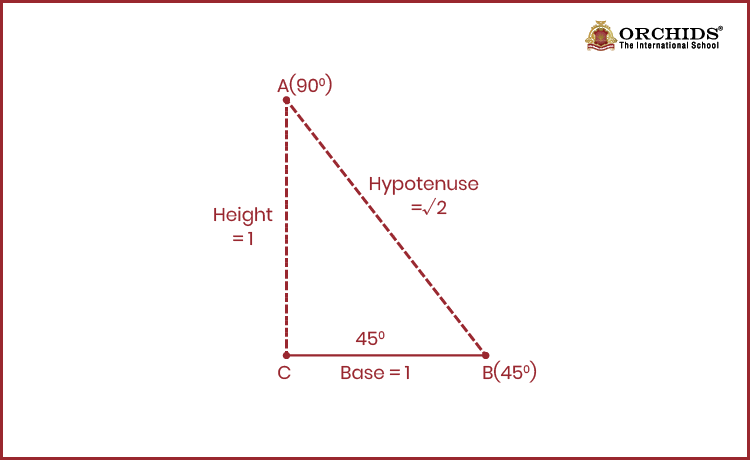
Here's what we have:
- Angle B = 45°
- Angle A = 90° (right angle)
- Angle C = 45° (because angles in a triangle add up to 180°)
- Side AC = 1 unit
- Side BC = 1 unit (same as AC because it's isosceles)
- Side AB (hypotenuse) = √2 units (using Pythagoras theorem)
Let's find the hypotenuse:
- Using the Pythagorean theorem:
- AB² = AC² + BC²
- AB² = 1² + 1²
- AB² = 1 + 1 = 2
- AB = √2
Now calculating the ratios for 45°:
- For angle B = 45°:
- sin 45° = Opposite/Hypotenuse = AC/AB = 1/√2 = 1/√2 or √2/2 (when rationalized)
- cos 45° = Adjacent/Hypotenuse = BC/AB = 1/√2 = 1/√2 or √2/2
- tan 45° = Opposite/Adjacent = AC/BC = 1/1 = 1
- cosec 45° = 1/sin 45° = √2/1 = √2
- sec 45° = 1/cos 45° = √2/1 = √2
- cot 45° = 1/tan 45° = 1/1 = 1
Trigonometric Ratios of 30° and 60° Angles
Now let's look at 30° and 60°. These angles you almost always see them together in the same triangle.
The special thing about this triangle is that it's actually half of an equilateral triangle. Let me show you how.
Step 1: Start with an equilateral triangle
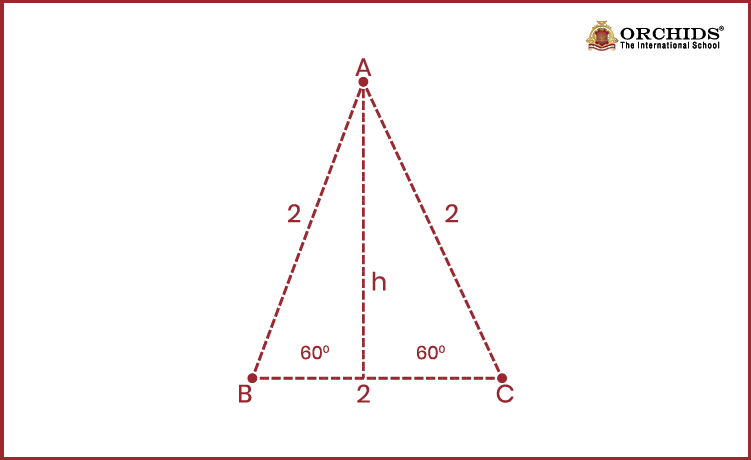
All sides = 2 units, all angles = 60°
Step 2: Draw a line from the top to split it in half
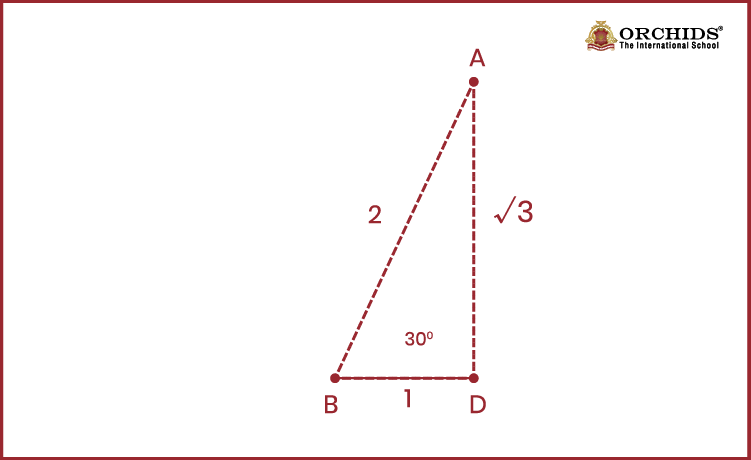
When we draw AD perpendicular to BC, we create two identical right triangles. Let's focus on triangle ABD.
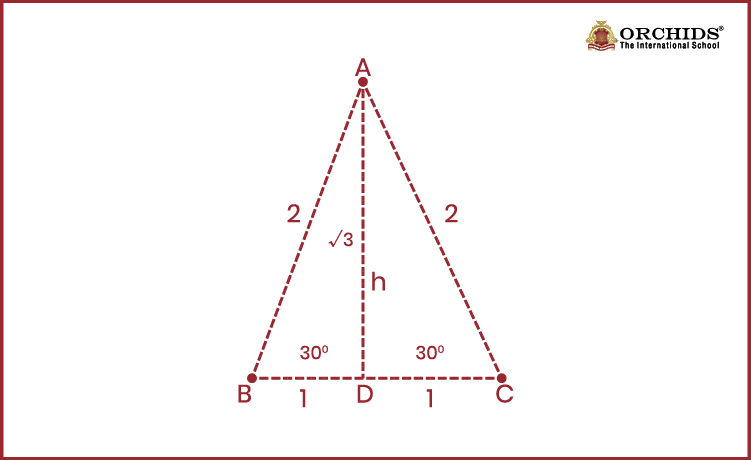
In triangle ABD:
- Angle B = 60°
- Angle A = 30° (half of the original 60°)
- Angle D = 90°
- Side BD = 1 unit (half of BC)
- Side AB = 2 units (original side)
- Side AD = ? (we need to find this)
Finding the height (AD):
- Using Pythagoras theorem:
- AB² = AD² + BD²
- 2² = AD² + 1²
- 4 = AD² + 1
- AD² = 3
- AD = √3
- So our triangle looks like this:
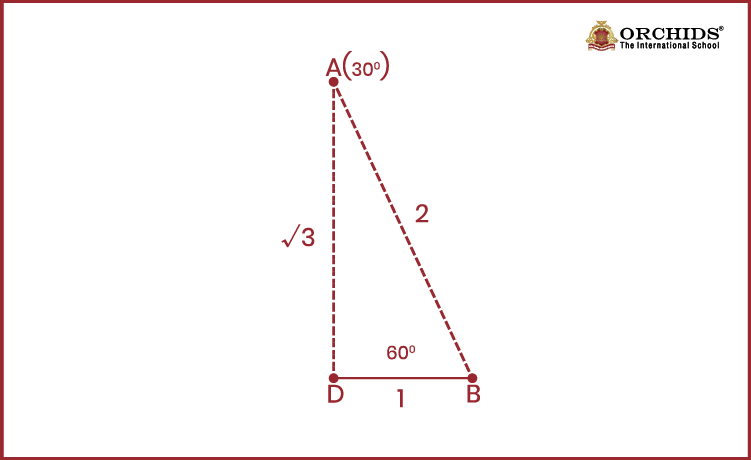
Trigonometric Ratios for 30°:
- For angle B = 60°:
- sin 60° = Opposite/Hypotenuse = AD/AB = √3/2
- cos 60° = Adjacent/Hypotenuse = BD/AB = 1/2
- tan 60° = Opposite/Adjacent = AD/BD = √3/1 = √3
- cosec 60° = 1/sin 60° = 2/√3 = 2√3/3
- sec 60° = 1/cos 60° = 2/1 = 2
- cot 60° = 1/tan 60° = 1/√3 = √3/3
Trigonometric Ratios for 60°:
- For angle A = 30°:
- sin 30° = Opposite/Hypotenuse = BD/AB = 1/2
- cos 30° = Adjacent/Hypotenuse = AD/AB = √3/2
- tan 30° = Opposite/Adjacent = BD/AD = 1/√3 = √3/3
- cosec 30° = 1/sin 30° = 2/1 = 2
- sec 30° = 1/cos 30° = 2/√3 = 2√3/3
- cot 30° = 1/tan 30° = √3/1 = √3
- Notice the pattern: Sin 30° equals cos 60°, and cos 30° equals sin 60°. They're complementary angles, which means they add up to 90°. This pattern holds true for all complementary angles.
Trigonometric Ratios of 0° and 90° Angles
These two angles are a bit different because we can't really draw a physical triangle for them in the traditional way. But we can understand them by imagining what happens when a triangle becomes extremely flat or extremely tall.
Understanding 0°:
Imagine you're slowly decreasing an angle in a right triangle. As the angle gets smaller and smaller, eventually it becomes almost 0°. What happens to the triangle?
Initial triangle: As angle approaches 0°:
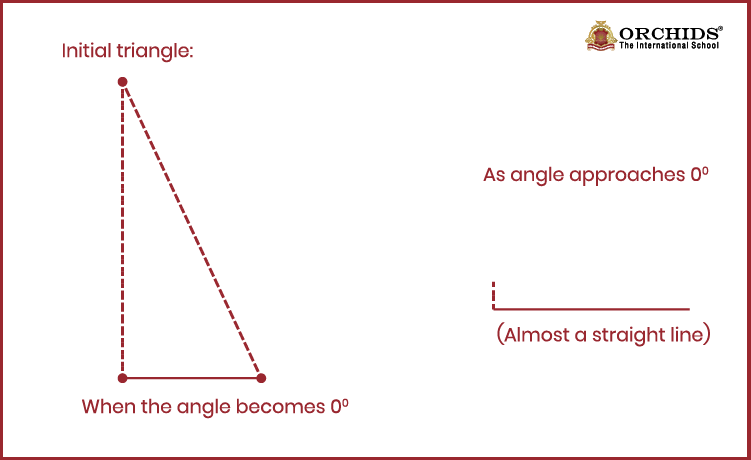
When the angle becomes 0°:
- The opposite side becomes 0
- The adjacent side becomes equal to the hypotenuse
- The triangle basically becomes a straight line
Trigonometric Ratios for 0°:
- sin 0° = Opposite/Hypotenuse = 0/hypotenuse = 0
- cos 0° = Adjacent/Hypotenuse = hypotenuse/hypotenuse = 1
- tan 0° = Opposite/Adjacent = 0/adjacent = 0
- cosec 0° = 1/sin 0° = 1/0 = Not defined (you can't divide by zero!)
- sec 0° = 1/cos 0° = 1/1 = 1
- cot 0° = 1/tan 0° = 1/0 = Not defined
- Understanding 90°:
- Now imagine the opposite - the angle keeps increasing until it becomes 90°. The triangle stands straight up!
- Initial triangle: As angle approaches 90°.
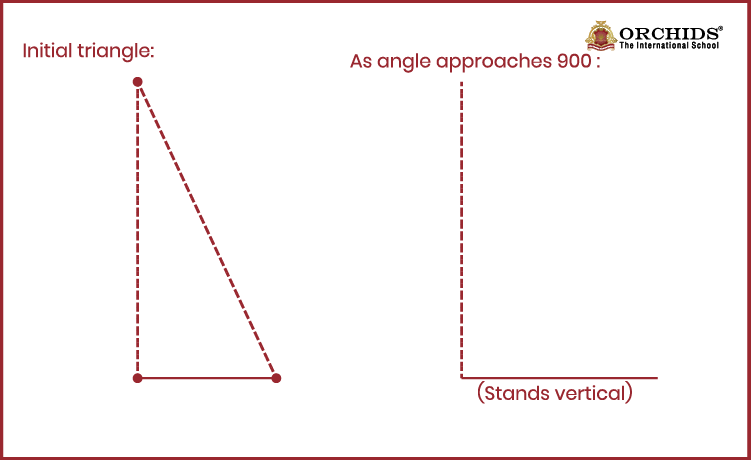
When the angle becomes 90°:
- The opposite side becomes equal to the hypotenuse
- The adjacent side becomes 0
- The triangle stands completely vertical
Trigonometric Ratios for 90°:
sin 90° = Opposite/Hypotenuse = hypotenuse/hypotenuse = 1
- cos 90° = Adjacent/Hypotenuse = 0/hypotenuse = 0
- tan 90° = Opposite/Adjacent = opposite/0 = Not defined
- cosec 90° = 1/sin 90° = 1/1 = 1
- sec 90° = 1/cos 90° = 1/0 = Not defined
- cot 90° = 1/tan 90° = 0/opposite = 0
- Key Pattern: Notice how sin and cos values swap between 0° and 90°! At 0°, sin is 0 and cos is 1. At 90°, sin is 1 and cos is 0. They're complementary
Trigonometric Table for These Angles
Complete Trigonometric Values Table
|
sin θ |
0 |
1/2 |
1/√2 |
√3/2 |
1 |
|
cos θ |
1 |
√3/2 |
1/√2 |
1/2 |
0 |
|
tan θ |
0 |
1/√3 |
1 |
√3 |
Not defined |
|
cosec θ |
Not defined |
2 |
√2 |
2/√3 |
1 |
|
sec θ |
1 |
2/√3 |
√2 |
2 |
Not defined |
|
cot θ |
Not defined |
√3 |
1 |
1/√3 |
0 |
Solved Examples on Trigonometric Ratios of Specific Angles
Example 1: Basic Value Finding
Question: Find the value of sin 30° + cos 60° + tan 45°
Solution:
First, let's write down what we know from the table:
- sin 30° = 1/2
- cos 60° = 1/2
- tan 45° = 1
Now substitute these values:
sin 30° + cos 60° + tan 45°
= 1/2 + 1/2 + 1
= 1 + 1
= 2
Answer: 2
Example 2: Using the Complementary Angle Property
Question: Prove that sin² 30° + cos² 30° = 1
Solution:
From the table:
- sin 30° = 1/2
- cos 30° = √3/2
Let's calculate:
sin² 30° + cos² 30°
= (1/2)² + (√3/2)²
= 1/4 + 3/4
= 4/4
= 1
Answer: This actually demonstrates the fundamental identity sin²θ + cos²θ = 1
Example 3: Simplifying Expressions
Question: Simplify: (sin 45° × cos 45°) ÷ tan 45°
Solution:
From our table:
- sin 45° = 1/√2
- cos 45° = 1/√2
- tan 45° = 1
Substituting:
(sin 45° × cos 45°) ÷ tan 45°
= (1/√2 × 1/√2) ÷ 1
= (1/2) ÷ 1
= 1/2
Answer: 1/2
Example 4: Finding Unknown Angle
Question: If sin θ = 1/2, find the value of θ (where 0° ≤ θ ≤ 90°)
Solution:
Looking at our sin column in the table, we need to find which angle gives us 1/2.
From the table:
- sin 30° = 1/2
Answer: θ = 30°
Example 5: Working with Multiple Ratios
Question: Calculate: 2 sin 30° cos 30° + tan² 45°
Solution:
From the table:
- sin 30° = 1/2
- cos 30° = √3/2
- tan 45° = 1
Now let's solve step by step:
2 sin 30° cos 30° + tan² 45°
= 2 × (1/2) × (√3/2) + (1)²
= 2 × (√3/4) + 1
= √3/2 + 1
= (√3 + 2)/2
Answer: (√3 + 2)/2 or approximately 1.866
Example 6: Real-World Application
Question: A ladder is leaning against a wall at an angle of 60° with the ground. If the ladder is 10 meters long, how high up the wall does it reach?
Solution: Let's draw this situation:
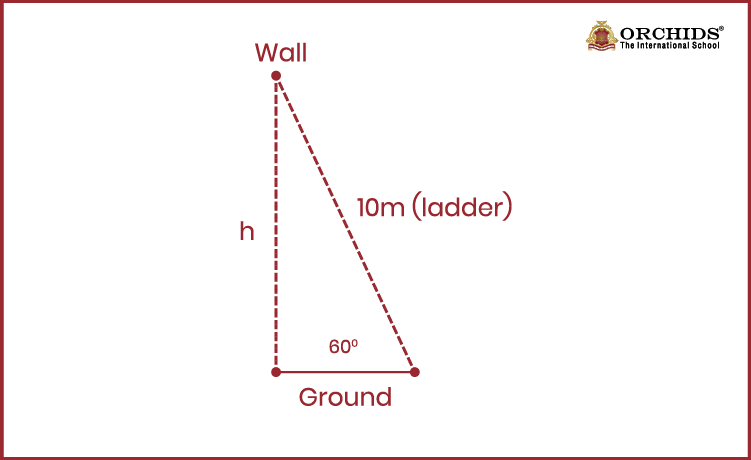
We need to find the height (h).
Using sin 60°:
sin 60° = Opposite/Hypotenuse = h/10
√3/2 = h/10
h = 10 × √3/2
h = 5√3
h ≈ 8.66 meters
Answer: The ladder reaches approximately 8.66 meters up the wall.
Example 7: Proving an Identity
Question: Prove that tan 30° × tan 60° = 1
Solution:
From the table:
- tan 30° = 1/√3
- tan 60° = √3
Multiplying:
tan 30° × tan 60°
= (1/√3) × √3
= √3/√3
= 1
Answer: Proved. This shows that tan 30° and tan 60° are reciprocals of each other.
Example 8: Complex Expression
Question: Find the value of: (cos 0° + sin 90°) / (cos 90° + sin 0°)
Solution:
From the table:
- cos 0° = 1
- sin 90° = 1
- cos 90° = 0
- sin 0° = 0
Substituting:
- (cos 0° + sin 90°) / (cos 90° + sin 0°)
- = (1 + 1) / (0 + 0)
- = 2/0
- = Not defined
- Answer: Not defined (because we can't divide by zero)
Practice Problems on Trigonometric Ratios of Specific Angles
Problem 1: Find the value of cos 45° + sin 45°
Problem 2: Calculate sin 60° - cos 60°
Problem 3: What is the value of tan 0° + tan 90°?
Problem 4: Find 2 sin 30° + 3 cos 60°
Problem 5: Calculate cos² 45° + sin² 45°
Problem 6: Simplify: (sin 30° × cos 60°) + (cos 30° × sin 60°)
Problem 7: If tan θ = √3, find the value of θ (0° ≤ θ ≤ 90°)
Related Topics:
Frequently Asked Questions on Trigonometric Ratios of Specific Angles
1. What are trigonometric ratios of specific angles?
Trigonometric ratios of specific angles are the exact values of sin, cos, tan, cosec, sec, and cot for standard angles like 0°, 30°, 45°, 60°, and 90°.
2. Which angles are called standard or specific angles?
The most common specific angles are: 0°, 30°, 45°, 60°, and 90°.
3. What are the main trigonometric ratios?
The three primary ratios are:
-
sin θ = Opposite / Hypotenuse
-
cos θ = Adjacent / Hypotenuse
-
tan θ = Opposite / Adjacent
4. What are the values of sin, cos, and tan at 30°?
-
sin 30° = 1/2
-
cos 30° = √3/2
-
tan 30° = 1/√3 (or √3/3)
5. What are the values of sin, cos, and tan at 45°?
-
sin 45° = √2/2
-
cos 45° = √2/2
-
tan 45° = 1
6. What are the values of sin, cos, and tan at 60°?
-
sin 60° = √3/2
-
cos 60° = 1/2
-
tan 60° = √3
Numbers make sense when they're taught right. To see how Orchids The International School turns Maths from intimidating to intuitive, reach out to our admissions team.


Admissions Open for 2026-27
What type of concept pages would you prefer?
CBSE Schools In Popular Cities
- CBSE Schools in Bangalore
- CBSE Schools in Mumbai
- CBSE Schools in Pune
- CBSE Schools in Hyderabad
- CBSE Schools in Chennai
- CBSE Schools in Gurgaon
- CBSE Schools in Kolkata
- CBSE Schools in Indore
- CBSE Schools in Sonipat
- CBSE Schools in Delhi
- CBSE Schools in Rohtak
- CBSE Schools in Bhopal
- CBSE Schools in Aurangabad
- CBSE Schools in Jabalpur
- CBSE Schools in Jaipur
- CBSE Schools in Jodhpur
- CBSE Schools in Nagpur
- CBSE Schools in Ahmednagar
- CBSE School In Tumkur










Orchids The International School is one of India's leading chains of CBSE and ICSE schools, with 130+ schools across the country.