

Volume of Frustum of Cone
A frustum of a cone is the solid obtained when the top portion of the cone is cut off by a plane parallel to its base. This solid shape is seen even in our real life, such as in buckets, glasses, containers, lampshades, etc. Understanding how to calculate the volume of a frustum is an important geometrical skill that has practical applications in engineering, architecture, and design. In this guide, we will learn the formula for the volume of a frustum of a cone, explore its step-by-step derivation, and solve examples to build a strong understanding of the concept.
Table of Contents
- What is the Volume of a Frustum of a Cone
- Derivation of Volume of a Frustum of a Cone
- Types and Properties of the Volume of a Frustum of a Cone
- Solved Examples on Volume of a Frustum of a Cone
- Frequently Asked Questions on Volume of Frustum of a Cone

What is the Volume of a Frustum of a Cone
A frustum of a cone is the solid formed when a plane parallel to the base cuts through a cone, removing its top portion.
Volume of frustum of a cone, V = (πh/3)(R² + Rr + r²),
where
-
R = radius of the larger base (bottom)
-
r = radius of the smaller top (upper face)
-
h = perpendicular height (vertical distance between the two parallel faces)
-
l = slant height = √[h² + (R − r)²]
Know more about related topics:
Derivation of Volume of a Frustum of a Cone
Consider a full cone with height H and base radius R. A smaller cone of height (H − h) and radius r is cut from the top.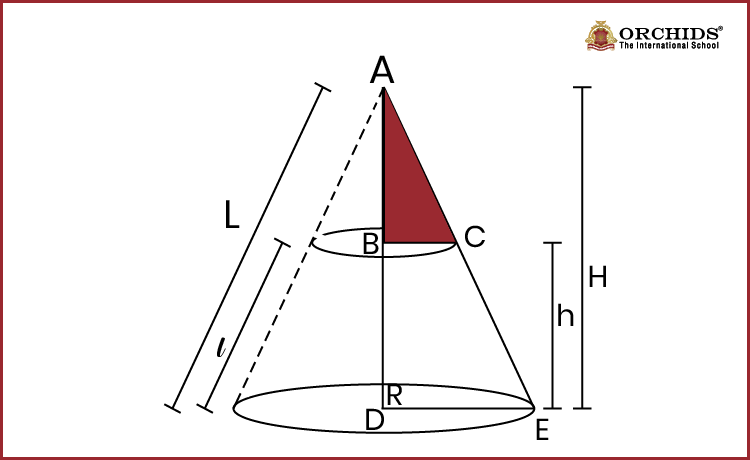
Let H and h be the heights of the cone and frustum, respectively. Let L and l be the slant heights of the cone and the frustum, respectively. Let R and r be the radii of the circular bases.
Triangles ABC and ADE are similar. Hence, the ratio of the corresponding sides is proportional, r/R = (H − h)/H
so H = Rh/(R − r).
Volume of full cone = (1/3)πR²H = (1/3)πR² × Rh/(R − r) = πR³h / [3(R − r)].
Height of small cone = H − h = Rh/(R − r) − h = rh/(R − r).
Volume of small cone = (1/3)πr² × rh/(R − r) = πr³h / [3(R − r)].
Volume of frustum = Volume of full cone − Volume of small cone.
= πh / [3(R − r)] × (R³ − r³)
Using the identity: R³ − r³ = (R − r)(R² + r² + Rr)
= πh/3 × (R² + r² + Rr)
= (πh/3)(R² + r² + Rr)
Types and Properties of the Volume of a Frustum of a Cone
Solved Examples on Volume of a Frustum of a Cone
Example 1: Find the volume of a frustum with R = 14 cm, r = 7 cm, and h = 6 cm. (Use π = 22/7)
Solution: Given: R = 14, r = 7, h = 6
Using V = (πh/3)(R² + r² + Rr)
R² = 196, r² = 49, Rr = 98
R² + r² + Rr = 196 + 49 + 98 = 343
V = (22/7)(6/3)(343) = (22/7)(2)(343)
= (22/7) × 686
= 22 × 98
= 2156 cm³
∴ Volume of frustum is 2156 cm³.
Example 2: A bucket is in the shape of a frustum with top radius 28 cm, bottom radius 21 cm, and height 30 cm. Find its capacity in litres. (Use π = 22/7)
Solution: R = 28 cm, r = 21 cm, h = 30 cm
Substituting values in the equation V = (πh/3)(R² + r² + Rr)
V = (π 30/3)(28² + 21² + 28 × 21)
= 399,060/7
= 57,008.57 cm³
1 litre = 1000 cm³
∴ V = 57,008.57/1000 = 57.01 litres.
∴ the capacity of the bucket is 57.01 litres.
Example 3: Find the volume of a frustum with R = 6 cm, r = 3 cm, h = 4 cm.
Solution: Given R = 6 cm, r = 3 cm, h = 4 cm
V = (πh/3)(R² + r² + Rr)
V = (π × 4/3)(63)
V = (4π/3)(63)
V = 84π cm³
∴ Volume of frustum is 84 cm³.
Numbers make sense when they're taught right. To see how Orchids The International School turns Maths from intimidating to intuitive, reach out to our admissions team.
Frequently Asked Questions on Volume of Frustum of a Cone
1. What is a frustum?
A frustum of a cone is the solid obtained when the top portion of the cone is cut off by a plane parallel to its base.
2. What is the difference between height and slant height of a frustum?
Height (h) is the perpendicular distance between the two parallel faces. Slant height (l) is the distance along the lateral surface.
3. Is a bucket a frustum?
Yes. Typically buckets are in the shape of a frustum.
4. What happens when r = 0 in the frustum formula?
The volume of a frustum is V = (πh/3)(R² + r² + Rr). When r = 0, V = (1/3)πR²h, i.e., it is a cone.
Related Links


Admissions Open for 2026-27
What type of concept pages would you prefer?
CBSE Schools In Popular Cities
- CBSE Schools in Bangalore
- CBSE Schools in Mumbai
- CBSE Schools in Pune
- CBSE Schools in Hyderabad
- CBSE Schools in Chennai
- CBSE Schools in Gurgaon
- CBSE Schools in Kolkata
- CBSE Schools in Indore
- CBSE Schools in Sonipat
- CBSE Schools in Delhi
- CBSE Schools in Rohtak
- CBSE Schools in Bhopal
- CBSE Schools in Aurangabad
- CBSE Schools in Jabalpur
- CBSE Schools in Jaipur
- CBSE Schools in Jodhpur
- CBSE Schools in Nagpur
- CBSE Schools in Ahmednagar
- CBSE School In Tumkur











Orchids The International School is one of India's leading chains of CBSE and ICSE schools, with 110+ schools across the country.