

The Tyger by William Blake: Full Poem, Summary and Poetic Devices for Students
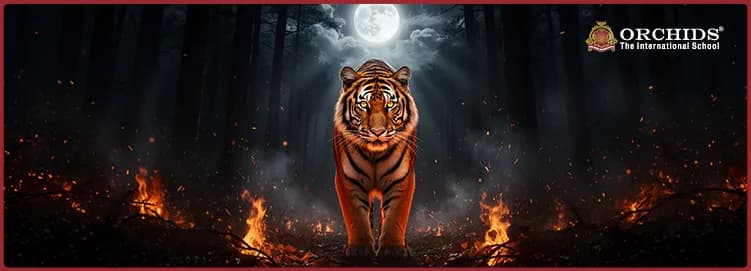
The Tyger is a poem built almost entirely from questions. In six short stanzas, William Blake asks who made the tiger, what tools were used, what kind of creator would dare to make something so fierce, and whether that same creator made the gentle lamb as well. None of the questions are answered. That is precisely the point.
Published in 1794 as part of Blake’s collection Songs of Experience, The Tyger is the counterpart to an earlier, gentler poem called The Lamb from his Songs of Innocence. Where The Lamb imagined a soft, obedient world created by a loving God, The Tyger confronts a world in which ferocity, terror and beauty exist alongside tenderness and demands to know how both can come from the same hand. It is one of the most widely studied poems in English literature, and its opening line, ‘Tyger Tyger, burning bright’, is among the most recognised in the English language.
This page sets out the complete poem, a clear The Tyger by William Blake summary, a stanza wise and line by line explanation, an analysis of The Tyger by William Blake, the poetic devices at work in it and the deeper questions it raises, along with exercises and FAQs.
Table of Contents
- The Tyger: The Full Poem
- The Tyger by William Blake Summary
- The Tyger Analysis
- Poetic Devices Used in the Poem The Tyger
- Themes and the Idea at the Heart of the Poem The Tyger
- Frequently Asked Questions about The Tyger
The Tyger: The Full Poem
by William Blake
Tyger Tyger, burning bright,
In the forests of the night;
What immortal hand or eye,
Could frame thy fearful symmetry?
In what distant deeps or skies
Burnt the fire of thine eyes?
On what wings dare he aspire?
What the hand, dare seize the fire?
And what shoulder, and what art,
Could twist the sinews of thy heart?
And when thy heart began to beat,
What dread hand? and what dread feet?
What the hammer? what the chain,
In what furnace was thy brain?
What the anvil? what dread grasp
Dare its deadly terrors clasp?
When the stars threw down their spears
And watered heaven with their tears:
Did he smile his work to see?
Did he who made the Lamb make thee?
Tyger Tyger burning bright,
In the forests of the night:
What immortal hand or eye,
Dare frame thy fearful symmetry?
Who Wrote The Tyger
The Tyger by William Blake was published in 1794 in his collection Songs of Experience, the companion volume to his earlier Songs of Innocence published in 1789. Blake was an English poet, painter and printmaker who lived from 1757 to 1827, and he produced both collections by hand, engraving the text and images himself onto copper plates and printing them personally, which makes even the physical existence of his books an act of creative conviction. During his own lifetime he was little known and often regarded as eccentric; it is only in the two centuries since his death that he has been recognised as one of the most original and visionary figures in English literary history.
The two collections, Songs of Innocence and Songs of Experience, are designed to be read together, as Blake himself indicated by subtitling them ‘Shewing the Two Contrary States of the Human Soul’. The Tyger and The Lamb are the most famous pairing within that larger design, one asking about a creature of terrifying power, the other addressing a symbol of gentle obedience, and together raising questions about the nature of creation, God and the coexistence of opposites that Blake never sought to resolve neatly.
The Tyger by William Blake Summary
A brief The Tyger by William Blake summary runs as follows. A speaker gazes at a tiger and is struck, almost stunned, by the combination of its beauty and its terror. The poem poses a series of questions about the tiger’s creator: what kind of being could have imagined something so fearful, reached into whatever remote place the fire of its eyes comes from, seized the fire, and then physically forged the creature’s sinews, heart and brain as though in a blacksmith’s workshop? The questions pile up without ever receiving an answer.
Near the end, the poem pauses on a strange image of the stars weeping and asks whether the creator smiled when he saw what he had made before posing what many readers consider the poem’s central question: did the same being who made the gentle, innocent lamb also make this terrifying creature? The poem closes by returning almost word for word to its opening stanza, with one significant change: ‘Could frame' in the first stanza becomes ‘Dare frame’ in the last, shifting the question from one of ability to one of audacity. The poem ends, as it began, without an answer.

Stanza Wise Summary of the Poem The Tyger
Stanza 1: The Burning Tiger
The poem opens with the speaker addressing the tiger directly and immediately, using its repeated name to mimic the rhythm of something insistent and almost incantatory. The tiger is described as burning bright in the forests of the night, an image that makes it seem like a flame moving through darkness. The speaker’s first question is addressed to an unnamed creator: what immortal hand or eye could have designed, or dared to design, the tiger’s fearful symmetry, its beauty that is also terrifying?
Stanza 2: The Fire of its Eyes
The speaker wonders where the fire visible in the tiger’s eyes originally came from, whether it was retrieved from some deep or distant sky. The language moves into the territory of myth, evoking a figure like Prometheus who stole fire from the gods, asking what wings could carry such a creator to that remote source and what hand could dare to seize fire of that intensity.
Stanza 3: The Making of the Heart
The speaker moves to the physical construction of the tiger, imagining the creator as a craftsman who had to twist the sinews of its heart into shape by strength and skill. The moment when the tiger’s heart first began to beat is described with a kind of awe, and the phrase ‘dread hand and dread feet’ applies the same word, dread, to both the creator and the creature, suggesting that the act of making something terrifying is itself a terrifying act.
Stanza 4: The Forge
This stanza extends the blacksmith metaphor fully, asking what hammer, chain, furnace and anvil were used to form the tiger’s brain. The imagery of a forge, with its heat, metal and controlled violence, is the poem’s most sustained attempt to imagine what the process of creating the tiger might have looked and felt like. The final two lines of the stanza ask what grip could have dared to hold something with such deadly terrors in it.
Stanza 5: The Stars and the Lamb
The most mysterious stanza in the poem opens with an image of the sars throwing down their spears and weeping, which most readers interpret as a moment of cosmic significance, perhaps the fall of the angels or a moment of divine grief. Against this backdrop, the speaker asks whether the creator smiled when he surveyed his finished work and then poses the poem’s most direct and searching question: did the being who made the gentle lamb also make this tiger?
Stanza 6: The Question Returns
The final stanza repeats the opening almost exactly, returning the poem to where it began. The single alteration, ‘Dare frame’ in place of ‘Could frame’, transforms the question from one about power to one about moral courage or audacity. The tiger still burns, the forest is still dark, and the question of who made it, and why, remains entirely unanswered.
The Tyger by William Blake Line by Line Explanation
Stanza 1
- ‘Tyger Tyger, burning bright’ opens with the tiger’s name repeated twice, a device that gives the poem an almost ritualistic or chant-like quality from its very first words. The tiger is described as burning, a word that connects it to fire, energy and danger rather than simply to warmth.
- ‘In the forests of the night’ places it in a world of darkness and mystery, where a burning creature is all the more startling because of the surrounding dark.
- ‘What immortal hand or eye, / Could frame thy fearful symmetry?’ introduces the central question: what kind of immortal, supernatural being could have designed a creature whose very symmetry, its balanced, perfect physical form, is at the same time fearful? The word ‘frame’ carries the sense of both designing and physically constructing.
Stanza 2
- ‘In what distant deeps or skies / Burnt the fire of thine eyes?’ asks where the raw material for the tiger’s intensity was sourced. The opposition of ‘deeps’ and ‘skies’ suggests that this source exists somewhere beyond ordinary reach, whether below the earth or above it.
- ‘On what wings dare he aspire?’ brings in the image of a creator who had to fly to some remote place to find this fire, evoking the myth of Prometheus, the Titan who stole fire from the gods and was punished for the presumption.
- ‘What the hand, dare seize the fire?’ asks what kind of hand could physically grasp something so dangerous.
Stanza 3
- ‘And what shoulder, and what art, / Could twist the sinews of thy heart?’ shifts the poem from the question of where the tiger’s fire came from to the question of how it was physically assembled, and the language here is that of a craftsman or sculptor working with resistant material. To twist sinews is hard, physical work, suggesting a creator who laboured over the tiger’s making.
- ‘And when thy heart began to beat, / What dread hand? and what dread feet?’ registers awe at the moment the creature first came to life, and applies the word ‘dread’ both to the creator’s hands and feet, suggesting that the maker, too, was engaged in something frightening.
Stanza 4
- ‘What the hammer? what the chain, / In what furnace was thy brain?’ extends the forge imagery, placing the creation of the tiger’s brain itself within a furnace, as though it had to be heated and beaten into shape from raw metal. The questions accumulate rapidly in this stanza, each one unanswered, each one adding to the impression of a violent, fiery, deliberately skilled act of making.
- ‘What the anvil? what dread grasp / Dare its deadly terrors clasp?’ asks what surface the tiger was hammered out on and what hands could hold something so dangerous in place while it was being made.
Stanza 5
- ‘When the stars threw down their spears / And watered heaven with their tears’ is the most debated image in the poem. The stars throwing down their spears is thought to evoke the moment in Milton’s Paradise Lost when the rebel angels surrendered or were cast out of heaven, and the weeping suggests that the creation of the tiger was accompanied by some form of cosmic mourning or awe.
- ‘Did he smile his work to see?’ asks whether the creator took satisfaction in what he had made, a question that carries an unsettling edge: to smile at the tiger is to smile at something terrible.
- ‘Did he who made the Lamb make thee?’ is the poem’s pivotal question, bringing together the two contrary poems and asking directly whether the same God who made innocence also made ferocity.
Stanza 6
The return of the opening stanza with its single changed word is one of the most carefully calculated moves in English poetry. ‘Could frame’ in the first stanza asks about capability; ‘Dare frame’ in the last asks about audacity and moral willingness. The tiger is still burning, still beautiful, still terrifying, and the question of its creation is still unanswered, but by the final word the poem has shifted from wondering whether such a creator exists to wondering whether any creator could or should have made such a choice.
They Tyger Analysis
What Kind of Poem is The Tyger?
The Tyger is a lyric poem composed of six quatrains, four-line stanzas with an AABB rhyme scheme, written in trochaic tetrameter, a metre that gives it an insistent, hammering rhythmic quality perfectly suited to its blacksmith imagery and its relentless sequence of questions. It is not a narrative poem; nothing happens in it. It is entirely made of questions addressed to an unnamed creator, and its power comes from the cumulative force of those unanswered questions rather than from any plot or resolution.
As part of Songs of Experience, it belongs to Blake’s broader symbolic system in which experience, as opposed to innocence, is the state of knowing that the world contains darkness, cruelty and terror alongside beauty and gentleness and that any serious reckoning with creation has to account for both.
What is the Tone of The Tyger?
The tone of The Tyger is one of intense, almost breathless awe, not the comfortable awe of admiration but something closer to wonder mixed with fear. The speaker is not at ease with what he is looking at; the tiger unsettles him deeply, and the questions he asks of its creator carry an edge of challenge alongside their reverence. There is also something incantatory about the tone, as though the repetition of questions and the recurring image of the burning tiger are designed to hold the reader inside the poem's spell rather than release them into any comfortable answer.
Poetic Devices Used in the Poem The Tyger
- Apostrophe: The poem opens with a direct address to the tiger itself, ‘Tyger Tyger’, treating it as though it can receive the speaker's words. This gives the poem its immediate, intense, almost confrontational quality from the very first line.
- Imagery: The central images of the poem, the burning tiger in a dark forest; the distant fire of its eyes; and the furnace, hammer, anvil and chain of the forge work together to create a world of fire, darkness and controlled but violent creation. The forge imagery in stanzas three and four is particularly sustained, building a picture of the creator as a cosmic blacksmith.
- Rhetorical questions: Every stanza is built almost entirely from questions, none of which receive an answer. This device drives the poem's central argument that the existence of something so terrifying as the tiger raises questions about its creator that cannot easily be answered or dismissed.
- Repetition: The word ‘dread’ recurs across stanzas three and four, applied both to the creature being made and to the maker doing the making, binding them together in a shared quality of terror. The near-identical repetition of the first stanza at the close of the poem creates a circular structure that reinforces the poem's refusal to resolve its questions.
- Allusion: The image of the stars throwing down their spears in stanza five alludes to the tradition of the fall of the angels found in Milton's Paradise Lost, and the figure of the creator seizing fire on wings evokes the myth of Prometheus. Both allusions place the tiger's creation in a context of cosmic transgression and consequence.
- Rhyme scheme and metre: The poem uses an AABB rhyme scheme across all six quatrains and is written in trochaic tetrameter, a metre that stresses the first syllable of each foot and gives the lines a driving, forceful rhythm. The effect is of something being hammered out rather than gently sung, which suits the poem's forge imagery and its mood of urgent, unresolved questioning.
Themes and the Idea at the Heart of the Poem The Tyger
The poem's most fundamental theme is the problem of creation: specifically, what the existence of something simultaneously beautiful and terrible implies about whoever or whatever made it. Blake does not offer the reader a theology or a philosophy in response to this question; instead, he intensifies it across six stanzas until it feels genuinely unanswerable.
Running alongside this is the theme of contraries, one of Blake's most persistent ideas. For Blake, the world is not made of good things and bad things but of contrary forces that define and generate each other: innocence and experience, gentleness and ferocity, the lamb and the tiger. To eliminate one would be to destroy the other. The tiger is not simply evil; it is the necessary dark counterpart to the lamb's light, and the poem asks whether a creator wise enough to make both deserves admiration, awe or something more unsettling than either.
The poem also raises questions about power, daring and moral responsibility. The shift from ‘could frame’ to ‘dare frame’ in the final stanza quietly transforms the question from one of capability to one of will: not whether the creator was able to make the tiger, but whether such a choice was right.
Frequently Asked Questions about The Tyger
1. Who wrote The Tyger?
The Tyger was written by William Blake and published in 1794 as part of his collection Songs of Experience.
2. What is The Tyger by William Blake about?
On the surface it is about a tiger, but at its core it is a meditation on the nature of creation, the coexistence of beauty and terror in the world, and what the existence of both implies about their creator.
3. What is the tone of The Tyger?
The tone is one of intense, fearful awe, driven by an urgent sequence of rhetorical questions that build in force across the poem without ever reaching resolution.
4. What does the tiger symbolise in the poem?
The tiger symbolises ferocity, power, terror and a dark creative energy that exists alongside but cannot be reduced to the gentleness represented by the lamb in Blake's companion poem.
5. What is the significance of the forge imagery in the poem?
The forge imagery, with its hammer, furnace, anvil and chain, presents the creator as a cosmic blacksmith who had to labour physically and forcefully to make the tiger, suggesting that creation of something so powerful was itself a violent and dangerous act.
6. What are the main poetic devices used in The Tyger?
The poem uses apostrophe, imagery, rhetorical questions, repetition, allusion and a consistent AABB rhyme scheme in trochaic tetrameter across six quatrains.
Admissions Open for 2026-27
More Poems
We hope this was useful for your child's learning journey. To explore more about what Orchids The International School has to offer, get in touch with our admissions team.
Popular Searches
- NCERT Solutions for Class 1 subjects
- NCERT Solutions for Class 2 subjects
- NCERT Solutions for Class 3 subjects
- NCERT Solutions for Class 4 subjects
- NCERT Solutions for Class 5 subjects
- CBSE School In Aurangabad
- CBSE Schools In Bangalore
- CBSE School In Bhopal
- CBSE Schools In Chennai
- CBSE Schools In Delhi
- Best CBSE Schools In Gurgaon
- CBSE School In Hyderabad
- CBSE School In Indore
- CBSE School In Jabalpur
- CBSE Schools In Jaipur
- CBSE Schools In Kolkata
- CBSE Schools In Mumbai
- CBSE Schools In Nagpur
- CBSE Schools In Pune
- Top CBSE School In Rohtak
- Best CBSE Schools In Sonipat











Orchids The International School is one of India's leading chains of CBSE and ICSE schools, with 110+ schools across the country.