

To the Skylark by William Wordsworth: Summary, Themes and Analysis
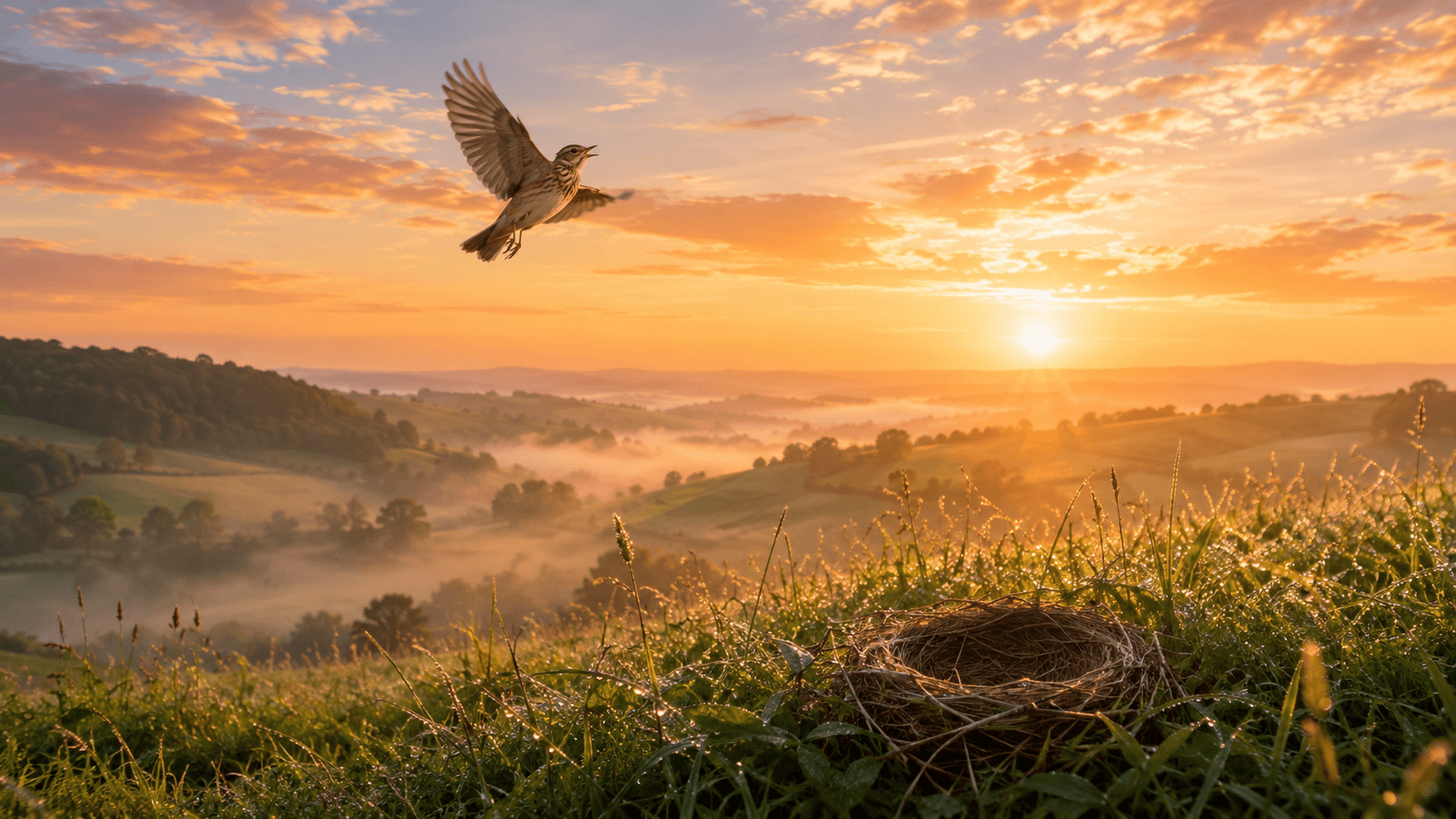
If you have ever looked up at a bird flying so high that it almost disappears, and still heard its song coming down clearly, you already have a feel for what William Wordsworth is doing in ‘To the Skylark’. This is a short poem, just twelve lines, but it packs in a full argument about freedom, home and what it means to live wisely.
To the Skylark by William Wordsworth is one of the poet's most admired nature poems. In this lyrical poem, Wordsworth addresses a skylark, a small bird known for its beautiful song and high flight. The poet observes how the bird rises into the sky while continuing to sing and reflects on the lessons human beings can learn from it.
This poem remains popular among students because of its clear language, rich symbolism, and universal message about finding harmony between high aspirations and everyday responsibilities. This guide walks through Wordsworth's poem on its own terms: who wrote it, what it says, what it means line by line, and why it still shows up in English literature syllabuses today.
Table of Contents
- About William Wordsworth
- Overview of the Poem
- Full Text of the Poem
- Summary of To the Skylark
- To the Skylark: Central Idea
- To the Skylark: Line by Line Explanation
- To the Skylark: Themes
- Literary Devices Used in To the Skylark
- Frequently Asked Questions about To the Skylark
About William Wordsworth
William Wordsworth was born in April 1770 in the Lake District of England, a place whose hills, lakes and birdsong shaped his poetry more than any classroom ever did. He studied at Cambridge but was more drawn to walking tours through the countryside than to formal study. A trip to France in 1790, right in the middle of the French Revolution, left a mark on his political thinking that shows up in his early work.
Back in England, Wordsworth settled with his sister Dorothy, who stayed his closest companion for life, and struck up a friendship with Samuel Taylor Coleridge. Together they published Lyrical Ballads in 1798, a book that is usually treated as the starting point of English Romanticism. Wordsworth argued that poetry should use the language ordinary people actually speak, not stiff, decorated verse, and that nature and everyday life deserved as much attention as grand historical events.
By the time he wrote ‘To the Skylark’ in 1825, Wordsworth was in his mid fifties and had already produced most of his best known work, including ‘I Wandered Lonely as a Cloud’ and ‘The Solitary Reaper’.
He was made Poet Laureate in 1843 and held the post until he passed away in 1850. The later Wordsworth wrote less and turned more conservative in outlook, but his love of nature as a teacher of wisdom never really left him, and ‘To the Skylark’ is a good example of that steady, older voice.
Overview of the Poem
Poem: To the Skylark

Poet: William Wordsworth
Published: 1825
Genre: Lyric poem
Movement: Romanticism
Full Text of the Poem
By William Wordsworth
Ethereal minstrel! pilgrim of the sky!
Dost thou despise the earth where cares abound?
Or, while the wings aspire, are heart and eye
Both with thy nest upon the dewy ground?
Thy nest which thou canst drop into at will,
Those quivering wings composed, that music still!
Leave to the nightingale her shady wood;
A privacy of glorious light is thine;
Whence thou dost pour upon the world a flood
Of harmony, with instinct more divine;
Type of the wise who soar, but never roam;
True to the kindred points of Heaven and Home!
Summary of To the Skylark
The poem opens with the speaker talking straight to the bird, calling it an ‘ethereal minstrel’ and a ‘pilgrim of the sky’. Right away Wordsworth gives the skylark two identities: it is a singer, and it is a traveller. Then comes the real question that drives the whole poem. Does the bird look down on the earth, where life is full of worry and trouble? Or, even while its wings are pushing it higher and higher, does some part of it, its heart and its eye, stay fixed on the nest sitting quietly on the wet morning grass below?
Wordsworth answers his own question gently. The bird, he says, can drop back down into that nest whenever it wants, folding its wings and letting the song go quiet. So the skylark is not running away from home. It carries the pull of home with it even while it climbs.
In the second half, the speaker turns to a comparison. He tells the skylark to let the nightingale keep her patch of ‘shady wood’, the dim, hidden corner of the forest where that other famous bird sings at night. The skylark does not need it. Its own space is a ‘privacy of glorious light’, a private stretch of open sky, and from up there it pours down a ‘flood of harmony’ on everyone below, guided by something the poet calls a more divine instinct.
The poem closes with its most quoted line. The skylark becomes a ‘type’, or a symbol, for wise people everywhere, those who can soar and explore and reach high, but never actually roam away from where they belong. The bird stays ‘true to the kindred points of Heaven and Home’, meaning it treats both aspiration and belonging as parts of the same loyalty, not as a choice between one or the other.
To the Skylark: Central Idea
The central idea of the poem is that real wisdom is not about choosing between ambition and belonging. It is about holding the two together, the way the skylark holds sky and nest together in a single flight. Wordsworth uses the bird as a stand in for the kind of person he admires: someone who can dream big, travel far, or chase high ideals, without ever cutting the thread that ties them back to home, family or roots.
There is also a quieter religious undertone running through the closing lines. The bird's song is described as carrying ‘instinct more divine’, and the whole poem can be read as a small parable about staying faithful to both the higher, spiritual pull of ‘Heaven’ and the everyday, grounded pull of ‘Home’, rather than treating them as rivals.
To the Skylark: Line by Line Explanation
Lines 1 to 2: The speaker greets the bird with two titles at once. ‘Ethereal minstrel’ paints it as a musician made of something lighter than ordinary matter, almost heavenly. ‘Pilgrim of the sky’ paints it as a traveller on a kind of spiritual journey through the air. Then comes the opening question: does this bird actually hate the troubled, care filled earth it flies away from?
Lines 3 to 4: Wordsworth offers a second possibility, and this is the one the rest of the poem leans toward. Maybe the wings are climbing upward, but the bird's heart and its gaze are still resting on the little nest down in the wet grass. Flight and attachment, in other words, are not opposites here.
Lines 5 to 6: This confirms the idea. The bird can return home whenever it chooses, simply by folding its trembling wings and letting its song fall silent. The image is calm and controlled, nothing desperate about the descent.
Lines 7 to 8: Now the speaker addresses the bird directly again, telling it to hand over the dark, leafy woodland to the nightingale, a bird traditionally linked with night, shadow and melancholy song. The skylark's own private territory is described instead as a ‘privacy of glorious light’, an open, sunlit space rather than a hidden one.
Lines 9 to 10: From that bright, high vantage point, the skylark showers the whole world with its music, described almost like a flood of blessing. The word ‘instinct’ suggests this is not learned behaviour but something built into the bird, and Wordsworth calls it ‘more divine’ than ordinary instinct, hinting that the song has a spiritual source.
Lines 11 to 12: The final couplet delivers the moral. The skylark stands as a ‘type’, meaning a symbol or model, for wise human beings who can rise, achieve and explore, without drifting away from where they truly belong. ‘Kindred points of Heaven and Home’ is the phrase most anthologies quote, and it suggests that aspiration and belonging are not enemies, they are related, ‘kindred’, parts of the same faithful life.
To the Skylark: Themes
- Freedom versus belonging. This is the poem's core tension. The skylark can fly higher than the eye can follow, yet it never actually cuts loose from its nest. Wordsworth uses this to argue that true freedom is not about escaping your roots, it is about being able to roam and return.
- The wisdom of balance. The closing couplet turns the bird into a moral example, a ‘type of the wise’. The lesson is that the wisest people are the ones who chase big things, ideas, ambition, distant goals, without ever losing their tie to home and the people in it.
- Nature as a moral teacher. True to Wordsworth's general style, the poem treats a simple bird as a source of ethical insight for humans. The skylark is not just admired for its song, it is held up as something people should learn from.
- Home as an anchor, not a cage. The nest on the ‘dewy ground’ is not shown as something limiting. It is what gives the bird's flight its meaning and its safe return. Home here is a steadying force, not an obstacle to freedom.
- A quiet spiritual undertone. Phrases like ‘instinct more divine’ and ‘kindred points of Heaven and Home’ bring in a light religious note. The bird's upward flight and its song are linked to something higher than instinct alone, hinting that staying loyal to both the spiritual and the earthly is itself a kind of faith.
- Contrast between two kinds of beauty. Through the nightingale comparison, Wordsworth sets up two models of song and life, one hidden and shadowed, one open and lit, without saying one is better than the other, just different.
Literary Devices Used in To the Skylark
Apostrophe: The entire poem is a direct address to the skylark, as if it can hear and respond. This is what gives the poem its intimate, conversational feel despite being so short.
Metaphor: “Ethereal minstrel” compares the bird to a heavenly musician, and “pilgrim of the sky” compares it to a spiritual traveller. Neither is literal, both elevate the bird beyond an ordinary animal.
Symbolism: By the end, the skylark stops being just a bird and becomes a “type,” a symbol standing in for wise human beings in general.
Contrast or antithesis: The poem is built on paired opposites: sky and ground, light and shade, flight and rest, wandering and home. The nightingale versus skylark comparison is the clearest example.
Personification: The bird is spoken to and described as having a “heart and eye,” emotional attachments, and moral qualities like wisdom and faithfulness, all human traits assigned to an animal.
Imagery: Strong visual imagery runs throughout the poem, the “dewy ground,” “quivering wings,” the “flood of harmony,” and the “privacy of glorious light” all create a vivid sensory picture.
Alliteration: Soft repeated sounds, like the “w” in “wings” and “will,” or the “d” in “dost” and “despise,” give the lines a smooth, musical quality that echoes the bird's own song.
Rhetorical question: The opening two questions, “Dost thou despise the earth…?”, are not meant to be answered by the bird, they exist to draw the reader into the poem's central puzzle.
Frequently Asked Questions about To the Skylark
What are the images in Ode to Skylark?
Answer: The major images include the skylark flying in the open sky, its hidden nest on the ground, bright sunlight, and the bird's flowing song. These images help convey ideas of freedom, wisdom, and harmony.
What does the poet tell to a skylark?
Answer: The poet praises the skylark for its beautiful song and balanced way of life. He admires how the bird can soar high while remaining connected to its home.
What is the main theme of To a Skylark?
Answer: The main theme is the balance between aspiration and responsibility. The poem suggests that true wisdom lies in reaching great heights without forgetting one's roots and duties.
Who is the speaker in To a Skylark?
Answer: The speaker is an observer who admires the skylark and reflects on the lessons it teaches. The speaker's thoughts closely reflect William Wordsworth's views on nature and human life.
Why does Wordsworth admire the skylark?
Answer: Wordsworth admires the skylark because it represents freedom, joy, wisdom, and balance. The bird's ability to rise high while remaining faithful to its nest makes it an ideal example of meaningful living.
What does the nest symbolize in the poem?
Answer: The nest symbolizes home, family, emotional security, and responsibility. It reminds readers that personal growth should not come at the cost of abandoning important relationships.
Why is To the Skylark important in Romantic poetry?
Answer: The poem reflects key Romantic ideas such as love of nature, personal reflection, simplicity, and the belief that nature can teach moral and spiritual truths.
Admissions Open for 2026-27
More Poems
We hope this was useful for your child's learning journey. To explore more about what Orchids The International School has to offer, get in touch with our admissions team.
Popular Searches
- NCERT Solutions for Class 1 subjects
- NCERT Solutions for Class 2 subjects
- NCERT Solutions for Class 3 subjects
- NCERT Solutions for Class 4 subjects
- NCERT Solutions for Class 5 subjects
- CBSE School In Aurangabad
- CBSE Schools In Bangalore
- CBSE School In Bhopal
- CBSE Schools In Chennai
- CBSE Schools In Delhi
- Best CBSE Schools In Gurgaon
- CBSE School In Hyderabad
- CBSE School In Indore
- CBSE School In Jabalpur
- CBSE Schools In Jaipur
- CBSE Schools In Kolkata
- CBSE Schools In Mumbai
- CBSE Schools In Nagpur
- CBSE Schools In Pune
- Top CBSE School In Rohtak
- Best CBSE Schools In Sonipat











Orchids The International School is one of India's leading chains of CBSE and ICSE schools, with 110+ schools across the country.