

Compare and Contrast: Learn Similarities and Differences in Stories and Characters
Imagine you have a basket of fruits, an apple and a banana. Can you tell how they are similar? How are they different? Both are sweet, healthy, and tasty. An apple is round and red, and a banana is long and yellow. You just compared and contrasted them! In this guide, you will learn how to compare characters, settings, and ideas in stories, poems, or even things around you.
Table of Contents
- What is Compare and Contrast
- Examples of Compare and Contrast
- How to Compare and Contrast
- Exercises on Compare and Contrast
- Frequently Asked Questions on Compare and Contrast

What is Compare and Contrast
Comparing and contrasting means to examine, identify and determine the similarities and differences between or among things. When comparing, you focus on what is alike, and when contrasting, you focus on what is different. We can compare and contrast characters, events, places, or ideas in stories, poems, or even things around us.
For example, let’s compare and contrast Donald Duck & Mickey Mouse.
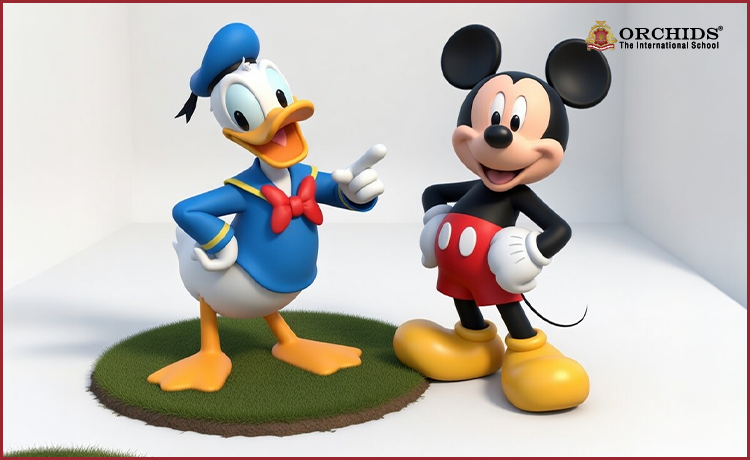
The similarities between Mickey and Donald are:
-
Both are animated cartoon characters.
-
Both were created by Walt Disney.
-
Both were designed to entertain children around the world.
The differences between Mickey and Donald are:
How to Compare and Contrast
Comparing and contrasting means finding what is the same and what is different in characters, settings, themes, or stories. By looking closely at how things begin, what happens, and how they end, we can understand the story better and notice important details.
-
Characters: When analysing the people or creatures in a story
-
Physical Appearances: Note their age, height, the clothes they wear, and features like hair or facial hair (beards).
-
Nature/Personality: Look at their temper, general attitude, current feelings, and daily habits.
-
Actions: How do they handle a situation? Analyse what they do, what they think, and what they feel when facing a problem.
-
Setting: The setting tells you where and when the story takes place
-
Location: Is it in a forest, village, cottage, or palace? Is it beside a lake or high in the clouds?
-
Time: Identify if it is day or night, or a specific season like summer or winter.
-
Weather Conditions: Is the atmosphere stormy, rainy, or bright and sunny?
-
Theme: The theme is the "heart" of the story
-
Key Idea: What is the main message the author wants to convey?
-
Lesson Learned: What did the characters learn by the end of the journey?
-
Plot Structure: A great way to contrast two stories is to look at the "bookends"
-
Compare how the story or poem begins.
-
Compare how the story or poem ends. (Are the endings happy, sad, or surprising?)
Exercises on Compare and Contrast
Exercise 1: Look at the images and answer the questions below.
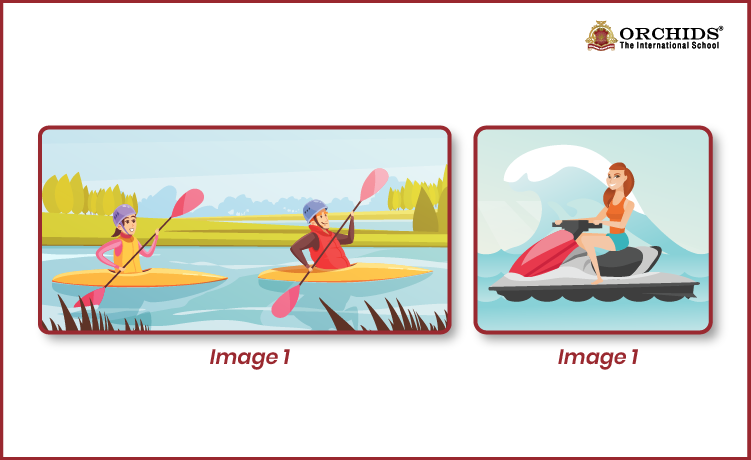
-
What is a common feature in both images?
-
Both are run on diesel.
-
Both sports are for females only.
-
Both are water-based adventure sports.
-
Both sports depend on big waves.
-
Which statement describes how the two sports are different?
-
Only one of them is dangerous.
-
Only one of them uses rows.
-
Only one of them is for fun.
-
Only one of them is for adults.
Answers:
-
Both are water-based adventure sports.
-
Only one of them uses rows.
Exercise 2: Find out how Tuki and her Grandfather are different.
Tuki lives with her Grandfather. He is a funny man with short white hair and a curious nose. He claims that his nose can smell mischief. Often, he proves himself correct by catching Tuki red-handed doing some mischief. One day, she had ice cream mixed with lots of choco-chip cookies while he was taking a nap. The moment he woke up, he sniffed Tuki’s long curly hair and said, “Little Miss Tuki had some ice cream along with cookies. Isn’t that so?”
-
One way Tuki is different from her Grandfather is that she ______?
-
likes to take a nap.
-
has black curly hair.
-
loves to be sniffed.
-
has a curious nose.
-
What does the passage tell us about Grandfather?
-
Where do you think the story takes place?
Answers:
-
has black curly hair.
-
He is funny, observant, and clever. He has short white hair and a curious nose that he claims can smell mischief. He often catches Tuki red-handed when she does something naughty.
-
The story likely takes place at Tuki’s home.
Frequently Asked Questions on Compare and Contrast
1. What is compare and contrast?
Answer: Comparing means finding what is similar, and contrasting means finding what is different between people, places, events, or ideas.
2. How to compare a character?
Answer: Look at the character’s appearance, personality, and actions to see how they are similar or different from others.
3. How can I compare the setting of a story?
Answer: Notice where and when the story happens, the weather, and the surroundings to compare different settings.
Strong language skills open doors well beyond the classroom, shaping how confidently a child reads, writes and expresses ideas. If you want to know more about how Orchids The International School builds these skills through its English curriculum, get in touch with our admissions team.


Admissions Open for 2026-27
What type of concept pages would you prefer?
CBSE Schools In Popular Cities
- CBSE Schools in Bangalore
- CBSE Schools in Mumbai
- CBSE Schools in Pune
- CBSE Schools in Hyderabad
- CBSE Schools in Chennai
- CBSE Schools in Gurgaon
- CBSE Schools in Kolkata
- CBSE Schools in Indore
- CBSE Schools in Sonipat
- CBSE Schools in Delhi
- CBSE Schools in Rohtak
- CBSE Schools in Bhopal
- CBSE Schools in Aurangabad
- CBSE Schools in Jabalpur
- CBSE Schools in Jaipur
- CBSE Schools in Jodhpur
- CBSE Schools in Nagpur
- CBSE Schools in Ahmednagar
- CBSE School In Tumkur











Orchids The International School is one of India's leading chains of CBSE and ICSE schools, with 110+ schools across the country.