

Describe a Place: Adjectives, Sensory Details and Complete Writing Guide for Class 3
When we describe a place, we are doing something more than simply listing its features. We are painting a picture with words, creating an image so vivid and complete that the reader can see, hear, smell and feel the place without ever visiting it. This is the true goal of descriptive writing: to bring a location alive on the page so fully that the reader forgets they are reading words at all.
For Class 3 Students, learning how to describe a place in writing is one of the most important and most enjoyable writing skills to develop. It teaches students to observe more carefully, to choose words to describe a place with precision and to organise their thoughts in a way that builds a clear, complete picture for their reader. A student who can describe a place well has mastered one of the building blocks of all good writing.
Table of Contents
- What Does It Mean to Describe a Place?
- How to Describe a Place
- How to Describe a Place in Writing: Step-by-Step
- Practice Worksheets
- Frequently Asked Questions about Describing a Place

What Does It Mean to Describe a Place?
To describe a place means to write about it in a way that forms a clear picture in the reader’s mind. A good description does not simply give facts; it makes the reader feel as though they are standing right there.
Key things a good place description does:
- Conveys a clear image of the location to the reader.
- Uses adjectives to describe a place and sensory details.
- Gives both factual information and, where appropriate, a personal opinion about the location.
What to include when you describe a place:
- Mention the location, its size and what is available there.
- Include geographical details, or describe the people, their clothing or their food habits where relevant.
- Use vivid, specific language rather than vague, general phrases.
Structure of a Description
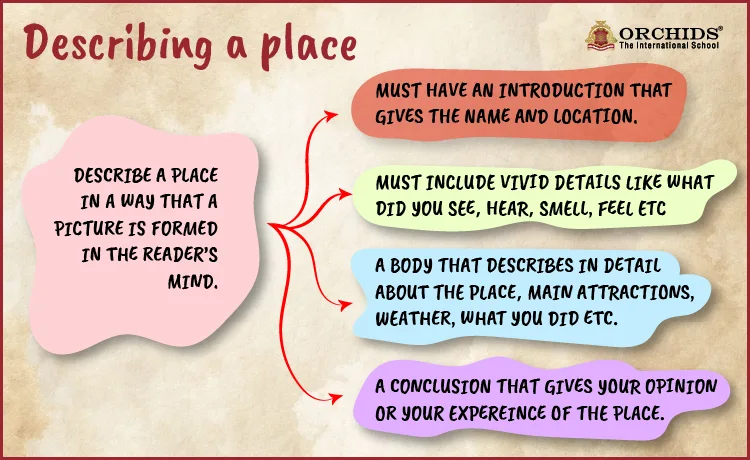
A well-organised piece of descriptive writing about a place is typically divided into three or more paragraphs.
Paragraph 1: Introduction
Introduce the place. Mention where it is, what it is and why you are writing about it.
Paragraph 2 (and More): Body
Describe the place in detail. Use words to describe a place effectively, including sensory details such as what you can see, hear, smell and feel.
Paragraph 3: Conclusion
End with your personal opinion about the place or a reflection on the experience of being there.
Describe a Place Example: Visit to the Zoo
The following is a complete describe a place example written in the form of a short essay. Read it carefully and notice how it uses adjectives to describe a place, sensory language and a clear structure.
Describe Your Visit to the Zoo
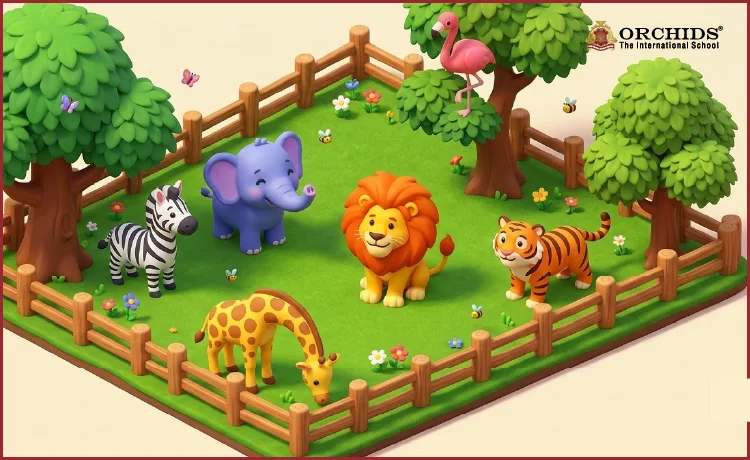
On a pleasant Saturday morning, my parents and I visited the Alipore Zoo in Kolkata. It was my first visit to a zoo. It is India’s oldest zoological park. My father purchased the entrance tickets. We saw many animals and birds there in their respective enclosures.
I saw swans, ducks, monkeys having bananas, elephants, lions, tigers, bears, deer, peacocks, snakes, horses, alligators, crocodiles, giraffes, ostriches, zebras and more.
I enjoyed watching them all. I also heard the roar of the tigers and the lions, the trumpet of the elephant, the screeching of the monkeys, the quack of the ducks and the chirping of the birds. We fed some of the animals and birds.
I came across my school friend and his parents there too. After roaming the zoo, we all sat down together to have refreshments, food and snacks. We clicked many pictures, including photographs of the animals. I had a wonderful time.
How to Describe a Place
A. Adjectives to Describe a Place
Using the right adjectives to describe a place is one of the most important skills in descriptive writing. Adjectives bring a location to life, helping the reader see it clearly.
The following table shows commonly used adjectives to describe a place:
|
Adjectives to Describe a Place |
|
|
ancient |
beautiful |
|
bustling |
charming |
|
contemporary |
compact |
|
crowded |
exciting |
|
famous |
fantastic |
|
fascinating |
huge |
|
lively |
popular |
|
picturesque |
polluted |
Using adjectives to describe a place in sentences:
- The ancient temple stood at the edge of the village.
- It was a bustling market full of colour and noise.
- The picturesque hillside was covered in green trees.
- The beach was crowded but beautiful.
- We entered the lively fair, and the excitement was instant.
B. Words to Describe a Place
Beyond adjectives, strong words to describe a place also include powerful verbs, specific nouns and vivid adverbs that work together to build a rich, complete picture.
Powerful verbs to describe a place:
|
Action |
Verb |
|
Sound |
echo, ring, hum, buzz, roar, whisper |
|
Light |
glitter, shimmer, glow, sparkle, gleam |
|
Movement |
rush, drift, wander, sprawl, stretch |
|
Smell |
waft, linger, fill, drift |
Descriptive nouns for places:
- landscape
- atmosphere
- surroundings
- horizon
- skyline
- backdrop
- scene
- setting
Using words to describe a place in a sentence:
- The lanterns glittered across the night market.
- A smell of freshly baked bread lingered in the air.
- The mountains stretched endlessly into the distance.
- The whole atmosphere of the old city was calm and peaceful.
C. How to Describe a Place Using Sensory Details
One of the most powerful techniques in how to describe a place in writing is the use of sensory details: language that appeals to all five senses so that the reader experiences the place, not just reads about it.
Use these five questions to build sensory details:
|
Question |
Description |
|
What do you see? |
Describe the colours, shapes, sizes and anything that catches your eye. |
|
What do you hear? |
Describe sounds: loud or soft, near or far, pleasant or unpleasant. |
|
What do you feel? |
Describe physical sensations: warmth, cold, the texture of surfaces, the feeling of wind or rain. |
|
What do you smell? |
Describe scents: flowers, food, the sea, rain on dry earth, wood smoke. |
|
What do you taste? (where relevant) |
If food or drinks are part of the scene, describe their taste. |
Sensory Details Example
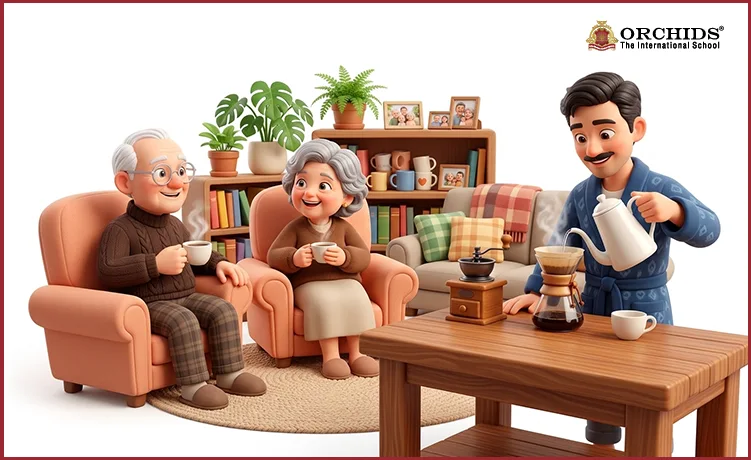
The following passage demonstrates how to describe a place in writing using sensory details.
As the day begins, wind sneaks into my room, causing a shiver down my spine. I have no choice but to wake up and open the window curtains. I hear the playful kids next door. I rush down the stairs for a walk to keep the chill away. I came back after an hour, and the atoms of hot tea relaxed me.
It is a warm ginger tea that comforts my dry throat and enthuses me for a hectic day ahead.
How to Describe a Place in Writing: Step-by-Step
The following steps provide a clear, simple process for how to describe a place in writing at Class 3 level.
Step 1: Choose Your Place
Think about a place you know well or have visited: your classroom, your garden, a market, a park, a beach. The more familiar you are with it, the richer your description will be.
Step 2: Make Notes Using the Five Senses
Before writing, jot down words for each sense category: what you see, hear, feel, smell and (if applicable) taste in this place.
Step 3: Choose Strong Adjectives to Describe a Place
Select the most precise and vivid adjectives to describe a place from your notes. Avoid repeating the same adjective more than once.
Step 4: Write Your Introduction
Name the place, give its location and create an immediate sense of atmosphere in your opening sentence.
Step 5: Write the Body Using Sensory Detail
Develop each sense across your body paragraphs. Include specific details, not vague generalities.
Step 6: Add Your Personal Reaction
Tell the reader how the place made you feel. This transforms a description into something personal and engaging.
Step 7: Write Your Conclusion
End with a final impression or personal opinion. This gives your description a satisfying close.
Practice Worksheets
A. Choose five adjectives to describe a place from the table on this page and write five original sentences, each using one adjective to describe a different location.
Example: The bustling railway station was full of people rushing to catch their trains.
B. Choose any place you know well. Complete the following sensory chart:
|
Sense |
What I Notice at This Place |
|
See |
|
|
Hear |
|
|
Feel |
|
|
Smell |
|
|
Taste (if applicable) |
|
Now use your completed chart to write a paragraph of four to five sentences that describes the place using sensory details.
C. Write a short essay (three paragraphs) describing ONE of the following places. Use the step-by-step guide from this page, include at least five adjectives to describe a place and use sensory details in the body paragraph.
- A visit to a park or playground.
- Your school on a sports day.
- A market or fair you have visited.
Strong language skills open doors well beyond the classroom, shaping how confidently a child reads, writes and expresses ideas. If you want to know more about how Orchids The International School builds these skills through its English curriculum, get in touch with our admissions team.
Frequently Asked Questions about Describing a Place
1. What are some good adjectives to describe a place?
Good adjectives to describe a place include: ancient, beautiful, bustling, charming, crowded, exciting, famous, fascinating, huge, lively, picturesque, polluted, popular and compact.
2. What are good words to describe a place?
Beyond adjectives, strong words to describe a place include powerful verbs like glitter, shimmer, echo and waft, as well as descriptive nouns like landscape, atmosphere and setting.
3. What tense should I use to describe a place?
The present tense is used when describing a place that still exists in general terms (‘The zoo is located in the heart of the city’). The past tense is used when describing a specific visit or providing historical information (‘It was crowded despite the chill’). Once you choose a tense, maintain it consistently throughout your description.
4. How do you use sensory details to describe a place?
To use sensory details when you describe a place, ask yourself five questions: What do I see? What do I hear? What do I feel? What do I smell? What do I taste? Then write at least one or two details for each sense.
Related Links


Admissions Open for 2026-27
What type of concept pages would you prefer?
CBSE Schools In Popular Cities
- CBSE Schools in Bangalore
- CBSE Schools in Mumbai
- CBSE Schools in Pune
- CBSE Schools in Hyderabad
- CBSE Schools in Chennai
- CBSE Schools in Gurgaon
- CBSE Schools in Kolkata
- CBSE Schools in Indore
- CBSE Schools in Sonipat
- CBSE Schools in Delhi
- CBSE Schools in Rohtak
- CBSE Schools in Bhopal
- CBSE Schools in Aurangabad
- CBSE Schools in Jabalpur
- CBSE Schools in Jaipur
- CBSE Schools in Jodhpur
- CBSE Schools in Nagpur
- CBSE Schools in Ahmednagar
- CBSE School In Tumkur











Orchids The International School is one of India's leading chains of CBSE and ICSE schools, with 130+ schools across the country.