

Sequencing: Learning How Events are Arranged in a Story
Have you ever tried to tell a story and gotten confused about what happened first? This is where sequencing helps. In every story, events happen in a particular order, and if you mix them up, it may not make sense. In this guide, you will learn what sequencing is, how to arrange events, and practise with exercises to organise a story.
Table of Contents
- What is Sequencing
- How to Sequence Events
- How to Sequence Events
- Sequencing Exercises
- Examples of Reported Speech
- Frequently Asked Questions about Sequencing

What is Sequencing
Sequencing means putting the events of a story in the order they occurred in. Every story has a flow; things happen step by step. When we arrange events properly, the story becomes easy to understand and more interesting to tell. Sequencing helps you to understand the story better, remember what happened, and tell the story clearly.
For example, imagine saying, “I went to school, then I woke up.” That sounds confusing, right? But when you say “I woke up, got ready, and then went to school,” it makes perfect sense. This is sequencing.
We often use words like first, next, then, after that, and finally to show the correct sequence of events. In short, sequencing is arranging events step by step so the story makes sense.
How to Sequence Events
Sequencing events means arranging a story in a clear order: beginning, middle, and end. This helps the story make sense and keeps the reader interested.
-
Beginning: Describes the character or the setting. The signal words used to identify the beginning are:
-
Once upon a time...
-
There lived a...
-
A long time ago...
-
One day...
-
On a hot sunny day...
-
Middle: Describes the actions of the characters such as “What happened?” and “When did it happen?” The signal words to identify the middle are:
-
Meanwhile...
-
After that...
-
Suddenly...
-
End: Gives closure to the story or shows what happens to the character. The signal words to identify the end of the story are:
-
In the end…
-
At the end...
-
Finally…
-
After all...
Sequencing Exercises
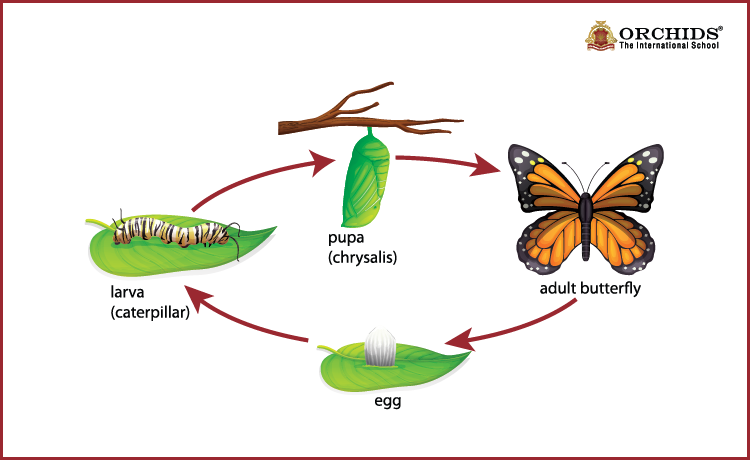
Exercise 1: Study the picture to learn about the life cycle of a butterfly.
-
Which comes first in the life cycle of a butterfly?
-
Larva
-
Pupa
-
Egg
-
Adult
-
What comes after the egg stage?
-
Adult
-
Larva
-
Pupa
-
Butterfly
-
Which stage comes just before the adult butterfly?
-
Egg
-
Larva
-
Pupa
-
Nest
-
Arrange the stages in the correct order:
-
Egg → Pupa → Larva → Adult
-
Egg → Larva → Pupa → Adult
-
Larva → Egg → Pupa → Adult
-
Pupa → Egg → Larva → Adult
Answers:
-
Egg
-
Larva
-
Pupa
-
Egg → Larva → Pupa → Adult
Exercise 2: Read the story and answer the questions.
Renu had heard a lot about Sassoon Dock. One day, she went there with her grandma to buy some fresh fish. Early in the morning, they took a taxi to the dock. While travelling, grandma told her the history of Sassoon Dock. Renu could smell the place from a distance. At 7 a.m. on Sunday, the place was quite busy. Huge tubs were full of pomfrets, baby sharks, prawns, crabs and a variety of unknown fish. People flocked around fishmongers to buy the fresh catch. Slowly, Renu got used to the smell. She saw a few fishing boats anchored at the dock. She wanted to visit the dock again.
According to the passage, arrange the events in the correct order.
-
Renu got into a taxi with her grandma.
-
Renu got the smell of fish.
-
Renu heard about Sassoon Dock.
-
Renu thought of visiting the fish market again.
-
Renu saw fishing boats in the sea.
-
Renu and her grandma reached the dock.
-
Renu saw huge containers filled with fish.
Answer:
-
Renu heard about Sassoon Dock.
-
Renu got into a taxi with her grandma.
-
Renu and her grandma reached the dock.
-
Renu got the smell of fish.
-
Renu saw huge containers filled with fish.
-
Renu saw fishing boats in the sea.
-
Renu thought of visiting the fish market again.
Frequently Asked Questions about Sequencing
1. What is sequencing?
Answer: Sequencing means arranging events in the correct order in which they happen.
2. Why is sequencing important?
Answer: Sequencing helps us understand a story better, remember events, and retell the story clearly.
3. What are sequence words?
Answer: Sequence words are words that show order, such as first, next, then, after that, and finally.
4. What are the three parts of sequencing?
Answer: The three parts are Beginning, Middle, and End.
Strong language skills open doors well beyond the classroom, shaping how confidently a child reads, writes and expresses ideas. If you want to know more about how Orchids The International School builds these skills through its English curriculum, get in touch with our admissions team.


Admissions Open for 2026-27
What type of concept pages would you prefer?
CBSE Schools In Popular Cities
- CBSE Schools in Bangalore
- CBSE Schools in Mumbai
- CBSE Schools in Pune
- CBSE Schools in Hyderabad
- CBSE Schools in Chennai
- CBSE Schools in Gurgaon
- CBSE Schools in Kolkata
- CBSE Schools in Indore
- CBSE Schools in Sonipat
- CBSE Schools in Delhi
- CBSE Schools in Rohtak
- CBSE Schools in Bhopal
- CBSE Schools in Aurangabad
- CBSE Schools in Jabalpur
- CBSE Schools in Jaipur
- CBSE Schools in Jodhpur
- CBSE Schools in Nagpur
- CBSE Schools in Ahmednagar
- CBSE School In Tumkur











Orchids The International School is one of India's leading chains of CBSE and ICSE schools, with 110+ schools across the country.