

Butterfly Facts: Metamorphosis, Biological Traits and Ecological Significance
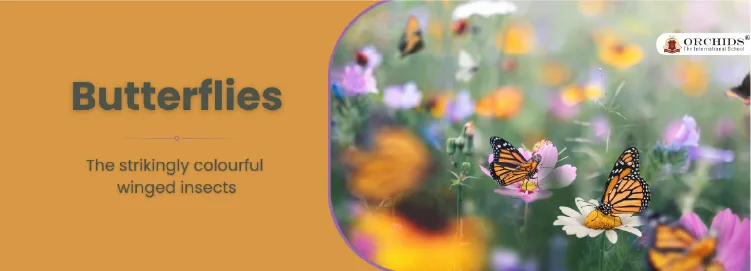
Butterflies are among the most beautiful insects found in nature with vivid colours. There are over 18,000 species of butterflies all around the world. These tiny colourful insects are found in diverse habitats from deserts to rain forests and grasslands. We can often spot them flying over flowers in your garden or in meadows or forests. A butterfly is not only a beautiful insect but it also has a huge ecological impact. In this article, we will study all fascinating facts about butterflies and understand their biological characteristics, life stages and role in our environment.
Table of Contents
- Body Structure and Parts of a Butterfly
- Four Life Stages of a Butterfly
- Importance of Butterflies in our Environment
- Interesting Butterfly Facts
- Frequently Asked Questions about Butterfly

Body Structure and Parts of a Butterfly
The body of a butterfly is divided into three different sections: head, thorax and abdomen. The head of the butterfly includes different parts such as compound eyes, proboscis and antennas. It is the sensory and feeding center of butterflies that help it to find flowers, suck nectar around and feel movement of wind. The second section of a butterfly's body is its thorax, it is the part between its head and the abdomen. Both the hide wings and the forewings of a butterfly are attached to this part. Thorax supports butterflies in flying by flapping their wings. The legs of the butterfly are also attached below thorax. Abdomen is the rarest section in the body of a butterfly that holds all vital organs required to respirate, digest and reproduce.
There are parts of the body of butterflies in all three sections: antenna, eyes, wings and proboscis. Butterflies suck nectar from flowers using proboscis that is an elongated straw-like mouthpart. When butterflies reach a certain age they reproduce and lay eggs. It is the beginning of the life cycle of a butterfly. Let’s understand the stages in the life of a butterfly.
Four Life Stages: Life Cycle of a Butterfly
The life cycle of a butterfly, called metamorphosis, is one of the most amazing transformations in the natural world. It is a magical cycle that turns a crawling caterpillar into a beautiful winged butterfly. Here are the different stages of the butterfly life cycle:
- Egg: A female butterfly lays eggs on leaves of a plant which then becomes the food for its offspring. Butterfly eggs are round and tiny in size that hatch within a few weeks.
- Caterpillar (Larva): From the eggs comes out a small caterpillar or larva that eats leaves and crawls on the plant or trees. The caterpillar eats to grow for gaining mass and energy required for the main transformation. These caterpillars play an important role in the food chain as the main herbivores which then get eaten by bats and other birds.
- Chrysalis (Pupa): During this stage, a caterpillar creates a protective shell around it called a cocoon to undergo the transformation from a caterpillar to a butterfly. After making a cocoon the caterpillar body breaks into a nutrient-rich fluid to form a butterfly with wings, antennas, legs and other parts.
- Butterfly (Adult): After 1-2 weeks the fully formed butterfly comes out of the cocoons with beautiful wings and takes its first flight within a few hours. This fascinating transformation is one among the most beautiful natural wonders to witness.
Importance of Butterflies in our Environment
Along with being nature’s beautiful winged insect, butterflies are the sentinels of our environment. They are the ecological workers that maintain biodiversity and balance our environment. Let’s learn about their role in our environment and their ecological importance:
Pollinators: Butterflies are pollinators that are a big contributor for about one-third of the food humans consume. By transferring pollen from one plant to another, butterflies help in the reproduction process of flowering plants. Butterflies suck nectar from flowers and incidentally carry pollen that sticks to their legs and gets carried to the other flowering plant’s stigma allowing the other plant to reproduce.
Role in Food Chain: Butterflies play an important role in the food chain by consuming plant energy. They eat plant diets both as caterpillars and butterflies which then evolve into the food chain when they’re consumed by birds, bats and other insects. They are a living proof of how life is closely connected between different organisms on earth.
Environment Health Indicator: Butterflies are valuable in detecting environmental health. These sensitive creatures respond rapidly to the deteriorating climatic conditions. The decline in the butterflies population is directly proportional to the environment's health. They also undergo behavioral modifications and evolutionary changes for ecological adaptation.
Interesting Butterfly Facts
- Butterflies have sensors in their feet that aid them taste plants and decide the appropriate place for laying eggs.
- There are thousands of microscopic scales on the butterflies wings that reflect and refract light. This color we see on butterflies is due to these scales.
- The eyes of a butterfly has around 6,000 tiny lenses which can see ultraviolet light and help it to find which flower has nectar.
- Instead of lungs, butterflies breathe through the tiny openings on their body called spiracles.
- Butterflies can fly at a speed of 12 miles per hour and there are around 1,65,000 known species of butterflies worldwide.
Frequently Asked Questions about Butterfly
1. What do butterflies eat and how do they eat it?
Butterflies suck nectar from flowers through their proboscis which is a straw like pipe in their mouth.
2. How do butterflies help in growing food?
Butterflies are essential pollinators that help in spreading pollen from one flower to another resulting in the reproduction of food in plants.
3. How long do butterflies live?
The average lifespan of a butterfly is about -4 weeks. However, some butterflies can live up to nine weeks.
4. Do butterflies sleep?
Butterflies do not sleep the same way as humans. They never close their eyes while sleeping. They usually sleep upside down hanging under leaves or on rocks
Understanding the world starts with the environment around us. To see how Orchids The International School brings EVS to life, reach out to our admissions team.


Admissions Open for 2026-27
What type of concept pages would you prefer?
CBSE Schools In Popular Cities
- CBSE Schools in Bangalore
- CBSE Schools in Mumbai
- CBSE Schools in Pune
- CBSE Schools in Hyderabad
- CBSE Schools in Chennai
- CBSE Schools in Gurgaon
- CBSE Schools in Kolkata
- CBSE Schools in Indore
- CBSE Schools in Sonipat
- CBSE Schools in Delhi
- CBSE Schools in Rohtak
- CBSE Schools in Bhopal
- CBSE Schools in Aurangabad
- CBSE Schools in Jabalpur
- CBSE Schools in Jaipur
- CBSE Schools in Jodhpur
- CBSE Schools in Nagpur
- CBSE Schools in Ahmednagar
- CBSE School In Tumkur











Orchids The International School is one of India's leading chains of CBSE and ICSE schools, with 110+ schools across the country.