

145 in Roman Numerals
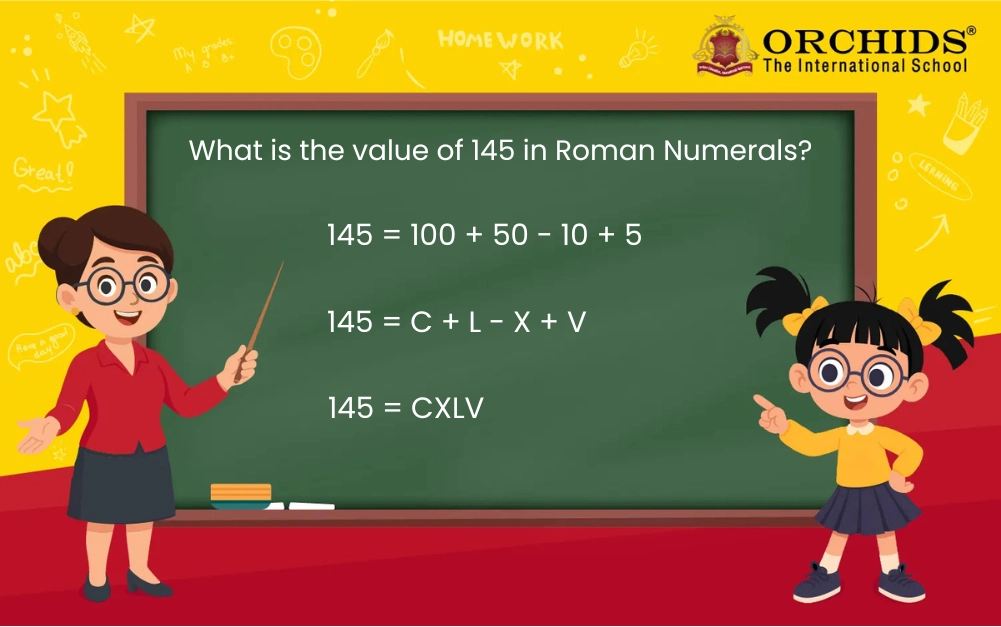
145 in Roman numerals is written as CXLV, using the ancient Roman number system. To understand this conversion, we first break the number into parts: 145 = 100 + (50 - 10) + 5. Each value is replaced with its Roman numeral symbol: 100 is C, 40 is written as XL (subtractive form), and 5 is V. When these symbols are combined, they form CXLV. Learning how to write 145 in Roman numerals helps students recognize both addition and subtraction rules used in Roman notation. It also improves number understanding and shows how ancient methods are still useful in learning numbers today.
Table of Contents
- How to Write 145 in Roman Numerals?
- Roman Numerals for Numbers Related to 145
- Solved Examples on 145 in Roman Numerals
- Fun Facts on 145 in Roman Numerals
- Practice Questions on 145 in Roman Numerals
- Conclusion
- Frequently Asked Questions on 145 in Roman Numerals
How to Write 145 in Roman Numerals?
145 in Roman numerals is written as CXLV. To understand how this number is formed, we break 145 into parts using Roman numeral values such as 1, 5, 10, 50, and 100.
Step-by-Step Explanation
The number 145 can be separated into values that match Roman numeral symbols:
-
145 = 100 + 40 + 5
-
100 is written as C
-
40 is written using the subtraction rule as XL (50 - 10)
-
5 is written as V
Roman Numeral Conversion
-
145 = 100 + (50 - 10) + 5
-
145 = C + XL + V
-
145 = CXLV
-
145 in Roman numerals = CXLV

Roman Numerals for Numbers Related to 145
|
Number |
Roman Numeral |
|
140 |
CXL |
|
141 |
CXLI |
|
142 |
CXLII |
|
143 |
CXLIII |
|
144 |
CXLIV |
|
145 |
CXLV |
|
146 |
CXLVI |
|
147 |
CXLVII |
|
148 |
CXLVIII |
|
149 |
CXLIX |
|
150 |
CL |
Know more about related topics:
Solved Examples on 145 in Roman Numerals
Example 1: Find the sum of CXX (120) and XXV (25). Write the answer in Roman numerals.
Solution:
-
CXX = 120
-
XXV = 25
-
120 + 25 = 145
-
145 in Roman numerals = CXLV
Example 2: Write the difference between CL (150) and V (5) in Roman numerals.
Solution:
-
CL = 150
-
V = 5
-
150 - 5 = 145
-
145 in Roman numerals = CXLV
Example 3: Multiply XXIX (29) by V (5). Express the result in Roman numerals.
Solution:
-
XXIX = 29
-
V = 5
-
29 × 5 = 145
-
145 = CXLV
Example 4: If a building were constructed in the year 145 AD, how would it be written on a Roman monument?
Solution:
The year 145 is written as CXLV on Roman monuments.
Example 5: Add L (50) + L (50) + XLV (45). Write the total in Roman numerals.
Solution:
-
50 + 50 + 45 = 145
-
145 in Roman numerals = CXLV
Fun Facts on 145 in Roman Numerals
-
CXLV = 145 uses both addition and subtraction rules in one number!
-
Roman numerals like CXLV are still seen on clock faces and historical buildings.
-
The subtraction pattern “XL = 40” is also used in numbers like XC (90) and IX (9).
-
Many classic movies and books use Roman numerals for copyright dates, like “© MCMLXV”.
-
After 145, numerals continue as CXLVI (146), CXLVII (147), and so on until CL (150).
Practice Questions on 145 in Roman Numerals
1. Write 145 in Roman numerals.
2. Find the sum of C (100) and XLV (45). Express the result in Roman numerals.
3. Subtract V (5) from CL (150). What is the answer in Roman numerals?
4. Multiply XXIX (29) by V (5) and write the result in Roman numerals.
5. What comes just before and after 145 in Roman numerals?
Conclusion
The number 145 in Roman numerals is written as CXLV, using C (100), XL (40), and V (5). This example clearly shows how addition and subtraction rules work together in Roman numerals. Learning numbers like 145 helps students understand patterns, improve number skills, and recognize Roman numerals used on clocks, books, and monuments today.
Explore 145 in Roman numerals and similar topics with easy explanations and examples at Orchids International School.
Numbers make sense when they're taught right. To see how Orchids The International School turns Maths from intimidating to intuitive, reach out to our admissions team.
Frequently Asked Questions on 145 in Roman Numerals
1. What is 145 in Roman numerals?
Answer: 145 in Roman numerals is CXLV. It is formed using C (100), XL (40), and V (5) together, representing 100 + 40 + 5 = 145.
2. How to write the number 145 step by step in Roman numerals?
Answer:
-
Break the number: 145 = 100 + 40 + 5.
-
Write their Roman forms: 100 = C, 40 = XL, 5 = V.
-
Combine them: C + XL + V = CXLV.
3. What comes before and after 145 in Roman numerals?
Answer:
-
Before 145; 144 = CXLIV
-
After 145, 146 = CXLVI
4. What is the meaning of CXLV in Roman numerals?
Answer:
-
CXLV represents the number 145.
-
It combines subtraction (XL = 40) and addition (C + XL + V) rules in one numeral.
5. Where can you find the number 145 written in Roman numerals in real life?
Answer: You can find CXLV engraved on historical monuments, ancient coins, clock dials, and movie release years that use Roman numerals.
Related Links


Admissions Open for 2026-27
What type of concept pages would you prefer?
CBSE Schools In Popular Cities
- CBSE Schools in Bangalore
- CBSE Schools in Mumbai
- CBSE Schools in Pune
- CBSE Schools in Hyderabad
- CBSE Schools in Chennai
- CBSE Schools in Gurgaon
- CBSE Schools in Kolkata
- CBSE Schools in Indore
- CBSE Schools in Sonipat
- CBSE Schools in Delhi
- CBSE Schools in Rohtak
- CBSE Schools in Bhopal
- CBSE Schools in Aurangabad
- CBSE Schools in Jabalpur
- CBSE Schools in Jaipur
- CBSE Schools in Jodhpur
- CBSE Schools in Nagpur
- CBSE Schools in Ahmednagar
- CBSE School In Tumkur











Orchids The International School is one of India's leading chains of CBSE and ICSE schools, with 110+ schools across the country.