

Application Problems Trigonometry
Trigonometry is not limited to formulas and identities; it is widely used to solve real-life problems. Application problems in trigonometry involve using ratios such as sine, cosine, and tangent to determine unknown heights and distances. These problems help in finding measurements that are difficult to calculate directly, such as the height of a building or the distance between two points. They provide a clear understanding of how mathematical concepts are applied in practical situations.
Table of Contents
- Problem 1: Height of a Building (Angle of Elevation)
- Problem 2: Ship Navigation Using Bearings
- Problem 3: Angle of Depression in Lighthouse Observation
- Problem 4: Surveying Across an Obstacle Using Triangulation
- Problem 5: Inclined Plane Forces in Physics
- Problem 6: Periodic Motion in Rotating Equipment
- Practice for Solving Trigonometry Problems
- Frequently Asked Questions on Application Problems in Trigonometry

Problem 1: Height of a Building (Angle of Elevation)
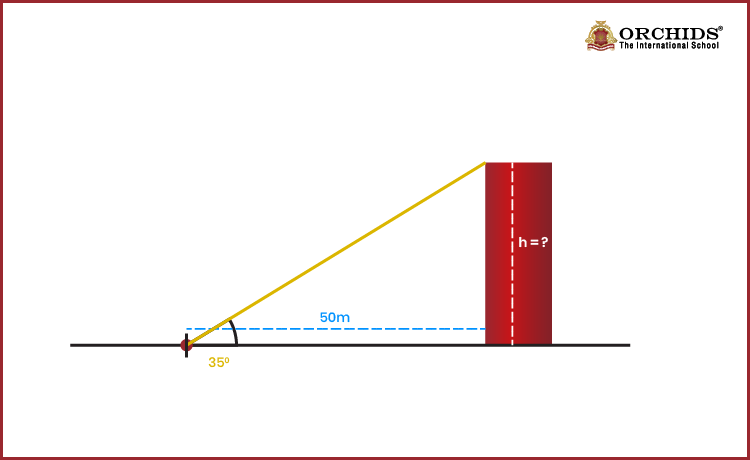
A surveyor stands 50 meters away from the base of a tall building. When she looks at the top of the building, her line of sight makes an angle of 35° with the horizontal ground. How tall is the building?
Solution:
The angle of elevation is the angle formed between the horizontal line and the observer's line of sight when looking upward at an object.
Step 1: Identify the right triangle. The surveyor's position, the building's base, and the building's top form a right triangle.
Step 2: Determine which trigonometric ratio applies. We know the horizontal distance (adjacent side) and the angle. We need the height (opposite side).
Formula: tan(θ) = Perpendicular / Base
Step 3: Substitute the known values: tan(35°) = h / 50
Step 4: Solve for height: h = 50 × tan(35°) h = 50 × 0.7002 h ≈ 35.01 meters
Answer: The building is approximately 35 meters tall.
Problem 2: Ship Navigation Using Bearings
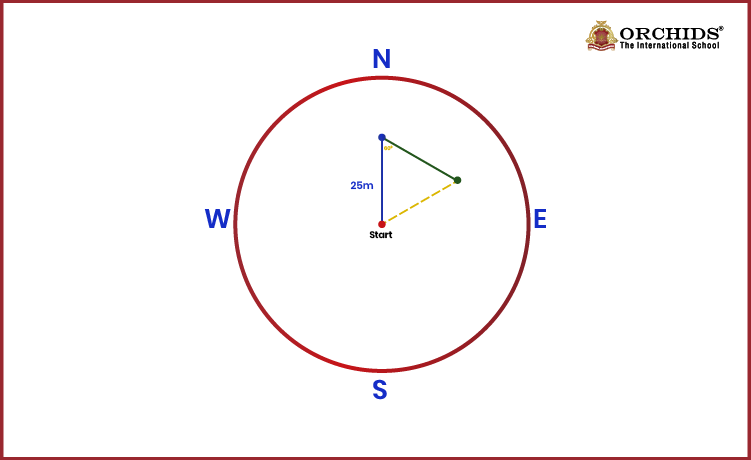
A ship travels 25 nautical miles due north, then turns and travels 18 nautical miles at a bearing of 120° (measured clockwise from north). What is the ship's final distance from its starting point?
Solution:
Bearings are measured clockwise from north. The interior angle is 180° - 120° = 60°.
Step 1: Sketch the path and identify the triangle with two sides (25 nm and 18 nm) and the included angle (60°).
Step 2: Apply the Law of Cosines: c² = a² + b² - 2ab·cos(C)
Step 3: Substitute values: c² = 25² + 18² - 2(25)(18)·cos(60°) c² = 625 + 324 - 900(0.5) c² = 949 - 450 = 499
Step 4: Solve: c = √499 ≈ 22.34 nautical miles
Answer: The ship is approximately 22.34 nautical miles from its starting point.
Problem 3: Angle of Depression in Lighthouse Observation
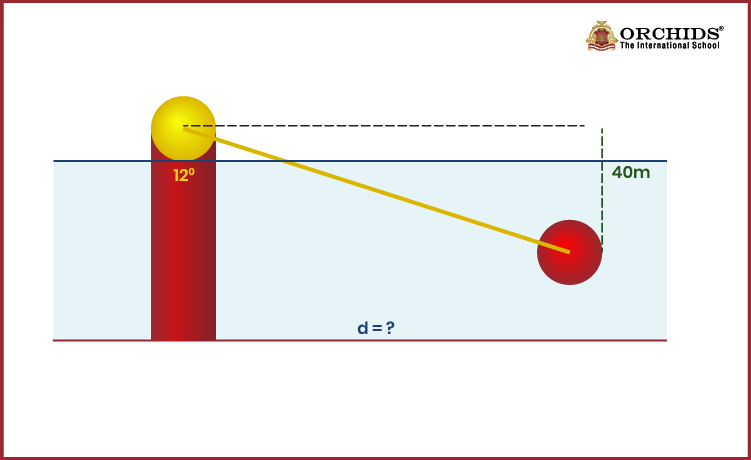
From the top of a 40 meter tall lighthouse, a keeper observes a ship at sea. The angle of depression to the ship is 12°. How far is the ship from the point directly below the lighthouse?
Solution:
The angle of depression equals the angle of elevation from the object's perspective.
Step 1: Set up the relationship using the tangent ratio.
Formula: tan(12°) = height / distance = 40 / d
Step 2: Rearrange and solve: d = 40 / tan(12°) d = 40 / 0.2126 d ≈ 188.2 meters
Answer: The ship is approximately 188.2 meters from the point directly below the lighthouse.
Problem 4: Surveying Across an Obstacle Using Triangulation
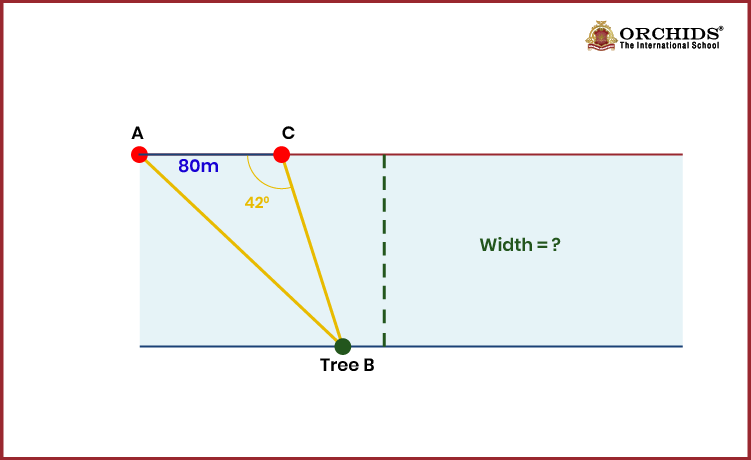
A surveyor needs to measure the width of a river. She places a stake at point A on her side and identifies a tree at point B directly across from her. She walks 80 meters along the bank to point C, then measures the angle ACB as 42°. What is the river's width?
Solution:
Triangulation measures distances to inaccessible objects using a known baseline and angles.
Step 1: Identify the right triangle with baseline AC = 80 m, angle ACB = 42°.
Formula: tan(42°) = AB / AC
Step 2: Substitute and solve: width = 80 × tan(42°) width = 80 × 0.9004 width ≈ 72.03 meters
Answer: The river is approximately 72 meters wide.
Problem 5: Inclined Plane Forces in Physics
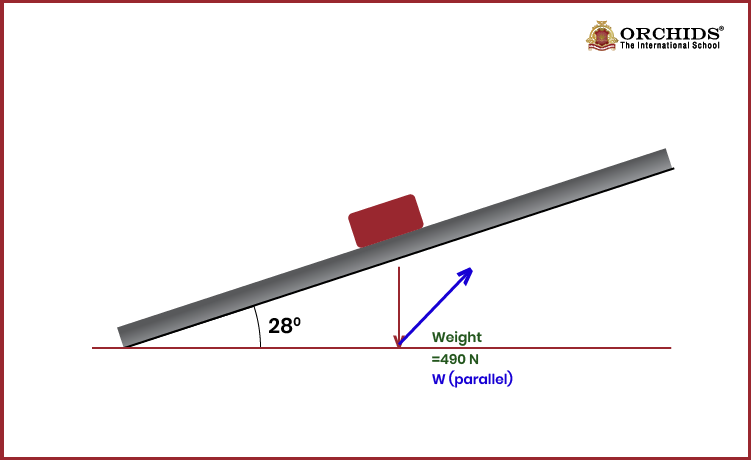
A 50 kilogram box is placed on an inclined plane tilted at 28° to the horizontal. Assuming no friction, what is the component of gravitational force acting along the plane (down the slope)?
Solution:
Gravity acts downward and decomposes into components parallel and perpendicular to the incline.
Step 1: Calculate total weight: W = mg = 50 kg × 9.8 m/s² = 490 N
Step 2: Decompose the weight. The component along the plane: W∥ = W × sin(θ)
Step 3: Calculate: W∥ = 490 × sin(28°) W∥ = 490 × 0.4695 W∥ ≈ 230.1 N
Answer: The component of force along the plane is approximately 230.1 newtons.
Problem 6: Periodic Motion in Rotating Equipment
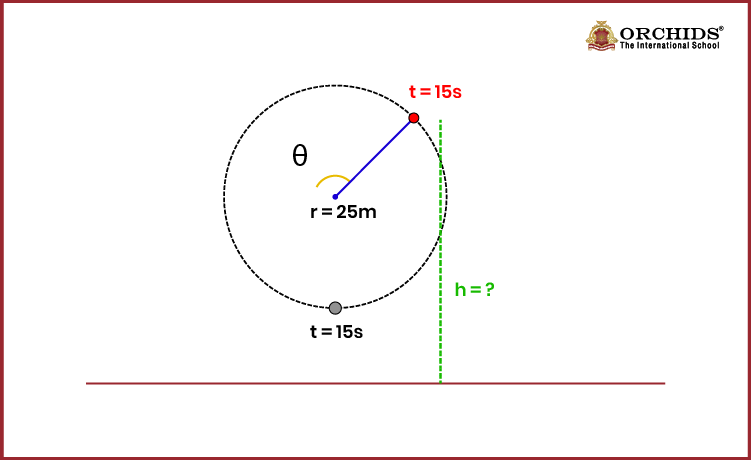
A ferris wheel has a radius of 25 meters and completes one full rotation every 40 seconds. A passenger starts at the lowest point. After 15 seconds, how high is the passenger above the lowest point?
Solution:
Rotating objects undergo periodic motion described by sinusoidal functions.
Step 1: Calculate angular velocity: Angular velocity = 360° / 40s = 9° per second
Step 2: Find the angle after 15 seconds: θ = 9° × 15s = 135°
Step 3: Calculate height above lowest point: Height = r(1 - cos(θ)) Height = 25(1 - cos(135°)) Height = 25(1 - (-0.7071)) Height = 42.68 meters
Answer: After 15 seconds, the passenger is approximately 42.7 meters above the lowest point.
Practice for Solving Trigonometry Problems
1. Sketch the Problem: Always begin by drawing a diagram. This clarifies relationships between angles and sides.
2. Label All Values: Write down given information and clearly mark unknowns.
3. Select the Right Ratio: Remember SOH-CAH-TOA to identify which trigonometric function to use.
4. Check Your Units: Ensure all measurements use consistent units before solving.
5. Verify Your Answer: Check if the answer makes sense in context.
6. Recognize Special Angles: Use exact values for 30°, 45°, and 60° angles.
Frequently Asked Questions on Application Problems in Trigonometry
1. What are the angles of elevation and depression?
The angle of elevation is the angle between the horizontal line and the line of sight when looking up at an object. The angle of depression is the angle between the horizontal line and the line of sight when looking down at an object.
2. When should I use sine, cosine, or tangent?
Use the trigonometric ratio based on the sides you know:
- Sine (sin) = Opposite ÷ Hypotenuse
- Cosine (cos) = Adjacent ÷ Hypotenuse
- Tangent (tan) = Opposite ÷ Adjacent
3. How do I solve problems with moving objects?
Draw a diagram showing the object's positions, identify the given distances or angles, apply the appropriate trigonometric ratio, and solve for the unknown. These problems often involve changing angles of elevation or depression.
4. What are the common steps to solve any trigonometry application problem?
- Read the problem carefully.
- Draw a labelled diagram.
- Identify the known and unknown values.
- Choose the correct trigonometric ratio.
- Substitute the values and solve.
- Write the answer with the correct unit.
5. Which trigonometric ratio should I use?
Choose the ratio based on the sides involved:
- Use sin for opposite and hypotenuse.
- Use cos for adjacent and hypotenuse.
- Use tan for opposite and adjacent.
6. What are the standard angle values I must memorize?
Students should remember the exact trigonometric values for 0°, 30°, 45°, 60°, and 90°, as they are frequently used in trigonometry problems and exams.
7. How do I solve "moving object" or "changing angle" problems?
Draw separate diagrams for each position of the object, note the change in distance or angle, apply the relevant trigonometric ratio, and compare the results to find the required value.
8. What is the difference between the angle of elevation and depression?
The angle of elevation is measured when looking upward from the horizontal, while the angle of depression is measured when looking downward from the horizontal.
9. What are the common exact values used in these problems?
The most common exact values are:
- sin 30° = 1/2, cos 30° = √3/2, tan 30° = 1/√3
- sin 45° = √2/2, cos 45° = √2/2, tan 45° = 1
- sin 60° = √3/2, cos 60° = 1/2, tan 60° = √3
These values are essential for solving application problems without using a calculator.
Numbers make sense when they're taught right. To see how Orchids The International School turns Maths from intimidating to intuitive, reach out to our admissions team.


Admissions Open for 2026-27
What type of concept pages would you prefer?
CBSE Schools In Popular Cities
- CBSE Schools in Bangalore
- CBSE Schools in Mumbai
- CBSE Schools in Pune
- CBSE Schools in Hyderabad
- CBSE Schools in Chennai
- CBSE Schools in Gurgaon
- CBSE Schools in Kolkata
- CBSE Schools in Indore
- CBSE Schools in Sonipat
- CBSE Schools in Delhi
- CBSE Schools in Rohtak
- CBSE Schools in Bhopal
- CBSE Schools in Aurangabad
- CBSE Schools in Jabalpur
- CBSE Schools in Jaipur
- CBSE Schools in Jodhpur
- CBSE Schools in Nagpur
- CBSE Schools in Ahmednagar
- CBSE School In Tumkur











Orchids The International School is one of India's leading chains of CBSE and ICSE schools, with 130+ schools across the country.