

Angle of elevation
The angle of elevation is the angle formed between the horizontal line and the line of sight directed upward toward an object. It is measured from the horizontal plane and indicates the height you need to look upward to see objects such as a building top or a flying kite. It is a key concept in trigonometry and is widely used in surveying, navigation, and architecture.
Table of Content
- Angle of Elevation Definition
- Angle of Elevation Formula
- Angle of Elevation and Angle of Depression
- Angle of Elevation Examples

Angle of Elevation Definition
The angle formed between the horizontal plane and the line of sight when an observer looks upward toward an object above the horizontal level.
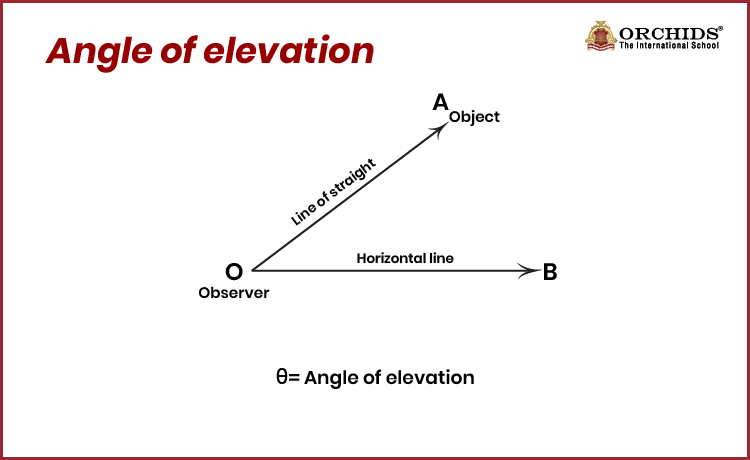
Key attributes of this angle
-
It is measured from the horizontal line upward
-
It is always between 0° and 90°
-
It originates at the observer's eye level
-
It is part of a right triangle in trigonometric problems
Know more about related topics:
Angle of Elevation Formula
The angle of elevation connects three values the height of the object (opposite side), the horizontal distance from the observer to the base (adjacent side), and the line of sight (hypotenuse). These are related through the standard trigonometric ratios.
Let:
-
θ = angle of elevation
-
h = vertical height of the object
-
d = horizontal distance from observer to base
The three primary formulas are:
The most commonly used formula is:
Which rearranges to:
-
h = d × tan θ to find height
-
d = h / tan θ to find horizontal distance
-
θ = tan⁻¹(h / d) to find the angle
Angle of Elevation And Angle of Depression
The Angle of Elevation And Angle of Depression. These two angles are closely related but operate in opposite directions.
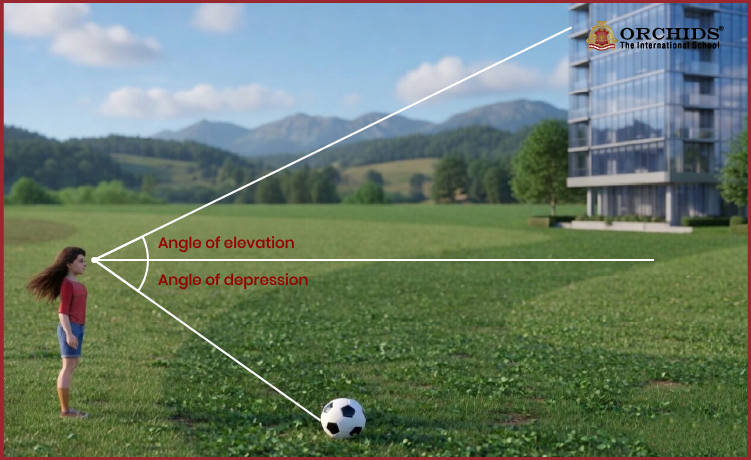
Alternate Angle Property: When a person on the ground looks up at an object, and a person at the top looks down, both angles are equal. This happens because the horizontal lines are parallel, and the line of sight forms equal alternate interior angles.
Angle of Elevation Examples
Example 1: A person standing 40 m away from a tree observes its top at an angle of elevation of 35°. Find the height of the tree.
Solution:
Using: tan θ = h / d
tan 35° = h / 40
h = 40 × tan 35°
h = 40 × 0.7002
h = 28.01 m
Example 2: An observer is standing 80 m from the base of a building. The building is 80 m tall. What is the angle of elevation to the top?
Solution:
Using: θ = tan⁻¹(h / d)
θ = tan⁻¹(80 / 80)
θ = tan⁻¹(1)
θ = 45°
Example 3: Finding Height of a Tower
Solution:
A person stands 10 m away from a tower. The angle of elevation to the top is 30°. Find the height of the tower.
Answer: Height ≈ 5.77 m.
Related Topics
Numbers make sense when they're taught right. To see how Orchids The International School turns Maths from intimidating to intuitive, reach out to our admissions team.
Frequently Asked Questions on Angle of elevation
1. What is the angle of elevation?
It is the angle formed when you look upward from your eye level to see an object above you, like the top of a building or a tree.
2. What is the formula for the angle of elevation?
The formula for the angle of elevation is: tan θ = height ÷ distance.
3. What is the difference between angle of elevation and angle of depression?
- Angle of elevation: looking upward
- Angle of depression: looking downward
4. Can the angle of elevation be more than 90 degrees?
No, the angle of elevation is always between 0° and 90°.
5. Where is the angle of elevation used in real life?
It is used to find the height of tall objects such as buildings, towers, trees, and mountains.
Related Links


Admissions Open for 2026-27
What type of concept pages would you prefer?
CBSE Schools In Popular Cities
- CBSE Schools in Bangalore
- CBSE Schools in Mumbai
- CBSE Schools in Pune
- CBSE Schools in Hyderabad
- CBSE Schools in Chennai
- CBSE Schools in Gurgaon
- CBSE Schools in Kolkata
- CBSE Schools in Indore
- CBSE Schools in Sonipat
- CBSE Schools in Delhi
- CBSE Schools in Rohtak
- CBSE Schools in Bhopal
- CBSE Schools in Aurangabad
- CBSE Schools in Jabalpur
- CBSE Schools in Jaipur
- CBSE Schools in Jodhpur
- CBSE Schools in Nagpur
- CBSE Schools in Ahmednagar
- CBSE School In Tumkur











Orchids The International School is one of India's leading chains of CBSE and ICSE schools, with 130+ schools across the country.