

Applications of Trigonometry
Trigonometry is a simple part of maths that helps us understand how angles and sides of a triangle are connected. It is useful for finding height, distance, and length in real life. People use it in many situations, like measuring the distance between two places or finding how far stars are from Earth. Before learning all its uses, it is better to first understand the basic idea of trigonometry and how it works.
Table of Contents
- Basics of Trigonometry
- Trigonometry Applications in Real Life
- Trigonometry in Measuring Heights
- Trigonometry in Astronomy
- Trigonometry in Flight Engineering
- Trigonometry in Navigation
- Trigonometry in Construction
- Trigonometry in Marine Biology
- Other Uses of Trigonometry
- Frequently Asked Questions on Applications of Trigonometry

Basics of Trigonometry
Many people think trigonometry is just a confusing topic from school, but it is actually used in real life all around us. In simple words, it helps us understand how the sides and corners of a triangle are connected.
It may sound difficult at first, but the basic idea is easy once you look at it slowly and clearly.
To keep it simple:
- Sine of an angle = Opposite ÷ Hypotenuse
- Cosine of an angle = Adjacent ÷ Hypotenuse
- Tangent of an angle = Opposite ÷ Adjacent
That's really the foundation. Everything else, the unit circle, radians, Pythagorean identities like sin²θ + cos²θ = 1, grows out from there. The unit circle in particular extends trigonometry beyond just triangles, which is why it ends up being useful in things like physics, engineering, and even audio technology.
Know more about related topics:
Trigonometry Applications in Real Life
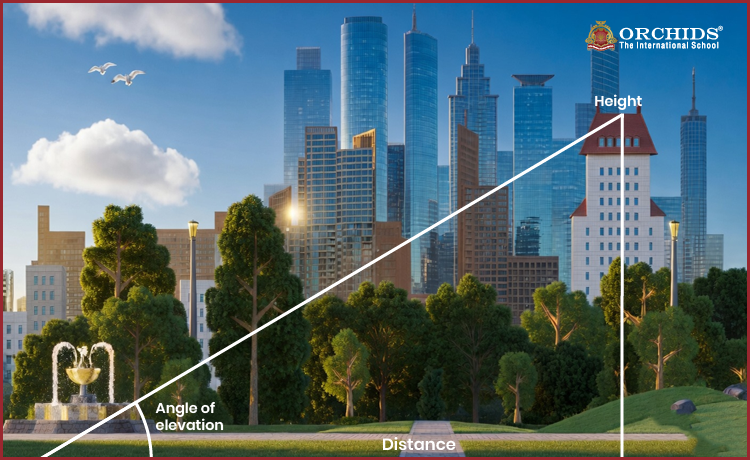
It may not have direct applications in solving practical issues but is used in various field. For example, trigonometry is used in developing computer music: as you are familiar that sound travels in the form of waves and this wave pattern, through a sine or cosine function for developing computer music. Here are a few applications where trigonometry and its functions are applicable.
Trigonometry in Measuring Heights
Suppose you have no special instruments and are unable to climb a structure to determine its height. There's a simple solution. Stand a short distance away and look up at the top. Note how steep your view is.
Now, use that angle along with your distance to find the height with a simple calculation. For example, if you are 50 meters away and looking up at a 60-degree angle, the building is about 86.6 meters tall.
Architects use this. Civil engineers use this. Forest rangers use it to estimate tree heights for logging plans or conservation projects. It's not glamorous, but it works, and it has worked reliably for centuries before GPS ever entered the picture.
Trigonometry in Astronomy
Astronomy and trigonometry have a long history together. Long before telescopes could capture the kind of detail they do today, ancient astronomers were using angle measurements to figure out distances to celestial objects. Hipparchus, working around the 2nd century BC, used trigonometric methods to estimate the distance from Earth to the Moon, and got surprisingly close.
The most popular method is known as parallax. A close star appears to move somewhat against the background of farther off stars as Earth revolves around the Sun. Astronomers can determine the star's distance using simple trigonometric ratios by measuring the angular shift between two locations in Earth's orbit.
In essence, this is triangulation: choose a known baseline, calculate the unknown distance, then measure the angles. In theory, it seems straightforward, but when working with distances expressed in light-years, a great level of precision is needed.
The Hubble telescope and other modern technology still rely on these same fundamental trigonometric techniques despite the advancements in technology. The math hasn't changed. The instruments just got better.
Trigonometry in Flight Engineering
A lot happens between the moment a plane lifts off and the moment it reaches cruising altitude, and trigonometry is involved in most of it.
When an aircraft climbs after take off, engineers calculate the altitude gained based on the angle of ascent and the distance traveled. If a plane climbs at 15 degrees over a path of 5,000 meters, the altitude gained is approximately 1,294 meters. That comes directly from the sine function.
Wind complicates things further. A crosswind pushes the aircraft sideways, so pilots have to adjust their heading to compensate. The way they calculate that correction is through something called the wind triangle, a vector diagram that uses trigonometry to find the right flight path despite the wind's interference. Pilots still learn this manually because understanding the underlying math matters when technology isn't available.
On the engineering side, designing wings involves calculating lift, drag, and thrust at various angles, all of which require breaking forces into horizontal and vertical components using sine and cosine. It applies trigonometry in one of its most critical forms.
Trigonometry in Navigation
Before GPS, crossing the ocean was not easy. Sailors had to rely on their expertise and meticulous tracking. In order to estimate their location, they began at a known position and continued to record their speed, direction, and time. A solid grasp of fundamental math was required for this process.
Things were a little more complicated because the Earth is round. To determine the fastest route between two locations, sailors had to include curves rather than just straight lines. These curved routes are still used by airplanes today to conserve fuel on lengthy flights.
Current GPS functions similarly. Your gadget uses signals sent by satellites to determine your location. The math behind it is still the same basic idea.
Knowing this doesn't just make for an interesting conversation. It means that when GPS fails, and it does fail, the people who understand the math behind it aren't helpless.
Trigonometry in Construction
Construction might be the field where people encounter trigonometry most often without realizing it. Roof design is a clear example. A roof is essentially a triangle sitting on top of a building, and its slope, or pitch, needs to be calculated carefully for structural and drainage reasons.
A builder working on a roof over a 10 meter span with a 30° degree pitch would calculate the rise as approximately 2.89 meters using the tangent function. That number determines how much material is needed, how the supporting structure is built, and whether snow or rainwater will run off properly.
Truss bridges and roof trusses are another area where trigonometry does heavy lifting, literally. Each structural member carries either tension or compression, and calculating the magnitude of those forces means resolving them into components. That's trigonometry applied to real load-bearing calculations where getting it wrong has serious consequences.
Even laying out a building's foundation uses it. The old 3-4-5 triangle rule, where a triangle with sides in that ratio always has a 90° degree angle, is something construction workers have used for generations to make sure corners are perfectly square. It's the Pythagorean theorem in action, and it's still used on job sites today.
Trigonometry in Marine Biology
This one genuinely surprises people. Marine biology doesn't immediately bring math to mind, but trigonometry plays a real role in how researchers study underwater life.
Take echolocation. Dolphins and whales emit sound waves that bounce off objects and return to them, letting these animals detect prey, obstacles, and other animals in the water. The angles at which these sound waves travel and reflect obey trigonometric rules. Scientists study how dolphins find things by looking at how their sounds travel through water. This helps them understand how dolphins locate objects so well. Underwater robots and submarines do something similar. They send sound signals, measure how they return, and use that information to map the ocean floor and find distances.
Basic math is required even while analyzing groups of fish. Fish constantly change direction while they swim together. To understand their behavior, researchers observe how they move and turn. They learn how a group maintains cohesion and moves as a unit by intently observing these motions.
Other Uses of Trigonometry
In music and sound engineering, sound waves travel as sine waves. Audio engineers use something called a Fourier transform, which breaks complex sounds down into individual frequency components using trigonometric functions, to do everything from fine-tuning an equalizer to building noise cancelling technology. Every time you put on a pair of noise cancelling headphones, trigonometry is partly responsible for the silence.
Math also quietly aids in medical scans. A CT scan captures many slice like images of the body from various angles. After that, these pictures are combined to create a complete interior perspective. Doctors are able to see clearly and detect issues because of simple calculations that assist in combining all the angles.
Trigonometry is frequently used by video game creators for collision detection, projectile arcs, camera angles, character rotation, and shadow casting. In practically every visual and tactile contact in a contemporary game, it operates silently in the background.
Forensic scientists also rely on it. Blood spatter analysis uses the angle at which drops hit a surface to trace back to the point of origin. It's a direct, practical application of angle measurement that has been used in criminal investigations for decades.
Numbers make sense when they're taught right. To see how Orchids The International School turns Maths from intimidating to intuitive, reach out to our admissions team.
Frequently Asked Questions on Applications of Trigonometry
1. What are the applications of trigonometry?
Trigonometry is used to find heights, distances, and angles in real life. It is helpful in fields like construction, navigation, and astronomy.
2. How is trigonometry used in navigation?
In navigation, trigonometry helps find direction, position, and distance. It is used in ships, airplanes, and GPS systems.
3. What are some real-life examples of trigonometry?
Examples include measuring the height of mountains, designing buildings, and calculating distances in space. It is also used in sound and light waves.
4. Why is trigonometry important?
Trigonometry is important because it helps in solving real world problems involving measurement and direction. It is widely used in science and engineering.
5. How is trigonometry used in measuring heights and distances?
It uses angles and a known distance to find unknown heights or lengths. For example, you can find the height of a building without climbing it.
Related Links


Admissions Open for 2026-27
What type of concept pages would you prefer?
CBSE Schools In Popular Cities
- CBSE Schools in Bangalore
- CBSE Schools in Mumbai
- CBSE Schools in Pune
- CBSE Schools in Hyderabad
- CBSE Schools in Chennai
- CBSE Schools in Gurgaon
- CBSE Schools in Kolkata
- CBSE Schools in Indore
- CBSE Schools in Sonipat
- CBSE Schools in Delhi
- CBSE Schools in Rohtak
- CBSE Schools in Bhopal
- CBSE Schools in Aurangabad
- CBSE Schools in Jabalpur
- CBSE Schools in Jaipur
- CBSE Schools in Jodhpur
- CBSE Schools in Nagpur
- CBSE Schools in Ahmednagar
- CBSE School In Tumkur











Orchids The International School is one of India's leading chains of CBSE and ICSE schools, with 110+ schools across the country.