

Heights and Distances: Formulas, Trigonometry, Examples & Practice Questions
Heights and Distances is an important application of trigonometry that helps us calculate the height of tall objects and the distance between places without measuring them directly. It uses concepts like angles of elevation, angles of depression, and trigonometric ratios to solve real-life problems in surveying, construction, navigation, and architecture.
In this article, you'll learn the concepts of heights and distances, important formulas, trigonometric ratios, solved examples, and practice questions to strengthen your understanding.
Table of Contents
- What are Heights and Distances?
- How to Find Heights and Distances
- Trigonometric Ratios of Standard Angles
- Heights and Distances Formulas
- Heights and Distances Example Questions
- Heights and Distances Practice Problems
- Frequently Asked Questions on Height and Distance Problems In Trigonometry

What are Heights and Distances?
Think about the last time you stood at the foot of a tall building and looked up. You had no way to physically measure its height, yet engineers, architects, and surveyors know its exact measurement down to the centimetre. This is precisely what heights and distances is about finding measurements you cannot directly take.
Heights and Distances is a real world application of trigonometry. It uses the relationship between angles and sides of a right-angled triangle to find unknown vertical heights or horizontal distances. Instead of climbing a tower or crossing a river to measure it, you stand at a safe point, measure an angle, and calculate what you need using simple formulas.
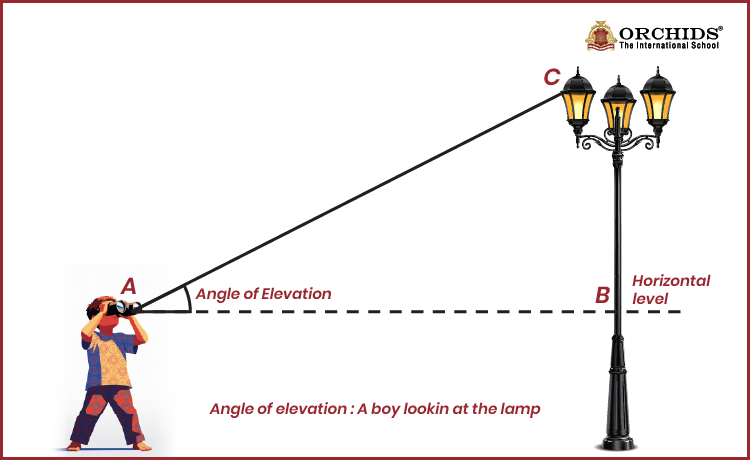
The concept rests on two foundational ideas the angle of elevation and the angle of depression.
Angle of Depression: When you look downward from a horizontal line to observe an object below you like a boat seen from a cliff the angle formed between the horizontal line and the downward line of sight is called the angle of depression.
One important fact worth knowing right away when two parallel horizontal lines are involved (the observer's eye level and the ground), the angle of elevation from below and the angle of depression from above are always equal. This equality comes from the property of alternate interior angles, and it is used constantly when solving problems.
Know more about related topics:
How to Find Heights and Distances
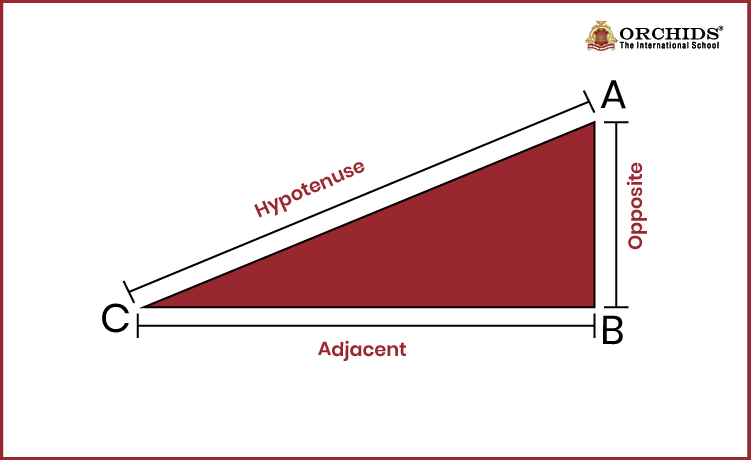
The method is rooted in right-angled triangles. Whenever you draw a diagram of a height and distance problem, a right triangle almost always appears naturally. One side represents the height (the object you want to measure), another represents the horizontal distance (how far away you are), and the angle between the horizontal ground and the line of sight becomes the key input.
The three sides of this triangle have specific names based on their position relative to the angle you are working with:
In most height and distance problems, tangent (tan θ) is the ratio of choice. That is because the two values you usually deal with the height of an object and the horizontal distance from it are the opposite and adjacent sides of the triangle. The hypotenuse (the slant line of sight) rarely features directly in basic problems unless the length of a rope, ladder, or incline is involved.
Here is a straightforward approach to solving any height and distance problem:
Step by Step Method
- Step 1: Draw the diagram. Sketch the situation. Mark the observer, the object, and the horizontal ground. A clean diagram prevents mistakes and makes the triangle visible.
- Step 2: Label the known values. Write the angle, height, or distance that the problem gives you directly on the diagram.
- Step 3: Identify the unknown. Decide what you need to find height, horizontal distance, or in some cases the length of the line of sight.
- Step 4: Choose the correct ratio. If you know height and want distance (or vice versa), use tan θ. If the slant length is involved, bring in sin or cos.
- Step 5: Solve for the unknown. Apply the formula, substitute the values, and simplify. Use standard angle values to avoid a calculator where possible.
Trigonometric Ratios of Standard Angles
Instead of calculating angles every time, mathematics provides a simple table of standard angles and their trigonometric ratios. These common angles andare used in most height and distance problems in school and exams. Learning and remembering these values makes solving problems much easier and faster.
| Ratio / Angle | 0° | 30° | 45° | 60° | 90° |
|---|---|---|---|---|---|
| sin θ | 0 | 1/2 | 1/√2 | √3/2 | 1 |
| cos θ | 1 | √3/2 | 1/√2 | 1/2 | 0 |
| tan θ | 0 | 1/√3 | 1 | √3 | Not defined |
| cosec θ | Not defined | 2 | √2 | 2/√3 | 1 |
| sec θ | 1 | 2/√3 | √2 | 2 | Not defined |
| cot θ | Not defined | √3 | 1 | 1/√3 | 0 |
Heights and Distances Formulas
Every height and distance problem fits into one of a few standard situations. Once you recognise the situation, the formula follows naturally. Below are the core formulas covering most cases you will face, from the simplest single angle problems to the more layered two-observer scenarios.
h = height of object, d = horizontal distance
Same formula angle of depression = angle of elevation
L = slant length (ladder, rope, incline)
Used when horizontal distance is unknown
Observer moves two angles from two positions
H = tower height, h = pole height, d = distance
This equality comes from alternate interior angles on parallel horizontals.
Heights and Distances Example Questions
Example 1: Finding the Height of a Tower
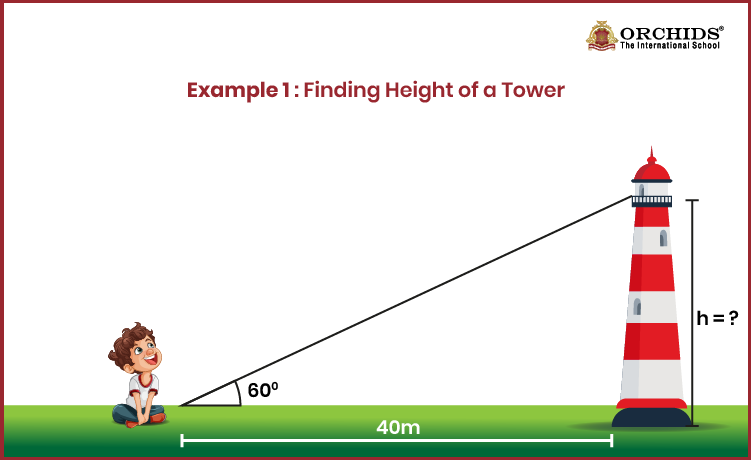
Question: From a point on the ground 40 m away from the base of a tower, the angle of elevation of the top of the tower is 60°. Find the height of the tower.
60° h = ? 40 m Point Tower
Solution:
tan 60° = h / 40
√3 = h / 40
h = 40√3
Height of the tower = 40√3 ≈ 69.28 m
Example 2 : Finding Distance Using Angle of Depression
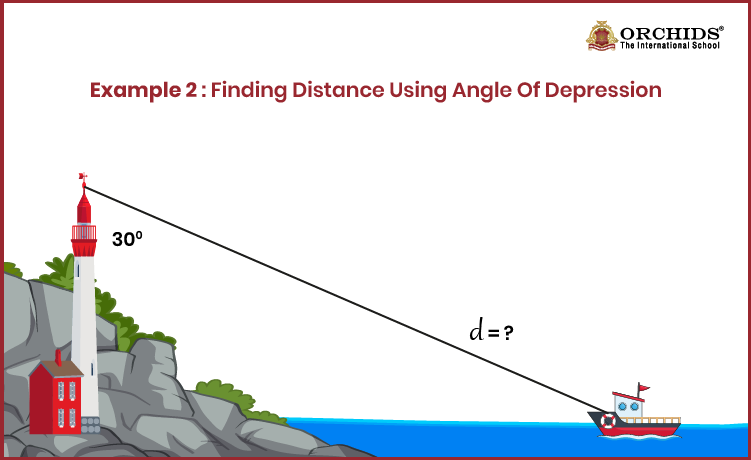
Question: From the top of a lighthouse 60 m high, the angle of depression of a ship at sea is 30°. Find the horizontal distance of the ship from the base of the lighthouse.
30° 60 m d = ? Lighthouse Ship
Solution: Using alternate angles, the angle of elevation from the ship = 30°.
tan 30° = 60 / d
1/√3 = 60 / d
d = 60√3
Horizontal distance of ship = 60√3 ≈ 103.92 m
Example 3 : Two Angles, Two Ships (Same Side)
.webp "Two Angles Two Ships (Same-Side)")
Question: From the top of a cliff 100 m high, the angles of depression of two ships on the same side of the cliff are 30° and 45°. Find the distance between the two ships.
Cliff 45° 30° 100 m Distance = ? Ship 1 Ship 2
For Ship 1 (θ = 45°): tan 45° = 100/d₁ ; d₁ = 100 m
For Ship 2 (θ = 30°): tan 30° = 100/d₂ ; d₂ = 100√3 m
Distance between ships = d₂ − d₁
= 100√3 − 100
= 100(√3 − 1)
Distance between the two ships = 100(√3 − 1) ≈ 73.2 m.
Heights and Distances Practice Problems
Working through problems on your own is the Easy way to build confidence with this topic. These practice questions cover the full range from direct single step problems to multi angle scenarios.
-
A flagpole stands vertically on the ground. From a point 20 m away, the angle of elevation of the top of the pole is 45°. Find the height of the flagpole. Hint: tan 45° = 1, so height equals horizontal distance directly.
-
The angle of elevation of the top of a tower from a point on the ground is 30°. On moving 20 m closer to the tower, the angle becomes 60°. Find the height of the tower. Hint: Set up two equations using tan 30° and tan 60°, then solve simultaneously.
-
A kite is flying at a height of 75 m above the ground. The string attached to the kite makes an angle of 45° with the horizontal. Find the length of the string. Use sin 45° = height / string length.
-
Two poles of equal height stand on opposite sides of a road that is 80 m wide. From a point between them on the road, the angles of elevation of the tops of the poles are 60° and 30°. Find the height of each pole and the position of the point on the road. Hint: Let the point divide the road into x and (80 − x). Form two tan equations and equate heights.
-
From the top of a 50 m tall building, the angles of depression of the top and bottom of another building are 30° and 60° respectively. Find the height of the second building and its horizontal distance from the first. Hint: Use angle of
Frequently Asked Questions on Height and Distance Problems In Trigonometry
1. Which trigonometric ratios are used in height and distance problems?
The main ratios used are sin θ, cos θ, and tan θ, depending on the given sides and angles.
2. What is the formula for height and distance in trigonometry?
The most commonly used formula is:
3. How to find distance using trigonometry?
Use the formula:when the height and angle are given.
4. What is the angle of elevation in trigonometry?
The angle of elevation is the angle formed when looking upward from the horizontal line to an object.
5. What is the angle of depression in trigonometry?
The angle of depression is the angle formed when looking downward from the horizontal line to an object.
6. Is angle of elevation equal to angle of depression?
Yes, both angles are equal because they are alternate interior angles.
Numbers make sense when they're taught right. To see how Orchids The International School turns Maths from intimidating to intuitive, reach out to our admissions team.


Admissions Open for 2026-27
What type of concept pages would you prefer?
CBSE Schools In Popular Cities
- CBSE Schools in Bangalore
- CBSE Schools in Mumbai
- CBSE Schools in Pune
- CBSE Schools in Hyderabad
- CBSE Schools in Chennai
- CBSE Schools in Gurgaon
- CBSE Schools in Kolkata
- CBSE Schools in Indore
- CBSE Schools in Sonipat
- CBSE Schools in Delhi
- CBSE Schools in Rohtak
- CBSE Schools in Bhopal
- CBSE Schools in Aurangabad
- CBSE Schools in Jabalpur
- CBSE Schools in Jaipur
- CBSE Schools in Jodhpur
- CBSE Schools in Nagpur
- CBSE Schools in Ahmednagar
- CBSE School In Tumkur











Orchids The International School is one of India's leading chains of CBSE and ICSE schools, with 130+ schools across the country.