

Area of Rhombus: Questions with Answers
Area of Rhombus: Questions with Answers is a useful topic for students who want to learn geometry in a simple way. Area of Rhombus helps you find the space inside a rhombus using easy formulas and clear steps. This topic is important because it builds a strong base in maths and improves problem solving skills. Students can practise different questions to understand how the formula works in real sums.
Area of Rhombus Formula
Formula Using Diagonals
Area = (d₁ × d₂) / 2
Where:
d₁ = first diagonal
d₂ = second diagonal
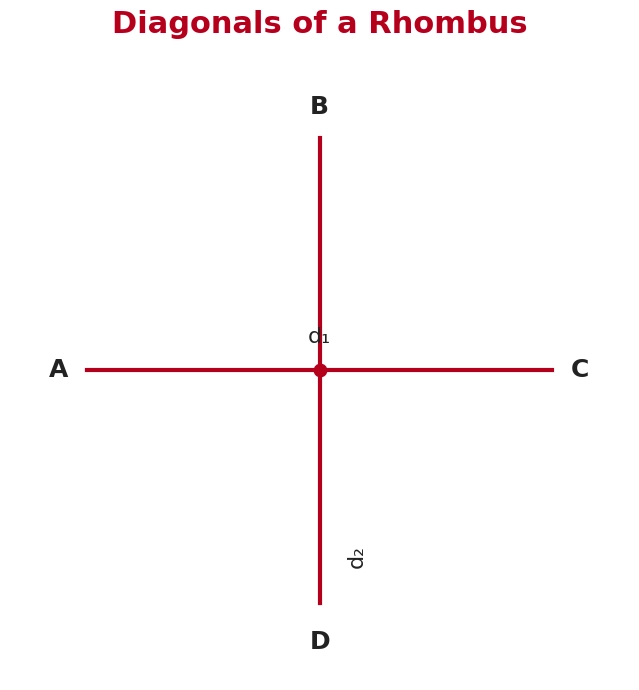
d₁ (horizontal diagonal)
d₂ (vertical diagonal)
Area = (AC × BD) / 2
Formula Using Base and Height
Area = Base × Height
Area = b × h
Where:
b = length of any side (base)
h = perpendicular height
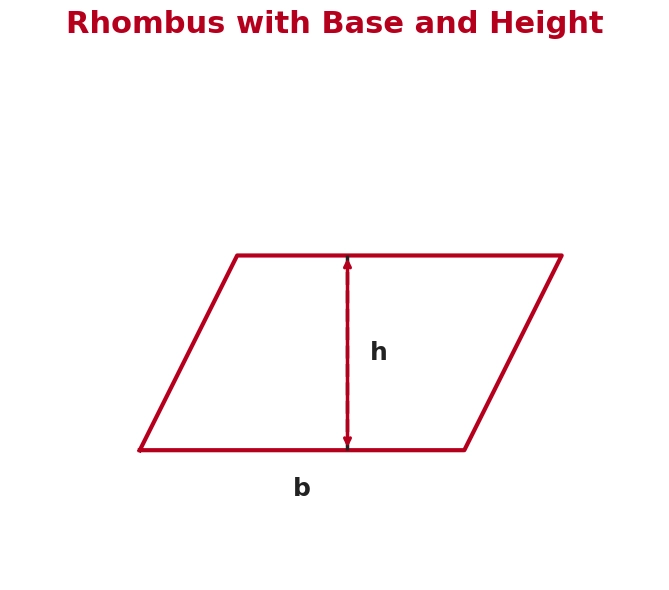
Area = b × h

Basic Area of Rhombus Questions
Find the Area Using Diagonals
Question 1: A rhombus has diagonals of length 8 cm and 6 cm. Find its area.
Given: d₁ = 8 cm, d₂ = 6 cm
Area = (d₁ × d₂) / 2
= (8 × 6) / 2
= 48 / 2
= 24 cm²
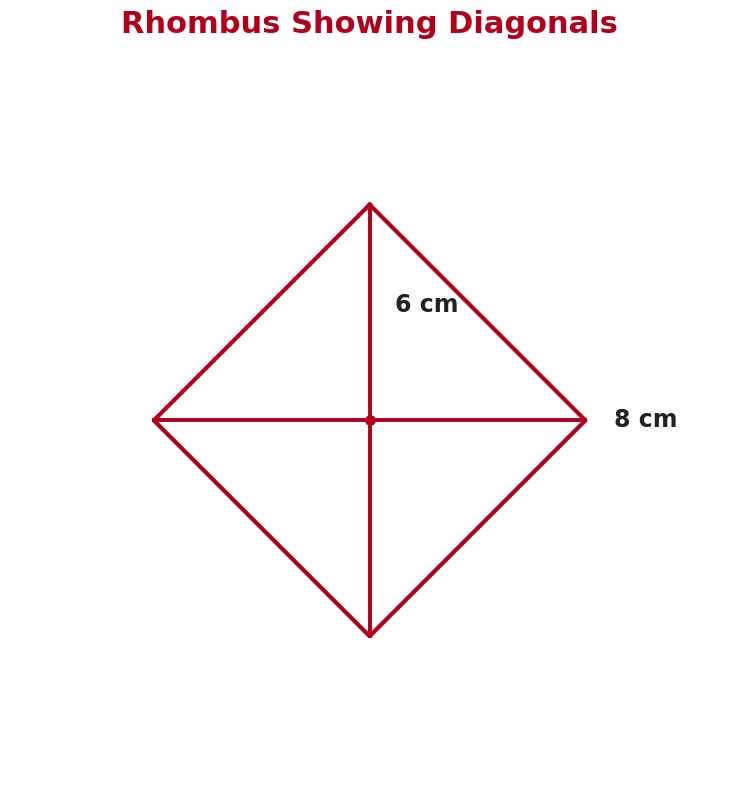
Answer: Area = 24 cm²
Question 2: Find the area of a rhombus with diagonals 14 cm and 10 cm.
Given: d₁ = 14 cm, d₂ = 10 cm
Area = (14 × 10) / 2
= 140 / 2
= 70 cm²
Answer: Area = 70 cm²
Question 3: The diagonals of a rhombus measure 20 m and 15 m. Find the area.
Given: d₁ = 20 m, d₂ = 15 m
Area = (20 × 15) / 2
= 300 / 2
= 150 m²
Answer: Area = 150 m²
Question 4: A rhombus has diagonals of 9 cm and 12 cm. Find its area.
Area = (9 × 12) / 2
= 108 / 2
= 54 cm²
Answer: Area = 54 cm²
Find the Area Using Base and Height
Question 5: A rhombus has a base of 7 cm and a height of 5 cm. Find its area.
Given: Base = 7 cm, Height = 5 cm
Area = Base × Height
= 7 × 5
= 35 cm²
Answer: Area = 35 cm²
Question 6: Find the area of a rhombus with base 12 m and perpendicular height 9 m.
Area = 12 × 9 = 108 m²
Answer: Area = 108 m²
Question 7: A rhombus-shaped tile has a base of 15 cm and height of 8 cm. Find its area.
Area = 15 × 8 = 120 cm²
Answer: Area = 120 cm²
Missing Measurement Questions
Question 8: The area of a rhombus is 60 cm² and one diagonal is 12 cm. Find the other diagonal.
Given: Area = 60 cm², d₁ = 12 cm, d₂ = ?
Area = (d₁ × d₂) / 2
60 = (12 × d₂) / 2
60 × 2 = 12 × d₂
120 = 12 × d₂
d₂ = 120 / 12
d₂ = 10 cm
Answer: Second diagonal = 10 cm
Question 9: A rhombus has an area of 96 m² and one diagonal of 16 m. Find the other diagonal.
96 = (16 × d₂) / 2
192 = 16 × d₂
d₂ = 192 / 16
d₂ = 12 m
Answer: d₂ = 12 m
Question 10: The area of a rhombus is 84 cm² and its base is 14 cm. Find the height.
Area = Base × Height
84 = 14 × h
h = 84 / 14
h = 6 cm
Answer: Height = 6 cm
Intermediate Area of Rhombus Questions
Word Problems
Question 11: A farmer has a rhombus-shaped field. The two diagonals of the field are 40 m and 30 m. Find the area of the field in square metres. If one bag of seeds covers 50 m², how many bags are needed?
Step 1: Find area of field
Area = (40 × 30) / 2 = 1200 / 2 = 600 m²
Step 2: Find number of seed bags
Bags = 600 / 50 = 12 bags
Answer: Area = 600 m², Bags needed = 12
Question 12: A kite-shaped decoration is made in the form of a rhombus. Its diagonals are 36 cm and 24 cm. Find the area of the decoration.
Area = (36 × 24) / 2
= 864 / 2
= 432 cm²
Answer: Area = 432 cm²
Question 13: A rhombus-shaped floor tile has a base of 20 cm and a height of 18 cm. How many tiles are needed to cover a floor of area 72,000 cm²?
Step 1: Area of one tile
Area = 20 × 18 = 360 cm²
Step 2: Number of tiles
= 72,000 / 360 = 200 tiles
Answer: 200 tiles needed
Unit Conversion Questions
Question 14: A rhombus has diagonals of 2 m and 1.5 m. Find the area in cm².
Step 1: Convert to cm
d₁ = 2 m = 200 cm
d₂ = 1.5 m = 150 cm
Step 2: Calculate area
Area = (200 × 150) / 2
= 30,000 / 2
= 15,000 cm²
Answer: Area = 15,000 cm²
Question 15: A rhombus has a base of 50 mm and height of 40 mm. Express the area in cm².
Step 1: Convert mm to cm
Base = 50 mm = 5 cm
Height = 40 mm = 4 cm
Step 2: Find area
Area = 5 × 4 = 20 cm²
Answer: Area = 20 cm²
Multi-Step Problems
Question 16: Two rhombuses have the same area of 120 cm². The first has diagonals 20 cm and 12 cm. The second has one diagonal of 15 cm. Find the other diagonal of the second rhombus.
Verify first rhombus:
Area = (20 × 12) / 2 = 120 cm²
Second rhombus:
120 = (15 × d₂) / 2
240 = 15 × d₂
d₂ = 16 cm
Answer: Second diagonal = 16 cm
Question 17: A rhombus has diagonals in the ratio 3:4. If the area is 216 cm², find both diagonals.
Let d₁ = 3x and d₂ = 4x
Area = (d₁ × d₂) / 2
216 = (3x × 4x) / 2
216 = 12x² / 2
216 = 6x²
x² = 36
x = 6
d₁ = 3 × 6 = 18 cm
d₂ = 4 × 6 = 24 cm
Verification: (18 × 24)/2 = 432/2 = 216
Answer: d₁ = 18 cm, d₂ = 24 cm
Challenging Area of Rhombus Questions
Application-Based Questions
Question 18: A rhombus-shaped garden has diagonals of 18 m and 12 m. A path of 1 m width runs along the border (perimeter). If each side of the rhombus is 10.82 m, find the area of only the garden (excluding the path).
Step 1: Area of full rhombus (garden + path)
Area = (18 × 12) / 2 = 108 m²
Step 2: For this problem, we use the inner area.
Since path is 1 m wide on all sides:
Inner diagonals = (18 − 2) and (12 − 2) = 16 m and 10 m
(path reduces each half-diagonal by 1)
Inner area = (16 × 10) / 2 = 80 m²
Path area = 108 − 80 = 28 m²
Answer: Garden area (without path) = 80 m²
Question 19: The diagonals of a rhombus are in the ratio 5:12. The perimeter of the rhombus is 104 cm. Find the area.
Perimeter = 4 × side = 104
Side = 26 cm
Let diagonals be 5k and 12k.
Each half-diagonal: 5k/2 and 12k/2
Using Pythagoras (side of rhombus):
(5k/2)² + (12k/2)² = 26²
25k²/4 + 144k²/4 = 676
169k²/4 = 676
k² = 676 × 4/169 = 16
k = 4
d₁ = 5 × 4 = 20 cm
d₂ = 12 × 4 = 48 cm
Area = (20 × 48) / 2 = 960 / 2 = 480 cm²
Answer: Area = 480 cm²
Higher-Order Thinking (HOTS)
Question 20: A rhombus is cut from a rectangle of dimensions 30 cm × 20 cm. The rhombus has diagonals equal to the length and width of the rectangle. Find the area of the remaining pieces.
Area of rectangle = 30 × 20 = 600 cm²
Area of rhombus = (30 × 20) / 2 = 300 cm²
Remaining area = 600 − 300 = 300 cm²
Remaining pieces = 4 corner triangles
Answer: Remaining area = 300 cm²
Question 21: Two congruent rhombuses are placed side by side sharing one side. If each rhombus has diagonals of 10 cm and 8 cm, what is the total area of the combined figure?
Area of one rhombus = (10 × 8) / 2 = 40 cm²
Total area = 2 × 40 = 80 cm²
(The shapes share a side but each has its own area)
Answer: Total area = 80 cm²
Mixed Geometry Problems
Question 22: A rhombus and a triangle have the same area. The rhombus has diagonals 16 cm and 12 cm. The triangle has base 24 cm. Find the height of the triangle.
Area of rhombus = (16 × 12) / 2 = 96 cm²
Triangle area = (1/2) × base × height
96 = (1/2) × 24 × h
96 = 12h
h = 8 cm
Answer: Height of triangle = 8 cm
Area of Rhombus MCQs
Easy MCQs
Q1: A rhombus has diagonals 6 cm and 8 cm. Its area is:
a) 48 cm² b) 24 cm² c) 14 cm² d) 96 cm²
Answer: b) 24 cm²
Solution: (6 × 8)/2 = 24
Q2: Area of rhombus formula using diagonals is:
a) d₁ + d₂ b) d₁ × d₂ c) (d₁ × d₂)/2 d) 2(d₁ + d₂)
Answer: c) (d₁ × d₂)/2
Q3: A rhombus with base 9 cm and height 4 cm has area:
a) 13 cm² b) 36 cm² c) 18 cm² d) 26 cm²
Answer: b) 36 cm²
Solution: 9 × 4 = 36
Q4: If d₁ = 10 and d₂ = 10, the area of the rhombus is:
a) 50 b) 100 c) 20 d) 25
Answer: a) 50
Solution: (10 × 10)/2 = 50
Moderate MCQs
Q5: Area of rhombus is 150 cm². One diagonal is 25 cm. The other diagonal is:
a) 10 cm b) 15 cm c) 12 cm d) 6 cm
Answer: c) 12 cm
Solution: 150 = (25 × d₂)/2 → d₂ = 12
Q6: A rhombus has diagonals in ratio 3:4 and area 96 cm². The longer diagonal is:
a) 12 cm b) 16 cm c) 8 cm d) 18 cm
Answer: b) 16 cm
Solution: (3x)(4x)/2 = 96 → x²= 16 → x=4
Longer = 4×4 = 16
Q7: Which rhombus has the greatest area?
a) d₁=10, d₂=8 b) d₁=12, d₂=6 c) d₁=9, d₂=9 d) d₁=15, d₂=5
Area a = (10×8)/2 = 40
Area b = (12×6)/2 = 36
Area c = (9×9)/2 = 40.5
Area d = (15×5)/2 = 37.5
Answer: c) d₁=9, d₂=9 has area 40.5 cm²
Q8: The perimeter of a rhombus is 40 cm. Its height is 6 cm. The area is:
a) 240 cm² b) 60 cm² c) 120 cm² d) 30 cm²
Answer: b) 60 cm²
Solution: Side = 40/4 = 10 cm; Area = 10 × 6 = 60
Q9: A rhombus has one diagonal double the other. If area = 100 cm², the diagonals are:
a) 5, 10 b) 10, 20 c) 8, 16 d) 20, 40
Let d₁ = x, d₂ = 2x
(x × 2x)/2 = 100
2x²/2 = 100
x² = 100
x = 10
Answer: b) 10 cm and 20 cm
Q10: If each diagonal of a rhombus is increased by 50%, the area increases by:
a) 50% b) 100% c) 125% d) 150%
Original area = (d₁ × d₂)/2
New diagonals = 1.5d₁ and 1.5d₂
New area = (1.5d₁ × 1.5d₂)/2 = 2.25 × original
Increase = 125%
Answer: c) 125%
Area of Rhombus Worksheet Questions
Fill in the Blanks
Q1: Area of rhombus = (_____ × _____) / 2
Answer: d₁ × d₂
Q2: If diagonals are 10 cm and 8 cm, area = _____ cm²
Answer: 40 cm²
Q3: Area = Base × _____
Answer: Height
Q4: If area = 72 cm² and one diagonal = 9 cm, other diagonal = _____ cm
Answer: 16 cm
Q5: A rhombus with base 11 cm and height 5 cm has area _____ cm²
Answer: 55 cm²
Q6: Total outcomes formula when finding area
with base and height: Area = b × ___
Answer: h
Q7: If both diagonals of a rhombus equal 6 cm,
area = _____ cm²
Answer: 18 cm²
Q8: The unit of area is always in _____ units.
Answer: square
Short Answer Questions
Q9: Find the area of a rhombus with diagonals 22 cm and 18 cm.
Area = (22 × 18)/2 = 396/2 = 198 cm²
Q10: A rhombus has base 13 cm and height 7 cm. Find its area.
Area = 13 × 7 = 91 cm²
Q11: The area of a rhombus is 144 cm². Both diagonals are equal. Find each diagonal.
(d × d)/2 = 144
d² = 288
d = √288 = 12√2 ≈ 16.97 cm
Q12: How does the area change if one diagonal is doubled and the other remains the same?
Original area = (d₁ × d₂)/2
New area = (2d₁ × d₂)/2 = d₁ × d₂ = 2 × original
Answer: Area doubles
Long Answer Questions
Q13: A rhombus-shaped plot has diagonals of 50 m and 40 m. The owner wants to: a) Find the total area b) Fence the plot (each side = 32 m, cost = ₹25 per m) c) Grass the entire area (cost = ₹15 per m²)
a) Area = (50 × 40)/2 = 1000 m²
b) Perimeter = 4 × 32 = 128 m
Fencing cost = 128 × 25 = ₹3,200
c) Grassing cost = 1000 × 15 = ₹15,000
Total cost = 3,200 + 15,000 = ₹18,200
Q14: Compare two rhombuses:
-
Rhombus A: diagonals 24 cm and 10 cm
-
Rhombus B: base 15 cm, height 8 cm
Which has the greater area? By how much?
Area of Rhombus A = (24 × 10)/2 = 120 cm²
Area of Rhombus B = 15 × 8 = 120 cm²
Both have EQUAL area.
Difference = 0 cm²
Download PDF - Area of Rhombus Questions
Read More About:
Frequently Asked Questions on Area of Rhombus Questions
1. What is the formula for the area of a rhombus?
The area of a rhombus is calculated by multiplying its diagonals and dividing the result by 2.
2. How do you find the area of a rhombus?
You can find the area using either the diagonals or the base and perpendicular height, depending on the information given.
3. Can you find the area of a rhombus using the side length?
No. The side length alone is not enough. You also need the height or the diagonals to calculate the area.
4. What is the area of a rhombus with diagonals 10 cm and 12 cm?
The area is 60 cm².
5. What is the area of a rhombus with base 8 cm and height 6 cm?
The area is 48 cm².
6. What are the units used to measure the area of a rhombus?
The area is measured in square units, such as cm², m², or km².
7. Where is the area of a rhombus used in real life?
The area of a rhombus is used in architecture, construction, floor tiling, engineering, art, and design to measure rhombus-shaped surfaces.
Numbers make sense when they're taught right. To see how Orchids The International School turns Maths from intimidating to intuitive, reach out to our admissions team.


Admissions Open for 2026-27
What type of concept pages would you prefer?
CBSE Schools In Popular Cities
- CBSE Schools in Bangalore
- CBSE Schools in Mumbai
- CBSE Schools in Pune
- CBSE Schools in Hyderabad
- CBSE Schools in Chennai
- CBSE Schools in Gurgaon
- CBSE Schools in Kolkata
- CBSE Schools in Indore
- CBSE Schools in Sonipat
- CBSE Schools in Delhi
- CBSE Schools in Rohtak
- CBSE Schools in Bhopal
- CBSE Schools in Aurangabad
- CBSE Schools in Jabalpur
- CBSE Schools in Jaipur
- CBSE Schools in Jodhpur
- CBSE Schools in Nagpur
- CBSE Schools in Ahmednagar
- CBSE School In Tumkur











Orchids The International School is one of India's leading chains of CBSE and ICSE schools, with 130+ schools across the country.