

Area of a Semicircle: Formula, Derivation, Solved Examples & Practice Questions
A semicircle is half of a circle, so its area is half the area of a complete circle. Knowing how to find the area of a semicircle is useful in geometry and in everyday situations such as measuring gardens, arches, windows, and playgrounds.
In this article, you will learn the formula for the area of a semicircle, understand how it is derived, follow simple steps to solve problems, and practise with solved examples and questions to strengthen your understanding.
Table of Contents
- What is the Area of a Semicircle?
- Area of a Semicircle Formula
- Derivation of Area of a Semicircle Formula
- How to Find the Area of a Semicircle?
- Solved Examples on Area of a Semicircle
- Practice Questions on Area of a Semicircle
- Frequently Asked Questions on Area of a Semicircle

What is the Area of a Semicircle?
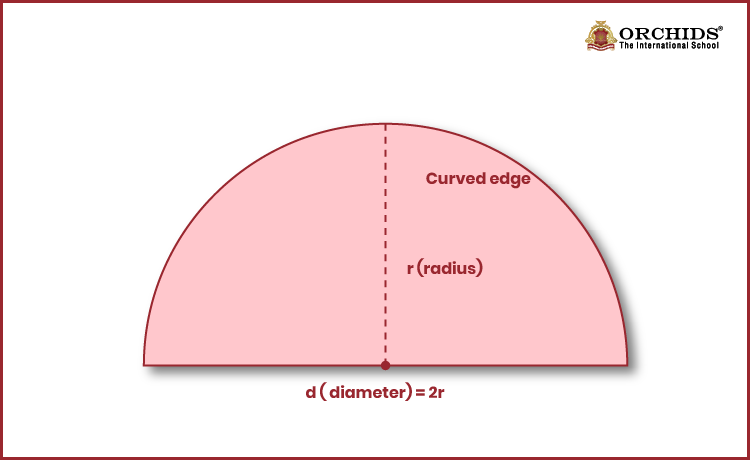
when you look at a semicircle's area, you just trying to figure out how much space is really inside that half circle. You cut a pizza right down the middle, and now you have two semicircles on your hands. The area's what actually tells you the size of each piece. Here's the thing, though, a semicircle isn't the same as a full circle. You got one side that curves nicely, and then one side that's completely flat, which we call the diameter. You actually see this shape everywhere in real life, from semicircular decks that need painting to gardens you're planning to plant. The bottom line is that we always measure area in square units. If you start with meters, you get square meters back as your answer.
Area of a Semicircle Formula
The formula for finding the area of a semicircle is actually quite simple once you understand it. Since a semicircle is half of a circle, you take the circle formula and divide it by two.
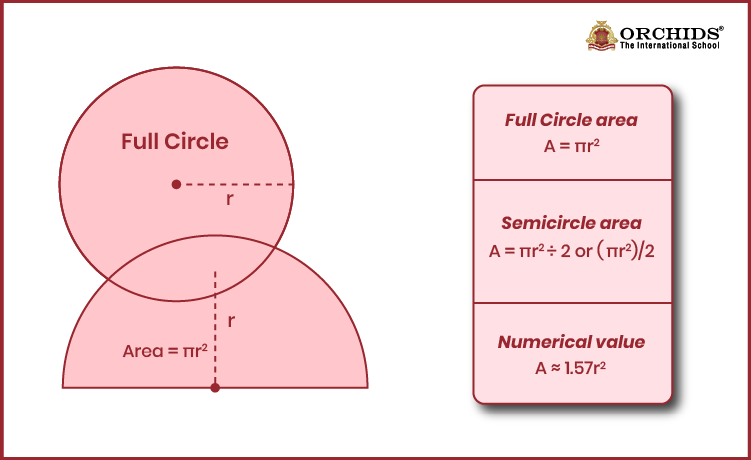
The formula is: Area = πr² ÷ 2
π (pi) is a special number that comes up whenever you work with circles. It's about 3.14, but sometimes people use 22/7 as a fraction instead. You'll find it on most calculators, and using 3.14 works fine for most situations.
r stands for radius. The radius is the distance from the very center point to the curved edge. It's always half of the diameter (the straight line across the widest part).
r² means you multiply the radius by itself. So if your radius is 5, you'd calculate 5 times 5, which equals 25.
÷ 2 is the division by two, which represents that we're only dealing with half a circle, not a whole one.
You might see this formula written in different ways, and they all mean the same thing:
- Area = πr² ÷ 2
- Area = (πr²)/2
- Area = 0.5 × πr²
- Area ≈ 1.57 × r² (since π/2 equals about 1.57)
Derivation of Area of a Semicircle Formula
Understanding where this formula comes from makes it stick in your mind much better than just memorizing it. The good news is that the derivation is really straightforward and doesn't require anything complicated.
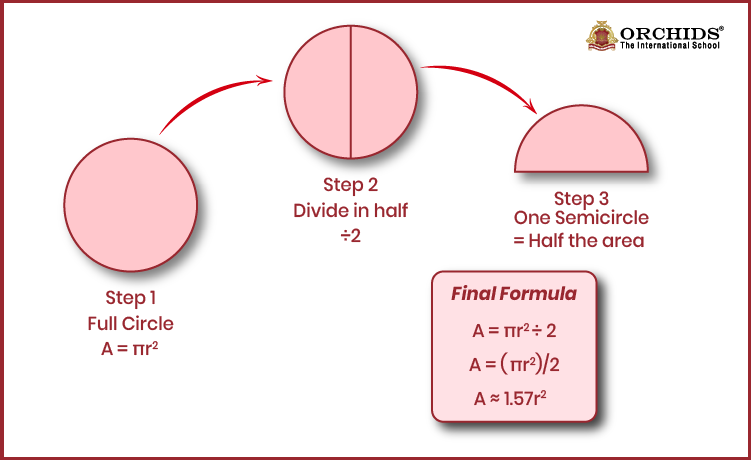
Step 1: The Full Circle Formula
We start with something everyone learns about circles: the area of a circle is πr². This formula has been around for thousands of years and is the foundation for everything we do with semicircles. Every circle, no matter how big or small, uses this same formula.
Step 2: What Makes a Semicircle
A semicircle happens when you take a circle and cut it perfectly in half. You do this by drawing a straight line through the center of the circle. That line is called the diameter. When you cut along this line, you get two identical pieces, and each piece is a semicircle.
Step 3: Simple Division
Here's the key insight: since you've cut the circle into two equal parts, each part must have exactly half the area of the original circle. So if the whole circle has area πr², then one semicircle has area = πr² ÷ 2.
Step 4: Different Ways to Write It
Once you have πr² ÷ 2, you can write it in whatever way makes most sense for your situation:
- Keep it as a fraction: (πr²)/2
- Write it as multiplication: 0.5 × πr²
- Use a decimal: 1.57 × r²
- Leave π in the answer: (πr²)/2
How to Find the Area of a Semicircle?
Finding the area of a semicircle is straightforward when you follow a simple process. Here's the practical method:
- Identify the radius: The radius is the distance from the centre of the semicircle to the curved edge. Sometimes you're given the radius directly, and sometimes you need to find it from other measurements. If you have the diameter (the straight line across the full width), simply divide it by 2 to get the radius.
- Square the radius: Multiply the radius by itself. For example, if your radius is 5 cm, then r² = 5 × 5 = 25 cm².
- Multiply by π: Take your squared radius and multiply it by pi (π ≈ 3.14). Using our example: 25 × 3.14 = 78.5
- Divide by 2: Finally, divide your result by 2 to account for the semicircle being half a circle. In our example: 78.5 ÷ 2 = 39.25 cm²
Different Values of π:
- Using π = 3.14: This is the most practical for everyday calculations
- Using π = 3.14159: This gives more precision
- Using π = 22/7: This fractional approach works well when you're working with fractions
Also use: Semicircle Area Calculator
Solved Examples on Area of a Semicircle
Example 1: Finding area with a given radius
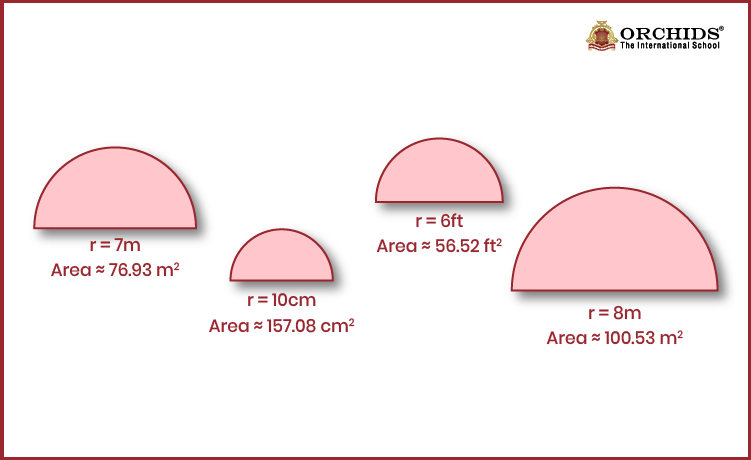
Problem: A semicircular garden has a radius of 7 meters. What is its area?
Solution: Given: r = 7 m
Step 1: Square the radius r² = 7 × 7 = 49 m²
Step 2: Multiply by π 49 × 3.14 = 153.86 m²
Step 3: Divide by 2 153.86 ÷ 2 = 76.93 m²
The area of the semicircular garden is approximately 76.93 square meters.
Example 2: Using a fractional radius
Problem: Find the area of a semicircle with radius 10 cm.
Solution: Given: r = 10 cm
Step 1: r² = 10 × 10 = 100 cm²
Step 2: 100 × π = 100π cm² (we can leave it in terms of π for exactness)
Step 3: (100π) ÷ 2 = 50π cm²
If we use π ≈ 3.14159: 50 × 3.14159 = 157.08 cm²
The exact answer is 50π cm², and the approximate decimal value is 157.08 cm².
Example 3: Finding area from diameter
Problem: A semicircular arch has a diameter of 12 feet. Calculate its area.
Solution: Given: d = 12 feet, so r = 12 ÷ 2 = 6 feet
Step 1: r² = 6 × 6 = 36 ft²
Step 2: 36 × 3.14 = 113.04 ft²
Step 3: 113.04 ÷ 2 = 56.52 ft²
The area of the semicircular arch is 56.52 square feet.
Example 4: Real world application
Problem: A semi-circular swimming pool has a radius of 8 meters. How much pool surface area needs to be covered with a shade?
Solution: Given: r = 8 m
Step 1: r² = 8 × 8 = 64 m²
Step 2: 64 × 3.14159 = 201.06 m²
Step 3: 201.06 ÷ 2 = 100.53 m²
The pool owner needs shade material to cover approximately 100.53 square meters of the pool surface.
Practice Questions on Area of a Semicircle
Try solving these problems. Work through each one carefully, and check your answers afterward.
1. A semicircular piece of cardboard has a radius of 5 inches. What is its area?
Hint: Use the formula with radius = 5 inches.
2. The diameter of a semicircular mat is 12 feet. Calculate the area of the mat.
Hint: Remember to divide the diameter by 2 first to get the radius.
3. You're building a semicircular deck with a radius of 10 meters. How many square meters of deck are you building?
Hint: Follow the four steps: square the radius, multiply by π, divide by 2.
4. A semicircular garden path has an area of 24.5 square meters. What is the radius of this path?
Hint: Work backwards from the area. Multiply by 2, divide by π, then find the square root.
5. Compare two semicircular tables. One has a radius of 4 feet, and the other has a radius of 6 feet. What is the difference in their areas?
Hint: Calculate the area of each table separately, then subtract.
Frequently Asked Questions on Area of a Semicircle
1. What is the formula for the area of a semicircle?
A semicircle is half of a full circle, so:
where r is the radius.
2. How do I find the area if I only have the diameter?
The radius is half the diameter:
d = r/2
Substitute into the area formula:
3. How is this different from finding the perimeter?
The perimeter includes:
-
Half the circumference of the circle
-
The straight line (diameter)
Perimeter = πr + 2r
or in terms of diameter:
4. What units should I use?
-
Area: square units (e.g., cm², m²)
-
Perimeter: linear units (e.g., cm, m)
Always use the same unit given in the problem.
5. Difference between area and perimeter?
-
Area measures how much space is inside the semicircle
- Perimeter measures the distance around the edge (curved part + straight diameter)
Numbers make sense when they're taught right. To see how Orchids The International School turns Maths from intimidating to intuitive, reach out to our admissions team.


Admissions Open for 2026-27
What type of concept pages would you prefer?
CBSE Schools In Popular Cities
- CBSE Schools in Bangalore
- CBSE Schools in Mumbai
- CBSE Schools in Pune
- CBSE Schools in Hyderabad
- CBSE Schools in Chennai
- CBSE Schools in Gurgaon
- CBSE Schools in Kolkata
- CBSE Schools in Indore
- CBSE Schools in Sonipat
- CBSE Schools in Delhi
- CBSE Schools in Rohtak
- CBSE Schools in Bhopal
- CBSE Schools in Aurangabad
- CBSE Schools in Jabalpur
- CBSE Schools in Jaipur
- CBSE Schools in Jodhpur
- CBSE Schools in Nagpur
- CBSE Schools in Ahmednagar
- CBSE School In Tumkur











Orchids The International School is one of India's leading chains of CBSE and ICSE schools, with 130+ schools across the country.