

Area of Sector of a Circle
The area of a sector in a circle measures the region covered inside its boundaries. Every sector starts right from the circle's center. Now, let's explore the area of sector formula and how to calculate it using radians or degrees.
Table of Contents
- What is a Sector of a Circle?
- Area of Sector Formula Derivation
- Area of Sector in Degrees
- Area of Sector in Radians
- Real Life Examples of Area of Sector
- Solved Examples on Area of Sector of a Circle
What is a Sector of a Circle?
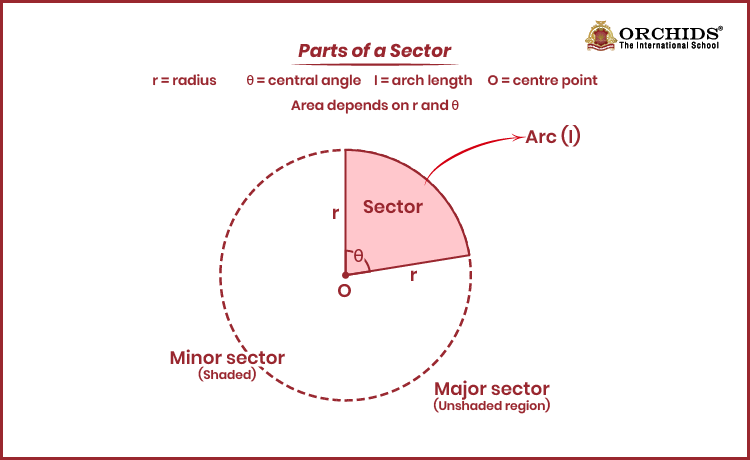
A sector of a circle is the region enclosed between two radii and the arc that connects them. The simplest way to picture it is a slice of pizza or a piece of pie. It has two straight edges that meet at the centre of the circle, and one curved edge on the outside.
Every sector has three key parts. The two radii are the straight sides. The arc is the curved boundary on the outside. The central angle is the angle formed at the centre between the two radii. The size of the sector depends entirely on how large that central angle. A minor sector is the smaller region formed when the central angle is less than 180°. A major sector is the larger region formed when the central angle is greater than 180°. Together, the minor and major sectors always make up the full circle. A semicircle is a special case where the central angle is exactly 180°, dividing the circle into two equal halves. A quadrant is another special case where the central angle is exactly 90°, giving exactly one quarter of the full circle.
When the central angle is 360°, the sector covers the entire circle. So the area of a full circle is simply a special case of the sector area formula with θ = 360°.
Know more about related topics:
Area of Sector Formula Derivation
The formula for the area of a sector is not something to memorise without understanding. It comes directly from comparing the sector to the full circle using proportion.
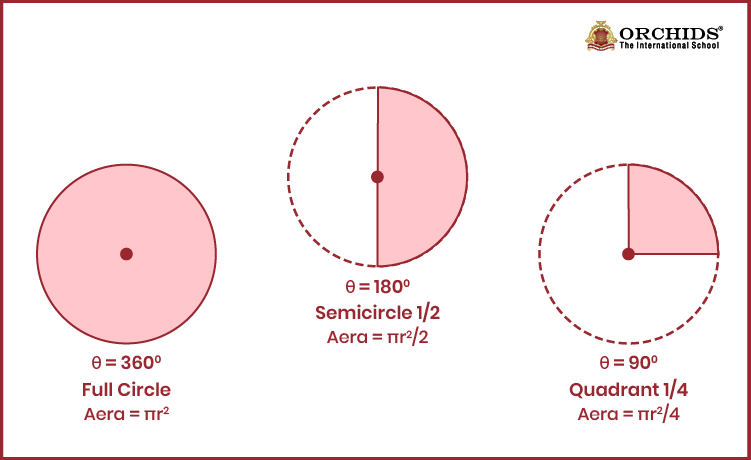
A full circle has a central angle of 360° and a total area of πr². A sector is just a fraction of that full circle. The fraction it occupies is equal to its central angle θ divided by 360°.
So if the sector's angle is θ degrees, the fraction of the circle it covers is θ divided by 360. Multiplying this fraction by the full circle area gives the sector area.
Area of Sector = (θ ÷ 360) × πr²
The core idea is simple. A sector is a proportional part of the full circle. If the angle is 90°, it is one quarter of the circle, so the area is one quarter of πr². If the angle is 180°, it is half the circle, so the area is half of πr². The formula captures this proportion in one clean expression.
Deriving Area Using Arc Length:
- The arc length of a sector is given by l = (θ/360°) × 2πr. Since the area formula also contains the factor θ/360°, you can substitute and simplify.
- Starting from Area = (θ/360°) × πr², replace (θ/360°) with l divided by 2πr. This gives Area = (l ÷ 2πr) × πr². The πr simplifies, leaving Area = (l × r) ÷ 2.
- So Area of Sector = half of arc length multiplied by radius. This form is especially useful when you are given the arc length directly rather than the angle.
Area of Sector in Degrees
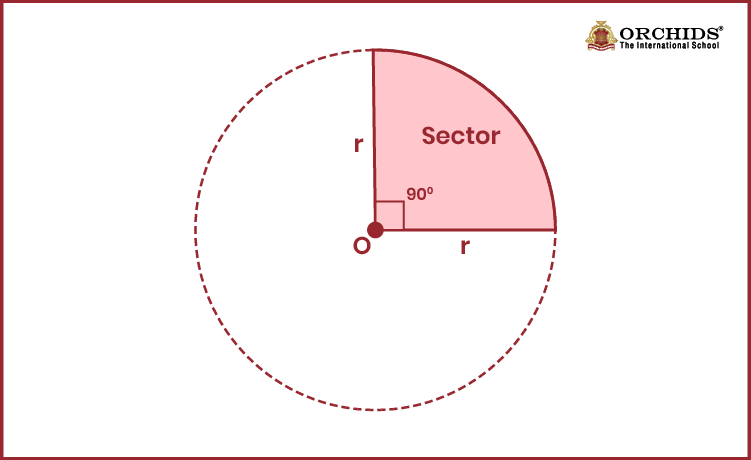
When the central angle is given in degrees, the formula uses 360° as the base since a full circle spans 360 degrees. This is the most common form used in school level problems.
Area = (θ ÷ 360°) × πr²
where θ is the central angle in degrees and r is the radius of the circle.
Checking the formula makes sense:
- When θ = 360°, the formula gives (360/360) × πr² = πr², which is the full circle area. Correct.
- When θ = 180°, the formula gives (180/360) × πr² = πr²/2, which is exactly half the circle. Correct.
- When θ = 90°, the result is πr²/4, which is one quarter of the circle. Correct.
- The area is always in square units. If the radius is in centimetres, the area is in square centimetres. If the radius is in metres, the area is in square metres.
Also use: Sector Area Calculator
Area of Sector in Radians
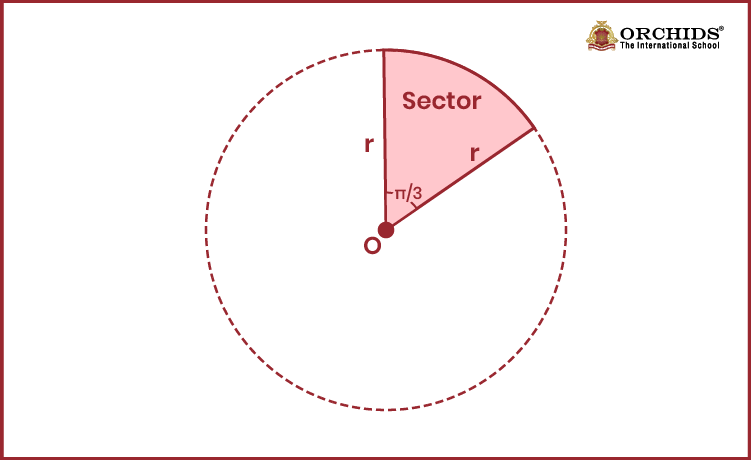
In higher mathematics and engineering, angles are measured in radians rather than degrees. One full circle equals 2π radians, which corresponds to 360°. When the central angle is in radians, the formula becomes simpler.
Area = (1/2) × r² × θ
where θ is the central angle in radians and r is the radius.
How this formula is derived:
- In the degree formula, replace 360° with 2π because a full circle is 2π radians.
- Area = (θ ÷ 2π) × πr²
- The π in the numerator and denominator cancel partially, giving:
- Area = (θ × r²) ÷ 2 = (1/2) × r² × θ
Comparing both formulas side by side:
- When the angle is in degrees, use Area = (θ/360) × πr². When the angle is in radians, use Area = (1/2) × r² × θ.
- The radian form is cleaner because the 2π in the denominator cancels with the π in πr², leaving no π in the final expression. This is why radians are preferred in calculus and advanced mathematics.
- To convert degrees to radians, multiply by π/180. To convert radians to degrees, multiply by 180/π.
- When θ = 2π in the radian formula, the area becomes (1/2) × r² × 2π = πr², which correctly equals the full circle area.
Real Life Examples of Area of Sector
Pizza Slice: Each slice of a pizza cut into equal pieces is a sector. If a pizza is cut into 8 equal slices, each slice has a central angle of 45° and its area is one eighth of the total pizza area.
Clock Hands: The region swept by the minute hand of a clock between two time points forms a sector. The angle swept in 15 minutes is 90°, covering exactly one quarter of the clock face area.
Umbrella Panel: Each fabric panel of an umbrella is shaped like a sector. Knowing the sector area helps manufacturers calculate how much fabric is needed to produce each panel.
Radar Coverage: The area covered by a radar or signal tower in a particular direction is modelled as a sector. Engineers use the sector area formula to calculate the coverage zone of the signal.
Sprinkler Systems: A garden sprinkler that rotates through a fixed angle waters a sector shaped region. The sector area formula tells the gardener exactly how much land is being irrigated.
Pie Charts: Each segment in a pie chart is a sector of a circle. The central angle of each sector is proportional to the data it represents, and its area reflects that proportion visually.
Solved Examples on Area of Sector of a Circle
Example 1: Area Using Degree Formula
Question: Find the area of a sector with radius 7 cm and central angle 60°. Use π = 22/7.
Solution: The formula is Area = (θ/360°) × πr².
Substituting θ = 60°, r = 7 cm:
- Area = (60/360) × (22/7) × 7²
- = (1/6) × (22/7) × 49
- = (1/6) × 22 × 7
- = (1/6) × 154
- = 25.67 cm²
Example 2: Area Using Radian Formula
Question: Find the area of a sector with radius 10 cm and central angle π/3 radians.
Solution:
- The formula is Area = (1/2) × r² × θ.
- Substituting r = 10 cm, θ = π/3:
- Area = (1/2) × 100 × (π/3)
- = 50π/3
- = 52.36 cm²
Example 3: Finding Radius from Area
Question: The area of a sector is 77 cm² and the central angle is 90°. Find the radius. Use π = 22/7.
Solution:
- Substituting into Area = (θ/360°) × πr²:
- 77 = (90/360) × (22/7) × r²
- 77 = (1/4) × (22/7) × r²
- 77 = (11/14) × r²
- r² = 77 × (14/11) = 7 × 14 = 98
- r = √98 = 7√2 ≈ 9.9 cm
Example 4: Area Using Arc Length
Question: The arc length of a sector is 12 cm and the radius is 5 cm. Find the area.
Solution:
- Using Area = (1/2) × arc length × radius:
- Area = (1/2) × 12 × 5 = (1/2) × 60 = 30 cm²
Example 5: Finding Central Angle from Area
Question: The area of a sector with radius 14 cm is 102.67 cm². Find the central angle. Use π = 22/7.
Solution:
- Substituting into Area = (θ/360°) × πr²:
- 102.67 = (θ/360) × (22/7) × 196
- 102.67 = (θ/360) × 616
- θ/360 = 102.67/616 = 0.1667
- θ = 0.1667 × 360 = 60°
Example 6: Real Life Application
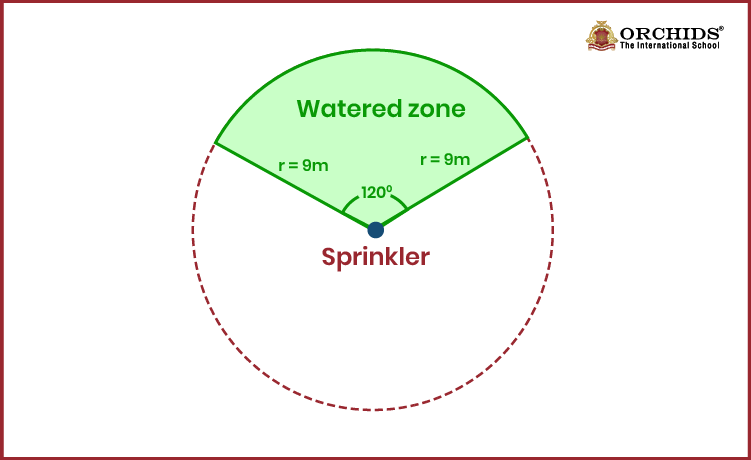
Question: A sprinkler rotates through 120° and waters a region up to 9 metres. Find the area watered. Use π = 3.14.
Solution:
The watered region is a sector with r = 9 m, θ = 120°.
Area = (120/360) × 3.14 × 9²
= (1/3) × 3.14 × 81
= (1/3) × 254.34
= 84.78 m²
Frequently Asked Questions on Area of Sector of a Circle
1. What is a sector of a circle?
A sector is a portion of a circle bounded by:
- two radii, and
- the arc between them
2. What is the formula for the area of a sector?
-
When angle is in degrees:
Area=θ360∘×πr2
-
When angle is in radians:
Area=12r2θ
3. Why do we divide by 360° in the formula?
Because a full circle is 360°, so a sector represents a fraction of the whole circle.
4. What is the difference between sector and segment?
-
Sector: region between two radii and an arc
-
Segment: region between a chord and an arc
Sector is always larger than the corresponding segment.
5. What happens when θ = 360°?
The sector becomes the whole circle:
Area=πr2
Related Links


CBSE Schools In Popular Cities
- CBSE Schools in Bangalore
- CBSE Schools in Mumbai
- CBSE Schools in Pune
- CBSE Schools in Hyderabad
- CBSE Schools in Chennai
- CBSE Schools in Gurgaon
- CBSE Schools in Kolkata
- CBSE Schools in Indore
- CBSE Schools in Sonipat
- CBSE Schools in Delhi
- CBSE Schools in Rohtak
- CBSE Schools in Bhopal
- CBSE Schools in Aurangabad
- CBSE Schools in Jabalpur
- CBSE Schools in Jaipur
- CBSE Schools in Jodhpur
- CBSE Schools in Nagpur
- CBSE Schools in Ahmednagar
- CBSE School In Tumkur












Orchids The International School is one of India's leading chains of CBSE and ICSE schools, with 110+ schools across the country.