

Understanding the Bivariate Frequency Distribution Table
Bivariate Frequency Distribution Table: It is a statistical table that shows the frequency of two variables at the same time. It shows the study of the relationship between the two variables. A bivariate frequency distribution table is the representation of data in rows and columns. It allows students to compare values and to find patterns quickly. It is widely used in statistics, economics, education and research for the analysis of paired data such as height and weight or marks in two subjects. Learn how to construct and interpret a Bivariate Frequency Distribution Table. You will improve your data analysis skills.
Table of Contents
- What Is a Bivariate Frequency Distribution Table?
- Why Is It Called "Bivariate"?
- Understanding Bivariate Data
- Difference Between Univariate and Bivariate Data
- Components of a Bivariate Frequency Distribution Table
- How to Construct a Bivariate Frequency Distribution Table
- Advantages of a Bivariate Frequency Distribution Table
- Limitations of a Bivariate Frequency Distribution Table
- Difference Between Univariate and Bivariate Frequency Distribution
- Difference Between Bivariate Frequency Distribution and Contingency Table
- Frequently Asked Questions on Bivariate Frequency Distribution

What Is a Bivariate Frequency Distribution Table?
A bivariate frequency distribution table is a statistical table that shows the frequency of occurrence of two variables simultaneously. It organizes data into rows and columns, where one variable is represented along the rows and the other variable appears along the columns. Each cell in the table shows how many times a particular combination of values occurred in the data set.
Definition
A bivariate frequency distribution table counts how often two things happen together.
Example
If you record the marks of 50 students in Mathematics and Science, your table might show how many students scored between 60 70 in Maths AND between 70-80 in Science at the same time.
Why Is It Called "Bivariate"?
The word "bivariate" comes from two Latin words:
"Bi" = Two
"Variate" = Variable
Bivariate = Involving two variables
It is called bivariate because it deals with exactly two variables simultaneously. If you study only one variable, it is univariate. If you study three or more variables, it is multivariate.
Understanding Bivariate Data
What Is Bivariate Data?
Bivariate data is data that is collected on two different variables from the same subject or observation. Both values are recorded together as a pair. When you measure two things about the same person or object at the same time, you create bivariate data. Each observation gives you a pair of values (x, y).
Examples:
- (Study hours, Marks obtained) for each student
- (Age, Blood pressure) for each patient
Difference Between Univariate and Bivariate Data
Components of a Bivariate Frequency Distribution Table
Rows and Columns
A bivariate frequency distribution table has a specific structure:
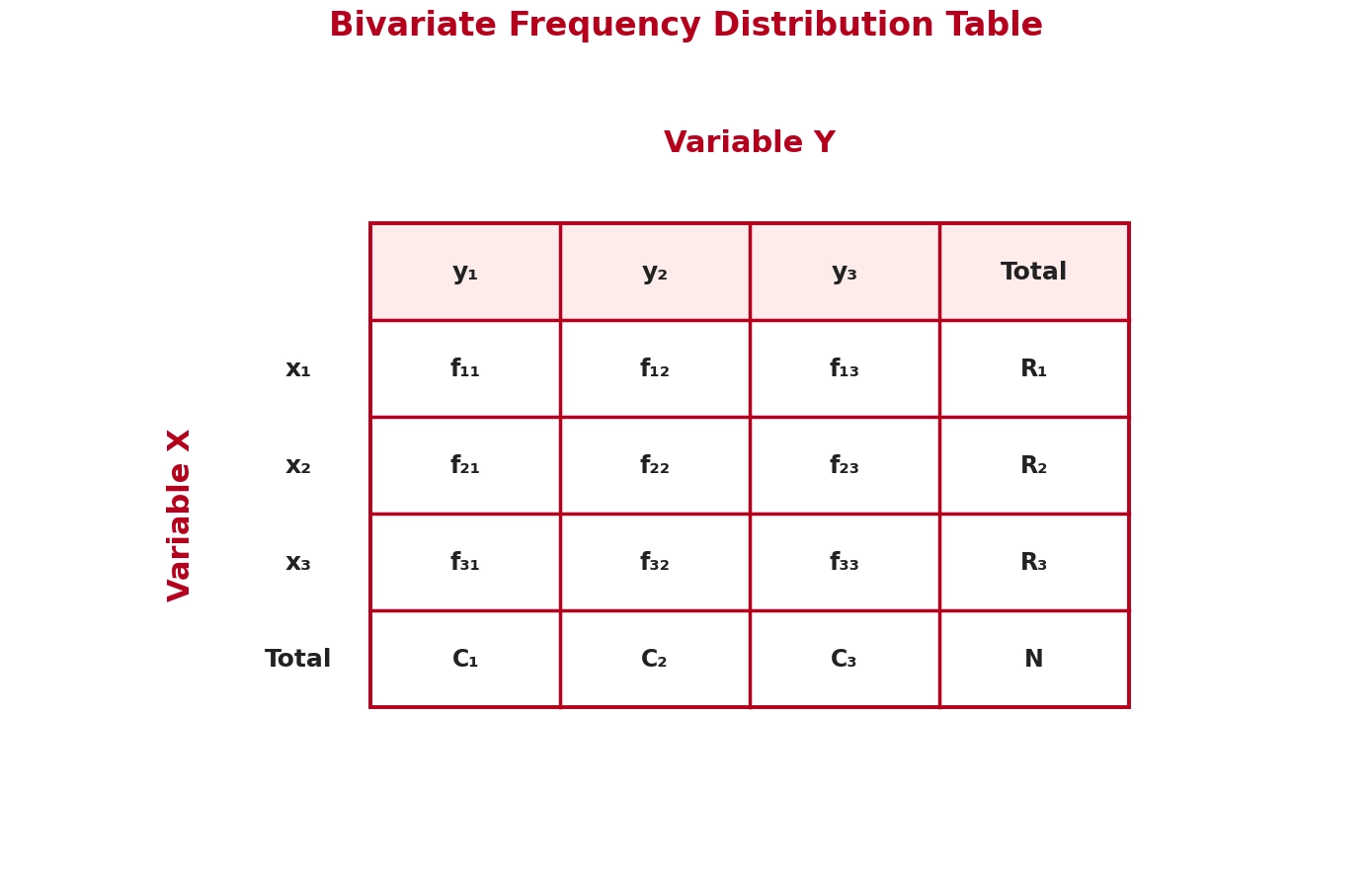
Where:
fij = frequency in row i, column j
R = Row total (marginal frequency)
C = Column total (marginal frequency)
N = Grand total
- Rows: Represent one variable (say Variable X). Each row corresponds to a class interval of X.
- Columns: Represent the other variable (say Variable Y). Each column corresponds to a class interval of Y.
- Cells: The intersection of a row and column contains the frequency for that particular combination of X and Y values.
Class Intervals
Class intervals divide the range of each variable into equal groups.
For Maths marks (0 - 100), class intervals: 0 - 20, 20 - 40, 40 - 60, 60 - 80, 80 - 100
For Science marks (0 - 100), class intervals: 0 - 20, 20 - 40, 40 - 60, 60 - 80, 80 - 100
Rules for class intervals:
-
All intervals should have equal width (usually)
-
Intervals should not overlap
-
All data values must fall within some interval
-
Number of intervals typically between 5 and 10
Frequencies
The frequency in each cell tells you how many observations fell in that particular combination of class intervals.
If cell (60 - 80 in Maths, 70 - 90 in Science) = 8
This means 8 students scored:
- Between 60 - 80 in Mathematics AND
- Between 70 - 90 in Science
Marginal Totals
Marginal totals are the row totals and column totals at the edges of the table.
Row marginal total = Sum of all frequencies in that row
(Tells you total count for that X class interval)
Column marginal total = Sum of all frequencies in that column
(Tells you total count for that Y class interval)
Grand total = Sum of all row totals = Sum of all column totals
Why "marginal"?
Because they appear at the margin (edge) of the table.
How to Construct a Bivariate Frequency Distribution Table
Step 1: Collect the Data
Gather paired data for both variables from the same subjects.
Example data: Marks of 20 students in Maths (X) and Science (Y)
| Student | Maths (X) | Science (Y) |
|---|---|---|
| 1 | 72 | 65 |
| 2 | 58 | 70 |
| 3 | 84 | 88 |
| 4 | 45 | 52 |
| 5 | 91 | 85 |
| 6 | 63 | 68 |
| 7 | 77 | 72 |
| 8 | 39 | 44 |
| 9 | 55 | 60 |
| 10 | 82 | 79 |
| 11 | 68 | 73 |
| 12 | 47 | 51 |
| 13 | 75 | 77 |
| 14 | 60 | 65 |
| 15 | 88 | 91 |
| 16 | 52 | 58 |
| 17 | 71 | 69 |
| 18 | 43 | 48 |
| 19 | 66 | 62 |
| 20 | 79 | 83 |
Step 2: Organize Both Variables
Decide the class intervals for each variable.
Maths (X) class intervals: 30-50, 50-70, 70-90, 90-110
Science (Y) class intervals: 40-60, 60-80, 80-100
| Maths (X) \ Science (Y) | 40 – 60 | 60 – 80 | 80 – 100 | Total |
|---|---|---|---|---|
| 30 – 50 | ||||
| 50 – 70 | ||||
| 70 – 90 | ||||
| 90 – 110 | ||||
| Total |
Step 3: Count the Frequencies
Go through each data pair and place a tally mark in the correct cell.
Student 1: Maths = 72 (row: 70 - 90), Science = 65 (col: 60 - 80)
Place tally in (70 - 90, 60 - 80) cell
Student 4: Maths = 45 (row: 30 - 50), Science = 52 (col: 40 - 60)
Place tally in (30 - 50, 40 - 60) cell
Continue for all 20 students.
Step 4: Complete the Table
Count tallies and fill in frequencies. Calculate row totals, column totals, and grand total.
Completed Table:
| Maths (X) \ Science (Y) | 40 – 60 | 60 – 80 | 80 –100 | Total |
|---|---|---|---|---|
| 30 – 50 | 3 | 1 | 0 | 4 |
| 50 – 70 | 1 | 5 | 0 | 6 |
| 70 – 90 | 0 | 6 | 3 | 9 |
| 90 –110 | 0 | 0 | 1 | 1 |
| Total | 4 | 12 | 4 | 20 |
Verification:
Row totals: 4 + 6 + 9 + 1 = 20
Column totals: 4 + 12 + 4 = 20
Grand total = 20
Bivariate Frequency Distribution Table Example
Example with Student Marks
Problem: The following table shows the distribution of 50 students based on their marks in English (X) and Hindi (Y). Both subjects are out of 100.
| English Marks (X) \ Hindi Marks (Y) | 30 – 50 | 50 – 70 | 70 – 90 | 90 – 100 | Total |
|---|---|---|---|---|---|
| 30 – 50 | 4 | 2 | 0 | 0 | 6 |
| 50 – 70 | 3 | 8 | 3 | 0 | 14 |
| 70 – 90 | 0 | 5 | 12 | 3 | 20 |
| 90 – 100 | 0 | 0 | 5 | 5 | 10 |
| Total | 7 | 15 | 20 | 8 | 50 |
Reading the table:
- 4 students scored 30 - 50 in English AND 30 - 50 in Hindi
- 12 students scored 70 - 90 in English AND 70 - 90 in Hindi
- 5 students scored 90 - 100 in both subjects
- Row total for English 70 - 90: 20 students
- Column total for Hindi 70 - 90: 20 students
Solved Example
Question: From the bivariate frequency distribution table below, find: a) Total number of students b) Number of students scoring above 60 in both subjects c) Number of students scoring below 60 in Mathematics
| Maths Marks (X) \ Science Marks (Y) | 20 – 40 | 40 – 60 | 60 – 80 | 80 – 100 | Total |
|---|---|---|---|---|---|
| 20 – 40 | 3 | 4 | 0 | 0 | 7 |
| 40 – 60 | 2 | 8 | 5 | 0 | 15 |
| 60 – 80 | 0 | 3 | 10 | 4 | 17 |
| 80 – 100 | 0 | 0 | 3 | 8 | 11 |
| Total | 5 | 15 | 18 | 12 | 50 |
Solutions:
a) Total students = Grand total = 50
b) Above 60 in BOTH subjects:
Students in rows 60 − 80 AND 80 − 100 (Math)
AND columns 60 − 80 AND 80 − 100 (Science):
(60 − 80 Math, 60 − 80 Science) = 10
(60 − 80 Math, 80 − 100 Science) = 4
(80 − 100 Math, 60 − 80 Science) = 3
(80 − 100 Math, 80 − 100 Science) = 8
Total = 10 + 4 + 3 + 8 = 25 students
c) Below 60 in Mathematics (rows 20 − 40 and 40 − 60):
Row total (20 − 40) = 7
Row total (40 − 60) = 15
Total = 7 + 15 = 22 students
Advantages of a Bivariate Frequency Distribution Table
Easy Data Organization
A bivariate frequency distribution table converts large, unorganized paired data into a compact and readable format. Instead of looking at hundreds of individual data pairs, you see a structured summary.
Without table: (72,65), (58,70), (84,88), (45,52)...
With table: A neat grid showing counts for each combination
Better Comparison
The table makes it easy to compare the distributions of two variables simultaneously. You can see at a glance which combinations are most common and which are rare.
Supports Statistical Analysis
A bivariate frequency distribution table forms the foundation for advanced statistical calculations including correlation coefficients, regression analysis, and chi-square tests.
Limitations of a Bivariate Frequency Distribution Table
Difficult with Large Data Sets
When data has many variables or very wide ranges, the table becomes too large and complex to read easily.
10 class intervals for X × 10 for Y = 100 cells
This becomes difficult to read and interpret.
Limited to Two Variables
The table can only handle two variables. If you need to study three or more variables simultaneously, you need more advanced techniques.
May Hide Individual Observations
Once data is grouped into class intervals, the exact individual values are lost. You know 8 students scored in a particular range, but not their exact scores.
Difference Between Univariate and Bivariate Frequency Distribution
Comparison Table
When to Use Each
Use univariate distribution when:
- You have only one variable to study
- You want to find average, spread, or shape of one variable
- You want to create a histogram or frequency polygon
Example: Distribution of test scores in a class
Use bivariate distribution when:
- You have two variables measured on the same subjects
- You want to study whether two variables are related
- You want to find correlation or association
Example: Test scores AND study hours for the same students
Difference Between Bivariate Frequency Distribution and Contingency Table
Similarities
Both bivariate frequency distribution tables and contingency tables:
- Organize data for two variables simultaneously
- Use rows for one variable and columns for the other
- Show frequencies in each cell
- Include marginal totals
- Help identify relationships between variables
Differences
Frequently Asked Questions on Bivariate Frequency Distribution
1. What is a bivariate frequency distribution?
A bivariate frequency distribution is a table that shows the frequencies of two variables together. It helps analyze how one variable is related to another.
2. What is the difference between a univariate and a bivariate frequency distribution?
A univariate frequency distribution summarizes the frequencies of a single variable, while a bivariate frequency distribution summarizes the frequencies of two variables simultaneously.
3. What are the two variables in a bivariate frequency distribution?
The two variables can be any related measurements, such as:
- Maths marks and Science marks
- Height and Weight
- Age and Income
- Study Hours and Test Scores
4. Why is a bivariate frequency distribution used?
It is used to study the relationship between two variables, identify patterns, compare data, and support statistical analysis.
5. How do you construct a bivariate frequency distribution table?
To construct the table:
- Identify the two variables.
- Divide each variable into suitable class intervals.
- Create rows for one variable and columns for the other.
- Count the observations in each combination of intervals.
- Calculate the row totals and column totals.
6. What is the purpose of row totals and column totals?
Row totals show the total frequency for one variable, while column totals show the total frequency for the other variable. They also help verify the overall total number of observations.
7. What is a cell frequency in a bivariate frequency table?
A cell frequency is the number of observations that belong to a specific row interval and column interval.
8. What are the advantages of a bivariate frequency distribution?
Some advantages are:
- Organizes large datasets clearly.
- Makes comparisons easier.
- Shows relationships between variables.
- Helps identify trends and patterns.
- Supports statistical analysis.
9. Where is a bivariate frequency distribution used?
It is widely used in:
- Education
- Business
- Economics
- Medical research
- Social sciences
- Data analysis
10. How do you interpret a bivariate frequency distribution?
Interpret the table by comparing frequencies across rows and columns to identify relationships, trends, or patterns between the two variables.
11. Can a bivariate frequency distribution be represented graphically?
Yes. It can be represented using:
- Scatter plots
- Heat maps
- 3D bar charts
- Clustered bar graphs
12. How is a bivariate frequency distribution useful in statistics?
It provides the foundation for studying relationships between variables and is often used before calculating correlation, regression, or performing other statistical analyses.
Numbers make sense when they're taught right. To see how Orchids The International School turns Maths from intimidating to intuitive, reach out to our admissions team.


Admissions Open for 2026-27
What type of concept pages would you prefer?
CBSE Schools In Popular Cities
- CBSE Schools in Bangalore
- CBSE Schools in Mumbai
- CBSE Schools in Pune
- CBSE Schools in Hyderabad
- CBSE Schools in Chennai
- CBSE Schools in Gurgaon
- CBSE Schools in Kolkata
- CBSE Schools in Indore
- CBSE Schools in Sonipat
- CBSE Schools in Delhi
- CBSE Schools in Rohtak
- CBSE Schools in Bhopal
- CBSE Schools in Aurangabad
- CBSE Schools in Jabalpur
- CBSE Schools in Jaipur
- CBSE Schools in Jodhpur
- CBSE Schools in Nagpur
- CBSE Schools in Ahmednagar
- CBSE School In Tumkur











Orchids The International School is one of India's leading chains of CBSE and ICSE schools, with 130+ schools across the country.