

CCLXVII Roman Numerals
CCLXVII Roman numerals represent the number 267, an ancient method used by the Romans to represent numbers. In this form, C means 100, L means 50, X means 10, V means 5, and I means 1. So, CCLXVII = 100 + 100 + 50 + 10 + 5 + 1 + 1 = 267. Reading and writing CCLXVII Roman numerals helps students connect mathematics with Roman history. It improves thinking skills by showing how numbers are added, subtracted, and arranged to form larger numbers. The study of CCLXVII Roman numerals is not only a mathematical skill but also a link to the past, making the study of numbers more interesting and meaningful in everyday life.
Table of Contents
- How to Write CCLXVII Roman Numerals in Numbers?
- Basic Rules to Write CCLXVII Roman Numerals in Numbers
- Numbers Related to CCLXVII Roman Numerals
- Solved Examples on CCLXVII Roman Numerals
- Facts About CCLXVII Roman Numerals
- Practice questions on CCLXVII Roman Numerals
- Conclusion
- Frequently Asked Questions on CCLXVII Roman Numerals

How to Write CCLXVII Roman Numerals in Numbers?
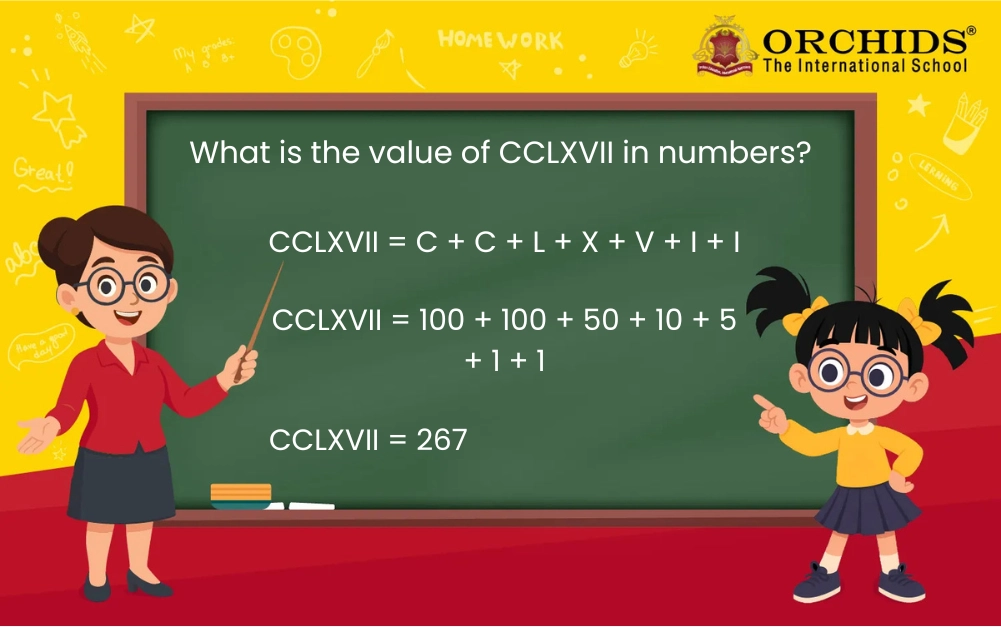
To write CCLXVII in numbers, we follow the basic rules of Roman numerals.
Step by step:
- C = 100
- C = 100
- L = 50
- X = 10
- V = 5
- I = 1
- I = 1
Now, add them together:
CCLXVII = C + C + L + X + V + I + I.
= 100 + 100 + 50 + 10 + 5 + 1 + 1.
= 267.
Therefore, CCLXVII Roman numerals in numbers is 267.
Know more about related topics:
Basic Rules to Write CCLXVII Roman Numerals in Numbers
1. Know the values:
- I = 1
- V = 5
- X = 10
- L = 50
- C = 100
- D = 500
- M = 1000
2. Write numerals in order from largest to smallest:
- Start with the largest value first: C (100), then add another C (100), followed by L (50), X (10), V (5), and finally II (2).
3. Add values when smaller numerals follow larger ones:
C (100) + C (100) + L (50) + X (10) + V (5) + II (2)
= C + C + L + X + V + I + I
= 100 + 100 + 50 + 10 + 5 + 1 + 1
= 267
Therefore, CCLXVII Roman numerals in numbers is 267.
Numbers Related to CCLXVII Roman Numerals
|
Roman Numerals |
Roman Numerals Expression |
Expanded Form |
Numbers |
|
CCLXII |
C + C + L + X + I + I |
100 + 100 + 50 + 10 + 1 + 1 |
262 |
|
CCLXIII |
C + C + L + X + I + I + I |
100 + 100 + 50 + 10 + 1 + 1 + 1 |
263 |
|
CCLXIV |
C + C + L + X + V − I |
100 + 100 + 50 + 10 + (5 − 1) |
264 |
|
CCLXV |
C + C + L + X + V |
100 + 100 + 50 + 10 + 5 |
265 |
|
CCLXVI |
C + C + L + X + V + I |
100 + 100 + 50 + 10 + 5 + 1 |
266 |
|
CCLXVII |
C + C + L + X + V + I + I |
100 + 100 + 50 + 10 + 5 + 1 + 1 |
267 |
|
CCLXVIII |
C + C + L + X + V + I + I + I |
100 + 100 + 50 + 10 + 5 + 1 + 1 + 1 |
268 |
|
CCLXIX |
C + C + L + X + X − I |
100 + 100 + 50 + 10 + (10 − 1) |
269 |
|
CCLXX |
C + C + L + X + X |
100 + 100 + 50 + 10 + 10 |
270 |
|
CCLXXI |
C + C + L + X + X + I |
100 + 100 + 50 + 10 + 10 + 1 |
271 |
Solved Examples on CCLXVII Roman Numerals
Example 1: A warehouse stored CCLX (260) boxes, and VII more were added. Express the total in Roman numerals.
Solution:
260 + 7 = 267
Therefore, 267 = CCLXVII.
Example 2: Add CC (200), L (50), X (10), V (5), and II (2). Write the total in Roman numerals.
Solution:
100 + 100 + 50 + 10 + 5 + 1 + 1 = 267
Therefore, 267 = CCLXVII.
Example 3: Subtract III (3) from CCLXX (270). Express the result in Roman numerals.
Solution:
270 − 3 = 267
Therefore, 267 = CCLXVII.
Example 4: Combine and simplify: CCLX + VII
Solution:
260 + 7 = 267
Therefore, 267 = CCLXVII.
Example 5: A library had CC (200) history books, L (50) science books, X (10) math books, V (5) art books, and II (2) new arrivals. Write the total in Roman numerals.
Solution:
100 + 100 + 50 + 10 + 5 + 1 + 1 = 267
Therefore, 267 = CCLXVII.
Facts About CCLXVII Roman Numerals
- Number Form: 267 is written as CCLXVII. (200 + 50 + 10 + 5 + 2).
- Expanded Form: C = 100, C = 100, L = 50, X = 10, V = 5, II = 2. (100 + 100 + 50 + 10 + 5 + 1 + 1 = 267).
- Subtractive Notation Used: No subtractive notation is used in CCLXVII.
- Symbol Count: Five different symbols appear C, L, X, V, and I (seven characters total).
- Number Property: 267 is not a prime number (it is divisible by 3).
Practice Questions on CCLXVII Roman Numerals
1. What is the value of CCLXVII in numbers?
2. How do you convert CCLXVII into Arabic numerals?
3. What comes before and after CCLXVII in Roman numerals?
4. What is the expanded form of CCLXVII?
5. What is CCLXVII + X in Roman numerals?
Conclusion
CCLXVII in Roman numerals represents the number 267. It is formed by combining CC (200), L (50), X (10), V (5), and II (2) using the Roman numeral addition rule. This example shows how smaller symbols are combined to form larger numbers in Roman numerals.
Explore more articles on CCLXVII Roman Numerals and related Maths concepts at Orchids The International School, where learning is made simple with clear explanations and well structured lessons.
Numbers make sense when they're taught right. To see how Orchids The International School turns Maths from intimidating to intuitive, reach out to our admissions team.
Frequently Asked Questions on CCLXVII Roman Numerals
1. What is the value of the Roman numeral CCLXVII?
The value of the Roman numeral CCLXVII is 267.
Explanation:
- C = 100
- C = 100
- L = 50
- X = 10
- V = 5
- I = 1
- I = 1
C (100) + C (100) + L (50) + X (10) + V (5) + II (2)
= C + C + L + X + V + I + I
= 100 + 100 + 50 + 10 + 5 + 1 + 1
= 267
Therefore, CCLXVII Roman numerals in numbers is 267.
2. What is the sum of CCLXVII and II?
CCLXVII + II
-
CCLXVII = 267
-
II = 2
Add the numbers:
- 267 + 2 = 269
Convert 269 back to Roman numerals:
-
200 = CC
-
60 = LX
-
9 = IX ( 10 - 1)
So, CC + LX + IX = CCLXIX.
Answer: CCLXVII + II = CCLXIX (269).
3. Is CCLXVII a prime number?
No, 267 is not a prime number. It is divisible by 3.
4. What is the result of CCLXVII - IV?
The result of CCLXVII − IV is CCLXIII.
- CCLXVII = 267
- IV = 4
267 − 4 = 263
So, 263 in Roman numerals is CCLXIII.
5. What should be subtracted from CCLXVII to get CLI?
To find the number:
-
CCLXVII = 267
-
CLI = 151
Now subtract:
- 267 − 151 = 116
116 in Roman numerals is CXVI.
Answer: CXVI should be subtracted from CCLXVII to get CLI.
Related Links


Admissions Open for 2026-27
What type of concept pages would you prefer?
CBSE Schools In Popular Cities
- CBSE Schools in Bangalore
- CBSE Schools in Mumbai
- CBSE Schools in Pune
- CBSE Schools in Hyderabad
- CBSE Schools in Chennai
- CBSE Schools in Gurgaon
- CBSE Schools in Kolkata
- CBSE Schools in Indore
- CBSE Schools in Sonipat
- CBSE Schools in Delhi
- CBSE Schools in Rohtak
- CBSE Schools in Bhopal
- CBSE Schools in Aurangabad
- CBSE Schools in Jabalpur
- CBSE Schools in Jaipur
- CBSE Schools in Jodhpur
- CBSE Schools in Nagpur
- CBSE Schools in Ahmednagar
- CBSE School In Tumkur











Orchids The International School is one of India's leading chains of CBSE and ICSE schools, with 110+ schools across the country.